
















































































































































Table of Contents
ToggleHow to Use Aromatherapy for Stress Relief at Home: A Beginner Guide
Author: RVLNSV PRASAD
Updated On: September 2026
About Us
Author Bio
Editorial Policy
Contact Us
Introduction
Aromatherapy can be a simple way to create a calmer moment during a busy day. You do not need an elaborate wellness routine or a collection of expensive essential oils. For many beginners, the real value may come from creating a short pause, using a pleasant scent, and stepping away from whatever is causing mental overload.
I became interested in how to use aromatherapy for stress relief at home during a stressful period in my own life. A few years ago, work felt nonstop. My phone seemed to buzz constantly, and even after getting home, my mind remained busy.
Sleep became harder, and I often felt worn out in the morning. Small problems also seemed more frustrating during particularly stressful weeks.
One evening, I tried lavender essential oil in a diffuser before bed. I did not expect it to solve my stress. Instead, the scent became part of a quieter evening routine.
I turned off my phone earlier, lowered the lights, read for a few minutes, and allowed myself to slow down.
That distinction matters.
Aromatherapy did not remove the source of my stress. It became one small part of a routine that helped me create a calmer transition into the evening.
Scientific evidence is more cautious than many wellness articles suggest. Aromatherapy has been studied for anxiety, stress, sleep, and other outcomes, but results vary according to the essential oil, method of use, population studied, and quality of the research. The National Center for Complementary and Integrative Health (NCCIH) describes aromatherapy as a complementary health approach involving essential oils, most commonly through inhalation or appropriately diluted topical use. NCCIH — Aromatherapy
This guide explains how to use aromatherapy at home while keeping the evidence and safety limitations clear.
Quick Answer: How to Use Aromatherapy for Stress Relief at Home
For a beginner, the simplest approach is to choose one essential oil with a scent you enjoy, use an appropriate inhalation method according to the product directions, and combine it with a short relaxation routine.
A practical five-to-10-minute routine could look like this:
- Choose a pleasant scent, such as lavender.
- Use a diffuser or another inhalation method according to the product instructions.
- Sit somewhere comfortable.
- Put your phone away for a few minutes.
- Breathe normally rather than forcing deep breaths.
- Pair the scent with a quiet activity such as reading, gentle stretching, or journaling.
- Stop if the scent causes headache, irritation, coughing, nausea, or another unwanted reaction.
Aromatherapy should be viewed as a complementary relaxation practice, not a replacement for medical treatment or professional care.
What Is Aromatherapy?
Aromatherapy is the use of essential oils derived from plants as a complementary health approach.
Essential oils can come from flowers, leaves, bark, roots, fruits, or other plant materials. Common oils used in aromatherapy include lavender, bergamot, Roman chamomile, lemon, ginger, geranium, and cedarwood. NCCIH — Aromatherapy
The oils are usually used in one of two ways:
- inhalation
- appropriately diluted application to the skin
Some products are also incorporated into massage or other complementary practices.
The important word is complementary.
Aromatherapy may be used alongside healthy lifestyle habits and appropriate medical care. It should not automatically be considered an alternative to evidence-based treatment.
Why can a scent feel emotionally powerful?
Smell is closely connected with areas of the brain involved in memory and emotion. That helps explain why a particular scent can remind you of a person, place, meal, or period of your life.
You may smell freshly baked food and immediately remember your childhood home.
You may notice a perfume and think about someone you know.
That emotional connection is one reason scent can become a useful part of a relaxation ritual.
However, enjoying a scent is not the same thing as proving that the essential oil treats a medical condition.
What Does the Research Say About Aromatherapy for Stress?
This is where it is important to separate promising evidence from proven treatment.
Aromatherapy has been investigated in clinical studies involving anxiety, stress, sleep, pain, and other outcomes. NCCIH notes that some studies suggest possible benefits, but evidence varies by condition, and the amount of rigorous research is limited for some uses. NCCIH — Aromatherapy
Lavender has received particularly substantial research attention.
A 2026 review examining recent randomized controlled trials concluded that lavender essential-oil aromatherapy may reduce anxiety in several studied groups. However, the researchers also noted that the precise mechanisms remain unclear and that more extensive clinical research is needed. 2026 PubMed Review — Lavender Essential-Oil Aromatherapy and Anxiety
Earlier systematic reviews have also reported potentially beneficial effects of lavender on anxiety. One meta-analysis included 22 randomized trials and found favorable effects on anxiety, although the researchers recommended further studies with stronger methodology. PubMed — Lavender Aromatherapy and Anxiety Systematic Review
Another systematic review and meta-analysis involving randomized trials reported reductions in anxiety and some other outcomes with lavender, while also identifying differences between studies and the need for additional research. PubMed—Effects of Lavender on Anxiety, Depression, and Physiological Parameters
What does that mean for you?
It means lavender aromatherapy is worth discussing as a relaxation option, but it should not be marketed as a guaranteed treatment for stress or anxiety disorders.
There is a meaningful difference between:
“Research suggests lavender aromatherapy may reduce anxiety in some situations.”
and:
“Lavender cures stress.”
The first reflects the evidence more responsibly.
The second goes too far.
Best Essential Oils for Stress Relief
There is no single essential oil that is guaranteed to work best for everyone.
Your preferred scent matters because an unpleasant smell is unlikely to become a relaxing part of your routine.
The evidence also differs between oils.
| Essential oil | Common reason people use it | Evidence considerations | Beginner approach |
|---|---|---|---|
| Lavender | Relaxation and bedtime routines | One of the more extensively studied oils for anxiety | Good oil to research first |
| Bergamot | Fresh, citrus-like aroma | Some research exists, but evidence is less established than lavender. | Use according to safety instructions. |
| Roman chamomile | Gentle, soothing aroma | Research exists, but evidence for stress relief is limited. | Choose if you enjoy the scent. |
| Frankincense | Meditation and quiet routines | Less evidence specifically for treating stress | Consider mainly as a preferred scent |
| Lemon | Fresh, uplifting aroma | Some studies examine mood, but this does not establish stress treatment. | Best approached as a scent preference |
1. Lavender Essential Oil
Lavender is probably the most useful oil to discuss when someone searches for essential oils for stress relief because it has a relatively large research base.
The 2026 review of recent randomized trials found evidence suggesting that lavender aromatherapy may reduce anxiety in various clinical and nonclinical groups, while emphasizing the need for further research. 2026 PubMed Review on Lavender and Anxiety
That makes lavender a reasonable starting point for someone who enjoys its smell.
It does not mean you need to use lavender every night.
2. Bergamot Essential Oil
Bergamot has a bright citrus aroma and is sometimes used in relaxation settings.
If you enjoy citrus scents, it may become part of a calming routine.
However, be especially careful with topical use of citrus oils because some citrus essential oils can increase photosensitivity when applied to skin before sun exposure. NCCIH highlights this safety issue for citrus and certain other essential oils. NCCIH—Sleep Disorders, Aromatherapy, and Safety
3. Roman Chamomile
Chamomile has a softer aroma that some people prefer in the evening.
Rather than claiming that chamomile will reduce stress, think of it as another scent option for a relaxation routine.
4. Frankincense
Frankincense has a deeper aroma and is commonly associated with meditation, reflection, and quiet environments.
Its traditional use does not establish that it treats stress.
If you enjoy the scent, you can use it as part of a calming environment while keeping your expectations realistic.
How to Use Aromatherapy at Home
There are several ways to use aromatherapy, but beginners should start with the simplest method that is appropriate for the product.
Method 1: Use a Diffuser Correctly
A diffuser can disperse an essential-oil aroma through a room.
If you use one:
- follow the manufacturer’s instructions
- use only the recommended amount
- keep it in a stable location
- avoid prolonged exposure if the scent becomes irritating
- ventilate the room appropriately
- keep oils and diffuser liquids away from children and pets
More oil does not automatically mean more relaxation.
In fact, using excessive amounts can make the smell overwhelming and may cause unwanted symptoms such as headache or irritation.
Method 2: Try a Personal Inhalation Method
A simple alternative is to place a small amount of an appropriate product on a tissue or use a purpose-designed personal inhaler according to its instructions.
You can then smell it briefly while sitting comfortably.
This has one practical advantage:
You can stop immediately if you dislike the scent.
There is no need to fill an entire room with fragrance.
Method 3: Pair Aromatherapy With Slow Breathing
The scent does not have to do all the work.
Try sitting quietly while breathing normally and comfortably.
Avoid forcing very deep breaths if they make you dizzy.
Instead, allow your breathing to become slower and more comfortable while you focus on the present moment.
The goal is to create a transition from doing to pausing.
Method 4: Create a Pre-Bedtime Scent Cue
This is one of the easiest routines to test.
Use the same pleasant scent as part of your evening wind-down.
For example:
9:30 PM → phone away → lights lower → pleasant scent → five minutes of reading → prepare for bed
The useful part may not be the essential oil alone.
The repeated sequence can become a behavioral cue that signals the end of a busy day.
NCCIH notes that evidence for aromatherapy and sleep is still limited, although a 2021 review of 16 studies involving 1,346 participants suggested possible improvements in sleep quality and insomnia symptoms while calling for larger, more rigorous studies. NCCIH — Aromatherapy and Sleep Evidence
A Simple 10-Minute Aromatherapy Stress-Relief Routine
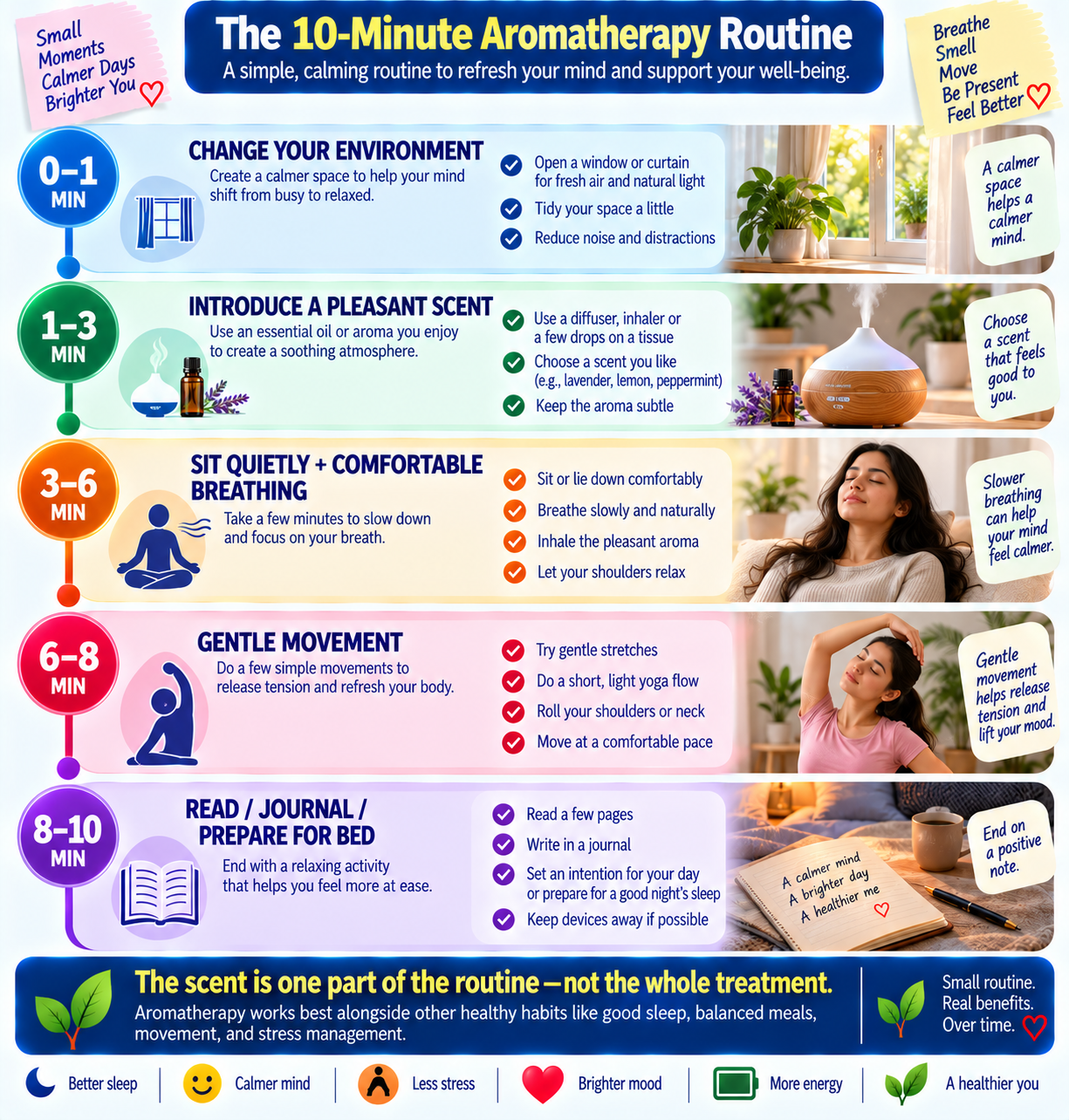
You do not need an hour-long wellness ritual.
Try this:
Minute 1: Change the environment
Move away from your computer or work area.
Put your phone on silent.
Minutes 2–3: Introduce the scent.
Use your chosen aromatherapy method according to the product directions.
Don’t keep adding oil because you cannot smell it strongly enough.
Minutes 4–6: Sit quietly
Let your shoulders relax.
Allow your breathing to become comfortable.
Minutes 7–8: Gentle movement
Try slow shoulder rolls, neck movements, or gentle stretching.
Stop if anything causes pain.
Minutes 9–10: Choose the next calm activity.
Read a few pages.
Write tomorrow’s priorities.
Drink water.
Prepare for bed.
This routine is intentionally simple.
The objective is to make relaxation easier to repeat.
Three Simple Aromatherapy Ideas Many Articles Miss
1. Use scent as a transition signal.
Instead of using aromatherapy continuously throughout the day, choose one predictable transition.
For example:
Work finished → change clothes → short walk → aromatherapy → dinner
The scent becomes associated with leaving work mode.
This is a practical behavioral strategy, not proof that the oil itself is treating stress.
2. Use a “one-scent rule.”
Beginners often buy five or ten oils immediately.
You do not need that.
Choose one scent that you genuinely enjoy.
Use it consistently for a few weeks as part of a relaxation routine.
If you dislike lavender, there is no reason to force yourself to use lavender just because it is popular.
3. Build a scent-free backup plan.
This is especially useful if you share a home with someone who dislikes fragrances or if strong smells trigger headaches or respiratory symptoms.
Your relaxation routine can work without essential oils.
Try:
quiet room + lower lighting + gentle stretching + slow breathing + reading
This prevents aromatherapy from becoming a requirement.
Aromatherapy for Stress Relief at Work
You do not always need a diffuser.
A personal inhalation method may be more practical in some settings, provided the product is appropriate and permitted where you work.
An even simpler approach is to use aromatherapy as a reminder to take a break.
For example:
smell → step away from screen → relax shoulders → take a short walk → return
The movement and break may be just as important to the overall routine as the scent.
If workplace fragrance could bother colleagues, avoid using shared-room diffusers.
Aromatherapy Before Bed
Many people associate lavender with bedtime.
That is understandable because lavender has been extensively studied in relation to anxiety and relaxation.
However, don’t tell yourself:
“Lavender will make me sleep.”
A better approach is:
“Lavender is part of my bedtime routine.”
That distinction prevents unrealistic expectations.
A good evening routine might include:
- reducing unnecessary screen time
- lowering room lighting
- reading
- gentle stretching
- preparing clothes for tomorrow
- using a preferred scent if tolerated
- keeping a consistent bedtime
Aromatherapy is one component, not the entire sleep strategy.
What Aromatherapy Can and Cannot Do
Aromatherapy may be useful for:
- creating a relaxation ritual
- making your environment more pleasant
- supporting a wind-down routine
- providing a pleasant sensory experience
- complementing broader stress-management habits
Aromatherapy should not be presented as:
- a cure for anxiety disorders
- a replacement for psychotherapy
- a replacement for prescribed medication
- a treatment for serious sleep disorders
- a substitute for medical evaluation
- a guaranteed way to lower stress hormones
This distinction is especially important because NCCIH describes aromatherapy as a complementary approach and notes that evidence varies considerably by use. NCCIH — Aromatherapy
Important Aromatherapy Safety Tips for Beginners
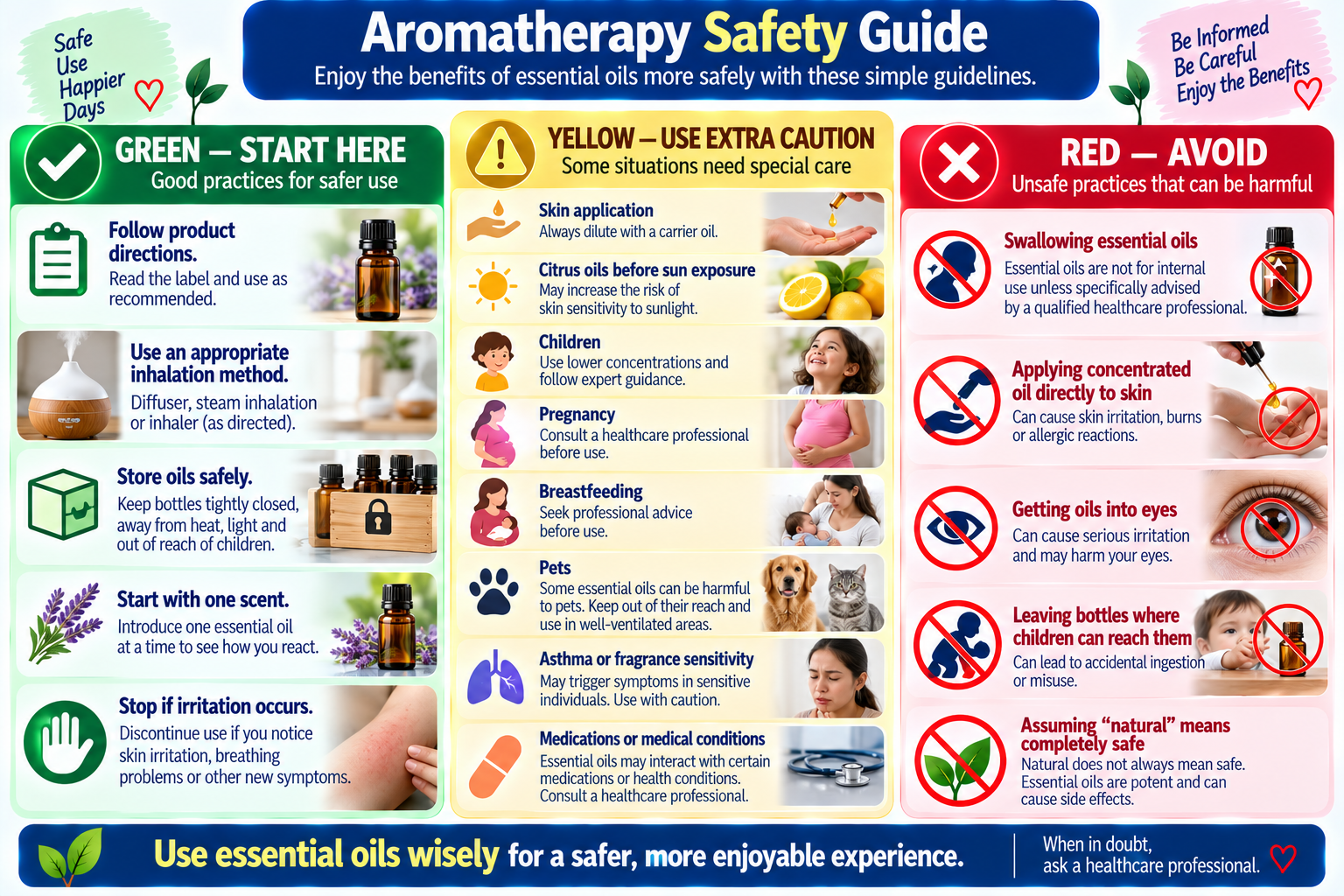
Essential oils are highly concentrated substances.
“Natural” does not automatically mean “harmless.”
Never assume more is better.
Using more drops can make a scent unpleasant and may increase irritation.
Follow the instructions for your particular product.
Be careful with skin application.
Pure essential oils should not routinely be applied directly to skin without appropriate dilution.
Poison Control notes that essential oils can cause skin reactions and recommends dilution when appropriate for topical use. Poison Control — Essential Oils: Poisonous When Misused
Avoid the eyes.
If an essential oil gets into your eyes, follow appropriate first-aid guidance and seek professional advice if irritation persists.
Do not swallow essential oils.
Essential oils are not ordinary cooking oils.
Some can cause serious poisoning if swallowed.
Poison Control documents cases of essential oil poisoning and advises keeping these products locked away from children and pets. Poison Control—Essential Oils Safety
Keep oils away from children
Children can be particularly vulnerable to poisoning from essential oils.
Store bottles securely and out of sight.
Consider pets.
Pets can be more sensitive to some fragrances and essential-oil exposures.
If you have pets, check with a veterinarian about the specific oil and method before using a diffuser around them.
Be cautious with citrus oils on skin.
Some citrus essential oils can increase photosensitivity.
NCCIH specifically warns that sun sensitivity can occur when certain citrus or other essential oils are applied to the skin before sun exposure. NCCIH—Aromatherapy Safety and Sleep
Stop if your body reacts badly.
Stop using the product if you develop:
- rash
- burning
- severe headache
- nausea
- coughing
- breathing difficulty
- dizziness
- other concerning symptoms
A pleasant scent should never require you to tolerate physical discomfort.
Who Should Be Especially Careful?
Some people should obtain individualized professional advice before using essential oils.
This includes:
- pregnant people
- breastfeeding people
- young children
- people with asthma or respiratory sensitivity
- people with significant allergies
- people with certain medical conditions
- people taking medications
- people with previous reactions to fragrances or essential oils
The exact risk depends on the essential oil, concentration, route of exposure, age, health status, and other factors.
That is why generalized “safe for everyone” claims are inappropriate.
Common Mistakes Beginners Make
Using too much oil
A stronger smell is not necessarily a better experience.
Start conservatively and follow the product instructions.
Buying too many oils
You don’t need a shelf full of bottles.
Start with one scent.
Treating aromatherapy like medicine
Essential oils should not be used as a substitute for treatment of significant anxiety, depression, insomnia, or another health condition.
Applying undiluted oil to the skin
This can increase the risk of irritation and allergic reactions.
Ignoring the product label
Different products have different intended uses.
Read the instructions.
Using a diffuser continuously
A diffuser does not need to run all day.
Use it according to the manufacturer’s directions and stop if the fragrance becomes irritating.
Assuming lavender works for everyone
Lavender has a relatively strong research base, but individual responses still vary.
Expecting instant stress relief
Stress is usually influenced by several factors.
One scent cannot solve chronic workload, relationship problems, financial pressure, poor sleep, or untreated mental health conditions.
What I Noticed Personally
My experience with aromatherapy was much more modest than some wellness articles suggest.
I did not suddenly become stress-free.
The more useful change was that the scent became associated with slowing down.
When I used lavender before bed, I was also putting away my phone earlier, lowering the lights, reading, and allowing myself to stop thinking about work.
Looking back, I would not say:
“Lavender fixed my stress.”
I would say:
“Lavender became one small cue that helped me create a calmer evening routine.”
That is an important difference.
Personal experience can explain why a habit feels useful.
It cannot prove that the same result will happen to everyone.
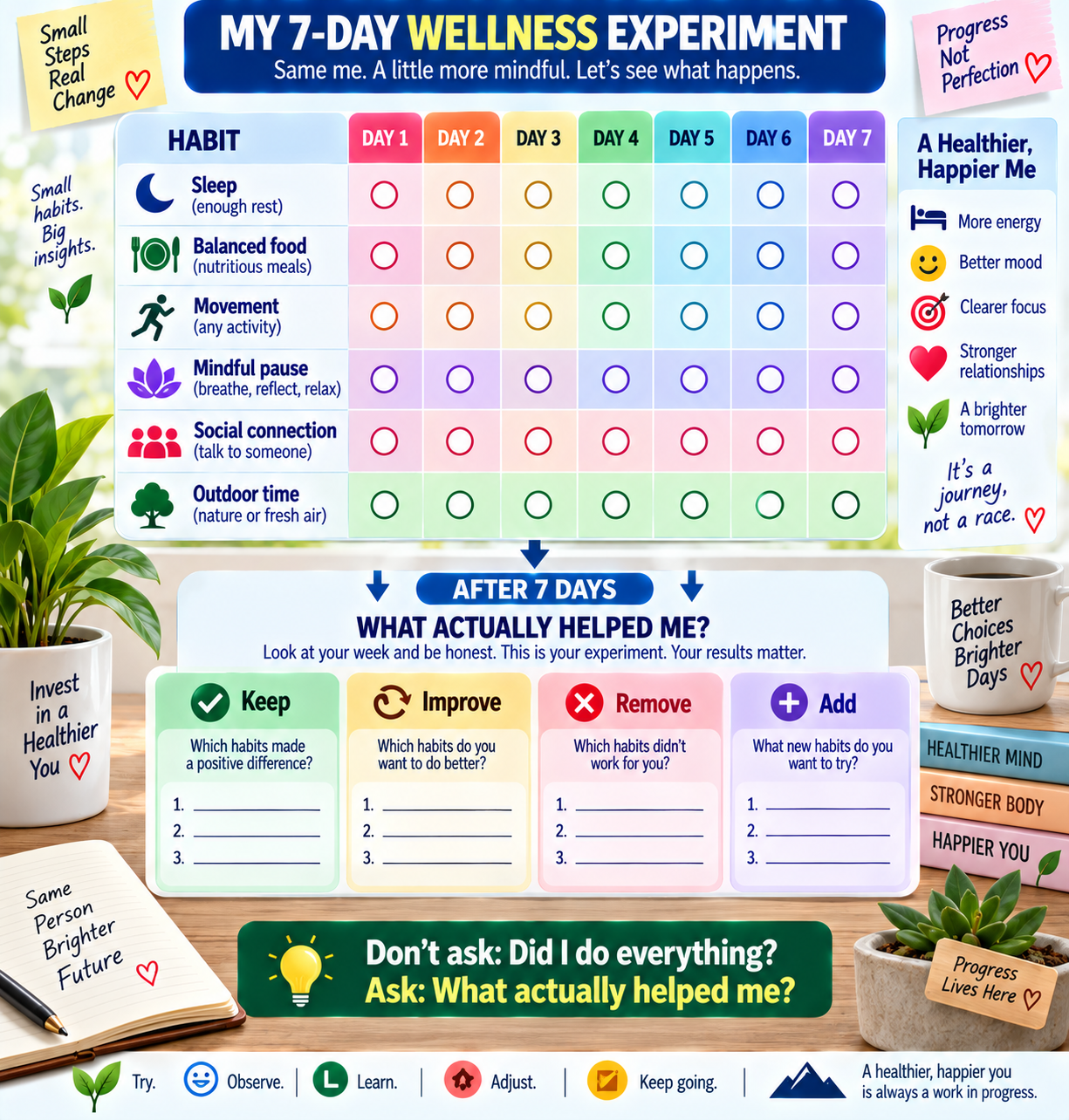
A People-First 7-Day Aromatherapy Experiment
Instead of immediately committing to a complicated routine, try a simple seven-day experiment.
| Day | Experiment |
|---|---|
| Day 1 | Choose one scent you genuinely like. |
| Day 2 | Try a short evening scent routine. |
| Day 3 | Pair the scent with five minutes of reading. |
| Day 4 | Pair it with gentle stretching. |
| Day 5 | Put your phone away during the routine. |
| Day 6 | Notice whether the scent feels relaxing or irritating |
| Day 7 | Decide whether the routine is worth continuing. |
At the end, ask yourself:
- Did I enjoy it?
- Did it help me create a pause?
- Did it cause any unwanted reaction?
Would I continue the routine even without expecting a medical benefit?
Those questions are more useful than trying to assign a numerical “stress reduction score” to a seven-day experiment.
When Aromatherapy Is Not Enough
Aromatherapy may be a reasonable relaxation practice, but persistent stress deserves more attention.
Consider speaking with a qualified healthcare professional if stress is:
- affecting your sleep regularly
- interfering with work
- affecting relationships
- causing persistent physical symptoms
- making it difficult to function normally
- associated with persistent anxiety or low mood
- becoming difficult to manage on your own
If you are experiencing severe psychological distress or thoughts of self-harm, seek urgent professional help rather than relying on aromatherapy.
A wellness routine should support your health.
It should never delay appropriate care.
How Aromatherapy Fits Into a Bigger Stress-Management Plan
Aromatherapy works best conceptually as one small part of a larger routine.
Think of your stress-management plan as a table with several legs.
| Area | Practical action |
|---|---|
| Sleep | Maintain a consistent sleep schedule. |
| Movement | Walk or exercise regularly. |
| Nutrition | Eat balanced meals. |
| Mental breaks | Take short screen-free pauses. |
| Social health | Talk with supportive people. |
| Relaxation | Try breathing, mindfulness, or another suitable practice. |
| Aromatherapy | Use a pleasant scent as an optional relaxation cue |
| Professional care | Seek help when symptoms persist or interfere with life. |
This broader approach prevents you from expecting one essential oil to solve every problem.
For example, you might use your evening aromatherapy routine alongside regular physical activity and other healthy habits. If you are looking for practical ways to manage daily stress, you can also explore Healthy Daily Habits for Stress Reduction.
If poor sleep is part of your stress cycle, your evening routine can also connect naturally with Healthy Evening Habits for Better Sleep.
Latest Research Developments in 2026
Research on aromatherapy is continuing rather than being a finished scientific story.
A 2026 review of recent randomized controlled trials specifically examined lavender essential-oil aromatherapy and anxiety. The review found potentially beneficial effects across several groups but emphasized that larger and more diverse studies are still needed and that the biological mechanisms are not fully established. 2026 PubMed — Lavender Aromatherapy and Anxiety
Another 2026 randomized controlled trial compared lavender aromatherapy with nature sounds among patients undergoing cataract surgery and examined anxiety and pain outcomes. This type of research is useful because it tests aromatherapy in a defined clinical situation, but results from surgical patients should not automatically be generalized to healthy people experiencing everyday stress at home. 2026 PubMed — Lavender Aromatherapy vs. Nature Sounds
A recent systematic review and meta-analysis also examined inhaled aromatherapy in patients undergoing coronary angiography and reported potential effects on anxiety and physiological outcomes. Again, this is a clinical population facing a specific medical procedure, so it should not be interpreted as proof that aromatherapy treats everyday chronic stress in the general population. 2026 PubMed—Aromatherapy, Anxiety, and Coronary Angiography
This is an important lesson in interpreting health research:
A positive study is evidence about the population and method that were actually studied.
It is not automatically evidence for every person, every essential oil, and every situation.
Key Takeaways
- How to use aromatherapy for stress relief at home starts with a simple, safe, and realistic routine.
- Lavender is one of the more extensively studied essential oils for anxiety and relaxation-related outcomes.
- 2026 research continues to suggest potential benefits from lavender aromatherapy, but more rigorous research is needed. 2026 PubMed Review—Lavender Essential-Oil Aromatherapy
- Aromatherapy is a complementary approach, not a replacement for medical or mental health treatment. NCCIH — Aromatherapy
- More essential oil does not mean more benefit.
- Do not routinely apply undiluted essential oils to your skin.
- Do not swallow essential oils.
- Keep essential oils away from children and pets. Poison Control—Essential Oils Safety
- Some citrus oils can cause photosensitivity when applied to skin before sun exposure. NCCIH — Aromatherapy Safety
- A calming routine may be more useful than relying on the essential oil alone.
- Personal experience can explain how a routine feels, but it is not proof of effectiveness for everyone.
Frequently Asked Questions
What is the best essential oil for stress relief?
Lavender is one of the most extensively studied essential oils for anxiety-related outcomes. However, there is no universal “best” oil for everyone. Personal scent preference and safe use matter. PubMed — Lavender and Anxiety Research
How do I use aromatherapy for stress relief at home?
For a beginner, use a suitable essential oil through an appropriate inhalation method such as a diffuser or personal inhaler according to the product instructions. Pair it with a short relaxation activity rather than expecting the scent alone to eliminate stress.
Can I use lavender oil every day?
There is no universal daily schedule that is appropriate for everyone and every product. Follow the product instructions, use the smallest amount needed for the intended method, and stop if you develop an unwanted reaction.
Can I put lavender oil directly on my skin?
Do not assume that pure essential oil is safe for direct skin application. Appropriate dilution is generally recommended for topical use, and product-specific instructions should be followed. Essential oils can cause skin irritation or allergic reactions. Poison Control—Essential Oils Safety
Can aromatherapy help with sleep?
Some research suggests possible improvements in sleep quality, but NCCIH notes that more rigorous research is needed. Aromatherapy is better considered one component of a healthy bedtime routine rather than a guaranteed sleep treatment. NCCIH — Aromatherapy and Sleep
How quickly does aromatherapy reduce stress?
There is no reliable universal timeframe. Some people may find a scent immediately pleasant or relaxing, while others may notice little difference. Research results also vary according to the essential oil, method, and population.
Is aromatherapy safe for everyone?
No. Essential oils can cause irritation, allergic reactions, poisoning if swallowed, and other problems when misused. Extra caution is appropriate for children, pregnant people, people with certain medical conditions, and people taking medications. NCCIH — Aromatherapy
Can I use essential oils in a diffuser around children?
Do not assume that a diffuser is automatically safe around children. Essential oils should be stored securely, and children should not have access to the bottles or diffuser liquids. Poison Control specifically warns about poisoning risks from essential oils in children. Poison Control — Essential Oils: Poisonous When Misused
Can aromatherapy replace treatment for anxiety?
No. Aromatherapy may be considered a complementary relaxation practice, but it should not replace professional evaluation or evidence-based treatment for an anxiety disorder.
Can aromatherapy replace medication?
No. Do not stop or change prescribed medication because of aromatherapy without discussing it with your healthcare professional.
Author Note
By RVLNSV PRASAD
I wrote this article from a practical, people-first perspective. My personal experience with lavender helped me understand how a small evening ritual can create a useful pause during stressful periods.
However, personal experience is not clinical evidence.
For that reason, this article separates personal observations from research findings and avoids presenting aromatherapy as a cure for stress, anxiety, or sleep disorders.
The focus is simple: explain what aromatherapy is, what current research suggests, how beginners can use it responsibly, and where the evidence has limitations.
Medical Disclaimer
This article is for general educational purposes and is not a substitute for medical advice, diagnosis, or treatment.
Aromatherapy should not be used to delay appropriate medical or mental health care.
Essential oils can cause skin irritation, allergic reactions, poisoning when swallowed, and other adverse effects when used incorrectly.
If you are pregnant, breastfeeding, caring for a child, taking medication, or living with a medical condition, discuss essential-oil use with an appropriate healthcare professional before using it.
If you experience difficulty breathing, severe allergic symptoms, poisoning, or another serious reaction, seek urgent medical care.
Fitness Disclaimer
Aromatherapy does not replace physical activity.
If you combine your relaxation routine with stretching, yoga, walking, or exercise, choose activities appropriate for your fitness level.
Stop exercise if you experience significant pain, dizziness, chest pain, unusual shortness of breath, or another concerning symptom, and seek appropriate medical advice.
For practical movement ideas, you can also read Benefits of Morning Walks for Mental Health.
Research Methodology
This article was updated using information from authoritative health organizations and peer-reviewed research, with particular attention to:
- NCCIH information on aromatherapy and safety
- 2026 peer-reviewed research on lavender aromatherapy and anxiety
- systematic reviews and meta-analyses of lavender and anxiety
- current safety information from Poison Control
- research involving aromatherapy and sleep
- recent clinical trials involving lavender aromatherapy
The article distinguishes between personal experience, preliminary evidence, clinical research, and established safety information rather than treating all aromatherapy claims as equally supported.
Conclusion
Learning how to use aromatherapy for stress relief at home does not require a complicated routine.
Start with one scent you genuinely enjoy.
Use it safely.
Create a short period when you are not answering messages or thinking about work.
Read.
Stretch gently.
Sit quietly.
Take a short walk.
Or simply allow yourself to do nothing for a few minutes.
The essential oil does not have to carry the entire burden.
That may actually be the most useful way to think about aromatherapy.
For me, lavender became a reminder that the working day was finished and it was time to slow down. The benefit was not a magical transformation. It was the combination of a familiar scent and a healthier evening routine.
Current research suggests that lavender aromatherapy may have a role in reducing anxiety in some settings, but researchers continue to study the size of the effect, the best methods of use, and which people are most likely to benefit. 2026 PubMed Review — Lavender Essential-Oil Aromatherapy and Anxiety
So use aromatherapy for what it can reasonably offer:
a pleasant sensory experience and a possible relaxation aid that can complement a broader approach to stress management.
Don’t expect one bottle of oil to solve chronic stress.
Instead, use it as one small part of a healthier life.
Sources
- NCCIH — Aromatherapy
- NCCIH—Sleep Disorders, Aromatherapy, and Safety
- 2026 PubMed—Effect of Lavender Essential Oil-Based Aromatherapy on Anxiety
- PubMed—Lavender Aromatherapy and Anxiety: Systematic Review and Meta-analysis
- PubMed—Effects of Lavender on Anxiety, Depression, and Physiological Parameters
- PubMed — Anxiety-Reducing Effects of Lavender Essential-Oil Inhalation
- 2026 PubMed — Lavender Aromatherapy and Nature Sounds in Cataract Surgery
- Poison Control — Essential Oils: Poisonous When Misused
- Poison Control — Lavender Oil Safety
Related Content:
9 Benefits of Yoga for Holistic Health and Well-Being
Healthy Daily Habits for Stress Reduction
Benefits of Morning Walks for Mental Health
Healthy Evening Habits for Better Sleep
Daily Holistic Wellness Routine for Beginners: 10 Simple Habits
Body, Mind, and Soul: A Holistic Approach to Health
Integrating Holistic Wellness Into Your Daily Routine
Simple Daily Habits to Support Natural Body Wellness
How to Build Healthy Habits and Stick to Them Daily
Mindfulness Practices for Mental Health
Post Views: 1,828








[…] How to Use Aromatherapy for Stress Relief at Home: A Beginner Guide […]
[…] How to Use Aromatherapy for Stress Relief at Home: A Beginner Guide […]
[…] How to Use Aromatherapy for Stress Relief at Home: A Beginner Guide […]
[…] How to Use Aromatherapy for Stress Relief at Home: A Beginner Guide […]