






















































































































































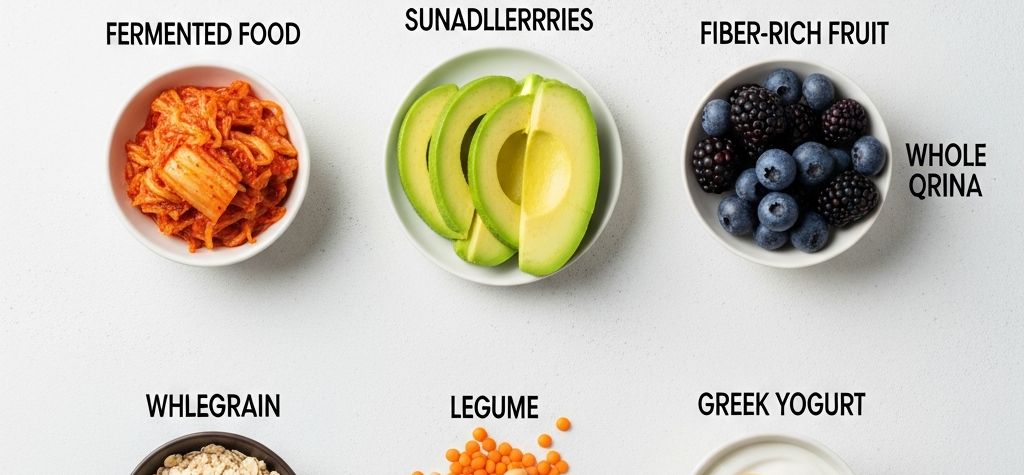
5 Best Foods for Gut Health: What to Eat for a Healthier Microbiome
Author: RVLNSV PRASAD
Updated On: October 2026
About Us
Author Bio
Editorial Policy
Contact Us
Quick Answer
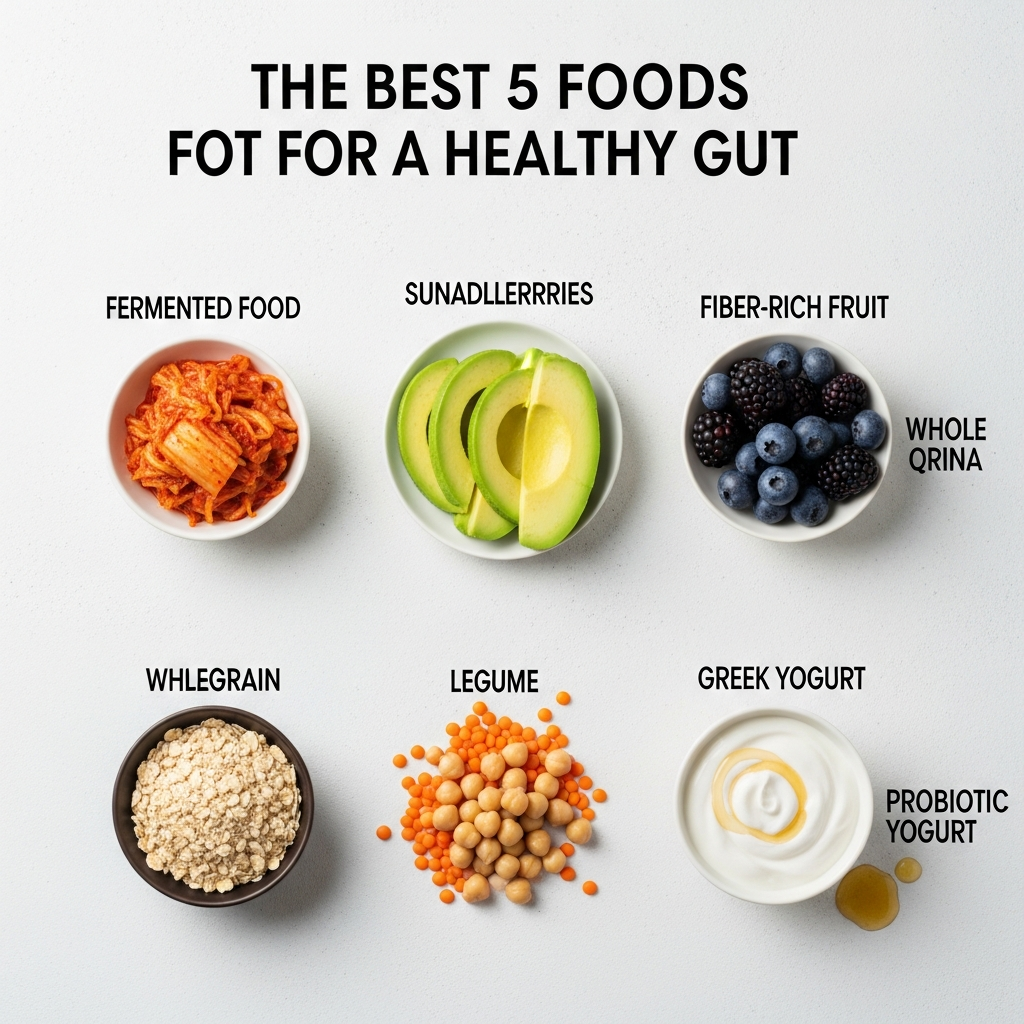
The best foods for gut health are not necessarily unfamiliar “superfoods.” A more useful approach is to regularly eat a variety of fiber-rich plant foods while including fermented foods that you tolerate well.
Five practical choices are plain yogurt with live cultures, oats, legumes such as lentils and beans, leafy vegetables, and fruits such as bananas or apples.
These foods provide different combinations of fiber, fermentable carbohydrates, resistant starch, polyphenols, vitamins, minerals, and, in some cases, live microorganisms.
The important point is that no single food can repair everyone’s gut. Your microbiome is individual, and dietary responses vary. Recent reviews emphasize that diet has a major influence on the gut microbiome, but researchers are still working to understand why people respond differently to the same foods. A 2025 review in Nature Reviews Microbiology explains the complex relationship between diet, the microbiome, and human health.
For most people, the goal should be dietary variety, adequate fiber, gradual changes, and foods that fit their own digestive tolerance.
Introduction: Your Gut Does Not Need a Perfect Diet
Gut health has become a popular health topic, but the conversation is sometimes more complicated than it needs to be.
You may have seen lists promising that one particular food will “heal” your gut, eliminate bloating, increase immunity, improve mood, and transform your microbiome.
Real nutrition science is more careful.
Your digestive system contains a complex community of microorganisms, along with the intestinal lining, immune system, nervous system, and other biological processes. What you eat can influence this ecosystem, but there is no universal five-food prescription that creates the same result for everyone.
A 2025 review describes the gut microbiome as an important link between nutrition and human health while emphasizing that responses to food differ between individuals. Researchers are increasingly studying how diet, microorganisms, and the individual host interact rather than looking for one universally beneficial food. Read the review in PubMed.
That distinction matters.
If beans make one person feel comfortably full while another experiences significant bloating, both experiences can be real.
If yogurt feels good for one person but causes symptoms in someone with lactose intolerance, that does not mean yogurt is universally “bad” or “good.”
This article takes a practical approach.
Instead of promising a miracle, it explains five evidence-supported food choices, why they may help, how to introduce them gradually, and what to do if your digestive system does not tolerate them well.
What Does “Gut Health” Actually Mean?
Gut health is broader than simply having regular bowel movements.
Your gastrointestinal tract is responsible for digestion and absorption of nutrients, but it also interacts with the immune system and the trillions of microorganisms living throughout the digestive tract.
The gut microbiome is influenced by diet, medications, age, environment, lifestyle, and many other factors.
A 2024 review in Nature Reviews Microbiology describes diet as a major factor shaping the composition, function, and diversity of the gut microbiome and discusses how different dietary patterns can have different effects. Read the full review.
This is why I prefer the phrase “support gut health” rather than promising to “fix” or “cleanse” the gut.
Your body already has sophisticated systems for digestion and waste removal.
The aim is to provide those systems with a nutritious dietary environment.
My Personal Experience With Changing My Diet
There was a period when I paid more attention to my digestion because meals did not always leave me feeling comfortable.
Instead of searching for a single “gut-healing” food, I started looking at the overall pattern of what I was eating.
I reduced heavily processed foods, paid more attention to fiber-rich foods, and introduced changes gradually rather than suddenly filling every meal with vegetables, oats, beans, and seeds.
That gradual approach was important.
I noticed that my digestion felt more comfortable when I made sustainable changes instead of trying to transform my diet overnight.
That is my personal experience, not a promise that the same foods will produce the same result for everyone.
Your digestive system has its own history, tolerance, and needs.
The 5 Best Foods for Gut Health
1. Plain Yogurt With Live Cultures
Yogurt is one of the easiest ways to include a fermented dairy food in your diet.
Some yogurts contain live microorganisms, including bacterial cultures used during fermentation.
However, an important distinction is often missed online:
Not every yogurt should automatically be treated as a probiotic treatment.
The microorganisms, strains, and amounts can vary between products.
Why yogurt may support gut health
Fermented foods are being actively studied for their effects on the gut microbiome and immune system.
In a landmark Stanford randomized clinical trial involving healthy adults, participants assigned to a diet high in fermented foods experienced increased microbiome diversity and reductions in several inflammatory markers compared with the high-fiber group. The study was relatively small and lasted 10 weeks, so it should not be interpreted as proof that fermented foods prevent disease. Stanford Medicine explains the findings.
That is a much more useful conclusion than saying:
“Yogurt heals your gut.”
How to eat it
Try plain yogurt with:
- Oats
- Banana
- Apple
- Nuts
- Seeds
- Cinnamon
- Fresh fruit
Choose a product appropriate for your dietary needs.
If dairy causes symptoms, lactose-free yogurt or a suitable non-dairy fermented alternative may be worth considering.
People with significant immune problems or specific medical conditions should seek professional advice before using probiotic supplements rather than assuming all probiotic products are harmless.
2. Oats
Oats are one of the simplest foods for gut health because they provide dietary fiber and can be incorporated into breakfast without much effort.
They contain beta-glucan, a type of soluble fiber that has been extensively studied for metabolic and cardiovascular effects.
Oats also contribute fermentable material that can interact with gut microorganisms.
The NHS includes oats among useful fiber sources for digestive health.
Why fiber matters
Dietary fiber is not a single substance.
Different fibers behave differently in the digestive tract.
Some are fermented by gut microorganisms, producing metabolites such as short-chain fatty acids. Others contribute bulk and help stool move through the digestive system.
A major 2025 review in Nature Reviews Microbiology explains that dietary fibers are a diverse group of nutrients and that their effects on the gut microbiome can vary between individuals. Read the review.
This is why “more fiber” is useful advice but “one specific fiber works for everyone” is not.
An easy oat combination
Try:
Oats + plain yogurt + banana + a small amount of nuts
This gives you a combination of whole-food carbohydrates, fiber, protein, and healthy fats.
If your digestive system is not accustomed to much fiber, start with a smaller portion.
3. Lentils, Beans, and Other Legumes
If I had to choose one category that deserves more attention in generic gut-health articles, it would be legumes.
Lentils, chickpeas, kidney beans, black beans, peas, and other pulses are affordable, versatile, and naturally rich in fiber.
They are especially useful for Indian households because dal, chana, rajma, lobia, and other legumes are already part of many traditional meals.
Why legumes are important for the gut
Legume fibers and other carbohydrates can reach the large intestine, where some are used by gut microorganisms.
This fermentation can produce short-chain fatty acids and other metabolites.
The evidence is part of a larger picture: dietary fiber interacts with gut microorganisms in ways that may influence metabolic and intestinal health. A 2025 review of fiber and microbiome mechanisms discusses these interactions in detail.
The mistake people make
They suddenly increase their intake.
Imagine someone who usually eats very little fiber.
On Monday, they decide to “heal their gut” and eat a huge bowl of beans, several servings of vegetables, oats, fruit, and seeds.
By evening, they feel bloated.
They conclude:
“Fiber doesn’t suit me.”
Sometimes the real problem is the speed of the change.
The NHS recommends increasing fiber as part of digestive health but also recognizes that some people experience bloating or symptoms from particular foods. NHS digestive-health guidance.
A better approach
Increase portions gradually.
For example:
- Week 1: Add a small serving of dal or lentils.
- Week 2: Add another fiber-rich meal if tolerated.
- Week 3: Increase variety.
Drink enough fluid unless your healthcare professional has advised you to restrict fluids.
4. Leafy Vegetables and Other Vegetables
Leafy vegetables such as spinach, fenugreek leaves, amaranth, and other greens provide fiber, vitamins, minerals, and plant compounds.
They are not magical “gut cleaners.”
Their value comes from being part of a diverse plant-rich diet.
That distinction is important because your microbiome benefits from exposure to many different food components rather than a repetitive diet built around one fashionable ingredient.
An easy Indian meal upgrade
Instead of creating a separate “gut-health meal,” modify the food you already eat.
For example:
Dal + rice → add spinach or another vegetable
Roti + sabzi → add a side of plain yogurt if tolerated
Khichdi: increase vegetables and use a suitable pulse.
Poha: add vegetables and peanuts.
This is a people-first approach because it doesn’t require buying expensive specialty foods.
5. Fruits Such as Bananas, apples, and Guava
Fruit provides fiber, water, and a range of plant compounds.
Bananas are particularly convenient because they are inexpensive, portable, and easy to include in breakfast or snacks.
Apples provide fiber, including pectin.
Guava is another practical option and can contribute substantial dietary fiber.
A recent review of fruit-based dietary patterns highlights the roles of fiber and polyphenols in interactions with the gut microbiome, while also emphasizing the need for more research and individualized nutrition. Read the 2025 review in PMC.
Don’t turn fruit into a supplement.
You don’t need to eat one particular fruit every day because someone online called it a “prebiotic superfood.”
Rotate your choices.
For example:
Monday: Banana
Tuesday: Guava
Wednesday: Apple
Thursday: Orange
Friday: Papaya
Weekend: Whatever seasonal fruit you enjoy
Variety is more useful than obsessing over one “perfect” fruit.
Comparing the 5 Foods
| Food | Main gut-related feature | Easy way to use it | Important consideration |
|---|---|---|---|
| Plain yogurt with live cultures | Fermented food/live microorganisms | With oats or fruit | Dairy may not suit everyone. |
| Oats | Soluble and fermentable fiber | Porridge or overnight oats | Increase fiber gradually. |
| Lentils/beans | Fiber and fermentable carbohydrates | Dal, chana, rajma | Can initially cause gas |
| Leafy vegetables | Fiber and plant compounds | Sabzi, dal, soups | Increase variety gradually. |
| Fruits | Fiber, water, and polyphenols | Whole fruit or snack | Choose variety rather than one “superfood.” |
The Bigger Secret: Your Gut May Benefit More From Variety Than a “Top 5” List
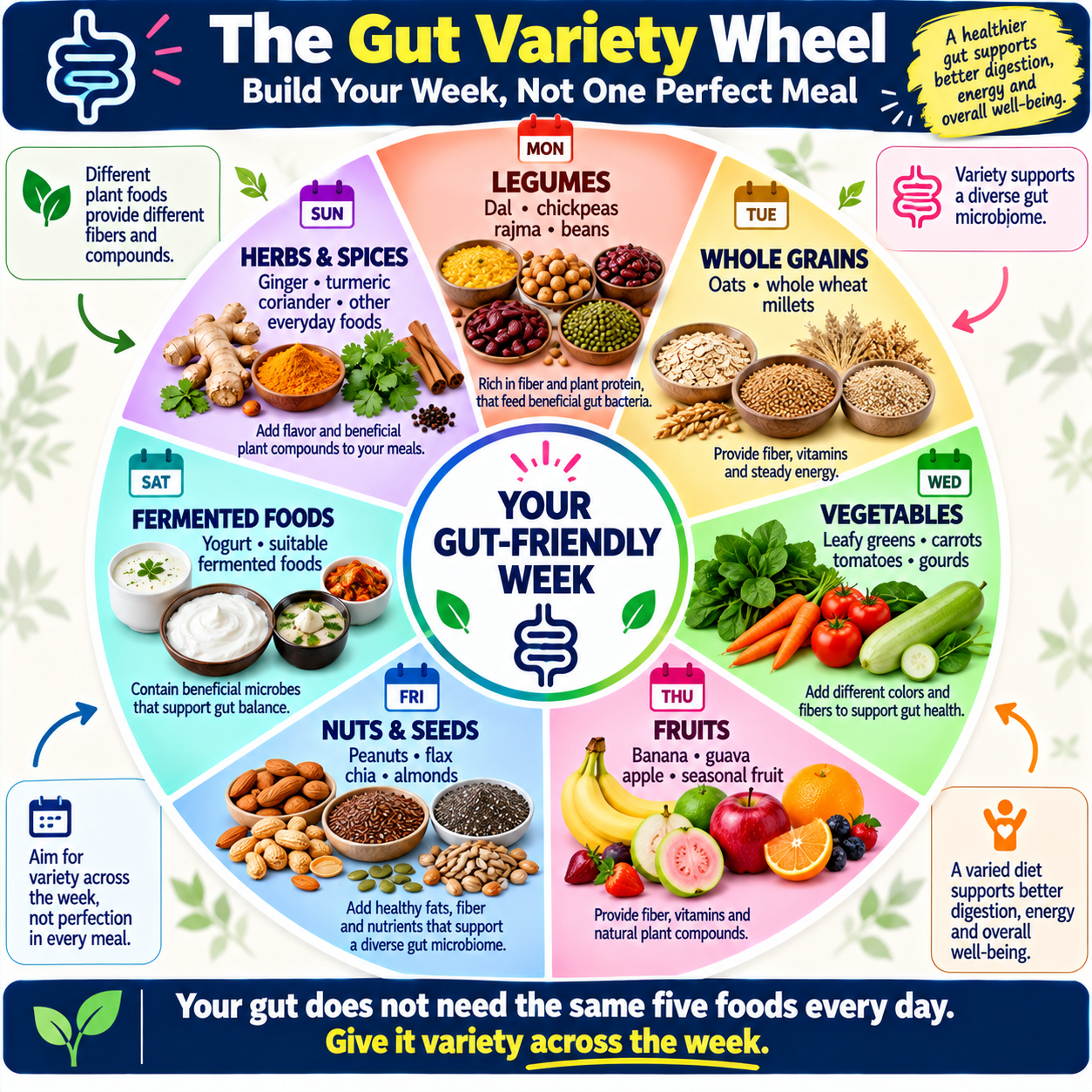
This is one of the most important points in this article.
The title says “five foods” because readers want a practical starting point.
But your gut does not understand SEO lists.
Your microbiome interacts with the overall dietary environment.
A 2025 review on diet and the microbiome emphasizes the complexity of these interactions and the importance of understanding whole dietary patterns rather than focusing only on isolated foods. Read the research.
That means a better weekly goal is
More variety of plant foods + adequate fiber + suitable fermented foods + fewer heavily processed dietary patterns.
You don’t have to eat 30 different plants in one day.
Think across the week.
Try rotating:
- Oats
- Lentils
- Chickpeas
- Beans
- Green vegetables
- Carrots
- Tomatoes
- Bananas
- Apples
- Guava
- Nuts
- Seeds
- Whole grains
- Herbs and spices
The objective is not perfection.
It is diversity.
Prebiotics vs. Probiotics: What’s the Difference?
These terms are often confused.
Probiotics
Probiotics are live microorganisms that, when administered in adequate amounts, confer a health benefit on the host.
Not every fermented food automatically qualifies as a probiotic under the scientific definition.
Prebiotics
Prebiotics are substances that are selectively utilized by host microorganisms and provide a health benefit.
Many dietary fibers can interact with gut microbes, but not every fiber should automatically be labeled a prebiotic.
Fermented foods
Fermented foods include foods such as yogurt, kefir, kimchi, and certain fermented vegetables.
They can contain live microorganisms, but the microbial content depends on the food, production process, and storage.
A detailed review in Nature Reviews Gastroenterology & Hepatology explains that fermented foods contain a variety of microorganisms and bioactive compounds and that their potential gastrointestinal effects depend on the specific food and fermentation process. Read the review.
This distinction makes your gut-health choices much easier to understand.
What If Healthy Foods Make You Bloated?
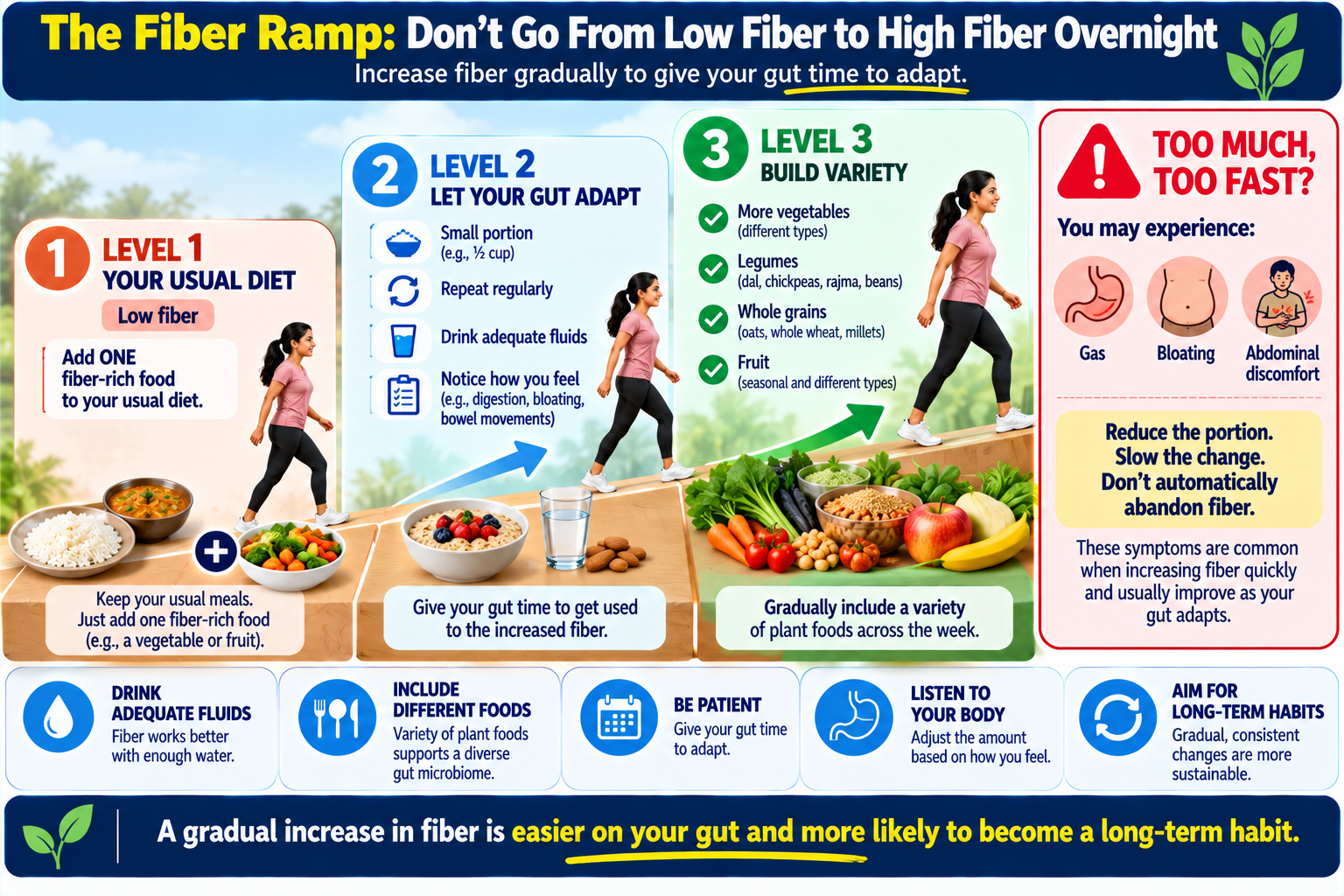
This is where many articles fail readers.
Someone eats more vegetables, beans, oats, and fruit because they want better gut health.
They become bloated.
Instead of adjusting the plan, they conclude that their digestive system is “damaged.”
Don’t jump to that conclusion.
A sudden increase in fiber can cause gas and bloating in some people.
Try a slower approach.
The 4-step adjustment
- Step 1: Reduce the portion rather than abandoning the food.
- Step 2: Introduce one major change at a time.
- Step 3: Keep a simple food-and-symptom diary.
- Step 4: Discuss persistent symptoms with a healthcare professional.
The NHS specifically recommends identifying individual food triggers when digestive symptoms occur rather than assuming that one diet works for everyone. NHS digestive-health guidance.
A Simple Gut-Friendly Meal Formula
You don’t need a complicated meal plan.
Try this basic structure:
- ½ plate: vegetables or salad, adjusted to tolerance
- ¼ plate: protein such as dal, beans, eggs, fish, tofu, or other suitable choices
- ¼ plate: whole grains or another carbohydrate source
- Optional: yogurt or another suitable fermented food
- Fruit: as part of the meal or later in the day
This is not a medical prescription.
It is a practical framework that makes a fiber-rich, varied eating pattern easier to implement.
A 7-Day Gut-Friendly Food Rotation
| Day | Breakfast | Main meal | Simple addition |
|---|---|---|---|
| Monday | Oats + banana | Dal + vegetables + rice | Plain yogurt |
| Tuesday | Yogurt + fruit + oats | Roti + chickpea curry + greens | Guava |
| Wednesday | Vegetable poha | Rajma + rice + vegetables | Apple |
| Thursday | Oats + fruit | Dal + roti + spinach | Yogurt |
| Friday | Yogurt + banana | Chana + roti + vegetables | Seasonal fruit |
| Saturday | Vegetable-based breakfast | Mixed dal + rice + greens | Fruit |
| Sunday | Your preferred balanced breakfast | Home-cooked meal with vegetables and legumes | Yogurt if tolerated |
The purpose is not to follow this exact menu.
Use it as a template for variety.
Three Gut-Friendly “Home Remedies” That Are Actually Practical
1. The gradual-fiber method
Instead of suddenly adding large amounts of fiber, increase it in small steps.
This is particularly useful if your usual diet is low in fiber.
2. The leftover-legume method
Cook a larger batch of dal, chickpeas, or beans and use the leftovers in another meal.
This reduces the effort required to eat more legumes.
3. The one-new-food rule
If your digestion is sensitive, don’t introduce five new foods simultaneously.
Try one change.
Observe.
Then make the next change.
This makes it easier to identify which foods you tolerate.
These approaches are not “cures.”
They are simple ways to make a healthier dietary pattern easier to maintain.
What About Ginger?
Ginger can be part of a healthy diet, and it is widely used in traditional food and beverages.
However, I would not place ginger among the five most important foods for general microbiome support simply because it is often promoted online as a “gut-healing” remedy.
The stronger general dietary message is to obtain adequate fiber and dietary variety while choosing foods you tolerate.
You can still use ginger in meals or tea if you enjoy it.
The difference is that we are not promising that ginger tea will “repair” the gut.
What About Lemon Water?
Lemon water is fine if you enjoy it.
But it is not a special detoxification treatment.
Your liver, kidneys, digestive system, and other organs already perform complex metabolic and waste-handling functions.
Adding lemon to water can make water more enjoyable and can provide a small amount of vitamin C, but there is no need to describe it as a gut cleanse.
If acidic drinks aggravate reflux or heartburn, they may not be a good choice for you. The NHS notes that acidic foods and drinks can trigger symptoms in some people with digestive conditions.
Common Mistakes That Can Hurt Your Gut-Health Plan
Mistake 1: Adding too much fiber too quickly
More is not always better when the change is sudden.
Mistake 2: Eating only the “top five foods”
Your gut benefits from a varied dietary pattern, not a five-food prison.
Mistake 3: Assuming all yogurt contains probiotics
Check the product and its labeling.
Mistake 4: Buying expensive supplements before improving food quality
Supplements have specific uses, but they should not automatically replace a varied diet.
Mistake 5: Ignoring individual tolerance
A food can be nutritious and still trigger symptoms in a particular person.
Mistake 6: Treating bloating as proof of “toxins”
Bloating can have many causes.
It does not mean your body is releasing toxins because you started eating healthy food.
Mistake 7: Expecting results in a few days
Gut-related changes can be complex, and symptoms may have multiple causes.
Latest Research: What Is Changing in Gut-Health Nutrition?
Gut-health science is developing rapidly.
Several recent findings are particularly relevant.
Research development 1: Scientists are moving toward personalized nutrition.
A 2025 review discusses how individual microbiome profiles may eventually contribute to more personalized dietary recommendations. However, this field is still developing, and routine microbiome testing should not be treated as a universal requirement for healthy people. Read the review on personalized nutrition.
This is important because two people can eat the same food and experience different digestive responses.
Research development 2: Fiber is powerful but not one-size-fits-all.
A major review published in Nature Reviews Microbiology explains that dietary fibers differ considerably and that their interactions with the microbiome can vary between individuals. Read the 2025 fiber review.
This means that “eat more fiber” is a good general principle, but the specific type and amount may matter.
Research development 3: Fermented foods deserve continued research.
The Stanford clinical trial found that a diet high in fermented foods increased microbiome diversity and reduced several inflammatory markers in healthy adults. However, the researchers described the findings as a clinical trial with a relatively small sample, and the results should not be turned into a blanket claim that fermented foods prevent disease. Stanford Medicine summary.
Research development 4: Whole dietary patterns matter.
A 2025 systematic review of 80 controlled clinical trials found that dietary interventions can affect gut microbial composition and inflammatory markers, but results were heterogeneous and changes in microbiome diversity were not consistent across studies. Read the systematic review.
This is exactly why I would avoid claiming that any five foods will produce a predictable microbiome transformation.
The People-First Gut Health Rule
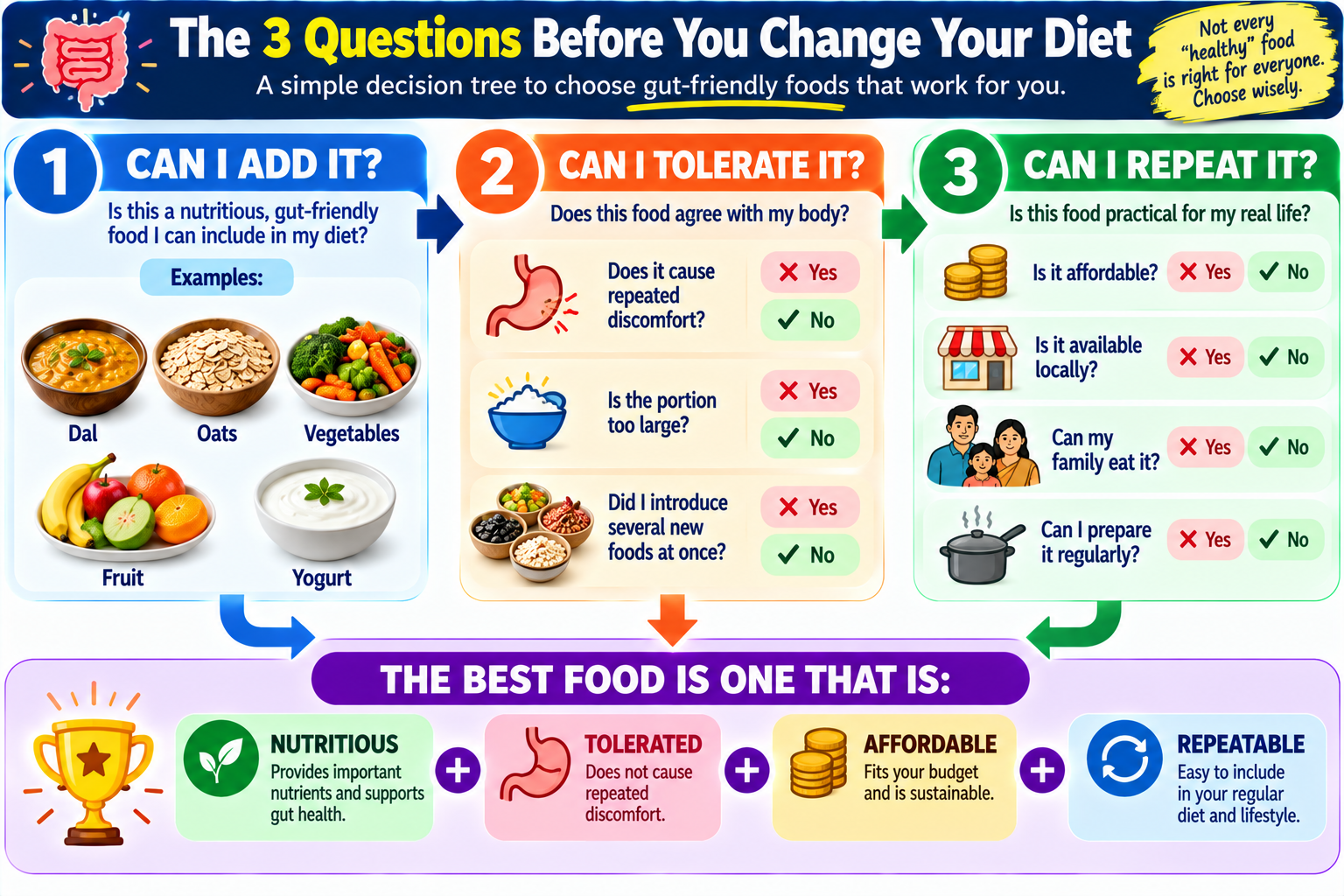
Here is the approach I would give to someone who says:
“I want to improve my gut health, but I don’t want a complicated diet.”
Start with three questions.
What can I add?
Maybe oats, vegetables, fruit, dal, or yogurt.
What can I tolerate?
Your digestive symptoms matter.
What can I repeat?
A food is only useful in your long-term diet if you can realistically keep eating it.
That is more practical than buying expensive powders, ordering unusual ingredients, or following a strict “gut reset.”
When Digestive Symptoms Need Medical Attention
Food can support digestive health, but diet should not be used to self-treat persistent or serious symptoms.
Talk with a healthcare professional if you have ongoing:
- Unexplained weight loss
- Blood in the stool
- Persistent vomiting
- Severe or worsening abdominal pain
- Persistent diarrhea
- Persistent constipation
- Difficulty swallowing
- Significant or unexplained changes in bowel habits
- Recurrent symptoms that interfere with daily life
A food list is not a substitute for diagnosis.
People with conditions such as inflammatory bowel disease, celiac disease, significant food allergies, severe IBS symptoms, or other digestive disorders may need individualized dietary guidance.
Key Takeaways
- The best foods for gut health are not magic foods; they are nutritious foods that support a varied dietary pattern.
- Plain yogurt with live cultures can provide a fermented-food option for people who tolerate dairy.
- Oats provide useful fiber and can be an easy daily food.
- Lentils, beans, and other legumes are excellent sources of dietary fiber and deserve more attention.
- Leafy vegetables contribute fiber and diverse plant compounds.
- Fruits such as bananas, apples, and guava provide fiber and other beneficial plant compounds.
- Increase fiber gradually if your current intake is low.
- Drink adequate fluids unless a healthcare professional has advised fluid restriction.
- Fermented foods and probiotic products are not identical.
- Your response to a particular food can differ from another person’s response.
- Dietary variety is more useful than obsessing over one “superfood.”
- Persistent digestive symptoms deserve medical evaluation.
Frequently Asked Questions
What are the 5 best foods for gut health?
Five practical choices are plain yogurt with live cultures, oats, legumes such as lentils and beans, leafy vegetables, and fiber-rich fruits such as bananas, apples, or guava.
What is the best food for gut bacteria?
There is no single best food for everyone’s gut bacteria. Fiber-rich plant foods and suitable fermented foods can contribute to a gut-supportive dietary pattern.
Is yogurt good for gut health?
Yogurt containing live cultures can be a useful fermented food. However, the microorganisms vary between products, and people with lactose intolerance or dairy sensitivity may need alternatives.
Are bananas good for the gut?
Bananas provide fiber and other nutrients and can be part of a gut-friendly diet. They should be viewed as one food within a varied diet rather than a treatment for digestive problems.
Are oats good for digestion?
Oats provide soluble and fermentable fiber and can contribute to a healthy dietary pattern. If you are not accustomed to much fiber, increase portions gradually.
Are beans good for gut health?
Beans and other legumes are excellent sources of dietary fiber, but they can cause gas or bloating in some people, especially when intake increases suddenly.
How quickly can food improve gut health?
There is no universal timeline. Some digestive effects may occur relatively quickly, while changes in dietary habits and the microbiome can take longer and vary considerably between individuals.
Should I take a probiotic supplement?
Not necessarily. Probiotics have specific strain-dependent effects, and evidence varies by condition. Food-first strategies are generally a sensible starting point for healthy people, while people with medical conditions should seek individualized advice.
Author Note
I believe gut health should be approached without fear or unnecessary complexity.
My own experience taught me that sustainable dietary changes are more useful than searching for one miracle food. Adding more whole foods gradually, paying attention to how my body responded, and reducing heavily processed choices felt much more realistic than following a rigid “gut detox.”
That is why this article does not promise that five foods will cure digestive problems.
The goal is simpler:
Eat a greater variety of nutritious foods, increase fiber gradually, include suitable fermented foods, and learn what works for your own body.
Medical Disclaimer
This article is for general educational purposes and does not provide medical diagnosis or treatment. Digestive symptoms can have many causes, and nutritional advice that is appropriate for one person may not be appropriate for another. If you have persistent digestive symptoms, unexplained weight loss, blood in the stool, severe abdominal pain, ongoing vomiting, or another concerning symptom, seek medical evaluation.
People with inflammatory bowel disease, celiac disease, significant food allergies, kidney disease, eating disorders, or other medical conditions should obtain individualized dietary guidance from a qualified healthcare professional.
Fitness Disclaimer
Diet and gut health are only part of overall wellness. Physical activity should be appropriate for your age, fitness level, and medical condition. If you have a chronic disease, significant injury, cardiovascular symptoms, or another health concern, seek professional advice before beginning a new exercise program.
Sources
- NIH — Health Benefits of Dietary Fibers Vary
- NHS — Good Foods to Help Your Digestion
- Nature Reviews Microbiology — The Interplay Between Diet and the Gut Microbiome
- Nature Reviews Microbiology—The Gut Microbiome and Dietary Fibres
- Nature Reviews Gastroenterology & Hepatology — Fermented Foods and Gastrointestinal Health
- PubMed — The Gut Microbiome Connects Nutrition and Human Health
- PubMed — Microbiome-Based Approaches to Personalized Nutrition
- PubMed Central — Dietary Interventions and the Gut Microbiota: Systematic Review of 80 Controlled Clinical Trials
- Stanford Medicine — Fermented-Food Diet and Microbiome Diversity
- PMC — Fruit-Based Diet and Gut Health Review
Final Thoughts
The healthiest gut is not created by eating one magical food.
It is supported by a dietary pattern that gives your digestive system a variety of nutrients and your gut microorganisms a variety of food components to work with.
Start with foods you already know and can afford.
Add oats to breakfast.
Include dal, beans, or another legume regularly.
Eat vegetables and fruit in different forms.
Choose plain yogurt with live cultures if you tolerate it.
Then give your body time to adjust.
If you notice bloating after increasing fiber, do not immediately conclude that healthy food is the problem. Reduce the portion, introduce changes more slowly, and pay attention to your individual response.
Most importantly, remember that gut health is not about following a perfect list of five foods.
It is about building a diverse, sustainable eating pattern that works in real life.
That is a much more realistic goal—and a much better foundation for long-term digestive health.
Similar Articles
- Weight Loss
- 3 Best Tips To Maintain Fitness
- Nutrient-8 Dense Foods for Immune System Support: A Comprehensive Guide to Boosting Your Immunity Naturally
- 10 Best Foods To Control Blood Sugar Levels
- 6 Natural Foods to Improve Digestion and Gut Health: A Comprehensive Guide
- Gut Health Revolution: How Nutrition Shapes Your Microbiome










[…] The Best 5 Foods to Eat for a Healthy Gut […]