






























































































































































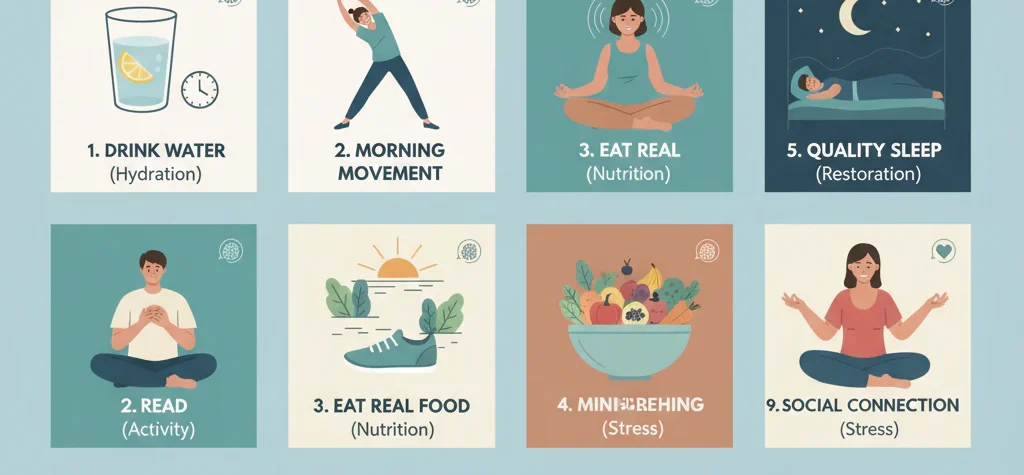
10 Science-Backed Healthy Habits for Beginners to Improve Your Health Naturally
Author
RVLNSV PRASAD
Fact-Checked By: Wellness Research Team
Last Updated: August 2026
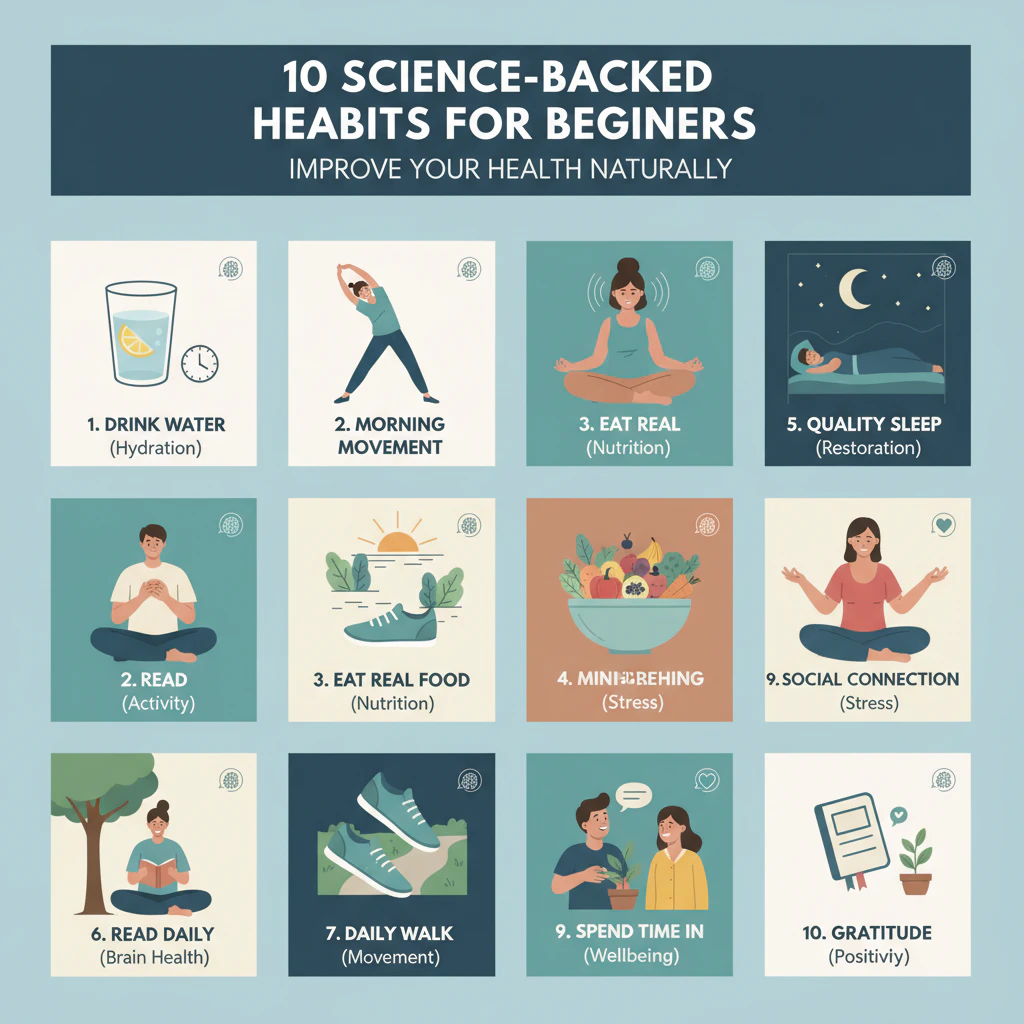
Author Note
RVLNSV PRASAD writes evidence-based wellness articles that simplify complex health topics into practical daily habits that readers can apply in their everyday lives. This guide combines current medical research, trusted public health recommendations, and practical lifestyle strategies from organizations such as the World Health Organization (WHO), National Institutes of Health (NIH), Centers for Disease Control and Prevention (CDC), Mayo Clinic, and Harvard Health Publishing.
Medical Disclaimer
This article is for educational purposes only and should not replace professional medical advice, diagnosis, or treatment. If you have an underlying medical condition or concerns about your health, consult a qualified healthcare professional.
Introduction
10 Science-Backed Healthy Habits for Beginners to Improve Your Health Naturally. These habits can help transform your well-being more effectively than trying drastic diets or complicated wellness plans. Most people believe becoming healthier requires huge lifestyle changes. In reality, research suggests that small daily actions practiced over time often produce more lasting results than short periods of extreme motivation. Centers for Disease Control and Prevention (CDC) – Healthy Living
One reason many people struggle is that they try to change everything at once. They overhaul their diet, begin intense workouts, wake up earlier, and promise never to miss a day. Within a few weeks, the routine feels overwhelming, and old habits return.
During my research on long-term wellness, one pattern appeared repeatedly. People who maintained long-term health for years depended on more than willpower. Instead, they developed routines, which became part of their everyday lives. They didn’t make flawless progress; they made steady progress.
The good news is that anyone can begin to develop healthier routines without pricey equipment, elaborate meal plans, or hours of free time. Small changes might even add up over months and years.
Here are 10 science-backed healthy habits for beginners, why they work, common pitfalls to avoid, and practical tips to help you implement these routines into your everyday life.
Quick Answer
10 Science-Backed Healthy Habits for Beginners to Improve Your Health Naturally: Yes—drink, eat healthy foods, move your body often, get adequate sleep, manage your stress, create routines, practice mindfulness, cut back on ultra-processed foods, get outside, and focus on consistent progress. If you practice these healthy habits for beginners regularly, they can help you stay healthy both physically and mentally over time.
Key Takeaways
- Small daily actions generally result in bigger long-term outcomes than drastic lifestyle changes.
- Build one habit at a time; it’s more likely to succeed.
- Hydration, diet, activity, sleep, and stress management all work together to maintain health.
- Consistency, not perfection.
- Healthy habits become easier when they’re automatic.
- Tracking progress can boost motivation.
- Sustainable behaviors generally beat short-term obstacles.
- Every positive choice contributes to better overall health.
Why Motivation Doesn’t Matter as Much as Small Healthy Habits
Most people wait until they feel like making healthier choices.
The trouble is that motivation varies day to day.
Habits keep going even when you don’t feel motivated.
Scientists studying behavior modification show that repeating tiny actions in the same setting makes them more automatic. That’s one reason it’s generally simpler to stick with daily routines than to rely on willpower alone. National Institutes of Health (NIH)
One thing I discovered in my studies is that healthy people are generally no more disciplined than anyone else. Instead, they created conditions that made it easier to make healthy choices. Having a water bottle nearby, having nutritious foods available, or taking a walk after dinner became automatic and required less discipline.
Instead of asking,
How to stay motivated forever?
A better question is, “How can I make it easier to make healthier choices every day?”
That small change in thinking often leads to long-term success.
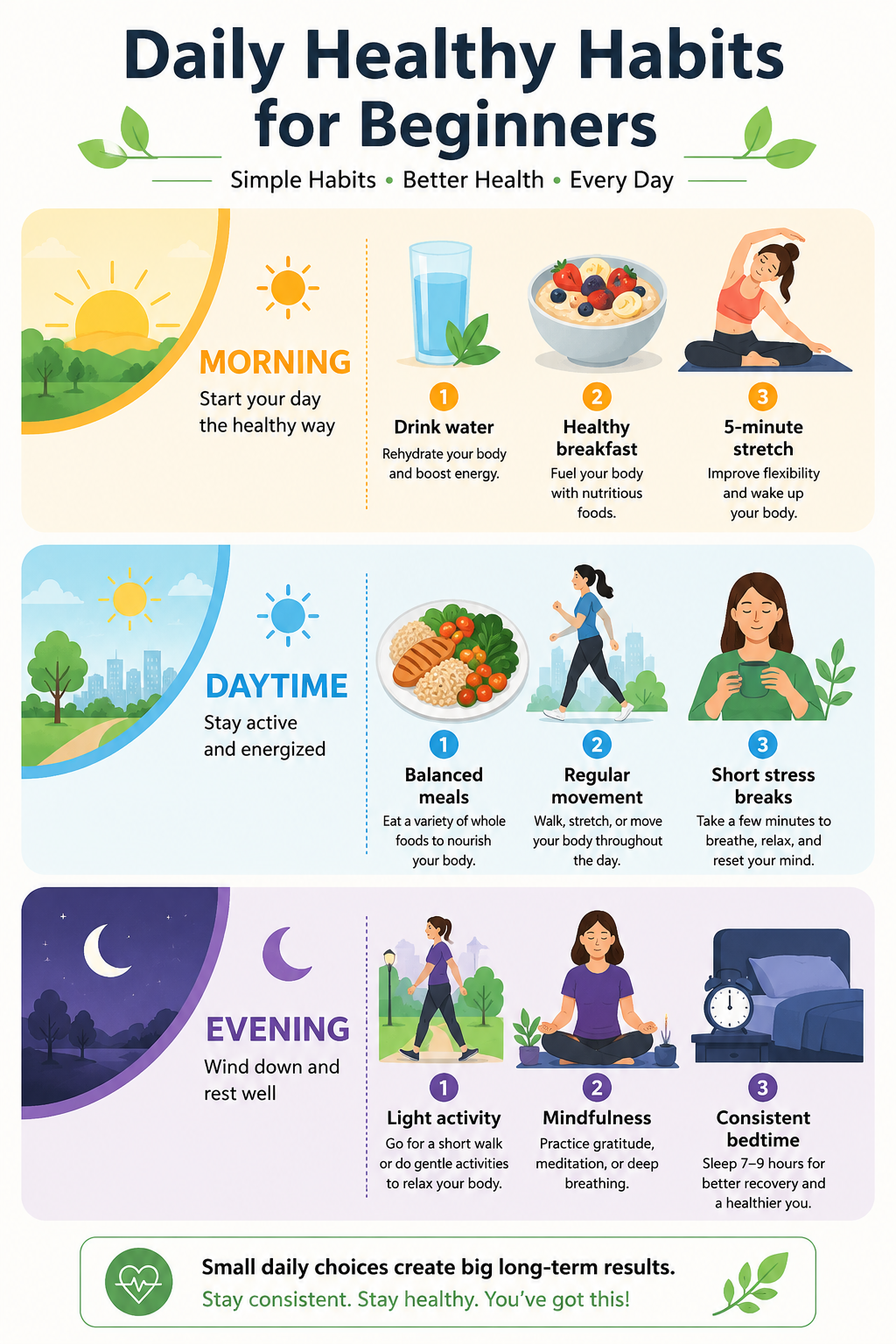
Healthy Habit Loop
| Cue | Habit | Reward |
|---|---|---|
| Wake up. | Drink a glass of water. | Feel refreshed. |
| Finish lunch. | Take a 10-minute walk. | More energy. |
| Brush your teeth. | Stretch for 5 minutes. | Reduced stiffness |
| Finish work. | Prepare tomorrow’s healthy lunch. | Less stress the next day |
1. Start Every Morning With Water
One of the simplest healthy daily habits you can build is drinking water soon after waking up.
After several hours of sleep, your body has gone without drinking fluids. Drinking water in the morning supports normal hydration and helps replace fluid lost overnight. Staying well-hydrated also assists several regular physiological functions, including temperature control and digestion. Mayo Clinic—How much water should you drink each day?
I know that in my research on hydration, many specialists don’t recommend elaborate hydration strategies for beginners. Instead, they encourage building the simple habit of drinking water consistently throughout the day.
Beginner Tip
- Keep a water bottle beside your bed.
- Drink one glass within 30 minutes of waking.
- Refill your bottle several times each day.
- Choose water instead of sugary drinks whenever possible.
Common Mistake
Waiting until you feel extremely thirsty before drinking.
2. Build Your Meals Around Whole Foods
Many beginners believe healthy eating means giving up all your favorite food.
That’s rarely necessary.
Instead, concentrate on adding nutritious foods to your balanced diet before you worry about getting rid of anything else.
Eating a balanced pattern that includes vegetables, fruits, whole grains, legumes, lean proteins, and healthy fats can supply key nutrients to help promote overall health. Harvard T.H. Chan School of Public Health – Nutrition Source
One thing I found surprising during my research is that people who successfully maintain healthy eating habits rarely describe their diet as “perfect.” They simply prepare more meals at home and make balanced choices most of the time.
Beginner Tip
Instead of removing foods immediately, add one serving of vegetables to one meal each day.
Common Mistake
Trying highly restrictive diets that are difficult to maintain.
Foods to Eat More Often
| Choose More Often |
|---|
| Vegetables |
| Fresh fruit |
| Whole grains |
| Beans and lentils |
| Lean proteins |
| Unsalted nuts |
| Plain yogurt |
| Water |
3. Keep Moving Your Body Daily
Regular activity is about far more than just physical wellness.
Physical activity helps support heart health, proper weight control, stronger muscles and bones, better sleep, and enhanced mental well-being. Centers for Disease Control and Prevention (CDC)—The Basics on Physical Activity
The good news is that you don’t need to conduct strenuous workouts to reap benefits.
Any movement is good, whether it’s walking, cycling, gardening, dancing, stretching, or climbing stairs.
In my research I discovered that people who remained active for years tended to gravitate toward things they enjoyed doing rather than force themselves to slog through workouts they did not like.
Activity Ideas for Beginners
- 20-minute stroll
- Gentle yoga
- Stretching
- Cycling
- Dance
- Gardening
- Bodyweight exercises
Beginner’s Advice
Pick something you enjoy doing rather than the exercise that burns the most calories.
Common Mistake
Starting with intense workouts that are difficult to continue.
4. Priority Quality Sleep Every Night
Many newcomers focus on eating healthier and exercising more but forget about one of the most vital healthy lifestyle habits—sleep.
Your body does many necessary things while you sleep. It helps to preserve memory, immunological function, hormone regulation, muscle repair, and general physical and mental well-being throughout this time. Getting enough sleep on a regular basis is a vital aspect of a healthy lifestyle. According to the Centers for Disease Control and Prevention (CDC)—About Sleep and Sleep Foundation, adults usually benefit from receiving adequate quality sleep every night.
In my study, I’ve found people looking for vitamins or energy boosters when the real issue is chronic bad sleep. Improving sleep patterns can make healthy eating, regular physical activity, and stress management easier.
Simple Tips for Better Sleep
- Go to bed at a set time every night.
- Wake up at the same time every day.
- Avoid screens before bedtime.
- Keep your bedroom cold, dark, and silent.
- Avoid heavy meals right before going to sleep.
Beginner’s Tip
Instead of trying to modify your whole bedtime routine at once, work on improving one sleep behavior at a time.
Typical Mistake
Not following a regular schedule and trying to “catch up” on sleep every weekend.
Healthy Evening Routine
| Time | Healthy Habit |
|---|---|
| 7:00 PM | Eat a balanced dinner. |
| 8:00 PM | Light walk or stretching |
| 9:00 PM | Reduce screen time. |
| 9:30 PM | Read a book or practice deep breathing. |
| 10:00 PM | Go to bed |
5. Learn to Manage Stress Every Day
Stress is a normal part of life.
The problem isn’t occasional stress.
It’s ongoing stress without healthy ways to manage it.
Chronic stress affects health in numerous ways, including sleep, hunger, physical activity, attention, and many other factors. Learning healthy ways to cope is good for your mental and physical health. American Psychological Association (APA) – Stress
One lesson I kept seeing during my research is that healthy people don’t necessarily avoid stressful situations.
Instead, they develop healthier responses.
Some take short walks.
Others practice breathing exercises.
Many simply schedule quiet moments during the day.
Those small routines gradually become powerful coping habits.
Simple Daily Stress Relief Ideas
- Five minutes of deep breathing.
- Short walk outside.
- Gentle stretching.
- Listening to relaxing music.
- Journaling.
- Talking with a trusted friend.
- Spending time in nature.
Beginner Tip
Schedule stress-management time like any other appointment.
Common Mistake
Waiting until you feel overwhelmed before trying to relax.
Why Small Breaks Matter
Many people believe relaxation only works if they have an entire day off.
Research and professional advice indicate that even little pauses during the day can alleviate mental weariness and boost focus. National Center for Complementary and Integrative Health (NCCIH) – Mindfulness and Meditation
I began taking five-minute rests in between long writing sessions.
Interestingly, those short breaks often helped me return with more energy and a clearer mind than if I had tried to keep going the whole time
6. Practice Mindfulness During Everyday Activities
Many beginners imagine mindfulness means sitting silently for an hour.
It doesn’t.
Mindfulness simply means paying attention to the present moment without immediately judging it.
You can practice mindfulness almost anywhere.
- While walking.
- While eating.
- While drinking water.
- While washing dishes.
In dialog.
Regular mindfulness activities have been shown to help reduce stress and enhance mental health. Meditation and Mindfulness—National Center for Complementary and Integrative Health (NCCIH)
What amazed me in my research on mindfulness was how simple it can be.
Many experienced practitioners recommend starting with only two or three minutes each day rather than attempting long meditation sessions immediately.
That advice makes the habit much easier to maintain.
Easy Mindfulness Exercises
- Notice your breathing for two minutes.
- Slowly drink a glass of water while paying attention to taste and temperature.
- Listen carefully during conversations.
- Observe your surroundings while walking.
- Eat one meal without looking at your phone.
Beginner Tip
Attach mindfulness to an activity you already do every day.
Common Mistake
Thinking your mind must become completely quiet.
Mindfulness isn’t about stopping thoughts.
It’s about noticing them without becoming controlled by them.
Habit Stacking: Make Healthy Habits Easier
One of the simplest ways to build healthy habits that last is to connect a new habit with one you already perform automatically.
Behavior researchers often call this habit stacking.
Instead of relying on memory, you allow one routine to remind you of perform another.
Habit Stacking Examples
| Current Habit | New Healthy Habit |
|---|---|
| Wake up. | Drink water. |
| Brush teeth. | Stretch for 3 minutes. |
| Finish breakfast. | Take vitamins (if recommended). |
| Finish lunch. | Walk for 10 minutes. |
| Make coffee. | Fill your water bottle. |
| Finish dinner. | Prepare tomorrow’s lunch. |
| Before bed | Practice deep breathing. |
During my research, I realized that healthy people often make routines automatic instead of depending on motivation.
That small difference makes healthy living much easier over time.
Weekly Beginner Wellness Routine
| Day | Main Focus |
|---|---|
| Monday | Drink more water. |
| Tuesday | Add one serving of vegetables. |
| Wednesday | Walk for 30 minutes. |
| Thursday | Practice mindfulness. |
| Friday | Reduce sugary drinks. |
| Saturday | Prepare healthy meals. |
| Sunday | Plan next week’s healthy habits |
Signs Your Healthy Habits Are Working
Many people expect dramatic changes after one week.
Real progress usually appears gradually.
You may notice:
- More consistent energy.
- Better sleep.
- Improved focus.
- Better mood.
- Healthier food choices are becoming easier.
- Drinking more water automatically.
- You feel less burdened by the day-to-day grind.
These small improvements can build on each other over time.
Common Mistakes Bigenners Make
Many healthy routines fail because people focus on perfection instead of progress.
Don’t make these common mistakes:
- One common mistake is trying to change all your habits at once.
- Comparison with other species
- This can come from incorrect advice on social media.
- Giving up after missing just one day is a common mistake.
- Expecting immediate results.
- Depending solely on motivation.
- Ignoring sleep while focusing only on diet.
One missed workout.
One unhealthy meal.
One stressful day.
None of these erase your progress.
Healthy living is built through consistent choices over months and years—not perfection every single day.
7. Spend More Time Outdoors Each Week
One of the easiest healthy lifestyle habits that beginners often overlook is spending time outdoors.
Fresh air, natural daylight, and green places encourage mobility and help break up lengthy spells of sitting. Being outside can also be beneficial for your mental health, especially when combined with regular physical activity. World Health Organization (WHO) – Physical Activity
There was one fascinating pattern that kept popping up in my investigation. Most folks thought they had to go to a gym or buy expensive equipment to get healthy. Yet some of the healthiest daily routines simply involved walking outside, gardening, or spending time in a nearby park.
Nature can be simple and still be beneficial.
Sometimes a short walk after dinner is enough to build a healthier routine.
Easy Ways to Spend More Time Outdoors
- Take a morning walk.
- Walk during lunch breaks.
- Garden for 20 minutes.
- Read outside.
- Walk while talking on the phone.
- Visit a local park on weekends.
Beginner Tip
Start with 10–15 minutes outdoors each day.
Common Mistake
Thinking outdoor activity only counts if it’s intense exercise.
8. Reduce Ultra-Processed Foods Gradually
Many beginners believe they need to eliminate every unhealthy food overnight.
That approach usually doesn’t last.
Instead, focus on progressively replacing processed foods with healthier options.
A healthful eating pattern includes many vegetables and fruits, whole grains and legumes, lean proteins, and healthy fats. Harvard T.H. Chan School of Public Health – Nutrition Source
One thing I learned while researching eating habits is that successful long-term changes usually happen through replacement—not restriction.
Instead of removing snacks completely
Replace chips with unsalted nuts.
Replace sugary drinks with water.
Replace pastries with fruit several days each week.
Small substitutions often become permanent habits.
Healthy Swaps
| Instead Of | Try |
|---|---|
| Sugary soda | Water with lemon |
| Potato chips | Unsalted nuts |
| Candy | Fresh fruit |
| White bread | Whole-grain bread |
| Fast food | Homemade meals |
| Sugary breakfast cereal | Oatmeal with fruit |
Beginner Tip
Replace one processed food each week instead of changing your entire diet.
Common Mistake
Thinking one unhealthy meal ruins your progress.
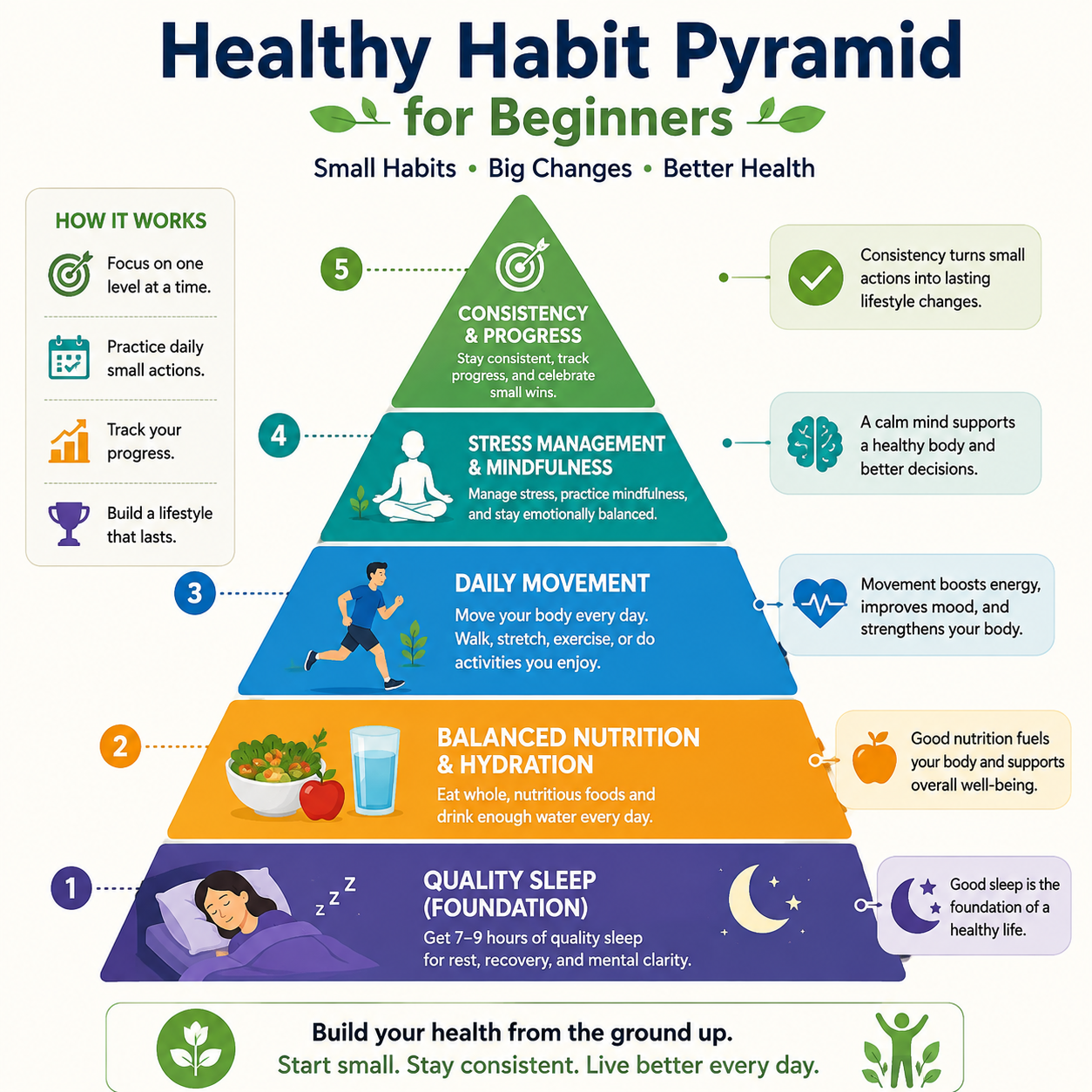
Healthy Habit Pyramid
| Level | Habit |
|---|---|
| Foundation | Sleep, hydration, balanced meals |
| Level 2 | Daily movement |
| Level 3 | Stress management |
| Level 4 | Mindfulness |
| Level 5 | Long-term consistency |
Think of this pyramid as a reminder that healthy living starts with basic daily routines rather than advanced wellness trends.
9. Develop good relationships
Taking care of your health doesn’t just mean eating right and exercising.
Supportive relationships are important as well for general well-being.
Friends, family, and co-workers can help you develop good habits and support you emotionally during hard situations.
Studies have revealed that those with positive social ties tend to have better physical and mental health. World Health Organization (WHO)
One observation I noticed while studying healthy lifestyles is that people often succeed more easily when they don’t try to make changes alone.
Walking with a friend.
Cooking meals together.
Joining a beginner yoga class can help.
Sharing progress with family.
These simple connections often improve consistency.
Ways to Build Supportive Relationships
- Walk with a friend.
- Join a local fitness group.
- Cook healthy meals together.
- Share your goals with family.
- Encourage one another to stay active.
Beginner Tip
Choose one person who supports your healthy lifestyle goals.
Common Mistake
Trying to change your lifestyle completely by yourself.
10. Track Progress, Not Perfection
Perhaps the most important healthy habit for beginners is to learn to evaluate your progress fairly..
Many people quit because they expect immediate results.
Real improvement often looks like this: Drinking more water this week than last week.
Drinking more water this week than last week.
Walking three days instead of none.
Eating vegetables more often.
Sleeping more consistently.
These small improvements matter.
In my research I observed that the most successful people tend to value consistency over perfection.
One missed workout doesn’t negate a month of training.
One bad meal doesn’t ruin weeks of healthy eating.
Progress continues as long as you keep returning to your healthy habits.
Beginner Progress Checklist
- Drinking water regularly
- Walking most days
- Sleeping consistently
- Eating balanced meals
- Managing stress
- Preparing meals at home
- Moving more often
- Building routines gradually
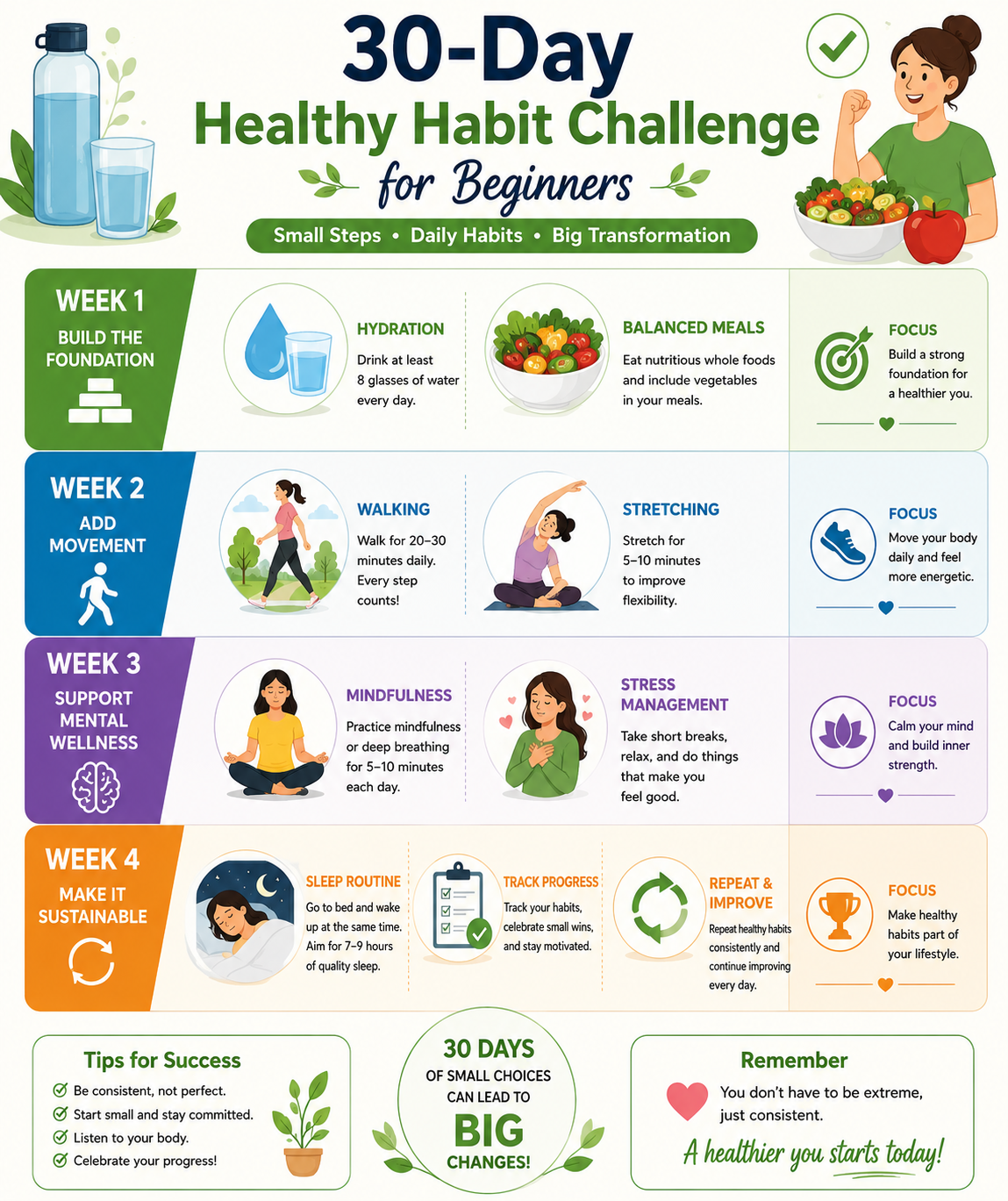
30-Day Healthy Habit Challenge
| Week | Goal |
|---|---|
| Week 1 | Drink more water every day. |
| Week 2 | Walk 20–30 minutes most days. |
| Week 3 | Eat vegetables with two meals daily. |
| Week 4 | Practice mindfulness and maintain your routine |
Small improvements repeated each week become lasting habits.
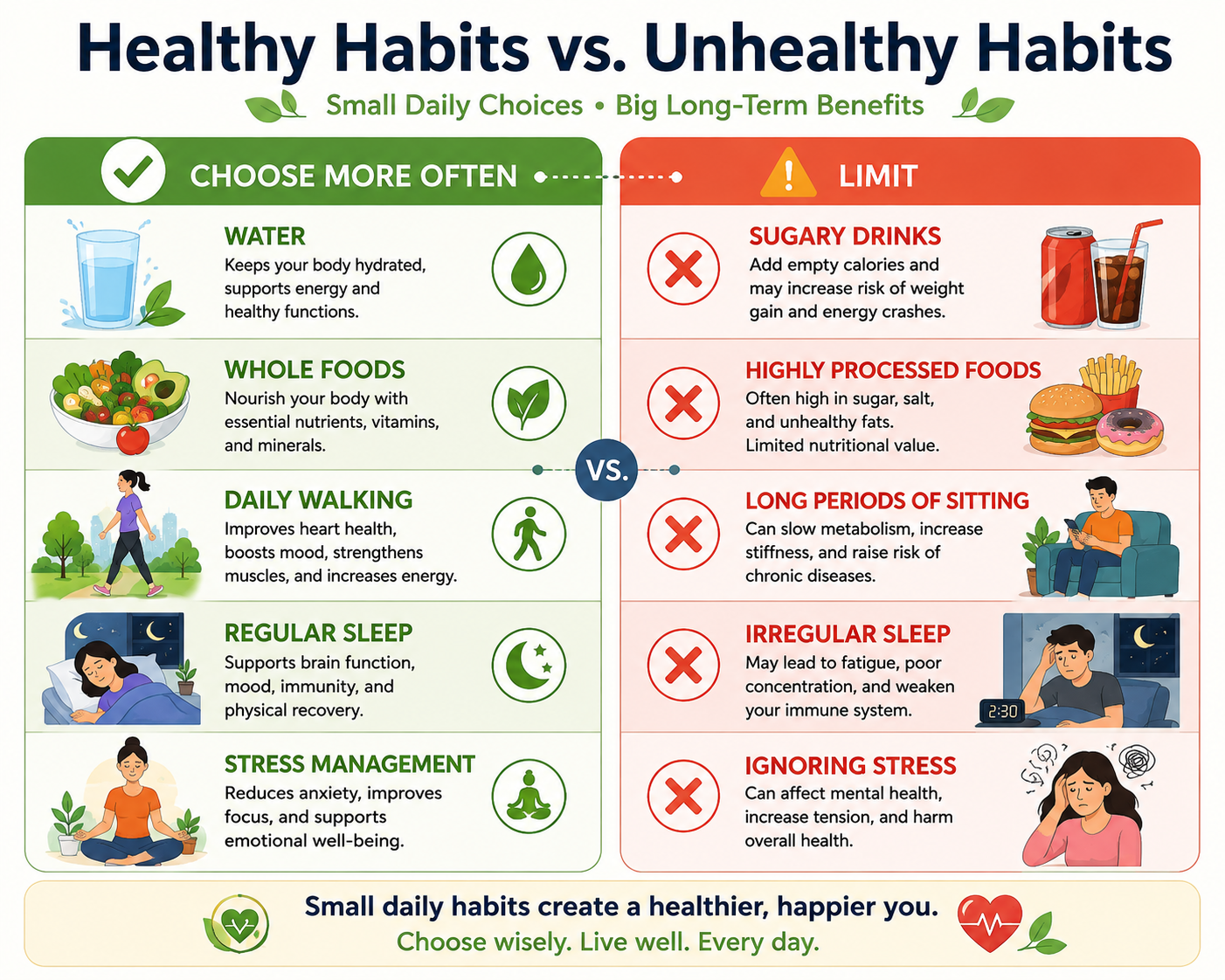
Healthy Habits vs. Unhealthy Habits
| Healthy Habit | Less Helpful Habit |
|---|---|
| Drink water regularly. | Sugary drinks all day |
| Prepare meals at home. | Frequent fast food |
| Daily walking | Sitting for long periods |
| Regular sleep schedule | Inconsistent sleep |
| Manage stress. | Ignore stress completely. |
| Whole foods | Highly processed foods |
Myths vs. Facts
| Myth | Fact |
|---|---|
| Healthy living requires expensive products. | Most healthy habits are inexpensive or free. |
| Missing one day means failure. | Consistency matters more than perfection. |
| Motivation creates lasting habits. | Daily routines build lasting habits. |
| Healthy eating must be perfect. | Balanced choices over time matter most. |
| Exercise has to be intense. | Moderate daily movement supports optimal health. |
Daily Healthy Habits Checklist
Drink enough water
Eat vegetables
Eat fruit
Walk for 20–30 minutes
Stretch
Practice mindfulness.
Reduce address routine for 7–9 hours.
Spend time outdoors
Practice gratitude
Signs Your New Lifestyle Is Working
Many changes happen gradually.
You may notice:
- More energy during the day.
- Better concentration.
- Improved sleep.
- More consistent routines.
- Healthier food choices are becoming automatic.
- Feeling less overwhelmed.
- Better mood.
- Increased confidence
One thing that amazed me in my investigation was the sheer number of people who overestimated these modest gains.
Many people anticipated radical changes within a week.
Instead, the most profound changes generally happened after months of repeating healthy habits.
That proves one essential lesson:
Healthy life is not about one flawless day.
It’s made by hundreds of modest choices, made again and again.
Research and Expert Opinion
According to previous research, long-term lifestyle choices better predict long-term health than short-term health issues or rapid remedies. The World Health Organization (WHO), Centers for Disease Control and Prevention (CDC), National Institutes of Health (NIH), and Harvard Health Publishing always talk about the importance of balanced nutrition, regular physical activity, adequate sleep, stress management, and avoiding harmful habits as the basis of good health.
During my research, one idea appeared repeatedly across trusted medical organizations: there isn’t one habit that guarantees good health. Instead, your daily routines work together. Hydration is important for activity. Sleeping well makes it easier to choose healthy foods. Exercise is good against stress. Little gains in one thing tend to lead to improvements in another.
This is why sustainable habits tend to work better than short-term interventions.
Daily Wellness Wheel
| Area | Healthy Daily Action |
|---|---|
| Hydration | Drink water regularly. |
| Nutrition | Choose mostly whole foods. |
| Movement | Walk or exercise daily. |
| Sleep | Maintain a regular sleep schedule. |
| Stress | Practice relaxation techniques. |
| Mindfulness | Stay present during everyday activities. |
| Relationships | Spend time with supportive people. |
| Prevention | Schedule routine health check-ups. |
Healthy living works best when these habits support one another rather than treating them as separate goals.
When do you need professional advice?
Healthy behaviors can help you stay well, but they are not a substitute for medical care.
See a healthcare professional if you:
- I feel constantly tired.
- Unexplained weight loss or weight gain.
- Have chronic sleep issues.
- Look for symptoms that disrupt your regular life.
- Need tailored nutrition recommendations.
- Plan to begin an exercise program after a long period of inactivity or if you have an underlying medical condition
A very essential habit of a healthy lifestyle that you might create is preventive health care.
Regular health check-ups can help spot potential health problems early and offer customized counsel. Mayo Clinic – Health & Lifestyle
Key Takeaways
- Healthy habits for beginners are not hard to do.
- Small, regular improvements often have the most long-term results.
- Water-balanced nutrition, movement, sleep, and stress management all operate in concert.
- This approach makes change more sustainable, one habit at a time.
- Skipping a day doesn’t undo your progress.
- Progress is more important than perfection.
- Long-term habits will often surpass short-term motivation.
My Personnel Reflection
As I dig deeper into evidence-based wellness, I repeatedly learn that big adjustments rarely lead to optimal health.
Rather, it stems from routinely made mundane decisions.
At first, I assumed healthier living required major sacrifices.
The more I studied trusted medical guidance, the more I realized experts kept returning to the same practical advice:
Drink enough water.
Move your body regularly.
Sleep well.
Eat balanced meals.
Manage stress.
Stay consistent.
What surprised me most was not how difficult these behaviors were, but how powerful they became when practiced consistently over time.
That experience has transformed my thinking on preventive health.
I now see enduring wellness as something that gradually develops through modest practices, not through a search for instant effects.
Conclusion
Building 10 Science-Backed Healthy Habits for Beginners to Improve Your Health Naturally doesn’t require perfection.
- You don’t need expensive equipment.
- You don’t need a complicated wellness plan.
- You don’t have to change your entire lifestyle overnight.
Instead, begin with one small habit.
Drink one extra glass of water.
Take one short walk.
Eat one healthier meal.
Go to bed a little earlier.
You can repeat those choices tomorrow.
Over time, these healthy habits last and become part of your everyday life.
Remember that each good decision, no matter how minor, is a deposit in your future health.
Start where you are.
Stay consistent.
Let healthy routines flow naturally.
Frequently Asked Questions
1. What’s the easiest healthy habit to start?
Drinking a lot of water each day is one of the easiest habits to begin. It’s simple to remember, involves little prep, and supports a lot of typical bodily functions.
2. How long does it take to form a healthy habit?
It depends on different individuals. Usually consistency is more important than striving to achieve immediate results. Doing the same thing over and over in a routine helps things become more automatic over time.
3. Does this mean I need to modify my complete lifestyle now?
No. Most experts suggest making one or two practical changes and then progressively introducing new behaviors.
4. What are the best ways to make money over the long term?
Healthy eating, regular physical activity, enough sleep, drinking plenty of fluids, managing stress, and not smoking all influence long-term health.
5. What happens if I skip a day?
Just move on to the next day. Missing one day hasn’t wiped out all your progress. Long-term consistency matters way more than short-term perfection.
6. Do good practices prevent disease?
Healthy habits contribute to lowering the risk of many chronic illnesses and enhancing overall health and well-being, but they do not guarantee disease prevention. Continue to follow your healthcare provider’s advice on screenings, vaccines, and medical care.
Similar Content










[…] 10 Science-Backed Healthy Habits for Beginners to Improve Your Health Naturally […]
[…] 10 Science-Backed Healthy Habits for Beginners to Improve Your Health Naturally […]
[…] 10 Science-Backed Healthy Habits for Beginners to Improve Your Health Naturally […]
[…] 10 Science-Backed Healthy Habits for Beginners to Improve Your Health Naturally […]
[…] 10 Science-Backed Healthy Habits for Beginners to Improve Your Health Naturally […]
[…] 10 Science-Backed Healthy Habits for Beginners to Improve Your Health Naturally […]
[…] 10 Science-Backed Healthy Habits for Beginners to Improve Your Health Naturally […]
[…] 10 Science-Backed Healthy Habits for Beginners to Improve Your Health Naturally […]
[…] 10 Science-Backed Healthy Habits for Beginners to Improve Your Health Naturally […]
[…] 10 Science-Backed Healthy Habits for Beginners to Improve Your Health Naturally […]
[…] 10 Science-Backed Healthy Habits for Beginners to Improve Your Health Naturally […]
[…] 10 Science-Backed Healthy Habits for Beginners to Improve Your Health Naturally […]
[…] 10 Science-Backed Healthy Habits for Beginners to Improve Your Health Naturally […]