






























































































































































Insomnia Treatment at Home: Evidence-Based Sleep Tips
Author: RVLNSV PRASAD
Updated On: September 2026
About Us
Author Bio
Editorial Policy
Contact Us

Introduction
- You go to bed tired.
- You close your eyes.
But sleep does not come.
Minutes turn into hours.
- You check the clock.
- You tell yourself, “I have to sleep now.”
The more you try, the more awake you feel.
Then morning arrives.
You get out of bed feeling exhausted, even though you spent hours trying to sleep.
If this sounds familiar, you are not alone. Trouble falling asleep, waking repeatedly during the night, or waking too early can make everyday life much harder. Poor sleep can affect concentration, mood, energy, work, relationships, and your ability to enjoy normal activities.
The frustrating part is that many people respond by searching for another quick solution.
A special tea.
Warm milk.
A supplement.
An oil massage.
A new sleep app.
Or simply going to bed earlier.
Some of these habits may feel relaxing, but chronic insomnia is more complicated than simply needing to relax before bed.
The good news is that there are evidence-based approaches that can help.
This guide to insomnia treatment at home explains what you can safely try yourself, which popular sleep remedies deserve caution, why consistent sleep habits matter, how cognitive behavioral therapy for insomnia (CBT-I) works, and when persistent sleep problems deserve professional evaluation.
You will also learn an important difference that many online articles miss:
Good sleep habits can support better sleep, but chronic insomnia may require structured treatment.
That distinction can save you from spending months trying one home remedy after another without addressing the underlying problem.
So instead of asking, “What can I drink tonight to make myself sleep?” a better question is
“What is keeping me awake, and what evidence-based approach can help break that pattern?”
Let’s start there.
Quick Answer
The best insomnia treatment at home is not one special drink, food, oil, or supplement. For many people, useful first steps include keeping a consistent wake time, going to bed when sleepy, reducing caffeine and alcohol near bedtime, making the bedroom comfortable for sleep, getting regular daytime activity, and addressing stress that keeps the mind active.
However, persistent insomnia may need more than sleep-hygiene advice. Cognitive behavioral therapy for insomnia (CBT-I) is a well-supported treatment for chronic insomnia and is recommended by major clinical guidelines. It can include cognitive strategies, stimulus control, relaxation techniques, and structured changes to time spent in bed.
If sleep problems continue for months, regularly affect daytime functioning, or may be caused by another medical or sleep condition, professional assessment is important.
Key Takeaways
- Insomnia can involve difficulty falling asleep, staying asleep, or waking too early.
- Short-term insomnia can occur after stress, illness, travel, schedule changes, or other disruptions.
- Chronic insomnia generally occurs at least three nights a week for three months or longer.
- A regular wake time is often more useful than simply trying to force yourself to sleep earlier.
- CBT-I is a major evidence-based treatment for chronic insomnia.
- Sleep hygiene can support treatment but should not be confused with a complete treatment for chronic insomnia.
- Caffeine, alcohol, nicotine, irregular schedules, stress, medications, pain, and other conditions can interfere with sleep.
- Sleep restriction therapy should not be improvised without appropriate guidance.
- A sleep diary can help identify patterns and provide useful information for a healthcare professional.
- Persistent insomnia deserves attention rather than endless experimentation with home remedies.
What Is Insomnia?
Insomnia is more than occasionally having a bad night.
A person with insomnia may have difficulty falling asleep, wake repeatedly during the night, wake earlier than intended and struggle to return to sleep, or experience sleep that does not feel restorative. Daytime effects can include tiredness, poor concentration, irritability, sleepiness, or difficulty functioning normally.
Short-term insomnia may develop during a stressful period or after a change in routine or environment. Chronic insomnia is generally defined as sleep difficulty occurring at least three nights per week for three months or longer.
One important point is often overlooked: insomnia can continue even when a person has enough opportunity and a suitable environment for sleep.
That is why simply telling someone to “sleep more” is not always useful.
Evidence: NHLBI: What Is Insomnia?
Common Insomnia Symptoms
Insomnia symptoms can appear differently from one person to another.
Nighttime symptoms
You may:
- Take a long time to fall asleep.
- Wake several times during the night.
- Lie awake for long periods.
- Wake much earlier than planned.
- Find it difficult to return to sleep.
- Feel that your sleep is light or poor quality.
Daytime symptoms
Poor sleep can leave you:
- Tired during the day.
- Less focused.
- Irritable or emotionally drained.
- Sleepy at inappropriate times.
- Less productive.
- Worried about whether you will sleep that night.
A useful habit is to notice both nighttime and daytime effects. Someone may underestimate their sleep problem because they focus only on the number of hours slept and ignore how the problem affects daily life.
Evidence: NHLBI: Insomnia Symptoms
What Causes Insomnia?
There is rarely one universal cause.
Insomnia may develop because of stress, anxiety, changes in routine, shift work, travel, uncomfortable sleep conditions, caffeine, nicotine, alcohol, certain medicines, pain, or another medical or sleep disorder.
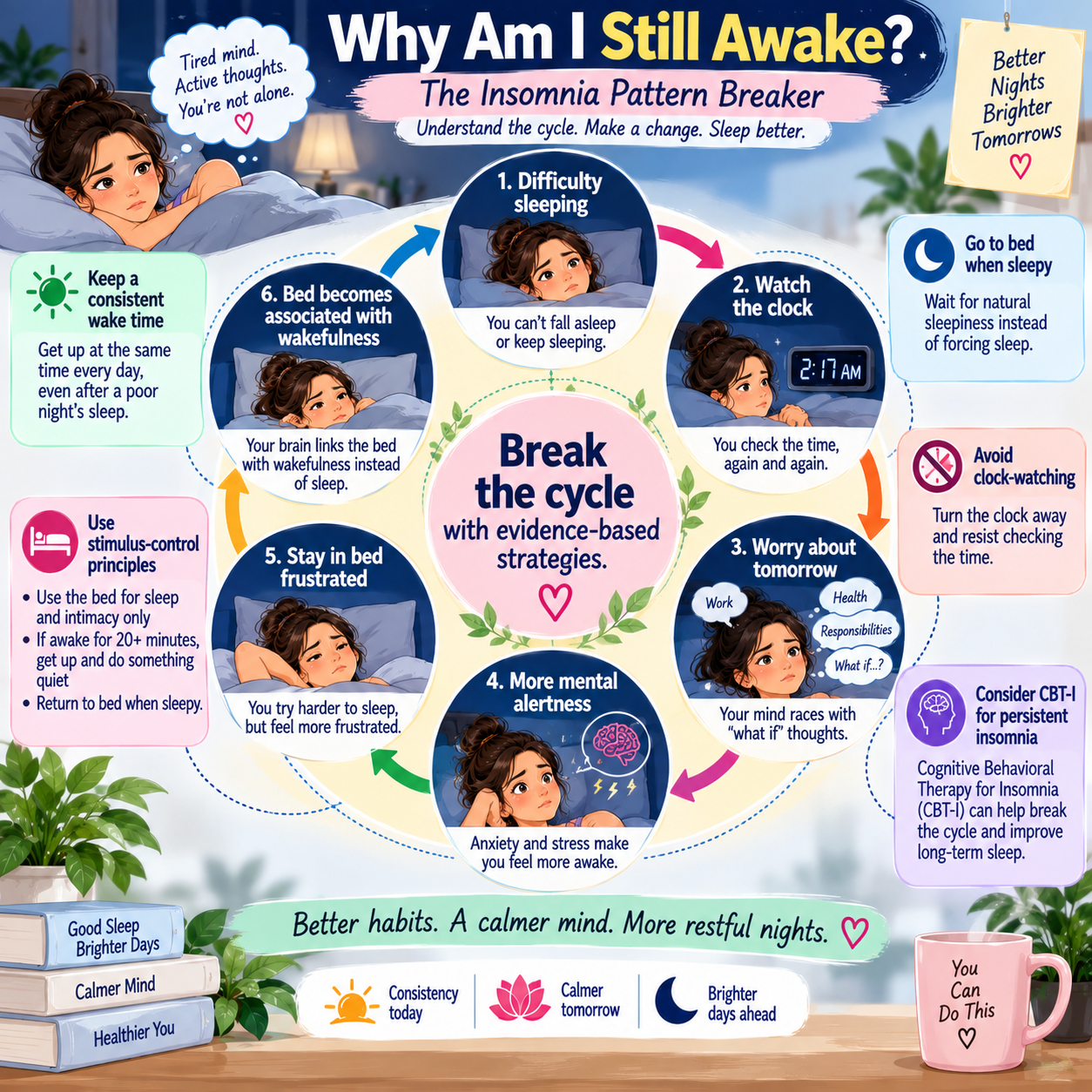
Some people also develop a cycle in which worrying about sleep makes sleep more difficult.
For example:
Poor sleep → worry about tonight → more time watching the clock → greater frustration → more difficulty sleeping
Breaking this cycle can be an important part of insomnia treatment.
Common contributors include:
Stress: Work, money, relationships, family responsibilities, or major life changes can interfere with sleep.
Irregular schedules: Frequently changing bedtime and wake time can make your sleep-wake rhythm less predictable.
Caffeine: Coffee, tea, energy drinks, cola, chocolate, and some medications can provide caffeine that remains active for hours.
Alcohol: Alcohol may make some people feel sleepy initially, but it can disrupt sleep later in the night.
Pain: Chronic pain can repeatedly wake a person.
Other sleep disorders: Snoring and interrupted breathing can point toward sleep apnea. An uncomfortable urge to move the legs may suggest restless legs syndrome.
Medications: Some medicines can interfere with sleep.
Hormonal changes: Menopause and other hormonal changes can affect sleep.
Evidence: NHLBI: Insomnia Causes and Risk Factors
Insomnia Treatment at Home: What Can You Try First?
Home strategies can be useful, especially for occasional or short-term sleep difficulties.
But they should be viewed as sleep-supportive habits, not guaranteed cures.
1. Set a Consistent Wake Time
This is one of the simplest changes to try.
Choose a wake time that you can maintain most days.
Try to keep it reasonably consistent on weekends as well.
Why focus on waking rather than simply forcing an early bedtime?
Because going to bed much earlier than your body is ready for can leave you lying awake and frustrated.
A stable wake time can help provide a more predictable daily rhythm.
2. Go to Bed When You Are Sleepy
Do not automatically get into bed simply because the clock says it is bedtime.
If you are wide awake, lying in bed for a long time can create an association between the bed and frustration.
Instead, aim to go to bed when you are genuinely sleepy while maintaining your planned wake time.
3. Make Your Bedroom Sleep-Friendly
Your bedroom does not need to look like a luxury hotel.
It needs to support sleep.
Try to keep it:
- Dark enough for comfortable sleep.
- Quiet or appropriately sound-controlled.
- At a comfortable temperature.
- Comfortable enough that bedding is not disturbing you.
- Free from unnecessary distractions.
If you regularly watch videos, scroll social media, answer work messages, or argue with people from bed, your brain can begin associating the bed with wakefulness rather than sleep.
4. Reduce Caffeine Near Bedtime
Caffeine sensitivity differs between people.
If you have difficulty sleeping, experiment with moving caffeine earlier in the day rather than assuming an evening cup will not matter.
Remember that caffeine is not limited to coffee.
It can also come from tea, energy drinks, cola, chocolate, and some medications.
5. Be Careful With Alcohol
Alcohol is sometimes used as a homemade “sleep remedy.”
That is not a good long-term strategy.
Although alcohol can initially make some people sleepy, it can produce lighter or disrupted sleep later.
If you are trying to improve insomnia, do not rely on alcohol as a sleep aid.
6. Get Regular Daytime Physical Activity
Regular physical activity can support overall health and sleep.
A simple walk, household activity, cycling, swimming, or another enjoyable form of movement can be useful.
You do not need an extreme workout plan.
If exercising very close to bedtime makes you feel more alert, move the session earlier.
7. Create a Wind-Down Period
Instead of moving directly from work, social media, or stressful conversations into bed, create a transition.
For example:
Work ends → lights become softer → relaxing activity → hygiene routine → bed when sleepy
This gives your mind a predictable signal that the active part of the day is ending.
Evidence: NHLBI: Insomnia Treatment
The Most Important Treatment for Chronic Insomnia: CBT-I
If you have been dealing with persistent insomnia, you should know about cognitive behavioral therapy for insomnia (CBT-I).
CBT-I is not simply “thinking positively.”
CBT-I is a structured treatment specifically developed for insomnia that can address unhelpful thoughts and behaviors, improve sleep timing, teach relaxation techniques, and strengthen the association between your bed and sleep.
Major clinical guidance recommends CBT-I for adults with chronic insomnia.
It can be delivered in person, by telephone, or through some online programs.
What Does CBT-I Include?
CBT-I may involve several components.
Cognitive therapy helps identify unhelpful beliefs and anxiety around sleep.
For example:
“If I don’t sleep eight hours tonight, tomorrow will be a disaster.”
A therapist may help you examine and challenge these types of thoughts.
Stimulus control aims to strengthen the connection between bed and sleep.
Relaxation techniques can help reduce physical and mental arousal.
Sleep scheduling can structure the amount and timing of time spent in bed.
These approaches are more comprehensive than simply telling someone to turn off their phone before bed.
Evidence: American Academy of Sleep Medicine guideline via PubMed
Evidence: NHLBI: CBT-I and Insomnia Treatment
A Simple Stimulus-Control Principle You Can Understand
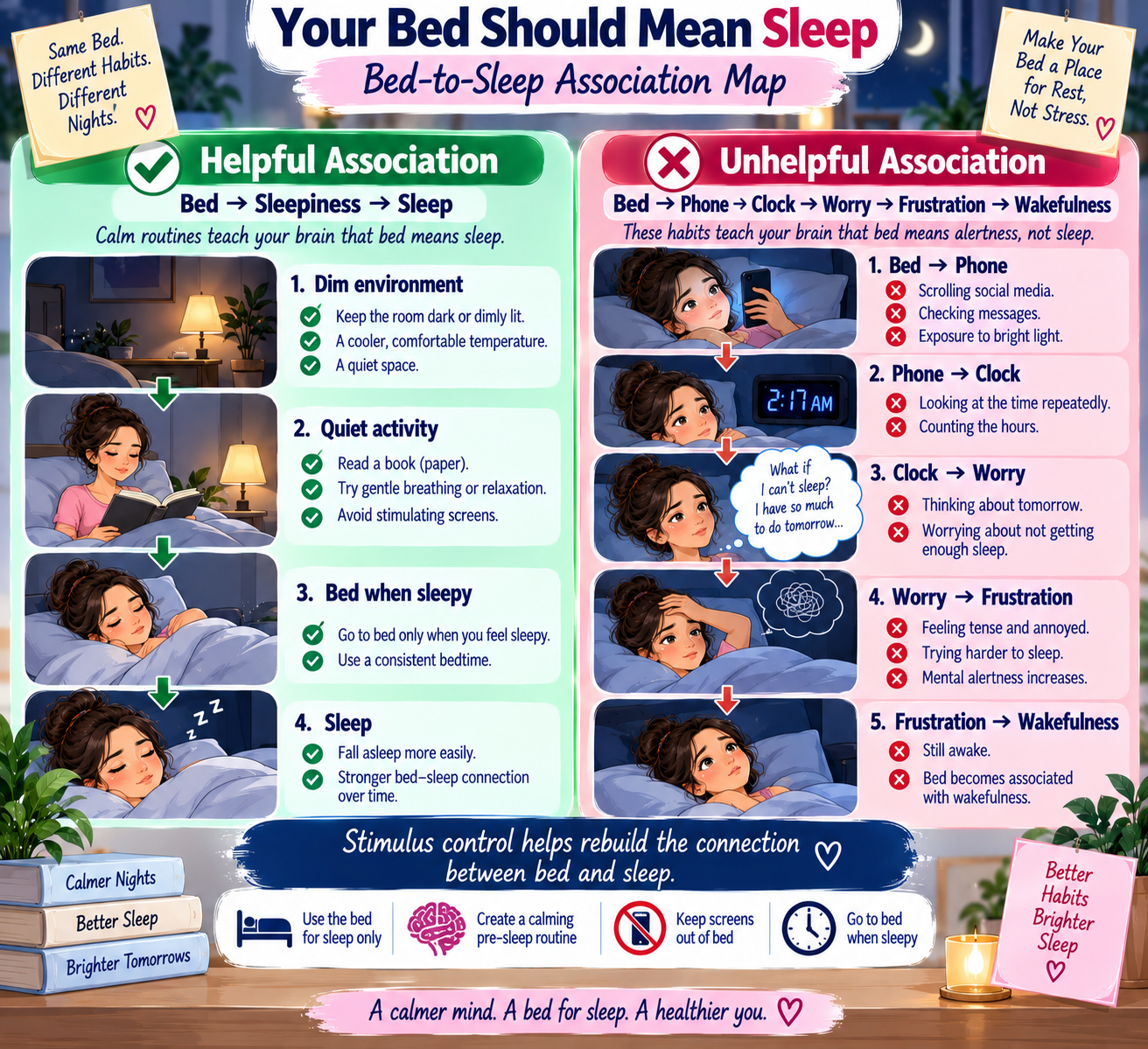
One useful concept from CBT-I is stimulus control.
The goal is to strengthen the association:
Bed → sleep
rather than:
Bed → phone + worrying + watching the clock + frustration
A typical approach may involve going to bed when sleepy and getting out of bed if you are unable to sleep, returning when sleepiness comes back.
The exact implementation can vary.
If insomnia is persistent, working with a trained professional is preferable to trying to create an intensive CBT-I program yourself.
The basic principle is simple:
Do not spend long periods awake in bed repeatedly training your brain that the bed is a place for wakefulness.
Evidence: NHLBI: Sleep Disorder Treatments
What About Sleep Hygiene?
Sleep hygiene is useful.
But there is an important distinction.
Sleep hygiene includes habits such as
- Maintaining a regular schedule.
- Limiting caffeine near bedtime.
- Making the bedroom comfortable.
- Getting daytime activity.
- Avoiding behaviors that interfere with sleep.
These habits can support better sleep.
However, sleep hygiene alone should not be presented as a complete treatment for chronic insomnia.
Clinical guidelines distinguish basic sleep-habit education from structured behavioral treatment such as CBT-I.
This is an important difference between general internet sleep advice and evidence-based insomnia treatment.
Evidence: AASM behavioral treatment guideline via PubMed
Easy At-Home Relaxation Routine
Here is a simple routine that does not require equipment.
The 5-minute “mental unload”
Before bed, take a piece of paper.
Write down:
1. What is worrying me?
Write one sentence.
2. What can I actually do about it tomorrow?
Write one small action.
3. What does not need to be solved tonight?
Write it down.
Then put the paper away.
This is not a cure for insomnia.
The purpose is to stop using your bed as a planning desk.
If your mind repeatedly returns to the same issue, remind yourself:
“I have written this down. Tomorrow is the time to act.”
This people-first approach can be especially useful for people whose main sleep problem is mental overactivity.
Another Simple Technique: The Bedroom Friction Check
Instead of buying a new sleep product, walk into your bedroom and ask:
“What here encourages me to sleep, and what encourages me to stay awake?”
Look for:
- Phone within arm’s reach.
- Bright lights.
- Work papers.
- Television.
- Uncomfortable bedding.
- Noise.
- Excessive heat.
- Clutter that creates stress.
Then remove one source of friction.
You do not have to redesign the entire bedroom.
Sometimes one small environmental change is easier to maintain than ten new habits.
Should You Use Warm Milk, Herbal Tea, or Supplements?
You may see many websites recommending foods, teas, herbs, oils, magnesium, melatonin, or other supplements as insomnia treatments.
Be careful with the word treatment.
A warm non-caffeinated drink can become part of a relaxing bedtime routine.
But that does not mean it treats chronic insomnia.
Likewise, supplements are not automatically safe simply because they are labeled natural.
Some can interact with medicines or produce side effects.
If you take prescription medicines, have a medical condition, are pregnant, or are considering regular use of a sleep supplement, discuss it with a healthcare professional.
The strongest evidence for chronic insomnia treatment is not based on a special food or drink.
It centers on behavioral and psychological approaches, particularly CBT-I.
Should You Try Sleep Restriction at Home?
This is an area where caution matters.
Sleep restriction is a component of CBT-I.
It involves carefully adjusting the amount of time spent in bed to consolidate sleep.
That does not mean you should simply decide to sleep for four hours every night.
Improperly restricting sleep can increase daytime sleepiness and may be unsafe for some people.
If you want to use sleep restriction therapy, it is better to learn the method from a qualified healthcare professional or trained CBT-I provider.
This is a good example of why evidence-based insomnia treatment is more complicated than a list of home remedies.
Keep a Sleep Diary for 1–2 Weeks
A sleep diary can reveal patterns that are difficult to remember.
For each day, record:
| What to track | Example |
|---|---|
| Bedtime | 10:45 PM |
| Approximate time you fell asleep | 11:30 PM |
| Night awakenings | 2 |
| Final wake time | 6:30 AM |
| Out-of-bed time | 6:45 AM |
| Naps | None |
| Caffeine | 2 cups before noon |
| Alcohol | None |
| Exercise | 30-minute walk |
| Daytime sleepiness | Moderate |
Do not become obsessed with calculating every minute.
The purpose is to identify patterns.
For example, you may discover that your worst nights consistently follow late caffeine, long afternoon naps, or irregular weekend sleep.
A sleep diary can also give a healthcare professional useful information when evaluating your symptoms.
Evidence: NHLBI: Insomnia Diagnosis and Sleep Diary
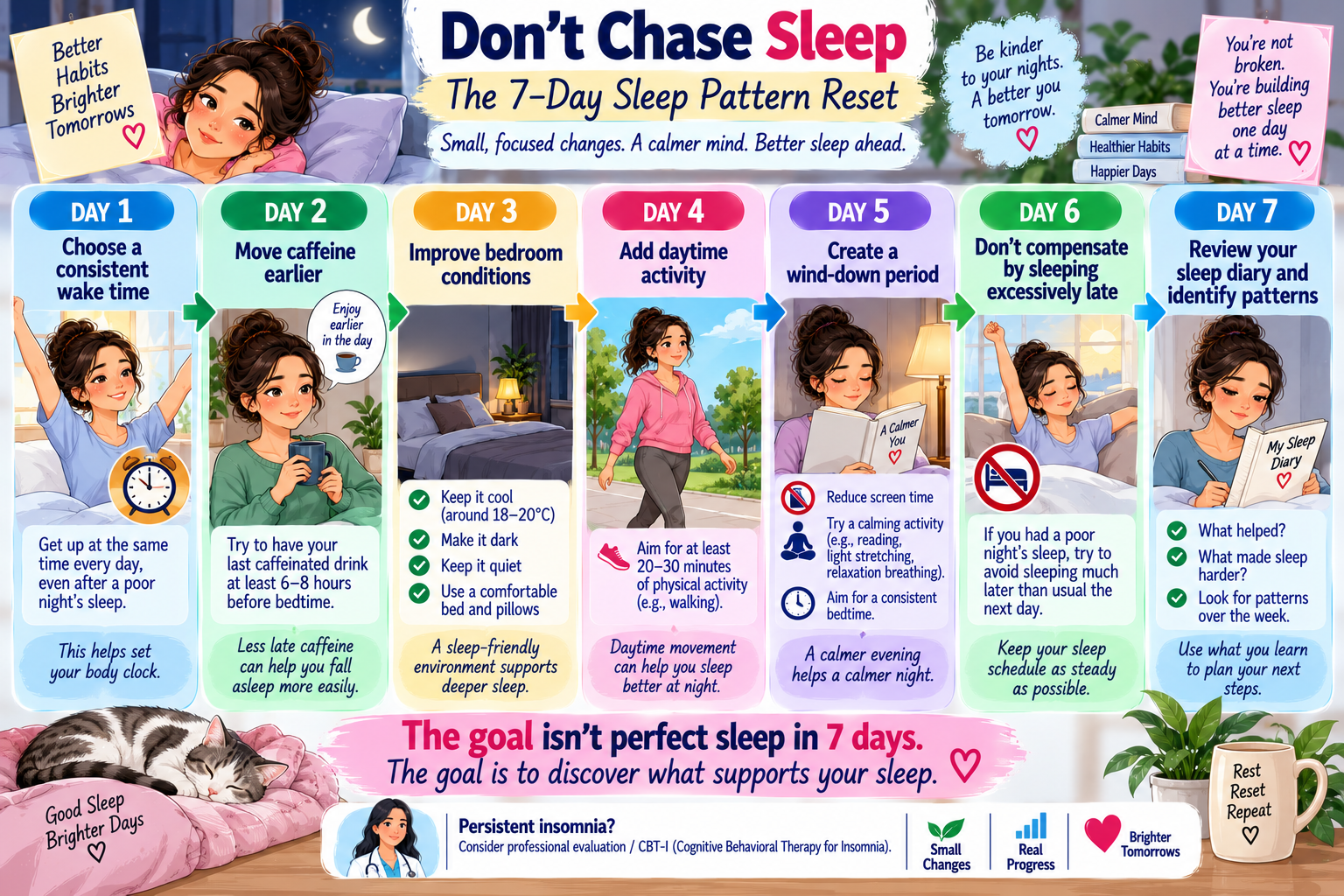
A 7-Day Insomnia Reset You Can Actually Maintain
Instead of attempting 15 changes at once, try a simple seven-day experiment.
| Day | One priority |
|---|---|
| Day 1 | Choose a consistent wake time. |
| Day 2 | Move caffeine earlier. |
| Day 3 | Improve bedroom darkness and comfort. |
| Day 4 | Add daytime physical activity |
| Day 5 | Create a 30-minute wind-down. |
| Day 6 | Keep the same wake time despite a poor night. |
| Day 7 | Review your sleep diary and identify the biggest pattern. |
The purpose is not to “cure insomnia in seven days.”
The purpose is to discover which behaviors are helping or interfering with your sleep.
If symptoms persist, move beyond self-help and consider professional evaluation.
Common Mistakes That Can Make Insomnia Worse
Mistake 1: Going to Bed Extremely Early
You may think more time in bed means more sleep.
It does not always work that way.
If you are wide awake, extra time in bed can increase frustration.
Mistake 2: Sleeping Late After a Bad Night
Sleeping much later can feel like the obvious solution.
But repeatedly changing your wake time can make your schedule less predictable.
Mistake 3: Watching the Clock
Checking the clock repeatedly can turn sleep into a performance test.
You wake up and immediately check the time, calculating how many hours of sleep you have left. As you realize how little time remains, anxiety begins to build.
Then you look again.
This can create a cycle of arousal.
Mistake 4: Using Alcohol as a Sleep Aid
Feeling sleepy after alcohol does not mean it is improving sleep quality.
Mistake 5: Taking Random Supplements
Natural does not automatically mean effective or risk-free.
Mistake 6: Treating Chronic Insomnia Only With Sleep Hygiene
Good sleep habits matter.
But chronic insomnia may need structured treatment such as CBT-I.
Mistake 7: Trying to Force Sleep
Sleep is not a task you can complete through willpower.
Trying harder can sometimes increase frustration.
Evidence: NHLBI: Insomnia Causes and Risk Factors
When Home Treatment Is Not Enough
Home strategies are reasonable for many occasional sleep problems.
But persistent insomnia should not become something you simply tolerate for years.
Consider professional help when:
- Sleep problems continue for months.
- Insomnia regularly affects your work, studies, relationships, or daily activities.
- You are excessively sleepy during the day.
- You frequently wake gasping, choking, or struggling to breathe.
- You snore loudly and have interrupted breathing.
- You experience unusual movements or sensations in your legs.
- Pain repeatedly prevents sleep.
- You suspect a medication is affecting your sleep.
- Anxiety, depression, or another mental health problem is contributing to the problem.
- Your sleep pattern has changed significantly without an obvious explanation.
Insomnia can sometimes be a symptom rather than the entire problem.
For example, sleep apnea, restless legs syndrome, pain, thyroid problems, medication effects, and mental health conditions may require their own evaluation.
Evidence: NHS: Insomnia Causes and Treatment
How Doctors Diagnose Insomnia
There is no single blood test that simply says “you have insomnia.”
A healthcare professional may ask about:
- When you go to bed.
- How long it takes to fall asleep.
- How often you wake.
- How early you wake.
- How you feel during the day.
- Your caffeine and alcohol use.
- Medicines and supplements.
- Medical conditions.
- Mental health.
- Snoring or breathing problems.
- Your sleep schedule.
A sleep diary can be particularly helpful.
In some situations, additional testing may be needed to look for another sleep disorder.
Chronic insomnia is generally characterized by symptoms occurring at least three nights per week for at least three months.
That definition does not mean you should wait three months before seeking help if the problem is already seriously affecting your life.
Evidence: NHLBI: How Insomnia Is Diagnosed
Insomnia Treatment Options Beyond Home Care
When insomnia is persistent, treatment should match the person and the underlying problem.
CBT-I
CBT-I is one of the most important evidence-based treatments for chronic insomnia.
It is structured rather than simply giving general advice.
Stimulus Control
This helps rebuild the association between bed and sleep.
Relaxation Therapy
Relaxation approaches may help reduce physical and mental arousal.
Sleep Scheduling
Structured changes to time in bed can be part of CBT-I.
Medication
Medication may be considered in some circumstances.
However, medication decisions should be individualized.
The choice depends on the type of insomnia, other health conditions, other medicines, risks, benefits, and personal preferences.
Medication should not automatically replace behavioral treatment.
A 2026 American Academy of Sleep Medicine clinical practice guideline specifically evaluated combination treatment involving CBT-I and insomnia medication for adults with chronic insomnia. It conditionally favored combination treatment over medication alone in certain circumstances, while also noting that CBT-I alone remains an important option.
Evidence: 2026 AASM Combination Treatment Guideline via PubMed
What Does the Latest Research Say About CBT-I?
The evidence base continues to support CBT-I as a central treatment for chronic insomnia.
An American Academy of Sleep Medicine clinical practice guideline gives a strong recommendation for multicomponent CBT-I in adults with chronic insomnia.
The guideline also discusses individual components such as stimulus control, sleep restriction, and relaxation therapy.
Importantly, the same guideline did not recommend sleep hygiene as a stand-alone treatment for chronic insomnia.
That distinction matters.
If you have chronic insomnia, simply buying blackout curtains, drinking herbal tea, and turning off your phone may not address the whole problem.
Those habits can be useful.
But chronic insomnia may require a structured intervention.
Evidence: AASM Behavioral and Psychological Treatments Guideline via PubMed
People-First Insight: Stop Making Sleep a Performance Test
One of the most frustrating experiences with insomnia is becoming obsessed with whether you are sleeping “correctly.”
You may start checking:
How many hours did I get?
How many times did I wake?
Why am I still awake?
Will I be exhausted tomorrow?
What if I cannot sleep again tonight?
Tracking can be useful when it helps identify patterns.
But constant checking can become another source of anxiety.
A healthier approach is to use information without allowing the information to control your night.
Your goal is not to produce a perfect sleep score.
Your goal is to build conditions that make healthy sleep more likely and seek appropriate treatment when those conditions are not enough.
A Practical Nighttime Decision Tree
If you are lying awake, ask yourself:
“Am I sleepy?”
Yes:
Stay focused on quiet sleep rather than checking the clock repeatedly.
No:
If you have been awake and frustrated for a while, consider getting out of bed and doing something quiet in dim light until you feel sleepy again.
“Is my mind racing?”
Write down the thought or tomorrow’s action.
Then return to a quiet activity.
“Am I repeatedly waking with breathing problems?”
Don’t treat that as ordinary insomnia.
Discuss it with a healthcare professional because sleep apnea or another condition may need assessment.
“Has this been happening for months?”
Move beyond endless home remedies.
Consider a professional insomnia evaluation and ask specifically about CBT-I.
Personal Experience: Keep It Honest
A health article should never invent a patient story or pretend to have clinical experience that the author does not have.
Instead of claiming:
“I treated a patient who…”
a more honest personal perspective is:
“One practical lesson from researching sleep problems is that people often try many small remedies while overlooking the bigger pattern: irregular sleep timing, stress, caffeine, excessive time awake in bed, and anxiety about sleep itself. Looking at the whole routine can be more useful than searching for one magic sleep remedy.”
That is a people-first observation without presenting fictional medical experience as fact.
Can You Treat Insomnia Naturally?
The word naturally needs some caution.
If by natural treatment you mean:
- regular daily activity,
- a consistent sleep schedule,
- reducing late caffeine,
- creating a comfortable bedroom,
- relaxation,
- reducing unnecessary nighttime stimulation,
then these can be reasonable parts of a healthy sleep routine.
But “natural” does not automatically mean “proven.”
Chronic insomnia should not be treated as a condition that can always be cured with herbal tea, essential oils, supplements, or special foods.
For persistent insomnia, evidence-based behavioral treatment is much more important.
Foods for Better Sleep: What Should You Know?
There is no single food that should be promoted as an insomnia cure.
A balanced diet supports general health, but eating a banana, drinking warm milk, or eating almonds should not be presented as a substitute for insomnia treatment.
The more useful question is:
“Does this evening habit help me relax without causing digestive discomfort, stimulation, or disrupted sleep?”
For some people, a light snack may be comfortable.
For others, eating heavily close to bedtime may be unpleasant.
Personal response matters.
What About Screen Time?
Screens can be part of the problem, but “blue light causes all insomnia” is an oversimplification.
The bigger issue may include what you are doing on the device.
A person who scrolls through stressful news, answers work messages, watches stimulating videos, or argues on social media immediately before bed may be increasing mental arousal.
Therefore, the useful question is not only:
“Is my phone producing blue light?”
Also ask:
“What is my phone making my brain do at 11:30 PM?”
If your phone repeatedly keeps you alert, create a practical boundary.
Charge it away from the bed.
Use an ordinary alarm clock if necessary.
Turn off unnecessary notifications.
Make the final part of the evening quieter.
A Better Way to Think About Insomnia Treatment at Home
Think of treatment as a ladder.
Step 1 — Identify the pattern
What exactly is happening?
Difficulty falling asleep?
Repeated awakenings?
Early waking?
Poor-quality sleep?
Daytime sleepiness?
Step 2 — Remove obvious barriers
Review caffeine, alcohol, irregular schedules, late stimulation, naps, bedroom conditions, and daytime inactivity.
Step 3 — Establish a stable routine
Especially a consistent wake time.
Step 4 — Learn evidence-based behavioral strategies
This is where CBT-I becomes important.
Step 5 — Look for underlying conditions
Persistent symptoms may require medical evaluation.
Step 6 — Consider medication when appropriate
Medication should be discussed with a healthcare professional rather than chosen randomly.
This approach is more useful than searching endlessly for another “miracle” home remedy.
Frequently Asked Questions
What is the best insomnia treatment at home?
For mild or short-term sleep difficulty, useful steps include a consistent wake time, going to bed when sleepy, reducing caffeine and alcohol near bedtime, maintaining a comfortable bedroom, getting daytime activity, and creating a relaxing evening routine. Persistent insomnia may require CBT-I or medical assessment.
Can insomnia be treated without medication?
Yes. CBT-I is an important non-drug treatment for chronic insomnia and is strongly recommended by the American Academy of Sleep Medicine for adults with chronic insomnia.
What is the fastest way to treat insomnia?
There is no guaranteed instant treatment. Trying to force sleep can increase frustration. For persistent insomnia, a structured evidence-based approach such as CBT-I is more appropriate than repeatedly changing home remedies.
Does warm milk cure insomnia?
No. Warm milk may be part of a relaxing routine for some people, but it should not be presented as a proven cure for chronic insomnia.
Is herbal tea good for insomnia?
A caffeine-free herbal drink may be relaxing for some people, but herbal tea should not be considered a replacement for evidence-based insomnia treatment.
How many hours of sleep do adults need?
Sleep needs vary. The NHS states that adults generally need around 7–9 hours on average, although individual needs differ.
When should I see a doctor for insomnia?
Seek professional advice when sleep problems persist, significantly affect daytime functioning, or occur with symptoms such as breathing interruptions, severe daytime sleepiness, significant mood problems, persistent pain, or other concerning symptoms.
What is CBT-I?
CBT-I means cognitive behavioral therapy for insomnia. It is a structured treatment that can address thoughts, behaviors, sleep timing, stimulus control, relaxation, and other factors that maintain insomnia.
Can stress cause insomnia?
Yes. Stress and worrying can contribute to insomnia. In some people, worry about not sleeping can itself become part of the cycle that keeps insomnia going.
Should I use sleeping pills?
Do not start or stop sleep medication without discussing it with a healthcare professional. Medication decisions depend on the individual and should consider benefits, risks, other medicines, and underlying conditions.
Final Checklist: Your At-Home Insomnia Plan
Before searching for another sleep remedy, check these basics:
- ☐ I have a reasonably consistent wake time.
- ☐ I avoid relying on alcohol to make me sleepy.
- ☐ I have reviewed my caffeine timing.
- ☐ My bedroom is comfortable for sleep.
- ☐ I get some physical activity during the day.
- ☐ I have a calming transition before bed.
- ☐ I avoid spending long periods awake and frustrated in bed.
- ☐ I am not constantly checking the clock.
- ☐ I have considered keeping a sleep diary.
- ☐ I know when to seek professional help.
- ☐ If insomnia is chronic, I have considered CBT-I rather than relying only on sleep-hygiene tips.
Author Note
By RVLNSV PRASAD
This article is intended to provide practical, evidence-based health information in simple language. It focuses on helping readers understand insomnia, identify common sleep barriers, and recognize when self-care is no longer enough.
The article has been updated to reflect current guidance and clinical evidence, including information from the National Heart, Lung, and Blood Institute and published insomnia treatment guidelines.
Medical Disclaimer
This article is for educational purposes only and is not a substitute for diagnosis, treatment, or personalized medical advice from a qualified healthcare professional.
Insomnia can sometimes be related to another medical condition, medication, mental health condition, or sleep disorder. If sleep problems persist or significantly affect your daily life, speak with a doctor or qualified sleep professional.
Do not start, stop, or change prescription medicines based solely on information in this article.
Fitness Disclaimer
Physical activity can support overall health and may support healthy sleep, but exercise is not a guaranteed treatment for insomnia.
Choose activities appropriate for your fitness level and health status. If you have a medical condition, significant symptoms, or concerns about exercising, consult an appropriate healthcare professional before starting a new exercise program.
Conclusion
The best insomnia treatment at home is not a single magic remedy.
It is a practical combination of behaviors that support healthy sleep, together with evidence-based treatment when insomnia becomes persistent.
Start with the basics.
Keep your wake time consistent.
Reduce late caffeine and alcohol.
Make your bedroom comfortable.
Get daytime activity.
Create a quiet transition into bedtime.
Avoid turning your bed into a place for worrying, scrolling, or watching the clock.
Most importantly, understand the difference between sleep hygiene and actual insomnia treatment.
If insomnia becomes chronic, CBT-I deserves serious consideration. It has strong support in clinical guidelines and is more comprehensive than simply collecting home remedies.
And if your sleep problem may be caused by another condition, don’t keep experimenting indefinitely.
Sometimes the most effective sleep improvement begins with finding out why you are not sleeping well in the first place.
Sources
- NHLBI: Insomnia Treatment
- NHLBI: Insomnia Diagnosis
- NHLBI: Insomnia Causes and Risk Factors
- NHLBI: Insomnia Symptoms
- NHS: Insomnia
- AASM Behavioral and Psychological Treatment Guideline — PubMed
- 2026 AASM Combination Treatment Guideline — PubMed
- American College of Physicians Insomnia Guideline — PubMed
Related Topics
- How to Achieve Balance Holistic Wellness Practices
- 4 Diseases Associated With Eczema Treatment
- Category holistic wellness
- Simple Habits for Better Sleep at Night: A Comprehensive Guide
- 13 Effective Tips on How to Get Sleep Quickly
- 10 Best Herbal Teas for Calming the Mind:A Comprehensive Guide Natural Stress Relief
- 9 Benefits Of Regular Exercise And Fitness







[…] Insomnia Symptoms Treatment […]
[…] Insomnia Symptoms Treatment […]