




































































































































































12 Dynamic Yoga Poses for Sustainable Weight Management: A Practical Guide
Author: RVLNSV PRASAD
Updated On: September 2026
About Us
Author Bio
Editorial Policy
Contact Us
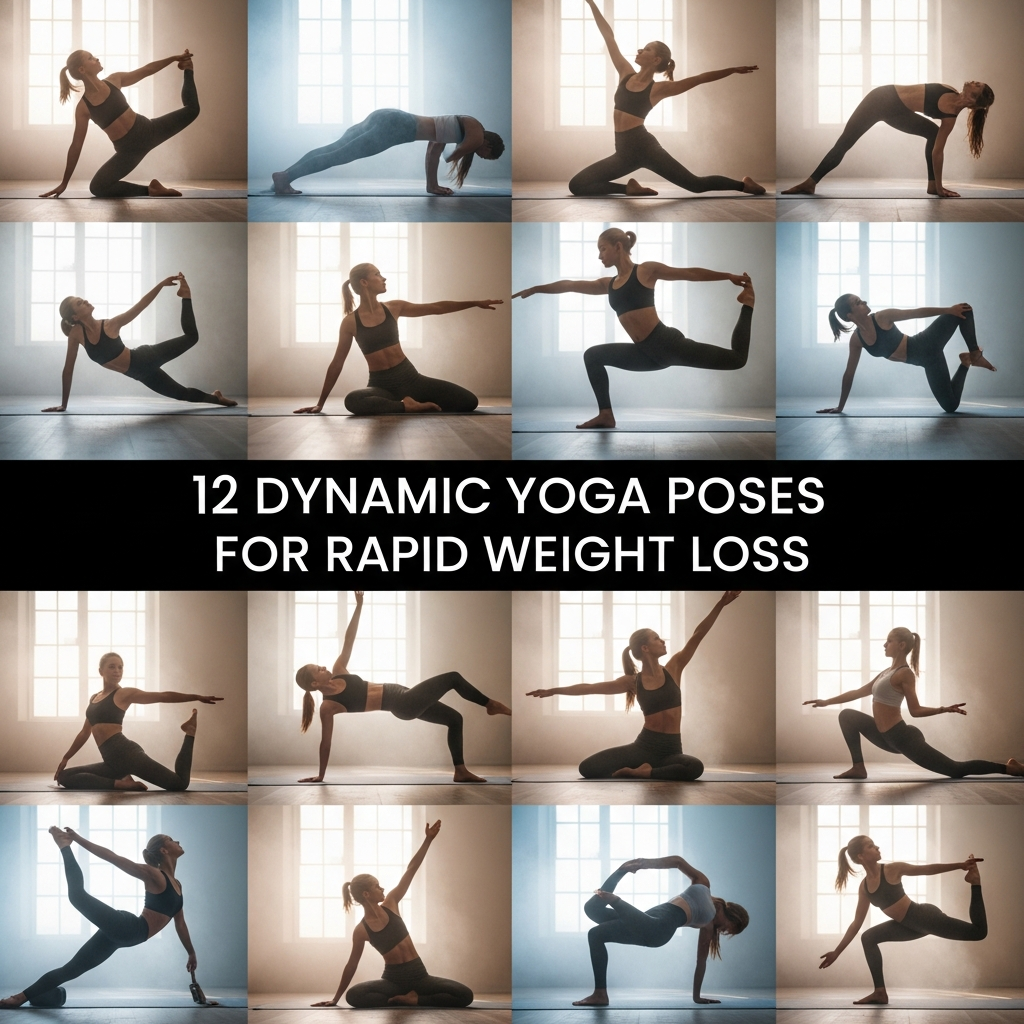
Quick Answer
Dynamic yoga poses for sustainable weight management can support an active lifestyle by helping improve strength, mobility, balance, coordination, and movement consistency. However, no single yoga pose can specifically burn belly fat or guarantee rapid weight loss. Research on yoga and direct weight-loss outcomes is mixed, while evidence suggests yoga may provide broader health and physical-activity benefits. NCCIH: Yoga Effectiveness and Safety
For better results, use yoga as one part of a broader routine that can include regular walking or other aerobic activity, muscle-strengthening exercise, nutritious eating, adequate sleep, and realistic long-term goals. The CDC recommends adults get at least 150 minutes of moderate-intensity aerobic activity each week plus muscle-strengthening activity on at least 2 days. CDC: Physical Activity Guidelines for Adults
Introduction
Dynamic yoga poses for sustainable weight management can be a useful part of an active lifestyle, but they should not be treated as a shortcut to rapid fat loss.
That distinction is important because many online articles reduce yoga and weight loss to a simple formula: perform a certain pose, burn calories, lose belly fat, repeat. Real weight management is considerably more complicated.
Your body weight is influenced by food intake, physical activity, sleep, medications, health conditions, genetics, environment, and other factors. The Centers for Disease Control and Prevention’s guidance on healthy weight emphasizes sustainable behaviors and regular physical activity rather than relying on one exercise or one short-term strategy.
Research on yoga itself is also more nuanced than many fitness articles suggest. A systematic review and meta-analysis of 30 trials involving 2,173 participants did not find consistent overall effects on body weight, BMI, body-fat percentage, or waist circumference, although some subgroup findings suggested potential benefits and the researchers noted important limitations in the evidence. PubMed: Yoga and Weight-Related Outcomes
At the same time, newer evidence should not be ignored. A 2026 systematic review and meta-analysis of randomized controlled trials involving adults with higher weight or obesity found that yoga was associated with improvements in several cardiometabolic measures, particularly blood pressure, although some outcomes remained uncertain. PubMed: Yoga and Cardiometabolic Health
So this article takes a different approach.
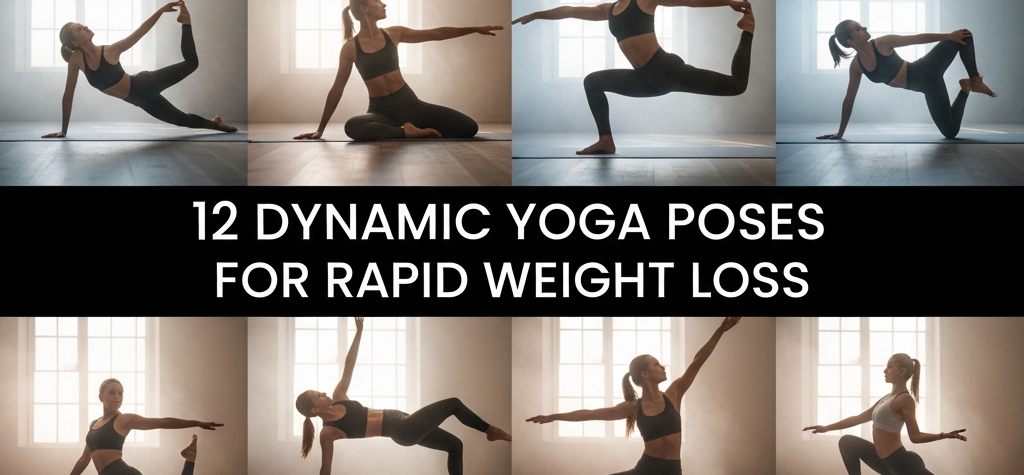
Instead of promising that one pose will “melt belly fat,” we will look at how 12 dynamic yoga poses can contribute to strength, mobility, balance, movement capacity, consistency, and an overall weight-management routine.
That is a more realistic question for someone who wants an exercise habit they can continue for months rather than something they can tolerate for three days.
Key Takeaways
- Yoga can be a useful component of a broader weight-management strategy.
- No individual yoga pose can selectively remove abdominal fat.
- Dynamic sequences can make a yoga session more physically active than purely restorative practice.
- Yoga can contribute to strength, mobility, balance, coordination, and movement confidence.
- Some yoga postures can count as muscle-strengthening activity. CDC: What Counts as Physical Activity for Adults
- Weight management should not depend on yoga alone.
- Combining yoga with walking, aerobic activity, resistance exercise, nutritious eating, adequate sleep, and realistic goals creates a more complete approach.
- Beginners should progress gradually rather than chasing difficult poses or long sessions.
- Yoga is generally considered safe when practiced appropriately, but injuries can occur. NCCIH: Yoga Effectiveness and Safety
- Sustainable progress is more useful than promising rapid results.
What Makes These Yoga Poses Different From a Typical Weight-Loss List?
Most “best yoga poses for weight loss” articles focus heavily on the number of calories supposedly burned by each pose.
That approach creates two problems.
First, calorie expenditure varies between people according to body size, movement intensity, duration, fitness level, and other factors.
Second, it encourages readers to think of exercise only as a way to erase calories from food.
A better framework is to ask what a movement actually contributes to physical capacity.
For this guide, each pose is considered according to five practical roles:
| Movement role | What it develops |
|---|---|
| Strength | The ability of muscles to produce and sustain force |
| Mobility | Comfortable movement through available joint ranges |
| Balance | Control of the body during changing positions |
| Coordination | Ability to organize several body parts together |
| Movement endurance | Ability to continue activity without excessive fatigue |
This framework makes the article more useful because you can understand why a pose belongs in your routine rather than simply being told that it “burns fat.”
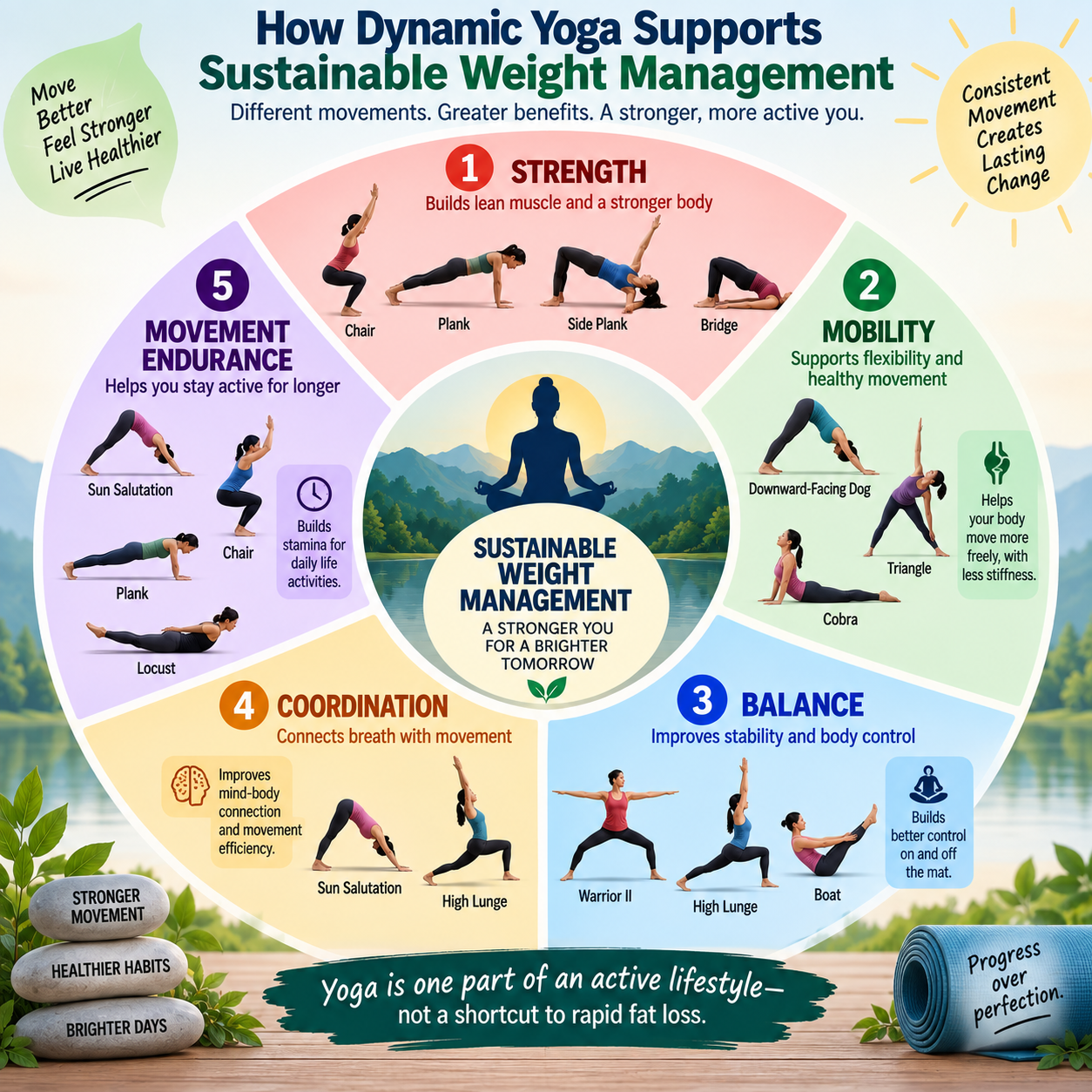
12 Dynamic Yoga Poses for Sustainable Weight Management
1. Sun Salutation: Build Whole-Body Movement Flow
The sun salutation, commonly called Surya Namaskar, is a sequence of linked movements rather than a single posture.
Depending on the variation, it can involve standing, forward folding, plank-like positions, controlled lowering, back extension, and returning to standing.
That makes it useful when you want to turn several yoga movements into a continuous practice.
What it can train:
- Whole-body coordination
- Movement transitions
- Muscular endurance
- Mobility
- General movement tolerance
For beginners, start slowly.
Rather than immediately performing many rounds, concentrate on learning the sequence and coordinating breathing with movement.
Once the sequence becomes familiar, you can gradually increase the duration or number of rounds.
Do not assume that a specific number of rounds equals a guaranteed calorie burn. Energy expenditure differs substantially between individuals, and the research does not support presenting Sun Salutation as a guaranteed rapid-weight-loss technique. PubMed: Yoga and Weight-Related Outcomes
2. Chair Pose: Build Lower-Body Strength
Chair Pose, or Utkatasana, resembles a controlled squat.
It places considerable demand on the muscles of the lower body while requiring you to maintain trunk control.
What it trains:
- Quadriceps
- Gluteal muscles
- Lower-body endurance
- Postural control
- Balance
A beginner does not need to lower deeply.
Start with a comfortable bend and gradually increase the challenge as your strength improves.
You can also practice the movement near a stable support if balance is a concern.
The goal is not to make the pose look dramatic.
The goal is to develop usable strength.
3. Warrior II: Combine Strength and Stability
Warrior II, or Virabhadrasana II, is a standing posture that combines lower-body effort with balance and trunk control.
It can become particularly useful when incorporated into a sequence with other standing movements.
What it trains:
- Leg endurance
- Hip stability
- Balance
- Postural awareness
- Controlled breathing during effort
Hold the pose only as long as you can maintain good alignment.
Instead of forcing a long hold, try shorter controlled periods on each side.
Over time, the movement can become part of a more dynamic yoga routine for weight management.
4. High Lunge: Challenge One Side at a Time
High lunge introduces an asymmetrical position in which one leg works differently from the other.
That changes the balance and stability demands compared with symmetrical standing poses.
What it trains:
- Lower-body strength
- Hip mobility
- Balance
- Coordination
Beginners can shorten the stance or lower the back knee.
There is no benefit in choosing a difficult variation simply because it looks more advanced.
A movement that you can perform consistently is more useful than one you can barely control.
5. Plank Pose: Develop Trunk and Upper-Body Control
Plank is commonly included in dynamic yoga sequences because it requires the body to maintain a stable position while supporting weight through the hands and feet.
What it trains:
- Abdominal and trunk endurance
- Shoulder stability
- Arm strength
- Whole-body control
A shorter, technically sound hold is preferable to a long hold in which your lower back begins to sag.
Beginners can perform a modified plank with the knees supported.
The CDC recognizes body-weight movements and some yoga postures as possible muscle-strengthening activities. CDC: What Counts as Physical Activity for Adults
That does not mean every yoga session automatically satisfies all strength-training recommendations.
It simply shows why some yoga movements can have a genuine strengthening role.
6. Side Plank: Add Lateral Stability
Side plank provides a different challenge from a traditional plank.
Your body must stabilize itself while positioned sideways, requiring coordinated work from the trunk, shoulder, and lower body.
What it trains:
- Lateral trunk stability
- Shoulder control
- Balance
- Coordination
A modified version with the lower knee on the floor is a useful starting point.
You can gradually progress toward a longer-leg variation when your strength and balance improve.
Do not force the movement if your shoulder or wrist becomes painful.
7. Boat Pose: Train Controlled Core Work
Boat Pose, or Navasana, is often promoted online as an exercise for “burning belly fat.”
That wording needs correction.
The pose can challenge abdominal and hip-flexor muscles, but strengthening the abdominal region does not mean you can selectively remove fat from that area.
What it trains:
- Trunk endurance
- Balance
- Hip-flexor strength
- Body control
Beginners can keep their knees bent and feet closer to the floor.
You can also reduce the duration of the hold.
The objective is controlled muscle work rather than an exaggerated posture.
8. Bridge Pose: Include the Back Side of the Body
Bridge Pose, or Setu Bandhasana, is valuable because it shifts attention toward the posterior side of the body.
The movement involves lifting the hips while keeping the feet grounded.
What it trains:
- Gluteal strength
- Hip extension
- Posterior-chain endurance
- Trunk control
Avoid trying to lift the hips as high as possible.
A smaller, controlled movement may be more appropriate for a beginner.
Anyone with significant back or hip pain should discuss appropriate exercise choices with a healthcare professional.
9. Downward-Facing Dog: Combine Mobility and Weight Bearing
The downward-facing dog can function as both a posture and a transition within a sequence.
It places the upper body in a weight-bearing position while encouraging movement through the hips and back of the legs.
What it can develop:
- Shoulder and arm endurance
- Hip mobility
- Posterior-chain flexibility
- Movement coordination
Do not worry about forcing the heels toward the floor.
Bending your knees may make the posture more comfortable and allow you to focus on maintaining a stable position.
10. Triangle Pose: Improve Control and Mobility
Triangle Pose, or Trikonasana, provides a different movement pattern from the more strength-oriented postures.
It combines standing stability, hip mobility, trunk positioning, and balance.
What it trains:
- Hip mobility
- Balance
- Trunk control
- Lower-body stability
A yoga block can be useful if reaching toward the floor causes you to twist excessively.
The block is not a sign that you are doing the pose incorrectly.
It is simply a tool for adjusting the movement to your current ability.
11. Cobra Pose: Add Controlled Spinal Extension
Cobra Pose can complement forward-folding and weight-bearing movements by introducing controlled spinal extension.
What it can train:
- Spinal movement awareness
- Chest and shoulder mobility
- Controlled extension
You do not need to push your chest dramatically upward.
A smaller range may be appropriate.
If the movement produces sharp or persistent pain, stop rather than attempting to stretch through it.
12. Locust Pose: Strengthen the Posterior Chain
Locust Pose, or Salabhasana, is less frequently included in generic online weight-loss lists.
That is precisely why it deserves consideration.
Rather than focusing exclusively on abdominal exercises, Locust encourages controlled work through the posterior body.
What it trains:
- Back-body endurance
- Glute activation
- Trunk control
- Shoulder positioning
Start with a small lift.
There is no requirement to raise the arms and legs as high as possible.
Quality matters more than height.
How Yoga Actually Fits Into Weight Management
This is the part that many short articles leave out.
A list of poses cannot create a complete weight-management strategy by itself.
Physical activity is only one part of the picture.
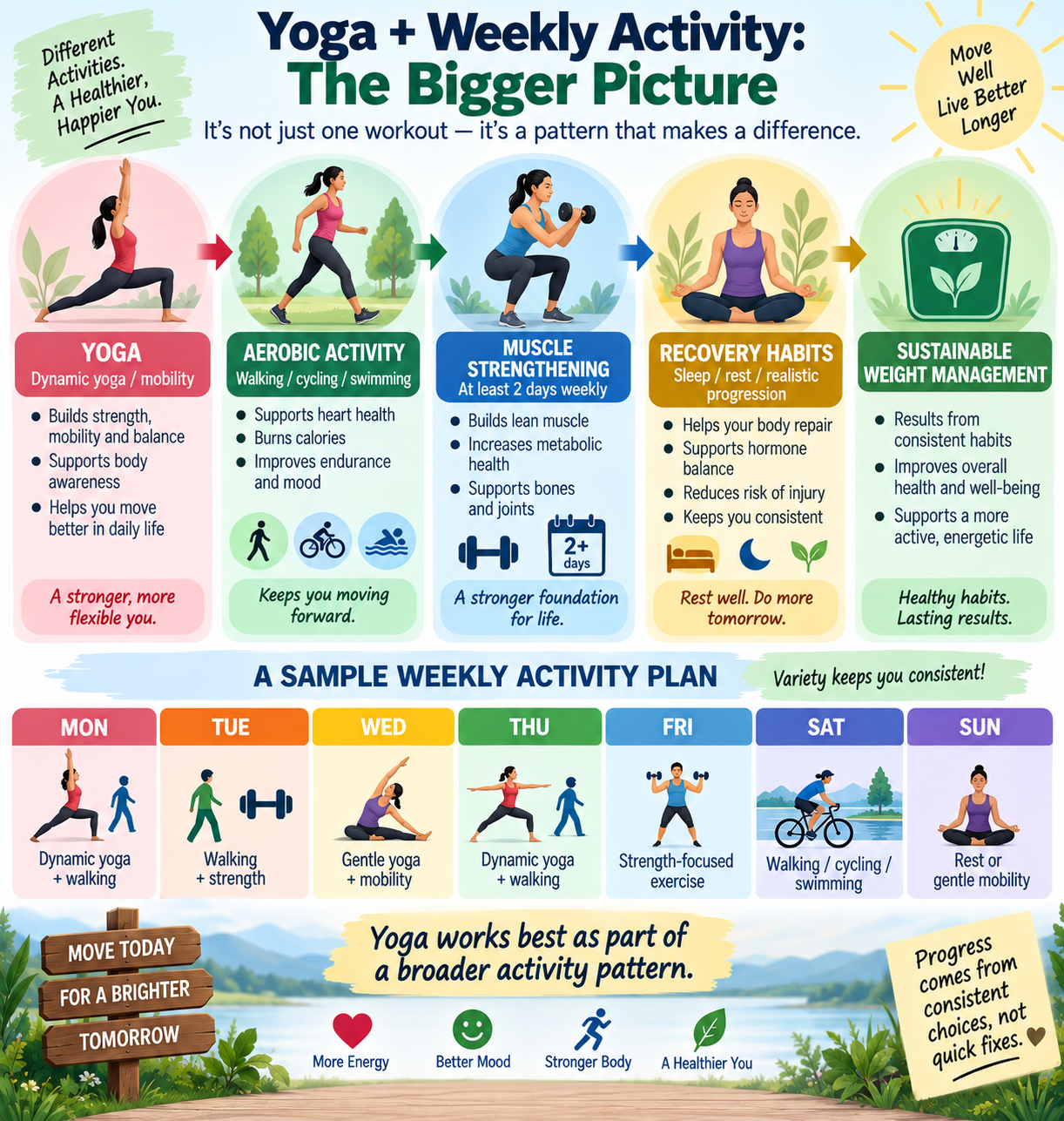
The CDC recommends that adults generally aim for at least 150 minutes of moderate-intensity aerobic activity each week, together with muscle-strengthening activity on at least 2 days per week. CDC: Physical Activity Guidelines for Adults
That does not mean you need to spend hours doing yoga.
Instead, yoga can occupy one part of your weekly activity pattern.
For example:
| Day | Example movement |
|---|---|
| Monday | Dynamic yoga + short walk |
| Tuesday | Brisk walking + strength training |
| Wednesday | Gentle yoga and mobility |
| Thursday | Dynamic yoga + walking |
| Friday | Strength-focused exercise |
| Saturday | Longer walk, cycling, swimming, or recreation |
| Sunday | Rest or gentle mobility |
This is an example rather than a medical prescription.
Your actual routine should reflect your fitness, health, schedule, preferences, and recovery.
A 20-Minute Yoga Routine for Beginners
If you are new to yoga, you do not need to begin with a 60-minute workout.
Try building a 20-minute session around movement quality.
# Minutes 1–3: Preparation
- Easy standing
- Shoulder circles
- Gentle trunk movement
- Comfortable breathing
4–8 Minutes: Dynamic movement
- Sun Salutation
- Chair Pose
- Warrior II
- High Lunge
9–13 Minutes: Strength-focused section
- Plank
- Modified Side Plank
- Boat Pose modification
- Bridge Pose
14–17 Minutes: Mobility and control
- Downward-Facing Dog
- Triangle Pose
- Cobra Pose
18–20 Minutes: Posterior-chain and recovery work
- Locust Pose
- Comfortable standing
- Slow breathing
The purpose is not to complete an impressive workout.
The purpose is to create a routine that you can repeat.
Why a Short Routine Can Be More Useful Than an Extreme Workout
One of the biggest practical mistakes in exercise planning is making the starting point too difficult.
Someone may begin with a demanding one-hour workout, feel exhausted afterward, experience soreness, skip the next session, and eventually stop exercising altogether.
A 15- or 20-minute routine may seem less impressive.
But if it is repeated four times a week, it becomes part of your lifestyle.
The CDC’s weight-management guidance emphasizes sustainable behaviors and regular physical activity rather than relying on extreme short-term methods. CDC: Steps for Losing Weight
That principle is especially important for beginners.
What Does “Dynamic” Actually Mean?
The word “dynamic” is sometimes used simply as a marketing term.
In this article, it has a practical meaning.
A dynamic yoga practice involves movement between positions rather than spending the entire session in long static holds.
Examples include:
- Moving from chair pose into standing
- Transitioning between warrior positions
- Repeating Sun Salutations
- Moving between Plank and Downward-Facing Dog
- Linking lunge variations
- Using controlled repetitions
The result can be a more active session.
However, “dynamic” does not automatically mean “high calorie burn.”
Intensity still depends on the pace, duration, movement selection, individual fitness, and how continuously the sequence is performed.
Can Yoga Alone Cause Weight Loss?
Possibly for some people, but it should not be presented as a guaranteed outcome.
Research has produced mixed results.
The 2016 systematic review found no consistent overall effects on several major weight-related measures. PubMed: Systematic Review of Yoga and Weight-Related Outcomes
A separate systematic review examining energy balance found limited evidence that yoga might reduce energy intake or increase physical activity, but the researchers emphasized that more objective research was needed. PubMed: Yoga and Energy Balance
Meanwhile, NCCIH summarizes evidence suggesting yoga may help some people lose weight, particularly when practices are longer, more frequent, sustained over several months, and combined with dietary components or home practice. NCCIH: Yoga Effectiveness and Safety
The most responsible conclusion is therefore
Yoga may support weight management, but it should not be marketed as a guaranteed rapid-weight-loss treatment.
What About Belly Fat?
This is one of the most common questions people have.
The answer is straightforward:
You cannot choose exactly where your body loses fat by choosing a particular exercise.
Boat Pose does not selectively remove abdominal fat.
Plank does not selectively remove abdominal fat.
Twisting poses do not selectively remove abdominal fat.
These movements can strengthen muscles and contribute to physical activity, but changes in body fat distribution occur through broader physiological processes.
So if an article promises that one yoga pose will specifically burn belly fat, treat that claim cautiously.
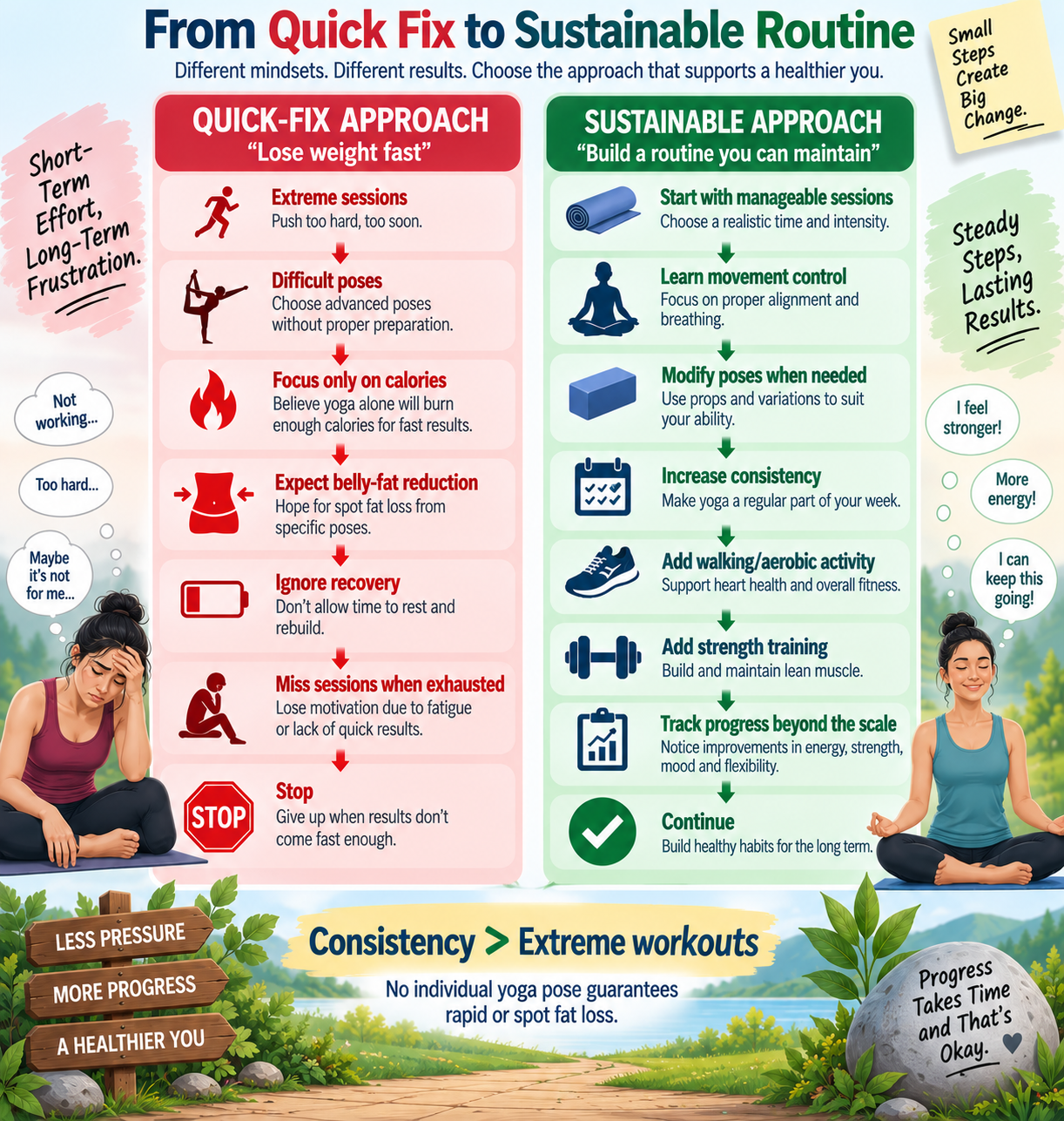
The Five-Part Progression Method
Instead of increasing difficulty randomly, use this progression:
1. Learn the movement.
Understand the basic position and breathing pattern.
2. Improve control
Perform the movement without rushing.
3. Increase consistency
Practice regularly before dramatically increasing intensity.
4. Increase challenge
Gradually add duration, repetitions, or more demanding variations.
5. Combine activities
Add walking, resistance training, cycling, swimming, or another activity you enjoy.
This approach is more sustainable than repeatedly searching for a “harder” yoga pose.
How to Know Whether Your Routine Is Working
The weighing scale is only one possible measure.
Consider tracking:
- Number of weekly sessions
- Walking duration
- Strength improvements
- Balance
- Flexibility
- Ability to complete a sequence
- Recovery between sessions
- Daily energy
- Comfort with physical activity
Weight may change, but the timeline is highly individual.
The CDC notes that weight management is affected by multiple factors, including eating patterns, physical activity, sleep, medications, age, genetics, and other influences. CDC: Tips for Balancing Food and Activity
That is why one person’s result should not be presented as a guaranteed result for everyone else.
My Personal Perspective
When people talk about weight loss, the conversation often becomes focused on speed.
How quickly can I lose weight?
- Which exercise burns the most calories?
- Which pose targets belly fat?
- Which routine gives results in seven days?
I understand why these questions are attractive.
But from a practical perspective, I think the better question is
Can I create a routine that I will still be doing several months from now?
That changes the entire approach.
A 20-minute yoga session that fits into your morning may be more valuable than an exhausting workout that you perform twice and abandon.
A modified pose may be more useful than a difficult pose that repeatedly causes discomfort.
A combination of yoga and walking may be more practical than expecting yoga alone to solve every aspect of weight management.
And measuring consistency may teach you more than stepping on the scale every morning.
That is why I prefer the phrase “sustainable weight management” rather than promising rapid results.
Safety: When You Should Modify Yoga
Yoga is generally considered safe for healthy people when performed appropriately, but injuries can happen. NCCIH reports that sprains and strains are among the more common yoga-related injuries and recommends appropriate instruction and modifications, especially for beginners. NCCIH: Yoga Effectiveness and Safety
Be particularly cautious if you:
- Have a recent injury
- Have significant back or joint pain
- Have balance difficulties
- Have uncontrolled high blood pressure
- Have a condition affected by certain body positions
- Are pregnant
- Recently underwent surgery
- Have been inactive for a long time
- Are unsure whether exercise is appropriate for you
If you are new to yoga, avoid forcing advanced positions simply because they appear impressive.
NCCIH specifically recommends that beginners avoid extreme practices such as headstands, shoulder stands, the lotus position, and forceful breathing without appropriate instruction. NCCIH: Yoga Effectiveness and Safety
Stop exercising and seek appropriate medical advice if you experience chest pain, fainting, severe dizziness, unusual shortness of breath, sudden weakness, or significant pain.
One Important Change I Recommend
Do not make your entire exercise routine about weight.
That may sound surprising in an article about weight management.
But it can make the habit easier to maintain.
Yoga can give you:
- Strength
- Mobility
- Balance
- Body awareness
- Movement confidence
- A structured activity
- An opportunity to slow down
- A way to reconnect with your body
Weight change may be one outcome, but it does not need to be the only reason you move.
That broader perspective can make exercise feel less like punishment.
Frequently Asked Questions
What yoga poses support weight management?
Dynamic movements such as sun salutations, chair pose, warrior II, high lunge, plank, side plank, boat pose, bridge pose, downward-facing dog, triangle pose, cobra pose, and locust pose can be incorporated into a broader weight-management routine. They should be viewed as tools for movement, strength, mobility, balance, and consistency rather than as individual fat-burning exercises.
Can yoga help with sustainable weight loss?
Yoga may contribute to sustainable weight management for some people, particularly when practiced consistently and combined with healthy eating and other physical activities. However, research on direct weight-loss outcomes remains mixed. PubMed: Yoga and Weight-Related Outcomes NCCIH: Yoga and Weight Loss
Can yoga alone reduce belly fat?
No exercise can guarantee selective fat loss from one body region. Yoga can strengthen the muscles of the abdomen and contribute to physical activity, but reducing body fat requires a broader approach.
How often should I do yoga for weight management?
There is no single frequency that guarantees weight loss. A practical starting point is several manageable sessions per week, while gradually building toward a broader weekly activity routine. Adults generally need at least 150 minutes of moderate aerobic activity weekly plus muscle-strengthening activity on at least two days. CDC: Adult Physical Activity Guidelines
Is a 20-minute yoga routine enough?
A 20-minute session can be an excellent starting point, particularly for someone who is new to exercise. It should be viewed as one component of your weekly activity rather than the entire weight-management strategy.
Can I do these yoga poses at home?
Many of these movements can be practiced at home, provided you have enough space and use appropriate modifications. Beginners may benefit from learning techniques from a qualified instructor, especially for more difficult movements. NCCIH: Yoga Safety Guidance
Conclusion
The most useful dynamic yoga poses for sustainable weight management are not necessarily the poses promoted as the fastest calorie burners.
They are movements that you can perform safely, understand clearly, modify when necessary, and continue practicing.
Sun salutation can create movement flow.
Chair pose and Warrior II can challenge the lower body.
Plank and side plank can develop trunk stability.
Bridge and locust can strengthen the posterior chain.
Triangle and downward-facing dog can add mobility and control.
But the real value comes from how these movements fit into your larger lifestyle.
Combine yoga with regular walking or aerobic activity, appropriate strength training, nutritious eating, adequate sleep, and realistic goals.
Most importantly, avoid expecting one pose to transform your body overnight.
A sustainable routine does not need to be extreme to be effective.
It needs to be realistic enough that you can keep doing it.
Author Note
Written by RVLNSV PRASAD, health content writer and creator of HealthTipsToYou. This article is intended to provide practical, evidence-informed health education. It uses information from established public-health organizations and peer-reviewed research and avoids presenting yoga as a guaranteed rapid-weight-loss treatment.
Medical Disclaimer
This article is for general educational purposes only and is not a substitute for personalized medical advice, diagnosis, or treatment. Exercise and yoga are not appropriate in exactly the same way for every person. If you have a medical condition, injury, significant pain, are pregnant, have recently undergone surgery, or are unsure whether a particular exercise is appropriate for you, consult a qualified healthcare professional before beginning or changing an exercise program.
Evidence-Based Sources
- National Center for Complementary and Integrative Health — Yoga: Effectiveness and Safety
- PubMed — A Systematic Review and Meta-Analysis on the Effects of Yoga on Weight-Related Outcomes
- PubMed—The Impact of Yoga on Components of Energy Balance in Adults With Higher Weight or Obesity
- PubMed—Impact of Yoga on Cardiometabolic Health in Adults With Higher Weight or Obesity
- CDC—What Counts as Physical Activity for Adults
- CDC — Steps for Losing Weight
- CDC — Tips for Keeping Weight Off
Related Content
- 10 Best Exercises to Lose Belly Fat
- How to Lose Belly Fat without Exercise
- 10 Best Yoga Asanas For Blood Sugar Control
- 8 Best Poses of Yoga For Asthma Cure
- 9 Benefits of Yoga for Holistic Health and Well-Being
- Home
- Category Weight Loss