4 Easy Healthy Recipes on a Budget: Simple, Nutritious Meals
Author: RVLNSV PRASAD
Updated On: September 2026
About Us
Author Bio
Editorial Policy
Contact Us
Introduction
Eating healthy does not have to mean buying expensive ingredients or spending hours in the kitchen.
A practical budget meal can start with something as ordinary as lentils, rice, eggs, chickpeas, oats, potatoes, or seasonal vegetables. The real skill is knowing how to combine these foods into meals that are filling, varied, and reasonably nutritious.
That is the idea behind these easy, healthy recipes on a budget.
You will find four simple recipes in this guide, but the goal is bigger than four recipes. I also want to show you how to build inexpensive meals, reuse ingredients, reduce food waste, make sensible substitutions, and plan shopping around foods that give you more nutritional value for your money.
The World Health Organization explains that a healthy diet should provide variety and can be built around foods such as whole grains, vegetables, fruits, legumes, and nuts, while limiting excess salt, free sugars, and unhealthy fats. It also notes that healthy diets need to reflect individual needs, local food availability, and dietary customs. World Health Organization — Healthy Diet
That makes budget cooking especially relevant. Nutritious eating does not have to follow an expensive or complicated food trend.
Quick Answer: What Are the Best Easy Healthy Recipes on a Budget?
Four practical options are
- One-pot lentil and vegetable stew — inexpensive, filling, and easy to batch cook.
- Simple egg and rice bowl—quick and adaptable to leftover vegetables.
- Chickpea and tomato skillet—a pantry-friendly meal with plant protein and fiber.
- Oat and banana breakfast bake—a simple breakfast or snack using inexpensive staples.
These recipes are starting points rather than rigid formulas.
You can substitute vegetables according to season and price, change the protein source, and use leftovers in another meal.
Key Takeaways
- Healthy eating can be built around affordable staple foods.
- Lentils, beans, chickpeas, oats, eggs, rice, and seasonal vegetables can form the foundation of many budget meals.
- A nutritious meal should provide variety rather than relying on one “superfood.”
- Frozen and canned foods can be practical choices when selected thoughtfully.
- Batch cooking can reduce both preparation time and food waste.
- Exact food costs vary by country, season, brand, and store, so fixed prices should not be treated as universal.
- You do not need to eliminate carbohydrates to eat healthfully.
- Whole grains, legumes, vegetables, fruits, nuts, and other nutrient-dense foods can fit into a balanced eating pattern.
- Leftovers should be cooled, refrigerated, and stored safely.
- The best budget meal plan is one you can realistically repeat.
What Makes a Healthy Meal Affordable?
A common mistake is to think that eating healthy means buying expensive products marketed as “healthy.”
You do not need protein bars, imported grains, specialty powders, or expensive packaged foods to build nutritious meals.
Instead, start with inexpensive staples.
Budget-friendly staples
| Food group | Affordable examples | How to use them |
|---|---|---|
| Legumes | Lentils, chickpeas, beans | Stews, curries, salads, bowls |
| Grains | Rice, oats, whole-grain foods | Breakfast, bowls, porridge |
| Protein | Eggs, beans, lentils, yogurt | Main meals and snacks |
| Vegetables | Carrots, cabbage, spinach, seasonal vegetables | Soups, stir-fries, stews |
| Fruit | Bananas, apples, seasonal fruit | Breakfast and snacks |
| Flavor | Onion, garlic, ginger, spices | Improve flavor without expensive sauces. |
| Healthy fats | Peanuts, seeds, vegetable oils | Cooking and toppings |
This approach is consistent with WHO India guidance, which explains that a diversified healthy diet can include staple foods such as rice and other cereals or starchy roots, legumes such as lentils and beans, vegetables, fruits, and animal-source foods such as eggs and milk. WHO India—Healthy Diet
This is important for Indian households because nutritious budget cooking does not need to copy expensive Western meal-prep trends.
Dal, rice, vegetables, eggs, curd, oats, chickpeas, peanuts, and seasonal produce can all have a place in a balanced eating pattern.
The Simple Budget Meal Formula
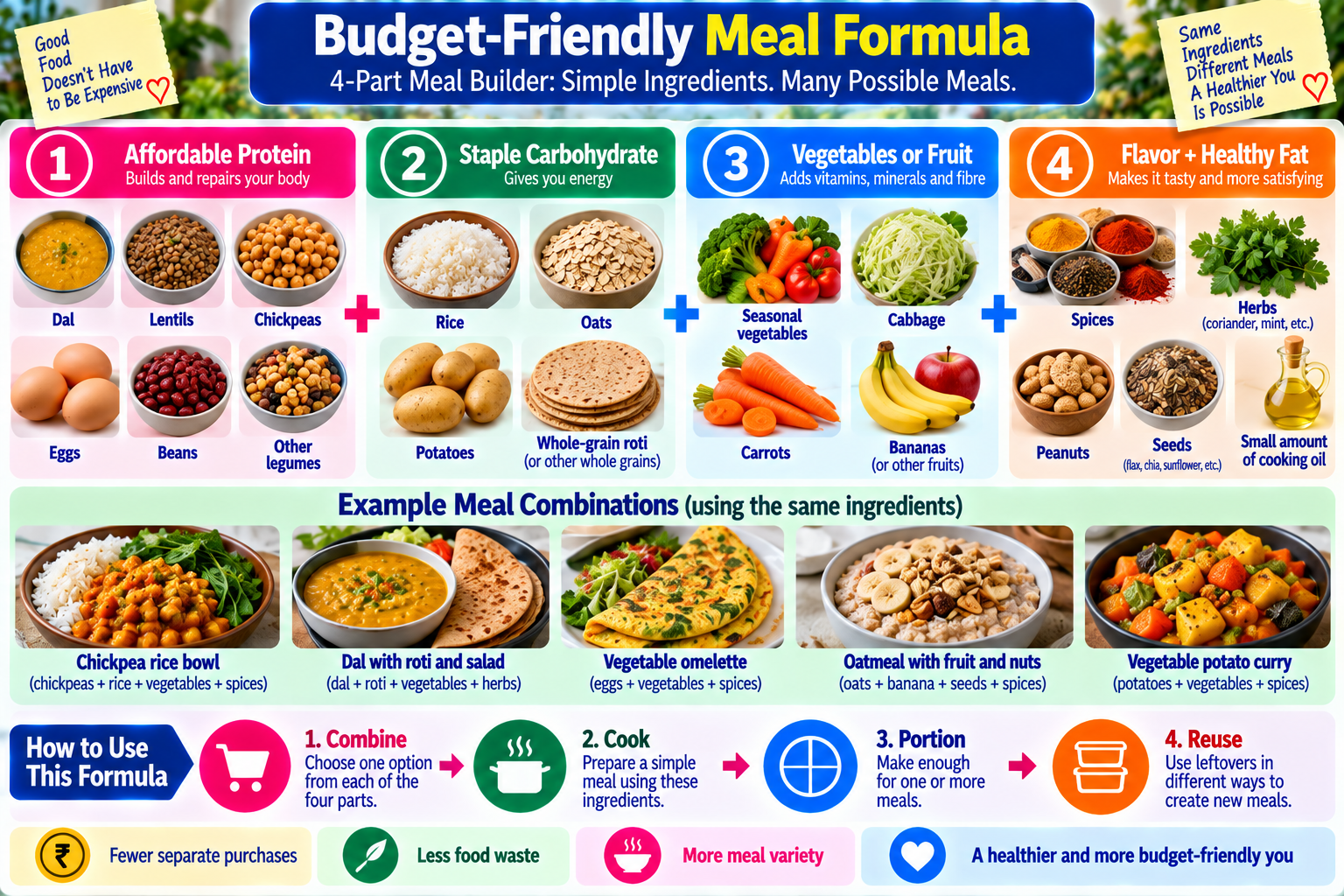
Instead of memorizing dozens of recipes, use this formula:
Affordable protein + staple carbohydrate + vegetables + flavor + appropriate fat
For example:
Lentils + rice + vegetables + spices + a small amount of cooking oil
Or:
Eggs + rice + vegetables + spices
Or:
Chickpeas + roti or rice + vegetables + curd
This approach gives you flexibility.
- If tomatoes become expensive, use another vegetable.
- If fresh spinach is unavailable, use another leafy vegetable.
- If chickpeas are not available, use beans or lentils.
The meal does not need to be perfect.
It needs to be practical and nutritionally sensible.
Harvard’s Healthy Eating Plate uses a similar overall framework, emphasizing vegetables and fruits, whole grains, healthy protein sources, and healthy plant oils when building balanced meals. Harvard T.H. Chan School of Public Health — Healthy Eating Plate
Why These Foods Make Sense Nutritionally
A healthy diet is about the overall pattern rather than one individual ingredient.
WHO recommends a varied diet containing vegetables, fruits, legumes, nuts, and whole grains while limiting excess free sugars, salt, saturated fats, and trans fats. World Health Organization — Healthy Diet
Harvard’s Healthy Eating Plate similarly recommends making vegetables and fruits a major part of meals, choosing whole grains, and including healthy protein sources such as beans and nuts. Harvard T.H. Chan School of Public Health — Healthy Eating Plate
Recent research also reinforces why overall diet quality matters. A 2026 systematic review examined diet-quality scores that incorporated dietary diversity and found that the evidence relating these scores to chronic disease and mortality outcomes was inconsistent. The authors concluded that current evidence is not sufficient to determine whether diversity-containing diet-quality scores themselves are associated with chronic disease outcomes. PubMed — 2026 Systematic Review of Diet Quality and Health Outcomes
That is an important nuance.
Eating many different foods is not automatically the same thing as eating a high-quality diet.
The nutritional quality of those foods still matters.
Recipe 1: One-Pot Lentil and Vegetable Stew
This is one of the most useful, easy, and healthy recipes on a budget because lentils are versatile, store well in dry form, and can be combined with inexpensive vegetables.
Why This Recipe Works
Lentils provide plant protein, fiber, and several micronutrients.
Vegetables add variety, fiber, vitamins, minerals, and flavor.
The recipe can also be adapted according to what is affordable in your area.
Legumes are included among the food groups associated with favorable health outcomes in a large 2025 umbrella review of systematic reviews and meta-analyses. However, those findings describe associations between food-group consumption and mortality and do not mean that one lentil recipe itself prevents disease. PubMed — 2025 Umbrella Review of Food Groups and All-Cause Mortality
Ingredients
- 1 cup dry lentils
- 1 medium onion
- 2 carrots
- 2 medium potatoes
- 2 cloves garlic
- 1 tablespoon cooking oil
- 1 teaspoon cumin
- 1 teaspoon black pepper
- Salt to taste
- 6 cups water
- Optional seasonal vegetables
How to Make It
- Rinse the lentils thoroughly.
- Chop the onion, carrots, potatoes, and garlic.
- Heat the oil in a large pot.
- Add the onion and garlic and cook until softened.
- Add the carrots and potatoes.
- Stir in the lentils, cumin, black pepper, and water.
- Bring the mixture to a boil.
- Reduce the heat and simmer until the lentils and vegetables are tender.
- Adjust the seasoning before serving.
How to Make It More Nutritious
You can increase the vegetable variety without significantly complicating the recipe.
Try adding:
- Spinach
- Cabbage
- Pumpkin
- Peas
- Tomatoes
- Seasonal leafy vegetables
Harvard recommends variety and color when choosing vegetables and fruits, rather than depending on a single vegetable. Harvard T.H. Chan School of Public Health — Healthy Eating Plate
Budget Tip
Dry lentils can be useful when you cook regularly because they can be stored for relatively long periods.
If canned lentils are more convenient, they can also work.
When buying canned foods, compare labels and choose options with less added sodium when practical.
Leftover Idea
Use leftover stew as a filling for a simple wrap or serve it with rice the following day.
That turns one cooking session into more than one meal.
Recipe 2: Simple Egg and Rice Bowl
An egg and rice bowl can be prepared quickly and modified according to whatever vegetables you already have.
Why This Recipe Works
Eggs provide protein and several important nutrients.
Rice provides carbohydrate and energy.
Vegetables can add fiber, vitamins, minerals, and texture.
The combination becomes more nutritionally varied when vegetables are included.
WHO specifically includes staple foods such as rice, legumes, vegetables, fruits, and animal-source foods such as eggs among foods that can contribute to a varied healthy diet. WHO India—Healthy Diet
Ingredients
- 1 cup cooked rice
- 2 eggs
- 1 teaspoon to 1 tablespoon cooking oil, depending on preference
- A small portion of vegetables
- Black pepper
- Salt to taste
Optional additions:
- Peas
- Spinach
- Carrots
- Cabbage
- Onion
- Tomato
- Leftover cooked vegetables
How to Make It
- Prepare the rice.
- Heat the oil in a pan.
- Add vegetables and cook until tender.
- Add the eggs and cook thoroughly.
- Add the cooked rice.
- Mix gently.
- Season according to taste.
Make the Bowl More Balanced
If your bowl is mostly rice and egg, add a generous serving of vegetables.
You could also serve fruit on the side.
The aim is not to make the meal complicated. Instead, focus on adding more variety to the foods you choose.
Harvard’s guidance emphasizes that the quality of carbohydrate matters, with whole grains, vegetables, fruits, and beans among preferred carbohydrate sources. Harvard T.H. Chan School of Public Health — Healthy Eating Plate
Budget Tip
This is a useful recipe for reducing food waste.
Instead of throwing away a small amount of cooked vegetables from the previous day, add them to the bowl.
You can also use leftover rice that has been stored safely.
Important Food-Safety Point
Cooked rice and other leftovers should be handled carefully.
USDA Food Safety and Inspection Service guidance recommends refrigerating leftovers promptly, storing them properly, and using most refrigerated leftovers within three to four days. USDA — Leftovers and Food Safety
Recipe 3: Chickpea and Tomato Skillet
Chickpeas are another inexpensive pantry staple that can turn into a satisfying meal with only a few additional ingredients.
Why This Recipe Works
Chickpeas provide plant protein, carbohydrate, fiber, and micronutrients.
Tomatoes add flavor and contribute nutrients.
Onions and spices make the dish more satisfying without requiring an expensive sauce.
Legumes such as chickpeas and lentils are consistent components of many healthy dietary patterns. WHO includes legumes among foods that can form part of a varied healthy diet. World Health Organization — Healthy Diet
Ingredients
- 1 cup cooked chickpeas
- 1 cup chopped tomatoes
- 1 medium onion
- 1 tablespoon cooking oil
- 1 teaspoon paprika
- ½ teaspoon cumin
- Black pepper
- Salt to taste
Optional:
- Spinach
- Green peas
- Chili
- Garlic
- Fresh coriander
How to Make It
- Drain and rinse the chickpeas if using canned chickpeas.
- Chop the onion and tomatoes.
- Heat the oil in a skillet.
- Add the onion and cook until soft.
- Add the tomatoes and spices.
- Add the chickpeas.
- Cook until the mixture thickens.
- Add spinach or another quick-cooking vegetable if desired.
- Serve with rice, roti, or another suitable staple.
Budget Tip
Canned chickpeas are convenient, but dried chickpeas can be useful for people who regularly cook larger batches.
Choose whichever option fits your budget, time, and storage situation.
Easy Substitutions
No chickpeas?
Use:
- Kidney beans
- Black beans
- Other cooked beans
- Lentils
No tomatoes?
Try another vegetable-based sauce or use vegetables already available at home.
The recipe is a framework rather than a strict formula.
Recipe 4: Oat and Banana Breakfast Bake
This recipe uses two inexpensive staples: oats and bananas.
It can work as a simple breakfast or snack.
Why This Recipe Works
Oats provide carbohydrate and fiber.
Bananas add sweetness and potassium.
Using ripe bananas can reduce the need for added sugar.
Whole grains such as oats are included in healthy eating guidance from both WHO and Harvard. WHO recommends obtaining much of the diet’s carbohydrate from sources such as legumes and whole grains, while Harvard’s Healthy Eating Plate recommends whole grains as a preferred carbohydrate source. World Health Organization—Healthy Diet Harvard T.H. Chan School of Public Health—Healthy Eating Plate
Ingredients
- 2 cups oats
- 2 ripe bananas
- 1 cup milk or unsweetened alternative
- 1 teaspoon cinnamon
Optional:
- Chopped peanuts
- Seeds
- Unsweetened yogurt
- A small amount of fruit
How to Make It
- Mash the bananas.
- Combine the oats, mashed bananas, milk, and cinnamon.
- Pour the mixture into a suitable baking dish.
- Bake at about 180°C until the mixture is set and lightly browned.
- Allow it to cool before cutting.
Make It More Filling
Add a small amount of nuts or seeds, or serve it with unsweetened yogurt.
The purpose is not to turn a simple recipe into an expensive health-food product.
Use whatever affordable ingredients are already part of your normal diet.
Budget Tip
Very ripe bananas that might otherwise be discarded can work well in this recipe.
That makes the recipe useful for reducing household food waste as well as keeping ingredient costs down.
The Budget-Friendly Healthy Plate
A useful way to improve these recipes is to think beyond the recipe itself.
Use this simple model:
| Part of the meal | Affordable options |
|---|---|
| Vegetables | Seasonal vegetables, cabbage, carrots, spinach, peas |
| Protein | Lentils, beans, chickpeas, eggs |
| Whole or staple carbohydrate | Oats, brown rice, whole grains, rice, potatoes |
| Fruit | Banana, apple, seasonal fruit |
| Healthy fat | Peanuts, seeds, vegetable oils |
| Flavor | Garlic, ginger, onion, herbs, spices |
This approach closely reflects the basic structure of Harvard’s Healthy Eating Plate, which recommends making vegetables and fruits a substantial part of meals, choosing whole grains, and including healthy protein sources. Harvard T.H. Chan School of Public Health — Healthy Eating Plate
You do not have to reproduce the exact proportions at every meal.
Your overall eating pattern matters.
How to Eat Healthy on a Tight Budget
Plan meals before shopping.
A short plan can prevent unnecessary purchases.
Choose three or four main meals before going to the store.
Then create your shopping list around them.
Buy ingredients that work in multiple meals.
This is one of the easiest ways to make a food budget work harder.
For example, a bag of lentils can become:
- Lentil stew
- Dal
- Lentil soup
- Lentil filling for wraps
Similarly, spinach can be used in:
- Egg bowls
- Lentil dishes
- Rice dishes
- Omelets
One ingredient serving several meals is often more useful than buying many different specialty ingredients.
Use seasonal produce.
The price of fresh vegetables can vary considerably.
When one vegetable becomes expensive, choose another.
Nutrition does not require eating the same vegetables throughout the year.
WHO notes that the exact composition of a healthy diet can vary according to locally available foods, dietary customs, and individual needs. WHO India—Healthy Diet
Compare fresh, frozen, and canned options.
Fresh is not automatically better for every situation.
Frozen vegetables can be convenient and reduce spoilage.
Canned beans and chickpeas can save preparation time.
Choose products with less added sodium or sugar when practical.
Cook once, use twice.
Batch cooking can save time.
For example, cook a larger amount of lentils and use part of it for dinner.
Use the remainder in another meal.
This reduces the temptation to order expensive food simply because there is nothing ready at home.
The “One Ingredient, Three Meals” Strategy
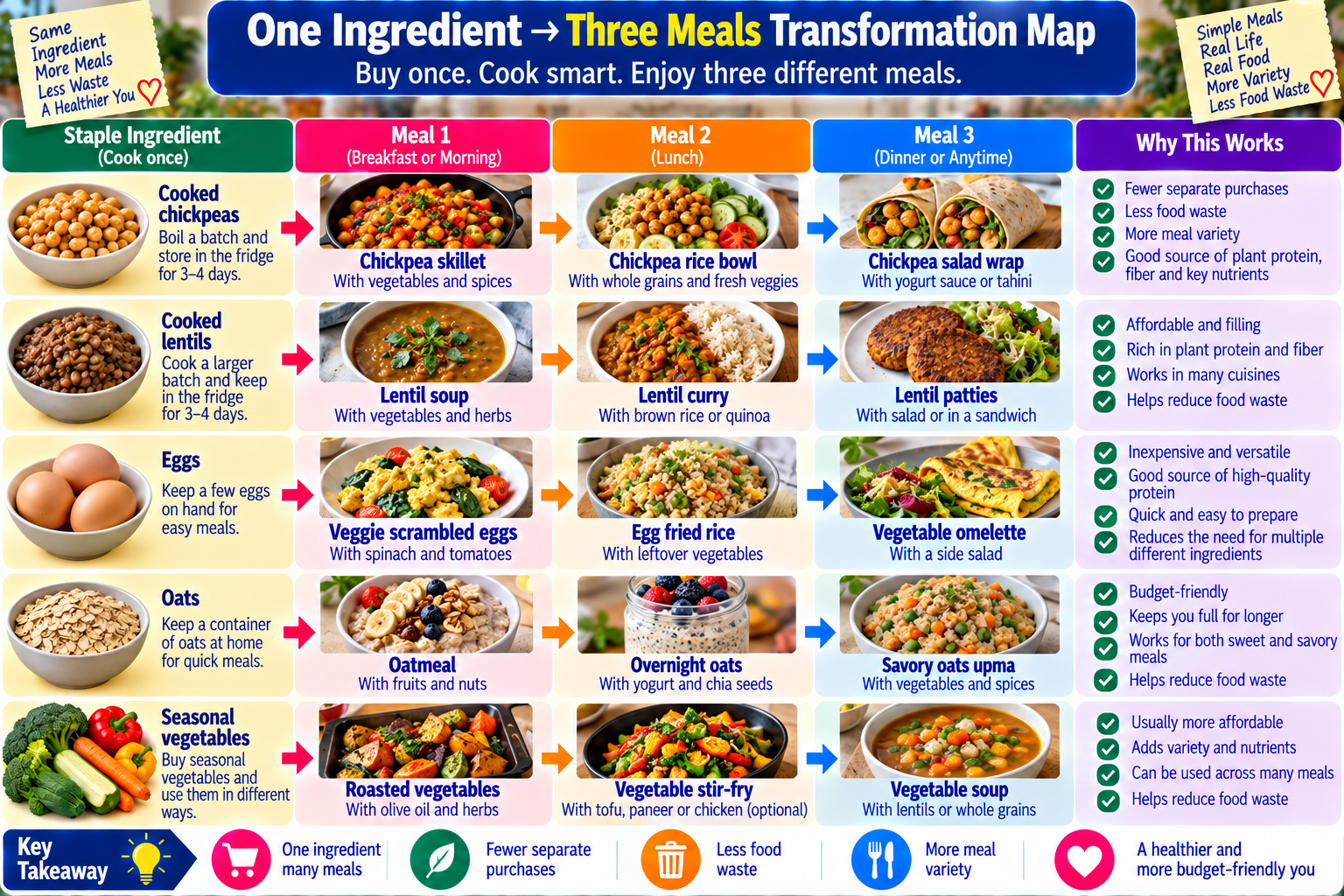
This is one practical budget strategy that many generic recipe articles overlook.
Before buying an ingredient, ask:
“Can I use this in at least three meals?”
For example:
Lentils
- Meal 1: Lentil vegetable stew
- Meal 2: Dal with rice
- Meal 3: Lentil filling with vegetables
Chickpeas
- Meal 1: Chickpea tomato skillet
- Meal 2: Chickpea salad
- Meal 3: Chickpea curry
Oats
- Meal 1: Oat banana bake
- Meal 2: Oat porridge
- Meal 3: Oats mixed with yogurt and fruit
This approach reduces the number of ingredients you need to purchase while increasing meal variety.
How to Make Budget Meals More Nutritious Without Spending Much More
Add one vegetable
- If your meal is mostly rice and eggs, add vegetables.
- If you are eating dal, add a vegetable side.
- If you are eating chickpeas, add tomatoes, spinach, cabbage, or another affordable vegetable.
Add legumes.
Lentils, beans, and chickpeas are versatile foods that can provide protein and fiber.
A 2025 umbrella review examined 41 meta-analyses involving more than one million participants and found favorable associations between higher consumption of several food groups, including legumes, and all-cause mortality. However, the authors also reported substantial heterogeneity across the evidence and varying study quality, so these findings should not be interpreted as proof that eating a particular legume recipe directly extends life. PubMed — 2025 Umbrella Review of Food Groups and All-Cause Mortality
Choose whole grains when practical.
You do not need to completely eliminate white rice or other refined grains.
Instead, consider incorporating whole grains when affordable and culturally appropriate.
Harvard’s Healthy Eating Plate recommends whole grains such as oats, brown rice, barley, and whole wheat because they generally have a milder effect on blood glucose and insulin than refined grains. Harvard T.H. Chan School of Public Health — Healthy Eating Plate
Use fruit as a simple dessert.
A banana, apple, orange, or seasonal fruit can be an inexpensive alternative to a highly processed sweet snack.
WHO recommends a wide variety of vegetables and fruit as part of a healthy diet. World Health Organization — Healthy Diet
Common Mistakes When Eating Healthy on a Budget
Mistake 1: Buying expensive “health foods”
A product does not become necessary simply because the packaging says:
- Natural
- Organic
- Fitness
- Protein
- Superfood
- Detox
Look at the actual ingredients and nutritional value.
Mistake 2: Buying too much fresh food
Fresh produce is nutritious, but buying more than you can use creates waste.
Buy quantities that match your household.
Mistake 3: Treating carbohydrates as unhealthy
Rice, oats, potatoes, wheat, and other carbohydrate foods can be part of a healthy diet.
The type and overall dietary pattern matter.
Harvard specifically emphasizes carbohydrate quality and favors sources such as vegetables, fruits, whole grains, and beans. Harvard T.H. Chan School of Public Health — Healthy Eating Plate
Mistake 4: Making every meal complicated
A healthy meal does not need ten ingredients.
Simple meals can be easier to repeat.
Mistake 5: Ignoring flavor
If healthy food is consistently bland, people may stop eating it.
Use affordable spices, garlic, onion, ginger, herbs, lemon, or other ingredients that fit your diet.
Mistake 6: Giving fixed food costs without a location
Food prices change.
A recipe that costs a certain amount in one city may cost significantly more or less elsewhere.
For that reason, this article focuses on budget-friendly ingredients and strategies rather than pretending that one price applies everywhere.
People-First Insight: Make the Healthy Choice the Easy Choice
The best budget meal is not necessarily the cheapest meal.
It is the meal you can actually prepare when you are tired, busy, or short on money.
That is why I prefer recipes with overlapping ingredients.
When lentils are already cooked, they become an easy addition to your meals. Chopped vegetables can quickly go into an egg bowl, while having oats and bananas ready can make breakfast much easier to prepare.
Healthy eating becomes more realistic when the healthier option is also convenient.
Personal Experience
In my own experience with budget cooking, one lesson stands out: complicated meal plans are difficult to maintain.
Simple ingredients are easier to buy.
Recipes that use the same ingredients in different ways are easier to repeat.
I have also found that cooking a larger batch can make the following day’s meal much easier.
That does not mean every family will have the same experience.
Food preferences, cooking facilities, household size, local prices, and cultural habits all matter.
The goal is to adapt the basic idea to your own kitchen rather than follow a rigid plan.
Latest Research: What Has Changed in Nutrition Thinking?
Nutrition research increasingly emphasizes overall dietary patterns rather than searching for one food that supposedly fixes everything.
A 2026 systematic review examined diet-quality scores that incorporated dietary diversity. The review included 16 reports and found inconsistent associations with chronic diseases, obesity, and mortality. The authors concluded that current evidence remains insufficient to determine whether diet-quality scores incorporating diversity are themselves associated with chronic disease outcomes. PubMed — 2026 Systematic Review of Diet Quality and Health Outcomes
Why Overall Food Quality Matters
This supports an important practical point:
More variety is not automatically better if the overall food quality is poor.
A 2025 umbrella review of 41 meta-analyses involving more than one million participants found that higher consumption of whole grains, fruits, vegetables, nuts, and fish was associated with lower all-cause mortality, while favorable associations were also observed for legumes and some other food groups. However, the researchers noted substantial heterogeneity and varying study quality across the underlying evidence. PubMed — 2025 Umbrella Review of Food Groups and All-Cause Mortality
Plant-Based Does Not Always Mean Healthy
Another systematic review examining plant-based dietary patterns found that the quality of the dietary pattern matters. A plant-based pattern emphasizing healthier foods should not be treated as equivalent to one dominated by refined or highly processed foods. PubMed — 2025 Plant-Based Dietary Patterns and Mortality Meta-analysis
This is an important distinction.
Plant-based does not automatically mean healthy.
Likewise, budget-friendly does not automatically mean nutritious.
The quality of the ingredients and the overall pattern still matter.
What This Means for Budget-Friendly Meals
Recent USDA-supported evidence synthesis also found strong evidence in adults that dietary patterns higher in vegetables, fruits, legumes, nuts, whole grains, and unsaturated fats, and lower in red and processed meats, refined grains, and sugar-sweetened foods and beverages, are associated with lower cardiovascular disease risk. PubMed — Dietary Patterns and Cardiovascular Disease Systematic Review
These findings support the basic approach used in this article: build meals around affordable nutrient-dense foods rather than relying on expensive products marketed for health.
Food Safety for Budget Meal Prep
Saving money should never mean taking unnecessary food-safety risks.
USDA Food Safety and Inspection Service guidance recommends cooking food safely, refrigerating leftovers promptly, and storing them appropriately. USDA — Leftovers and Food Safety
The USDA guidance states that leftovers should generally be refrigerated within two hours and can usually be kept in the refrigerator for 3 to 4 days when stored properly. Large quantities should be divided into shallow containers so they cool more rapidly. USDA — Leftovers and Food Safety
For batch cooking:
- Divide large quantities into suitable containers.
- Refrigerate or freeze promptly.
- Label containers with the date.
- Use older leftovers first.
- Reheat leftovers thoroughly.
- When in doubt about food safety, discard the food rather than taking the risk.
USDA recommends reheating leftovers to 165°F (74°C). USDA — Leftovers and Food Safety
This is especially important for cooked rice, eggs, lentils, meat, and other perishable foods.
Easy Ingredient Substitution Table
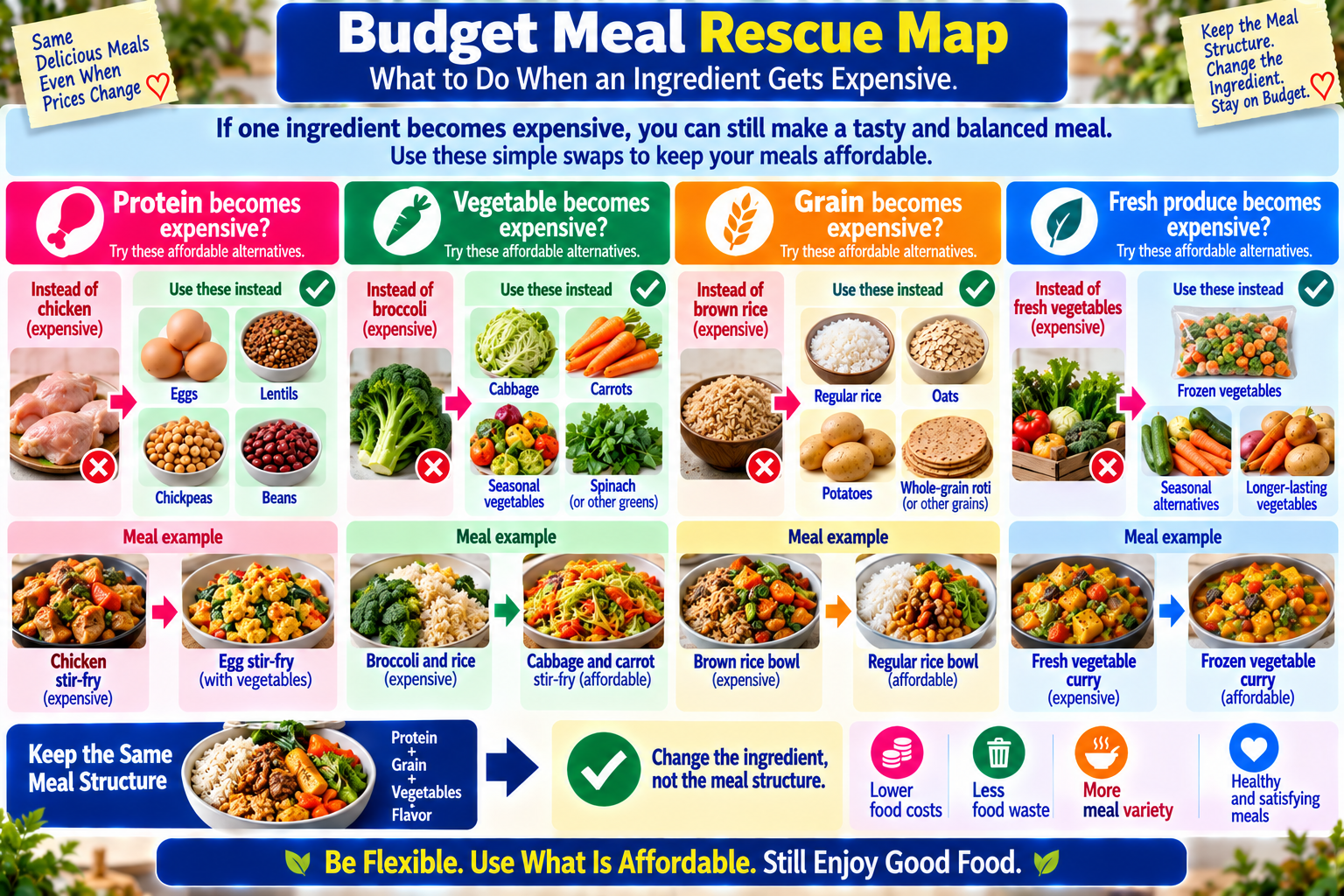
| If you don’t have | Try instead. |
|---|---|
| Lentils | Other cooked beans or lentils |
| Chickpeas | Kidney beans or another bean |
| Carrots | Seasonal vegetables |
| Spinach | Cabbage or another leafy vegetable |
| Fresh tomatoes | Canned tomatoes without unnecessary added ingredients |
| Eggs | Beans, lentils, or another suitable protein |
| Banana | Another affordable fruit |
| Brown rice | Another whole grain or available staple |
| Expensive nuts | Peanuts or seeds, where appropriate |
Substitutions should still take into account allergies, dietary restrictions, and individual nutritional needs.
Who Should Modify These Recipes?
These recipes are intended for generally healthy adults.
People with diabetes, kidney disease, food allergies, celiac disease, digestive disorders, eating disorders, or other medical conditions may need individualized dietary advice.
For example, someone who needs to restrict potassium, protein, sodium, carbohydrates, or specific allergens should not assume that a generally healthy recipe is automatically appropriate for them.
Pregnant people, children, older adults, and people taking certain medications may also have different nutritional needs.
Frequently Asked Questions
Can I really eat healthy on a small budget?
Yes. A nutritious diet can include inexpensive staples such as lentils, beans, chickpeas, oats, eggs, vegetables, fruit, and grains. WHO specifically recognizes legumes, grains, vegetables, fruits, and appropriate animal-source foods as components of a varied healthy diet. WHO India—Healthy Diet
What are the cheapest healthy foods?
Prices vary by location, but commonly affordable choices include lentils, beans, chickpeas, oats, rice, potatoes, eggs, bananas, seasonal vegetables, and other locally available staples.
Are these recipes suitable for weight loss?
They can fit into a weight-management diet, but a recipe alone does not cause weight loss. Overall calorie intake, portion sizes, activity, sleep, food choices, and individual health factors all matter.
Can I use white rice?
Yes.
White rice can be part of a healthy eating pattern.
If you prefer, you can sometimes replace part or all of it with brown rice or another whole grain. The overall meal matters more than treating one food as forbidden.
Are canned beans healthy?
Canned beans can be a convenient, nutritious option. Check the label when possible and choose lower-sodium varieties when available. Rinsing canned beans can also reduce some sodium.
Can I freeze these meals?
Some of these recipes can be frozen, although texture may change after freezing and reheating. Follow appropriate food-safety practices and use suitable airtight containers.
How long can I keep cooked leftovers?
USDA guidance states that most cooked leftovers can be refrigerated for 3 to 4 days when handled and stored properly. USDA — Leftovers and Food Safety
Do healthy meals need to be expensive?
No.
Cost and nutritional quality are separate concepts.
Expensive food can be nutritious, but inexpensive foods can also provide protein, fiber, vitamins, minerals, and other nutrients.
A Simple Budget Shopping List
If you want to start with a small shopping list, consider:
Protein and legumes
- Lentils
- Chickpeas
- Beans
- Eggs
Staples
- Rice
- Oats
- Potatoes
- Whole-grain foods when affordable
Vegetables
- Onions
- Carrots
- Cabbage
- Spinach
- Tomatoes
- One or two seasonal vegetables
Fruit
- Bananas
- One seasonal fruit
Flavor
- Garlic
- Ginger
- Cumin
- Black pepper
- Turmeric or other preferred spices
Optional
- Peanuts
- Seeds
- Plain yogurt or curd
You do not need to purchase everything at once.
Start with what you already use.
Author Note
This article focuses on practical, affordable nutrition rather than expensive diet products or complicated meal plans.
The recipes are designed to give readers flexible starting points that can be adapted to local ingredients, food prices, household size, and personal preferences.
The nutrition discussion is based on guidance from the World Health Organization, WHO India, Harvard T.H. Chan School of Public Health, USDA Food Safety and Inspection Service, and recent systematic reviews and meta-analyses. World Health Organization — Healthy Diet
Medical Disclaimer
This article is for general educational purposes and does not provide individualized medical or nutritional advice.
The recipes are intended for generally healthy adults.
If you have diabetes, kidney disease, heart disease, food allergies, gastrointestinal disease, an eating disorder, or another medical condition requiring dietary management, speak with a qualified healthcare professional or registered dietitian before making major dietary changes.
Do not use these recipes as a substitute for prescribed medical nutrition therapy.
Fitness Disclaimer
Food is only one part of health and fitness.
Your nutritional needs can change according to activity level, age, body size, training volume, health status, and personal goals.
If you exercise regularly or participate in demanding sports, your energy and protein requirements may differ from those of someone with low physical activity.
A qualified healthcare professional or sports dietitian can help you determine an appropriate eating plan when individualized guidance is needed.
Research Methodology
This article prioritizes authoritative nutrition guidance and recent evidence syntheses.
Sources included the World Health Organization, WHO India, Harvard T.H. Chan School of Public Health, USDA Food Safety and Inspection Service, and PubMed-indexed systematic reviews and meta-analyses.
Recent research was considered particularly important for the sections discussing overall diet quality, plant-based dietary patterns, cardiovascular health, legumes, whole grains, and food-group associations with long-term health outcomes. PubMed — 2026 Systematic Review of Diet Quality and Health Outcomes
Because much nutrition research is observational, associations between dietary patterns and long-term health should not automatically be interpreted as proof that a particular food or recipe directly prevents disease.
Sources
- World Health Organization — Healthy Diet
- WHO India — Healthy Diet
- Harvard T.H. Chan School of Public Health — Healthy Eating Plate
- USDA — Leftovers and Food Safety
- PubMed — 2026 Systematic Review of Diet Quality and Health Outcomes
- PubMed — 2025 Umbrella Review of Food Groups and All-Cause Mortality
- PubMed — 2025 Plant-Based Dietary Patterns and Mortality Meta-analysis
- PubMed — Dietary Patterns and Cardiovascular Disease Systematic Review
Final Thoughts
Eating well on a budget is less about finding the cheapest possible food and more about getting useful nutrition from ingredients you can afford, prepare, and actually enjoy.
Lentils can become a hearty stew. Eggs can become a quick rice bowl. Chickpeas can become a satisfying skillet. Oats and bananas can become a simple breakfast.
The same ingredients can then appear in several different meals. That is where budget cooking becomes practical.
Focus on Overall Diet Quality
Current nutrition guidance supports dietary patterns built around vegetables, fruits, legumes, whole grains, nuts, and other nutrient-dense foods, while emphasizing that individual dietary needs and local food availability matter. World Health Organization — Healthy Diet
Recent evidence also suggests that the overall dietary pattern matters more than searching for individual miracle foods. Research on dietary patterns and cardiovascular health, for example, supports patterns containing more vegetables, fruits, legumes, nuts, whole grains, and unsaturated fats and fewer red and processed meats, refined grains, and sugar-sweetened foods and beverages. PubMed — Dietary Patterns and Cardiovascular Disease Systematic Review
Make Healthy Eating Sustainable
You do not need a perfect diet. You need a sustainable one.
Start with a few inexpensive ingredients. Plan before shopping. Cook enough for another meal when practical. Use seasonal foods. Substitute rather than abandon a recipe when one ingredient becomes expensive.
Most importantly, make healthy eating simple enough that you can continue doing it.
That is the real purpose of easy, healthy recipes on a budget.
Similar Content
- 3 Best Tips To Maintain Fitness
- How to Lose Weight on Keto Diet
- 12 Best Fat Burning Supplements Women
- Healthy Eating Meal Plan for Wellness
- Home
- Wholesome Nutrition