













































































































































How to Treat Acne at Home: 12 Evidence-Based Ways
Author: RVLNSV PRASAD
Updated On: September 2026
About Us
Author Bio
Editorial Policy
Contact Us
Quick Answer
If you want to know how to treat acne at home, start with a simple and consistent skincare routine rather than trying multiple viral remedies at the same time.
For mild acne, evidence-based options include benzoyl peroxide, adapalene, salicylic acid, and azelaic acid. A gentle cleanser, non-comedogenic moisturizer, and broad-spectrum sunscreen can support the routine and help reduce unnecessary irritation.
The goal is not to make every pimple disappear overnight. Effective acne treatment usually takes time. The right approach is to reduce active breakouts, help prevent new clogged pores, and protect the skin from irritation, dark marks, and scarring.
Key Takeaways
- Mild acne can often be managed initially with appropriate home treatment.
- A gentle cleanser is better than aggressive scrubbing.
- Benzoyl peroxide can help treat inflammatory acne.
- Adapalene helps prevent clogged pores and treats several forms of acne.
- Salicylic acid can help with blackheads, whiteheads, and clogged pores.
- Azelaic acid can help acne and post-acne dark marks.
- Moisturizer can make acne treatments easier to tolerate.
- Sunscreen is important when you are treating acne and dark marks.
- Avoid squeezing or repeatedly picking pimples.
- Do not expect acne to disappear overnight.
- Give a suitable routine enough time to show improvement.
- Deep, painful, persistent, or scarring acne may require professional treatment.
Introduction
Acne is one of those skin problems that can make people search for quick solutions. When a new pimple appears, it is easy to reach for a harsh scrub, toothpaste, lemon juice, or another home remedy that promises fast results.
But treating acne successfully is usually less about finding a miracle remedy and more about using the right treatment consistently.
If you are searching for how to treat acne at home, the most useful place to start is with treatments that have clinical evidence behind them. Depending on the type of acne, these can include benzoyl peroxide, topical retinoids such as adapalene, salicylic acid, and azelaic acid.
The American Academy of Dermatology’s acne guideline supports several of these topical treatments as evidence-based options for acne management.
American Academy of Dermatology — Acne Clinical Guideline
Home treatment is most appropriate for many cases of mild acne. However, not every type of acne should be treated entirely on your own. Deep, painful nodules, significant scarring, or acne that continues to worsen may need professional evaluation.
This guide explains 12 practical ways to treat acne at home, how to choose between common acne ingredients, what mistakes to avoid, and when it is time to see a dermatologist.
What Causes Acne?
Acne vulgaris develops in and around hair follicles. Several processes can contribute to acne, including increased oil production, dead skin cells blocking follicles, hormonal influences, and inflammation.
When a pore becomes blocked, it can develop into a blackhead or whitehead. Inflammation can then produce red pimples and, in more severe cases, deeper painful lesions.
This is why acne is not simply a problem caused by having a dirty face. Washing excessively or scrubbing harder does not address all of the biological processes involved in acne.
Hormonal changes can also influence oil production and acne activity. This is one reason acne can occur during adolescence and can also continue or appear during adulthood.
NHS — Acne: Causes and Treatment
Understanding this is important because it changes how you approach treatment. Instead of trying to “clean” acne away, focus on treatments that address clogged pores, inflammation, and other factors involved in acne.
Who Can Treat Acne at Home?
Home treatment can be reasonable for mild acne, especially when you have a relatively small number of blackheads, whiteheads, or occasional small pimples.
A simple over-the-counter routine may be enough for some people. The key is to choose an appropriate active ingredient and use it consistently.
However, home treatment is not suitable for every situation.
You should consider professional medical advice if you have:
- Deep or painful acne
- Frequent nodules or cyst-like lesions
- Significant acne scarring
- Acne affecting large areas of the face, chest, or back
- Acne that is getting worse
- Acne that does not improve after consistent treatment
- Acne that is significantly affecting your confidence or quality of life
The earlier severe acne is evaluated, the more opportunities there may be to control inflammation and reduce the chance of permanent scarring.
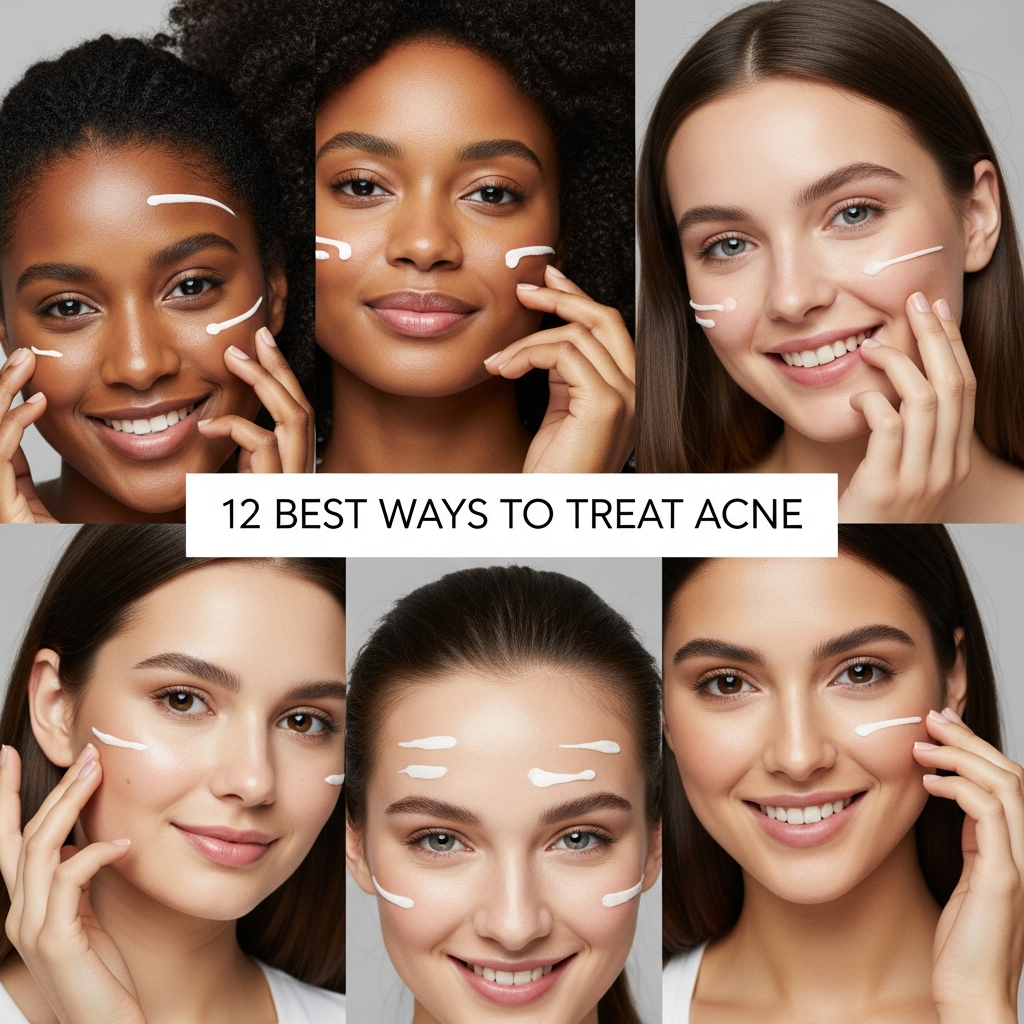
12 Best Ways to Treat Acne at Home
1. Start With a Gentle Cleanser
One of the simplest steps in an acne routine is also one of the easiest to get wrong.
Acne-prone skin does not need aggressive scrubbing. Instead, use a gentle cleanser to remove sweat, excess oil, cosmetics, and surface debris without unnecessarily irritating the skin.
Wash gently with your fingertips rather than using rough brushes or abrasive cloths.
A practical routine is to cleanse your face in the morning and evening and after heavy sweating when necessary.
Avoid repeatedly washing your face throughout the day simply because you notice oiliness. Excessive cleansing can leave the skin uncomfortable and may make it harder to tolerate acne treatments.
NICE recommends gentle cleansing as part of acne management and advises avoiding products that can contribute to irritation or clogged pores.
NICE — Acne Vulgaris: Management, updated April 2026
The purpose of cleansing is to support the rest of your routine. It is not to scrub acne away.
2. Consider Benzoyl Peroxide
Benzoyl peroxide is one of the most established topical treatments for acne.
It can help reduce acne-causing bacteria and inflammation and can also be useful when blocked pores and inflammatory pimples occur together.
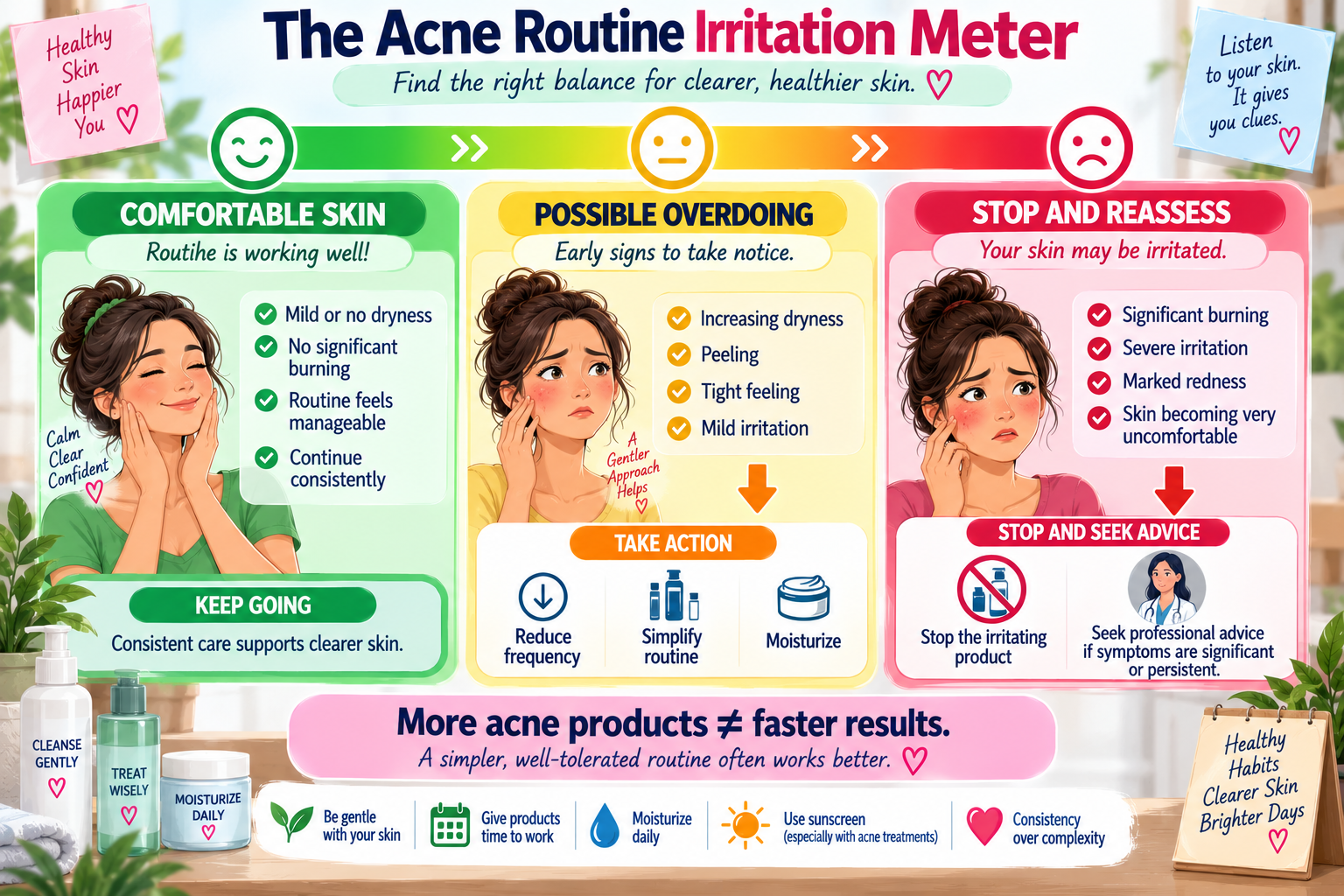
If you are new to benzoyl peroxide, start cautiously. Some people experience dryness, redness, peeling, or irritation, particularly when they begin using it too frequently.
Using a lower strength or applying it less often at first can be useful if your skin is sensitive.
NHS — Benzoyl Peroxide for Acne
Benzoyl peroxide can also bleach fabrics. Be careful around towels, pillowcases, and clothing.
One practical mistake is assuming that using more benzoyl peroxide will clear acne faster. More product does not necessarily mean better results. The goal is a dose and frequency that you can tolerate consistently.
3. Try Adapalene for Clogged Pores
Adapalene belongs to a group of medicines called topical retinoids.
It helps regulate the process that causes pores to become clogged and can be particularly useful for blackheads and whiteheads. It can also help with some inflammatory pimples.
American Academy of Dermatology — Acne Diagnosis and Treatment
Unlike a spot treatment that is applied only to a visible pimple, adapalene is generally used as part of a broader acne routine.
A common mistake is applying too much because you want faster results. A thin layer is generally preferable to covering the skin with a thick amount.
Retinoids can initially cause dryness or irritation. Introducing them carefully and maintaining moisturization can make the routine easier to tolerate.
Important pregnancy warning: topical retinoids such as adapalene should not be used during pregnancy. If you are pregnant, trying to become pregnant, or unsure whether a retinoid is appropriate for you, consult a healthcare professional.
4. Use Salicylic Acid for Clogged Pores
Salicylic acid is another commonly used acne ingredient.
It can help loosen dead skin cells and improve clogged pores. This makes it particularly useful for people whose acne includes blackheads and whiteheads.
American Academy of Dermatology — Acne Diagnosis and Treatment
Salicylic acid is available in different skincare products and strengths. If your skin becomes dry or irritated, reduce how frequently you use it rather than automatically adding another active ingredient.
If you are already using adapalene or benzoyl peroxide, be especially careful about adding several exfoliating products at once.
5. Consider Azelaic Acid
Azelaic acid is useful because it can address more than one concern.
It can help acne and inflammation and may also help with dark spots that remain after acne lesions heal.
American Academy of Dermatology — Acne Diagnosis and Treatment
This can make azelaic acid an appealing option for someone dealing with both active acne and post-inflammatory hyperpigmentation.
However, dark marks and acne scars are not the same thing. A flat brown or dark mark left after a pimple is different from a permanent indentation or raised scar.
If you have significant scarring, professional assessment may be more useful than simply adding more acne products.
6. Do Not Skip Moisturizer
If your skin is oily, you may think moisturizer will make acne worse.
That is not necessarily the case.
Many acne treatments can cause dryness or irritation. A suitable moisturizer can make it easier to tolerate these treatments and maintain a comfortable skin barrier.
Look for products labelled:
- Non-comedogenic
- Oil-free
- Suitable for acne-prone skin
- Fragrance-free if your skin is sensitive
The right moisturizer should feel comfortable rather than heavy or irritating.
You do not need to avoid moisturizer simply because you have oily skin. Instead, choose a formulation that suits your skin.
7. Protect Your Skin From the Sun
Sunscreen does not directly cure acne, but it is an important part of protecting acne-prone skin.
Choose a broad-spectrum, non-comedogenic sunscreen with SPF 30 or higher.
Sun exposure can make some post-acne dark marks more noticeable. Sunscreen is therefore particularly relevant if your main concern is not only active pimples but also the discoloration left behind after acne.
AAD — Tips for Treating a Deep, Painful Pimple at Home
If you dislike the feel of sunscreen, try different lightweight formulations rather than skipping sun protection completely.
8. Stop Picking and Squeezing Pimples
This may be one of the hardest recommendations to follow.
A whitehead can look as though it is ready to be squeezed. A painful pimple can be tempting to press repeatedly.
But manipulating acne can increase inflammation and may contribute to scarring or prolonged discoloration.
Instead of squeezing, leave the lesion alone and continue your acne treatment.
For an individual pimple, a hydrocolloid patch may also provide a physical barrier that makes touching or picking more difficult.
AAD specifically advises against popping deep, painful pimples.
AAD — Tips for Treating a Deep, Painful Pimple at Home
If you frequently pick your skin without realizing it, keeping your nails short and using a patch over a particularly tempting spot can be practical strategies.
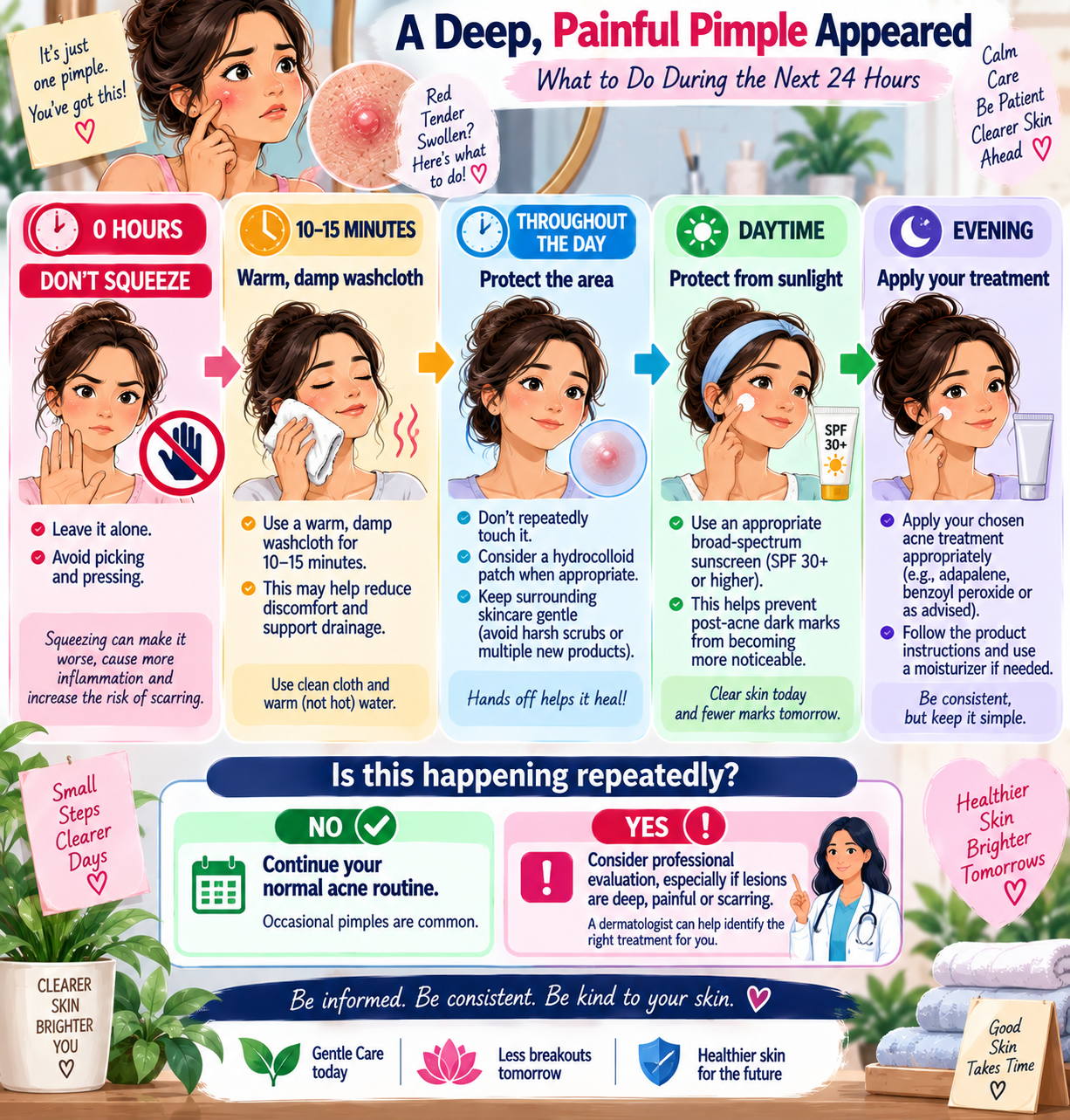
9. Use a Warm Compress for a Deep, Painful Pimple
A warm compress can be useful as supportive home care for an individual deep, painful pimple.
The American Academy of Dermatology recommends a warm, damp washcloth for 10–15 minutes, three times a day, for a deep, painful pimple. It also advises against popping the lesion.
American Academy of Dermatology — How to Treat a Deep, Painful Pimple at Home
The important distinction is that a warm compress is supportive care. It is not a cure for severe nodular or cystic acne.
If you repeatedly develop deep, painful lesions, do not keep relying on warm compresses alone. That pattern is a reason to consider professional evaluation.
10. Choose Non-Comedogenic Skin, Hair, and Makeup Products
Your acne routine is not limited to acne medication.
The products that come into contact with your face can also matter.
When possible, choose skincare, makeup, and hair products labelled non-comedogenic or oil-free.
Pay attention to:
- Foundation
- Concealer
- Moisturizer
- Sunscreen
- Hair oils
- Styling products
- Cleansers
- Facial oils
If a heavy hair product repeatedly touches your forehead or temples, for example, consider whether it may be contributing to clogged pores in that area.
Also remove makeup before sleeping.
The objective is not to become afraid of every cosmetic product. Instead, choose products that are less likely to contribute to clogged pores and that your skin tolerates well.
11. Give One Routine Enough Time to Work
One of the most common acne-treatment mistakes is giving up too quickly.
Someone may use a product for three or four days, see another pimple, and immediately decide that the treatment does not work.
Acne does not usually respond that quickly.
The NHS notes that acne treatment can take weeks or months and emphasizes continuing treatment rather than expecting immediate clearance.
NHS — Acne Treatment and How Long It Takes
This does not mean you should continue using a product that causes severe irritation. It means you should give an appropriate, tolerable treatment enough time to judge its effect.
Avoid changing your entire routine every few days.
12. Know When Home Treatment Is Not Enough
Home treatment has limits.
If you have deep, painful acne, significant scarring, widespread inflammation, or acne that continues despite consistent treatment, adding more over-the-counter products may not be the best next step.
A dermatologist can determine whether you need prescription-strength topical treatment, oral medication, or another approach.
This is especially important when acne is leaving scars. Scars can become much more difficult to address once they have fully developed.
Do not interpret professional treatment as a failure of home care. Sometimes the appropriate next step is simply moving from self-care to medical treatment.
A Simple At-Home Acne Routine
You do not need a complicated 10-step routine to start treating mild acne.
A basic routine can look like this:
| Time | Routine |
|---|---|
| Morning | Gentle cleanser → moisturizer → SPF 30+ sunscreen |
| Evening | Gentle cleanser → selected acne treatment → moisturizer |
| As needed | Hydrocolloid patch or warm compress for an individual painful pimple |
The exact active ingredient depends on your acne type, skin sensitivity, and other circumstances.
For example, someone with mainly blackheads and whiteheads may benefit from adapalene or salicylic acid, while someone with inflammatory pimples may consider benzoyl peroxide.
You do not need to use every active ingredient simultaneously.
In fact, starting several treatments at once can make irritation more likely and make it difficult to identify which product is helping or causing problems.
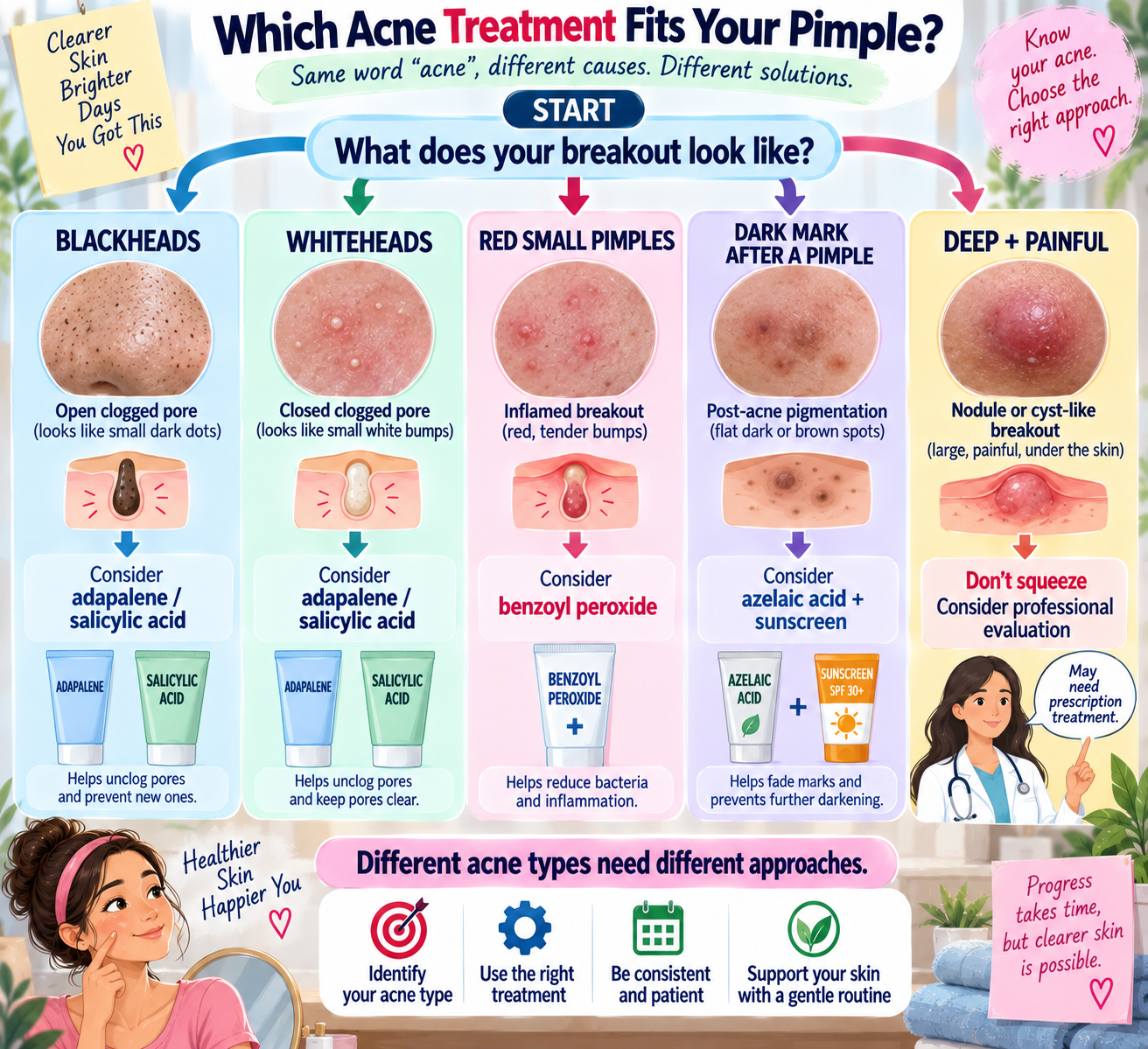
How to Choose an Acne Treatment
Different acne ingredients have different purposes.
| Main concern | Ingredient or approach to consider |
|---|---|
| Blackheads | Adapalene or salicylic acid |
| Whiteheads | Adapalene or salicylic acid |
| Small inflammatory pimples | Benzoyl peroxide |
| Acne with dark marks | Azelaic acid plus sunscreen |
| Individual deep painful pimple | Warm compress; avoid squeezing. |
| Persistent or scarring acne | Professional evaluation |
These are general educational options, not a personal diagnosis.
If You Mainly Have Blackheads
Blackheads are open clogged pores.
A topical retinoid such as adapalene can help prevent pores from becoming blocked, while salicylic acid can help with clogged pores.
Consistency is more important than aggressively exfoliating the skin.
If You Mainly Have Whiteheads
Whiteheads are closed clogged pores.
Adapalene can be useful because it helps prevent the formation of clogged pores. Salicylic acid can also be considered.
Avoid trying to force whiteheads out by squeezing them.
If You Mainly Have Red Pimples
Benzoyl peroxide is one evidence-based option for inflammatory acne.
Start in a way that your skin can tolerate. Excessive dryness is not proof that a treatment is working better.
If You Have Dark Marks After Acne
The flat dark areas left after pimples may be post-inflammatory hyperpigmentation rather than true acne scars.
Azelaic acid can be useful for acne and dark marks, while sunscreen can help protect the skin from additional sun-related darkening.
If the marks are persistent or extensive, a dermatologist can help determine the most appropriate approach.
If You Have Deep, Painful Acne
Deep, painful acne deserves more caution.
A warm compress can provide supportive care for an individual painful pimple, but repeated deep lesions can indicate acne that needs professional treatment.
Do not repeatedly squeeze deep acne in an attempt to make it disappear.
Can You Treat Acne Overnight?
Usually, no.
This is one of the most important expectations to correct when discussing acne treatment at home.
A pimple may temporarily look less swollen or irritated after appropriate supportive care, but acne generally does not completely disappear overnight.
Most evidence-based acne treatments require consistent use over time.
Be cautious with products or social media posts promising to “clear acne overnight.”
There is a major difference between:
Reducing the appearance of one pimple temporarily
and
Treating the underlying acne process.
The second goal requires a consistent treatment strategy.
What About Natural Acne Home Remedies?
The term “acne home remedies” covers a wide range of ideas.
Some are harmless supportive measures, while others may irritate the skin or distract from treatments that have better evidence.
Natural does not automatically mean effective.
Aloe Vera
Aloe-based products may feel soothing to some people, particularly when the skin feels irritated.
However, aloe should not be treated as a replacement for established acne treatments such as benzoyl peroxide, topical retinoids, salicylic acid, or azelaic acid.
If you use an aloe product, choose a formulation designed for skin rather than assuming that applying any household preparation is appropriate.
Honey
Honey is sometimes promoted as a natural acne treatment.
However, household honey should not be considered a first-line acne treatment simply because it is natural.
If your goal is to treat acne effectively, evidence-based acne ingredients are a more reliable starting point.
Green Tea
Green tea and green-tea extracts have attracted interest in skincare research.
That does not mean that drinking green tea or applying homemade green-tea mixtures is an established primary treatment for acne.
Use evidence-based acne therapy as the foundation of your routine.
Lemon Juice
Lemon juice is a common online recommendation, but it is not part of guideline-based acne treatment.
Rather than applying acidic kitchen ingredients to inflamed facial skin, choose products formulated and tested for topical skincare.
Toothpaste
Toothpaste is not an acne treatment.
It is designed for cleaning teeth, not treating facial skin. Applying it to pimples can irritate the skin and potentially make the area more uncomfortable.
The American Academy of Dermatology specifically advises against toothpaste for acne.
AAD — Adult Acne Treatment Dermatologists Recommend
If you want an acne spot treatment, use a product formulated for acne rather than a household product formulated for another purpose.
Essential Oils
Essential oils are concentrated substances and can irritate sensitive or inflamed skin.
Do not assume that an essential oil is automatically safer than an established acne treatment because it comes from a plant.
When treating acne, evidence and tolerability matter more than whether an ingredient sounds natural.
Does Diet Cause Acne?
Diet is one of the most frequently discussed acne topics.
People often ask whether they should stop eating dairy, sugar, chocolate, or other foods to clear their skin.
The evidence is more complicated than many online claims suggest.
Current NICE guidance specifically considers dietary interventions in acne management and does not recommend a specific diet as a standard acne treatment.
NICE — Acne Vulgaris: Management
The American Academy of Dermatology has also reported that there is insufficient evidence to make broad dietary recommendations for acne treatment.
That does not mean that diet can never matter to an individual. It means you should be cautious about claims that one particular food or diet is the universal cause or cure for acne.
Instead of eliminating large groups of foods unnecessarily, focus first on an evidence-based skincare routine and an overall balanced diet.
Adult Acne: Why It Can Be Different
Acne is not limited to teenagers.
Adults can also experience acne, including people who never had significant acne during adolescence.
Adult acne can be influenced by hormonal changes, medications, skincare products, and other factors.
The treatment approach still depends on the type and severity of acne.
For mild adult acne, topical ingredients such as adapalene, benzoyl peroxide, salicylic acid, or azelaic acid may be considered.
However, persistent or severe adult acne deserves professional assessment, particularly when there are deep, painful lesions or scarring.
Acne Marks vs. Acne Scars
Many people use the words “acne marks” and “acne scars” interchangeably, but they are not necessarily the same.
A flat dark or red area left after a pimple may gradually fade. This is different from a scar involving a permanent change in the texture of the skin.
Examples of acne scarring include:
- Depressed or indented scars
- Raised scars
- Uneven skin texture
Home acne treatment can help prevent new breakouts, but established scars may require treatments specifically designed for scarring.
This is another reason not to squeeze pimples. Preventing unnecessary trauma to inflamed skin can be part of reducing the risk of long-term marks and scars.
How to Start an Acne Routine Without Irritating Your Skin
If you are completely new to acne treatment, simplicity can help.
Step 1: Establish gentle cleansing
Use a mild cleanser consistently.
Step 2: Choose one main active ingredient.
Instead of immediately combining four different products, select one evidence-based acne ingredient appropriate for your main concern.
Step 3: Add moisturizer.
Use a non-comedogenic moisturizer to help manage dryness.
Step 4: Use sunscreen during the day.
Choose broad-spectrum SPF 30 or higher.
Step 5: Give the routine time.
Do not judge the treatment after only a few days.
Step 6: Adjust based on tolerance
If irritation becomes significant, reduce frequency and reassess rather than continuously adding more products.
This approach makes your routine easier to understand and maintain.
People-First Insight: The Best Routine Is One You Can Maintain
There is a practical side to acne treatment that is sometimes overlooked.
A theoretically excellent routine is not useful if you cannot tolerate it.
For example, imagine someone sees several acne videos online and purchases:
- A strong exfoliating acid
- Benzoyl peroxide
- Adapalene
- A facial scrub
- A clay mask
- Multiple spot treatments
They use everything at once because they want fast results.
Within a week, their skin becomes dry, irritated, and uncomfortable. They stop everything.
The problem was not necessarily that evidence-based ingredients were ineffective. The problem was the strategy.
A better approach is gradual.
Choose an appropriate treatment, use it consistently, support the skin with moisturizer and sunscreen, and give it enough time.
Common Mistakes When Treating Acne at Home
Mistake 1: Using too many active ingredients
More ingredients do not automatically mean faster improvement.
Mistake 2: Scrubbing aggressively
Acne is not simply dirt sitting on the surface of the skin.
Mistake 3: Washing your face repeatedly
Excessive washing can irritate your skin.
Mistake 4: Picking pimples
Picking can increase inflammation and the risk of marks and scars.
Mistake 5: Changing products every few days
Give a suitable treatment enough time to work.
Mistake 6: Ignoring moisturizer
Acne treatments can cause dryness. A suitable moisturizer may improve comfort and adherence.
Mistake 7: Skipping sunscreen
Sun protection is particularly important when dealing with post-acne dark marks.
Mistake 8: Using toothpaste
Toothpaste is not designed to treat acne.
Mistake 9: Believing every natural remedy
A natural ingredient is not automatically a clinically proven acne treatment.
Mistake 10: Expecting overnight results
Acne generally requires patience and consistency.
When Should You See a Dermatologist?
You should consider professional evaluation if your acne is:
- Deep
- Painful
- Widespread
- Leaving scars
- Persistent despite consistent treatment
- Getting progressively worse
- Affecting your confidence or quality of life
Professional treatment can include prescription topical therapies, oral medicines, and other approaches depending on the diagnosis.
NHS — Acne Treatment and When to See a Doctor
Do not respond to severe acne by simply increasing the number of over-the-counter products you use.
Sometimes the most effective acne treatment for pimples is not another home remedy but an appropriate medical assessment.
Acne Treatment During Pregnancy
Pregnancy changes and which acne treatments are appropriate.
Topical retinoids such as adapalene should not be used during pregnancy. Oral tetracycline antibiotics also have important pregnancy-related restrictions.
NICE provides specific guidance concerning acne treatment and pregnancy.
NICE — Acne Vulgaris: Management
If you are pregnant, planning a pregnancy, or unsure whether a particular acne ingredient is appropriate, speak with your doctor, dermatologist, or obstetric healthcare professional before starting a new treatment.
Do not assume that an over-the-counter product is automatically safe during pregnancy simply because it is available without a prescription.
How Long Should You Try Home Acne Treatment?
The answer depends on the treatment, the severity of your acne, and how your skin responds.
The important principle is to avoid judging a treatment after only a few days.
NHS — Acne Treatment and How Long It Takes
If a treatment is causing severe irritation, that is different from simply not seeing immediate improvement. Severe irritation should not be ignored.
If you have used an appropriate routine consistently and your acne is still not improving, professional advice can help determine whether you need a different approach.
Frequently Asked Questions
What is the best way to treat acne at home?
For mild acne, start with a simple routine based on an appropriate evidence-based active ingredient such as benzoyl peroxide, adapalene, salicylic acid, or azelaic acid.
Pair treatment with gentle cleansing, moisturizer, and sunscreen, and avoid picking your skin.
How can I treat mild acne at home?
A practical starting point is
Gentle cleanser → one appropriate acne treatment → moisturizer → sunscreen.
Choose the active ingredient according to your main acne concern and introduce it in a way your skin can tolerate.
What is the best acne treatment for pimples?
Benzoyl peroxide is an established topical option for inflammatory pimples. Other ingredients may be more appropriate depending on whether you mainly have blackheads, whiteheads, clogged pores, or dark marks.
Can I treat acne at home without a dermatologist?
Some cases of mild acne can be managed with over-the-counter treatment.
However, deep, painful acne, significant scarring, or persistent acne may require professional treatment.
Is benzoyl peroxide good for acne?
Yes. Benzoyl peroxide is an established acne treatment and is included among recommended topical therapies in the AAD acne guideline.
Is adapalene good for blackheads?
Adapalene can help prevent clogged pores and is commonly used for comedonal acne, including blackheads and whiteheads.
Can salicylic acid clear clogged pores?
Salicylic acid can help loosen dead skin cells and improve clogged pores. It is commonly used for acne involving blackheads and whiteheads.
Can azelaic acid help dark marks after acne?
Azelaic acid can help acne and may also help dark spots left after acne. Sunscreen is also important when dealing with post-acne pigmentation.
Should I moisturize if I have oily acne-prone skin?
Yes. Choose a lightweight, non-comedogenic moisturizer that your skin tolerates well.
Moisturizer can be particularly useful when acne treatments cause dryness or irritation.
Can I pop a pimple?
It is better not to squeeze or pop pimples.
Manipulating acne can increase inflammation and may increase the risk of marks and scarring.
Does toothpaste remove pimples?
No. Toothpaste is not an appropriate acne treatment and can irritate facial skin.
AAD—Adult Acne Treatment Dermatologists Recommend
Can I use lemon juice for acne?
Lemon juice is not a guideline-based acne treatment. It is better to use products specifically formulated for acne-prone skin.
Can acne disappear overnight?
Usually not.
Evidence-based acne treatments generally require consistent use over time.
Does diet cause acne?
There is not enough evidence to recommend one specific diet as a universal acne treatment.
Current NICE guidance specifically considers dietary interventions and does not recommend a specific acne diet as standard treatment.
NICE — Acne Vulgaris: Management
Does poor hygiene cause acne?
No. Acne is not simply caused by poor hygiene.
Acne involves processes such as clogged follicles, increased oil production, hormonal influences, and inflammation.
Is adult acne normal?
Adult acne can occur and may continue beyond adolescence.
If adult acne is persistent, painful, or scarring, professional evaluation may be worthwhile.
When should I stop treating acne at home?
Seek professional advice if your acne is deep, painful, widespread, scarring, worsening, or not improving despite consistent treatment.
Can sunscreen make acne worse?
Some heavy or unsuitable products may be problematic for acne-prone skin, which is why choosing a non-comedogenic sunscreen can be helpful.
You do not need to avoid sunscreen simply because you have acne.
Is natural acne treatment better?
Not necessarily.
“Natural” describes an ingredient’s origin, not the quality of clinical evidence supporting it.
For acne, choose treatments based on evidence, safety, and how well your skin tolerates them.
A Simple Acne Checklist
Before buying another acne product, ask yourself:
1. What type of acne do I have?
Blackheads, whiteheads, inflammatory pimples, and deep painful lesions may need different approaches.
2. Am I already using an active ingredient?
If yes, consider whether adding another active could increase irritation.
3. Am I using moisturizer?
Dryness can make acne treatment harder to tolerate.
4. Am I using sunscreen?
Especially important if you have post-acne dark marks.
5. Am I picking my skin?
If yes, work on reducing this habit.
6. Have I given my current treatment enough time?
Do not judge an acne treatment after only a few days.
7. Is my acne severe or scarring?
If yes, professional assessment may be the better next step.
What an Evidence-Based Acne Routine Looks Like
A practical routine does not have to be complicated.
Morning
Step 1: Gentle cleanser
Step 2: Appropriate moisturizer
Step 3: Broad-spectrum SPF 30+ sunscreen
Evening
Step 1: Gentle cleanser
Step 2: Selected acne treatment
Step 3: Moisturizer
For an Individual Painful Pimple
Use a warm, damp compress for 10–15 minutes when appropriate and avoid squeezing.
A hydrocolloid patch may also help prevent touching or picking.
What Not to Do When Treating Acne
Avoid turning acne treatment into an experiment with every ingredient in your kitchen.
Do not:
- Scrub your face aggressively
- Squeeze every whitehead
- Apply toothpaste to pimples
- Use lemon juice as an acne treatment
- Change your entire routine every few days
- Apply multiple strong actives without considering irritation
- Assume that more product means faster results
- Expect an overnight cure
- Ignore deep, painful acne
- Continue a product that causes severe irritation without seeking advice
A Realistic Goal for Acne Treatment
The goal of acne treatment is not necessarily to have perfect skin every morning.
A more realistic goal is
Fewer new breakouts → less inflammation → fewer clogged pores → fewer marks and scars over time.
This perspective can make acne treatment less frustrating.
You may still occasionally develop a pimple while your routine is working.
That does not automatically mean that the treatment has failed.
Final Advice: Keep Your Acne Routine Simple
If you remember only a few points from this article, remember these:
- Start with a gentle cleanser.
- Choose an evidence-based acne ingredient appropriate for your skin.
- Do not use every active ingredient at once.
- Moisturize regularly.
- Wear broad-spectrum SPF 30+ sunscreen.
- Do not squeeze or pick pimples.
- Use a warm compress for an individual deep painful pimple when appropriate.
- Give your routine enough time to work.
- Avoid unproven or irritating kitchen remedies.
- See a dermatologist if your acne is deep, painful, persistent, or scarring.
Author Note
About the Author: R.V.L.N.S.V. Prasad
This article is intended to provide practical, evidence-based health information in an easy-to-understand format. It is written for educational purposes and is not a substitute for individualized medical advice.
The information has been prepared using guidance from established medical and health organizations, including the American Academy of Dermatology, NHS, and NICE.
Medical Disclaimer
This article provides general educational information about acne and acne treatment. It does not diagnose, treat, or prevent any medical condition.
Acne can vary considerably between individuals. If you have severe, painful, persistent, or scarring acne, consult a qualified healthcare professional or dermatologist.
If you are pregnant, planning pregnancy, breastfeeding, or taking prescription medicines, discuss acne treatment with your healthcare professional before starting a new medication or active ingredient.
Do not use this article as a substitute for diagnosis or individualized medical treatment.
Fitness Disclaimer
The information on this website is for general educational purposes and should not be considered individualized medical or fitness advice.
Exercise and physical activity can be part of a healthy lifestyle, but exercise itself should not be considered a treatment for acne.
If sweating, friction, or exercise equipment appears to aggravate your skin, discuss persistent problems with an appropriate healthcare professional.
Conclusion
Learning how to treat acne at home does not require a complicated skincare routine or a collection of viral home remedies.
For mild acne, start with simple skin care and consider evidence-based ingredients such as benzoyl peroxide, adapalene, salicylic acid, or azelaic acid when appropriate.
Support your routine with a gentle cleanser, non-comedogenic moisturizer, and broad-spectrum sunscreen. Most importantly, avoid squeezing or repeatedly picking pimples and give your treatment enough time to work.
Do not be discouraged if acne does not disappear overnight. Effective acne treatment is usually a process of consistent care rather than a one-day solution.
And if your acne is deep, painful, persistent, or leaving scars, do not keep experimenting with increasingly aggressive home remedies. Professional evaluation may provide a more effective and safer path forward.
The best acne routine is ultimately the one that is evidence-based, gentle enough to tolerate, and consistent enough to maintain.
Sources
- American Academy of Dermatology — Acne Clinical Guideline
- NHS — Acne: Causes and Treatment
- NICE — Acne Vulgaris: Management
- NHS — Benzoyl Peroxide
- American Academy of Dermatology — Acne Diagnosis and Treatment
- AAD — Tips for Treating a Deep, Painful Pimple at Home
- AAD — How to Treat a Deep, Painful Pimple at Home
- NHS — Acne Treatment
- AAD — Adult Acne Treatment Dermatologists Recommend
- NICE — Acne Vulgaris: Management and Pregnancy Guidance
Simple Habits for Better Sleep at Night: A Comprehensive Guide
Related topics
- 10 Best Herbal Remedies to Control Diabetes
- Best Ways to Treat Kidney Stones
- Home
- 4 Holistic Approaches to Managing Chronic Pain: A Comprehensive Guide
- 10 Best Morning Health Propensities to Boost Your Vitality and Productivity
- Train Smarter, Not Harder: Optimizing Workouts for Maximum Results
- Gut Health Revolution: How Nutrition Shapes Your Microbiome









[…] 12 Best Ways to Treat Acne […]
[…] 12 Best Ways to Treat Acne […]