






































































































































































Table of Contents
Toggle10 Herbal Teas for Calming the Mind Naturally: What the Evidence Really Says
Updated On: September 2026
About Us
Author Bio
Editorial Policy
Contact Us
Introduction
Stress can make an ordinary day feel much heavier. You may notice racing thoughts, muscle tension, difficulty switching off at night, or the feeling that your mind is still working when the rest of your body is ready to rest.
A warm cup of tea can become a simple pause in that cycle.
However, there is an important difference between saying that a tea helps you create a relaxing routine and claiming that it treats anxiety. Research on herbal products varies considerably, and many studies have investigated extracts, capsules, or standardized preparations rather than an ordinary cup of tea. The National Center for Complementary and Integrative Health (NCCIH) notes that evidence for several commonly promoted herbs remains preliminary or inconclusive. NCCIH: Anxiety and Complementary Health Approaches
That distinction matters.
In this guide, I will look at herbal teas for calming the mind naturally from a practical and evidence-based perspective. You will find commonly used options, what research actually tells us, how to use them as part of a calming routine, and when an herbal tea may not be appropriate.
Quick Answer
The most commonly used herbal teas for calming the mind naturally include chamomile, lemon balm, lavender, passionflower, valerian, tulsi, ginger, and peppermint. Some of these herbs have human research related to anxiety, relaxation, or sleep, but the strength of evidence differs considerably.
For example, NCCIH says preliminary studies suggest chamomile may help generalized anxiety disorder, while evidence for passionflower is limited and conclusions are not definite. For valerian, there is not enough evidence to determine whether it helps anxiety. NCCIH: Anxiety and Complementary Health Approaches
Ashwagandha is different because much of its research involves concentrated extracts or supplements rather than ordinary tea. A 2026 systematic review found promising effects on stress and anxiety but also emphasized the need for better-quality trials before firm clinical recommendations can be made. PubMed: 2026 Ashwagandha Systematic Review and Dose-Response Meta-analysis
So, think of calming tea as one small part of a relaxation routine, not as a replacement for treatment when anxiety or sleep problems are persistent.
Key Takeaways
- Chamomile is one of the better-studied herbs for anxiety-related outcomes, although evidence is still not conclusive.
- Lemon balm has promising research, but much of the evidence involves standardized preparations rather than ordinary tea.
- Passionflower may help some anxiety symptoms, but research remains limited.
- Lavender has some promising evidence, but research specifically on lavender tea is much thinner.
- Valerian is widely used for sleep, yet evidence for anxiety is insufficient.
- Green tea contains L-theanine but also caffeine, so it may not suit people who are sensitive to caffeine.
- Ashwagandha research largely involves extracts rather than normal tea.
- “Natural” does not automatically mean safe.
- Herbal tea should not replace professional treatment for a diagnosed anxiety disorder or persistent insomnia.
What Does “Calming the Mind” Actually Mean?
“Calming the mind” is not a medical diagnosis.
For one person, it may mean feeling less tense after a stressful workday. For another, it may mean having a quieter evening routine or finding it easier to transition into bedtime.
Anxiety disorders are different. They can involve persistent and excessive worry, physical symptoms, avoidance, sleep problems, and interference with everyday life. NCCIH notes that occasional anxiety is a normal part of life, whereas anxiety disorders can become severe, persistent, difficult to control, and disruptive to daily activities. NCCIH: 7 Things to Know About Complementary Health Approaches for Anxiety
Herbal tea may be part of someone’s self-care routine, but it should not be presented as a treatment for an anxiety disorder.
Why Herbal Tea May Feel Calming
There are several reasons a cup of herbal tea may become associated with relaxation.
First, many herbal teas are naturally caffeine-free. That makes them useful as alternatives to caffeinated beverages later in the day.
Second, the preparation itself can create a pause. Boiling water, steeping the herbs, sitting down, and drinking slowly can interrupt a busy routine.
Third, some herbs contain compounds that are being investigated for effects on the nervous system. Research has examined compounds found in herbs such as chamomile and lemon balm, although the presence of a particular compound does not automatically prove that drinking the tea produces a therapeutic effect.
The important point is that the ritual and the ingredient are not necessarily the same thing.
NCCIH’s evidence review emphasizes that complementary approaches for anxiety vary substantially in their evidence and that more high-quality research is needed for many natural products. NCCIH: Anxiety and Complementary Health Approaches
Tea vs. Herbal Extract: An Important Difference
This is one of the most overlooked points in articles about calming teas.
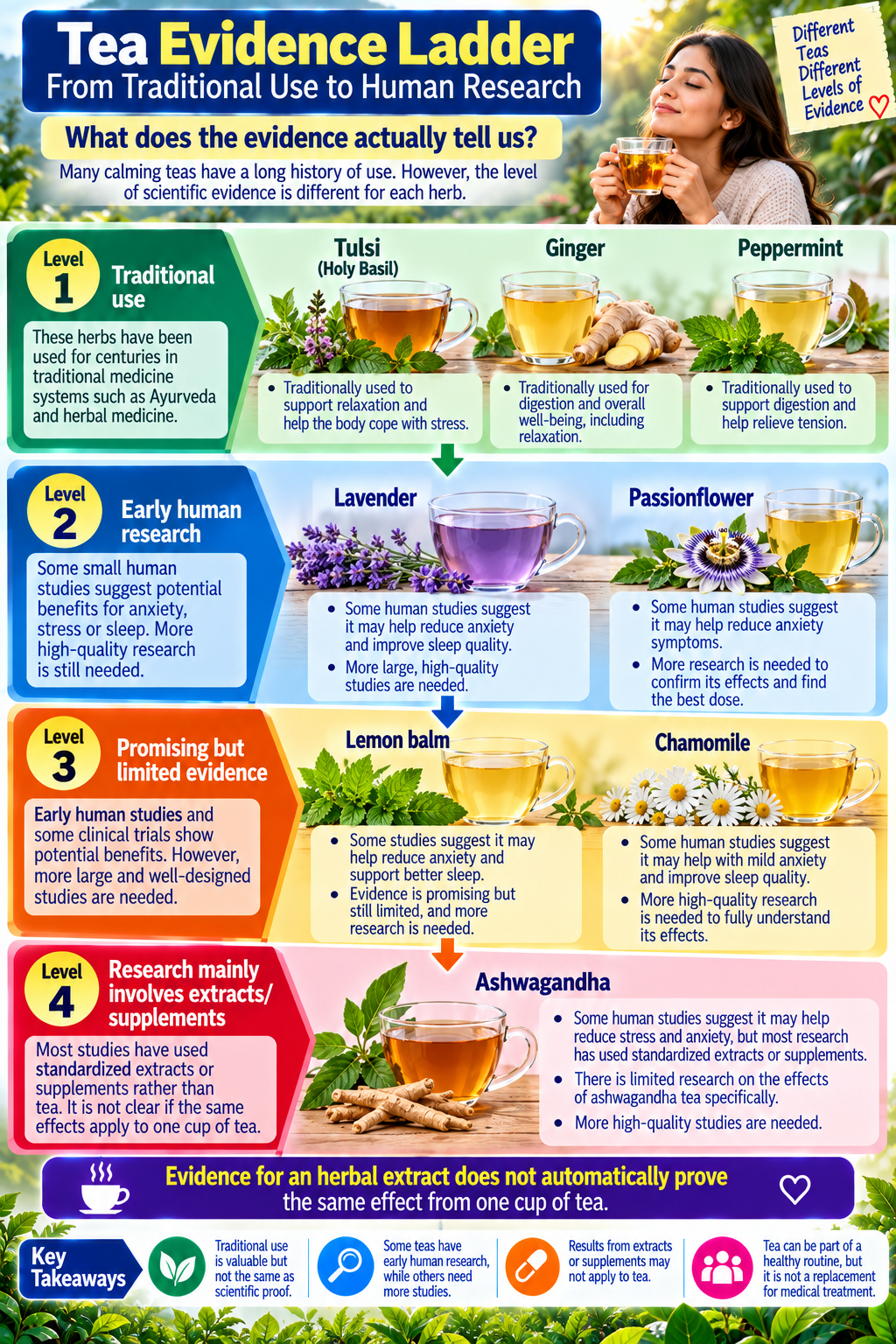
Suppose a clinical trial finds that a concentrated chamomile extract reduces anxiety symptoms. That does not automatically mean that one ordinary cup of chamomile tea will produce the same effect.
The dose, extraction method, chemical composition, duration of use, and study population may all be different.
The same issue applies to ashwagandha, lavender, lemon balm, and other herbs.
For example, a 2026 systematic review included 22 randomized controlled trials of ashwagandha supplementation and found promising effects on stress, depression, and anxiety. However, the researchers noted heterogeneity among studies and said further high-quality trials are needed before the findings can be translated into firm clinical recommendations. PubMed: 2026 Ashwagandha Mental Health Meta-analysis
Therefore, throughout this article, I use phrases such as “may support,” “has been studied,” and “evidence is limited” rather than promising that a particular tea will treat anxiety.
10 Herbal Teas for Calming the Mind Naturally
1. Chamomile Tea
Chamomile is probably the most familiar choice when people think about bedtime or relaxation tea.
It has been investigated for anxiety, sleep, and other conditions. A systematic review and meta-analysis of randomized and quasi-randomized trials found some evidence of benefit for generalized anxiety disorder and sleep quality, but the researchers also noted limited evidence for some other anxiety and insomnia outcomes and called for larger trials. PubMed: Chamomile Systematic Review and Meta-analysis
NCCIH is similarly cautious. It states that some preliminary studies of chamomile dietary supplements suggest possible benefits for generalized anxiety disorder, but the findings are not conclusive. NCCIH: Chamomile—Usefulness and Safety
How to use it
A practical option is to drink caffeine-free chamomile tea during your evening wind-down period.
Instead of drinking it while scrolling through stressful news or work messages, try sitting somewhere quiet for 10 to 15 minutes.
That turns the tea into a behavioral cue for slowing down.
Important safety point
Chamomile is generally considered safe in amounts commonly found in foods and teas, but allergic reactions can occur. People allergic to ragweed or related plants may be more likely to react. NCCIH also notes potential medicine interactions. NCCIH: Chamomile Safety Information
2. Lemon Balm Tea
Lemon balm has a mild citrus aroma and is traditionally used for relaxation.
It also has more scientific interest than many casual “calming tea” lists suggest.
A systematic review and meta-analysis of clinical trials reported improvements in anxiety and depression scores with lemon balm compared with placebo, although the researchers noted substantial variation among studies. This means the findings are promising but should not be interpreted as proof that an ordinary cup of lemon balm tea treats anxiety.
For that reason, it is important to distinguish evidence involving lemon balm preparations from evidence specifically involving tea.
A simple way to try it
Lemon balm works well as an afternoon or early-evening caffeine-free drink.
If you are using it specifically for relaxation, make the drinking experience slow rather than treating it like another beverage to consume while working.
3. Lavender Tea
Lavender is better known for its fragrance and aromatherapy uses, but lavender has also been investigated as an oral preparation.
NCCIH reports that studies of oral lavender oil products have suggested possible benefits for anxiety, but limitations in the research mean definite conclusions cannot yet be reached. NCCIH: Lavender—Usefulness and Safety
That distinction is important because evidence involving oral lavender oil does not automatically establish the same effect from lavender tea.
Why people like it
The floral aroma can make the tea feel different from ordinary beverages.
For some people, that sensory experience becomes part of an evening ritual.
However, avoid presenting lavender tea as a proven treatment for anxiety.
Safety
Lavender products may cause side effects in some people and may increase drowsiness when combined with sedative medicines. NCCIH recommends discussing complementary products with healthcare professionals when medication or other health considerations are involved. NCCIH: Lavender — Usefulness and Safety
4. Passionflower Tea
Passionflower has traditionally been used as a calming herb.
There is some human research suggesting that oral passionflower may reduce anxiety symptoms, including anxiety associated with certain procedures. However, NCCIH says the available evidence is limited and conclusions are not definite. NCCIH: Passionflower — Usefulness and Safety
Passionflower has also been studied for sleep. Some research suggests it may increase total sleep time, although findings about falling asleep and staying asleep are mixed. NCCIH: Passionflower — Usefulness and Safety
When it may fit
Passionflower is better viewed as an occasional calming option rather than something everyone needs to drink every night.
NCCIH says passionflower may be safe as a tea for up to seven nights, while longer-term safety information is less established. Possible side effects include drowsiness, dizziness, and confusion. NCCIH: Passionflower — Usefulness and Safety
People should also avoid using passionflower around surgery unless their healthcare professional recommends it because of possible interactions with anesthesia.
5. Valerian Root Tea
Valerian root is one of the most frequently discussed herbs for sleep.
However, its reputation is stronger than the evidence in some areas.
NCCIH states that there is not enough evidence to determine whether valerian is helpful for anxiety, while research on sleep has produced inconsistent findings. NCCIH: Anxiety and Complementary Health Approaches
That makes valerian an excellent example of why a popular herb should not automatically be described as a proven remedy.
If you try valerian
Do not combine it casually with alcohol or sedative medicines.
NCCIH also notes that long-term safety is unknown and that possible side effects include headache, stomach upset, and mental dullness. NCCIH: Valerian — Usefulness and Safety
6. Tulsi Tea
Tulsi, also known as holy basil, is widely used in Indian traditional wellness practices.
It is a particularly relevant option for readers in India because it is familiar and readily available in many households.
However, traditional use and modern clinical evidence are not the same thing.
Rather than saying that tulsi tea “reduces anxiety” or “balances stress hormones,” it is safer to describe it as a caffeine-free herbal drink that some people include in a relaxing routine.
A practical Indian-style routine
Try tulsi tea during a quiet evening period instead of automatically reaching for another cup of caffeinated chai.
The benefit may come partly from replacing caffeine late in the day and creating a consistent transition from work to rest.
That is a more realistic claim than promising a direct medicinal effect.
7. Ginger Tea
Ginger tea is not primarily an anxiety remedy.
Its strongest practical role in a calming routine may be sensory and digestive.
The warm flavor can be comforting after a meal, and some people prefer it when they want something caffeine-free but more stimulating in flavor than chamomile.
Try this combination.
Fresh ginger can be steeped with water and combined with lemon for taste.
If you add honey, remember that honey contributes added sugar. It is not necessary for the calming effect.
Ginger tea should therefore be presented as a comforting caffeine-free beverage, not as a clinically established treatment for anxiety.
8. Peppermint Tea
Peppermint has a cooling taste that many people find refreshing.
It is particularly popular after meals, while its value in a relaxation routine may be more practical than medicinal.
A cup of peppermint tea can provide a short break from work and reduce the tendency to reach for another caffeinated beverage.
One important caution
Peppermint may aggravate reflux symptoms in some people.
Therefore, someone with frequent heartburn may prefer another caffeine-free option.
9. Green Tea
Green tea is slightly different from the other options on this list.
It contains caffeine.
It also contains L-theanine, an amino acid that has been investigated for stress and cognitive effects.
Recent research on L-theanine has examined whether supplementation affects stress, anxiety, attention, and related outcomes. This evidence should not be interpreted as proof that ordinary green tea treats anxiety because supplement doses and tea consumption are not necessarily equivalent.
Who should be cautious?
If caffeine makes you restless, increases your heart rate, or interferes with your sleep, green tea may not be your best evening drink.
Choose a caffeine-free herbal infusion instead.
10. Ashwagandha Tea
Ashwagandha deserves special treatment because it is often placed in the same category as ordinary herbal teas even though much of its research concerns extracts and supplements.
A 2024 systematic review and meta-analysis of nine randomized controlled trials involving 558 participants reported improvements in perceived stress, anxiety scores, and cortisol with ashwagandha formulations compared with placebo. The researchers also said more information is needed about long-term safety. PubMed: 2024 Ashwagandha Stress and Anxiety Meta-analysis
A newer 2026 systematic review included 22 studies and reported promising effects on stress and anxiety, but the authors emphasized heterogeneity and the need for better-designed trials before firm clinical recommendations can be made. PubMed: 2026 Ashwagandha Mental Health Meta-analysis
The safety issue matters.
NCCIH notes that ashwagandha may cause drowsiness and gastrointestinal problems, while rare cases of liver injury have been reported. It should be avoided during pregnancy and breastfeeding and may interact with thyroid medicines, sedatives, immunosuppressants, diabetes medicines, blood-pressure medicines, and other drugs. NCCIH: Ashwagandha — Usefulness and Safety
For that reason, I would not recommend treating ashwagandha tea like an everyday harmless beverage.
If you are considering concentrated ashwagandha products, discuss them with a healthcare professional, particularly if you take medication or have a medical condition.
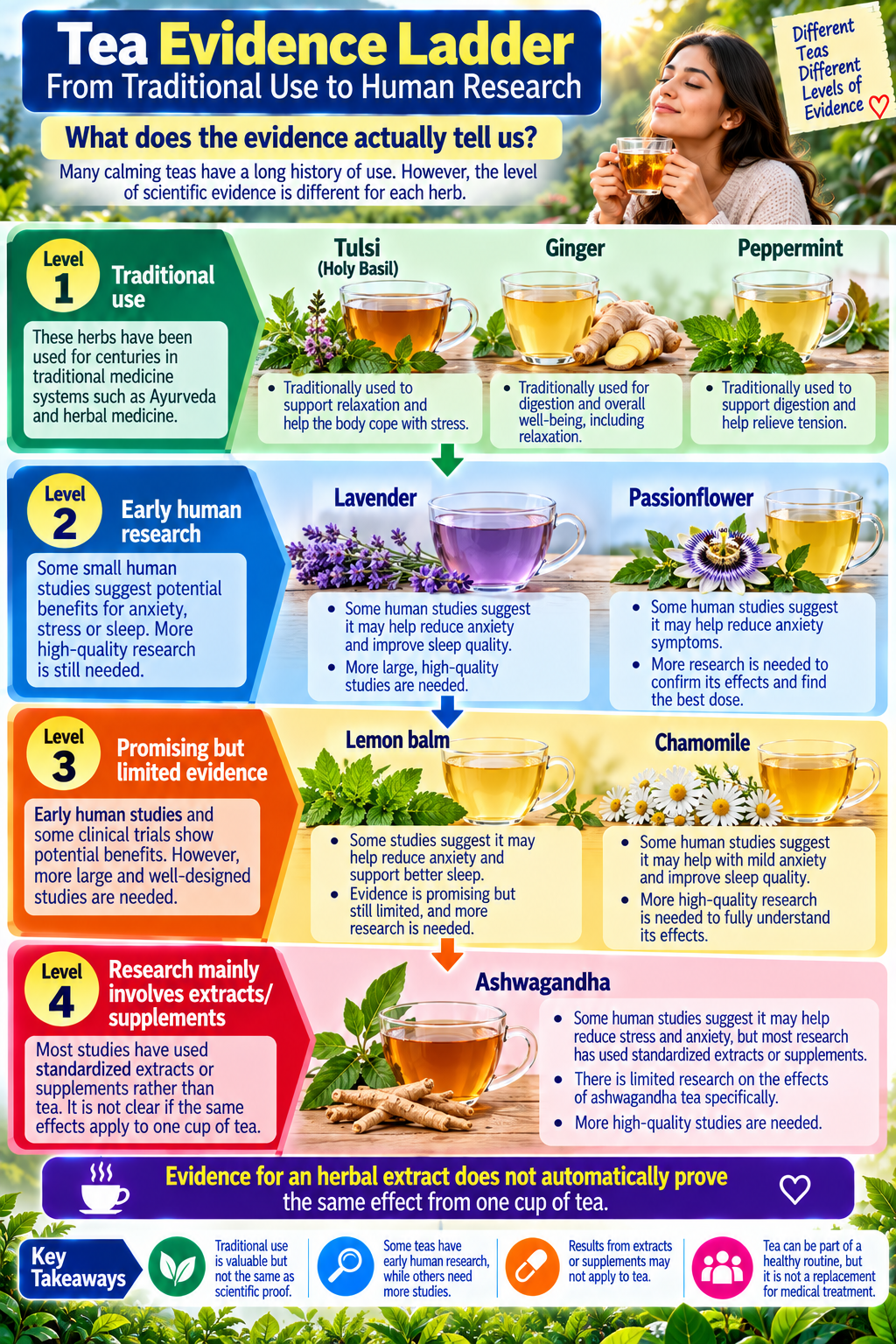
Which Herbal Tea Fits Your Goal?
| Goal | Option to consider | What to know |
|---|---|---|
| Evening wind-down | Chamomile | Some research exists, but the evidence is not conclusive. |
| Citrus-flavored relaxation | Lemon balm | Promising research, but tea-specific evidence is limited. |
| Floral evening drink | Lavender | Evidence is preliminary. |
| Occasional calming routine | Passionflower | Some promising research, but limited evidence |
| Sleep-focused herbal drink | Valerian | Evidence for sleep is inconsistent. |
| Familiar Indian herbal option | Tulsi | Traditional use is extensive; clinical evidence is more limited. |
| Digestive comfort | Ginger | Better known for digestive uses than anxiety |
| Refreshing caffeine-free drink | Peppermint | Useful as a beverage choice; may aggravate reflux |
| Daytime tea | Green tea | Contains caffeine and L-theanine |
| Stress-focused supplement | Ashwagandha | Evidence is mainly from extracts; important safety considerations |
A Better Way to Use Herbal Tea for Stress
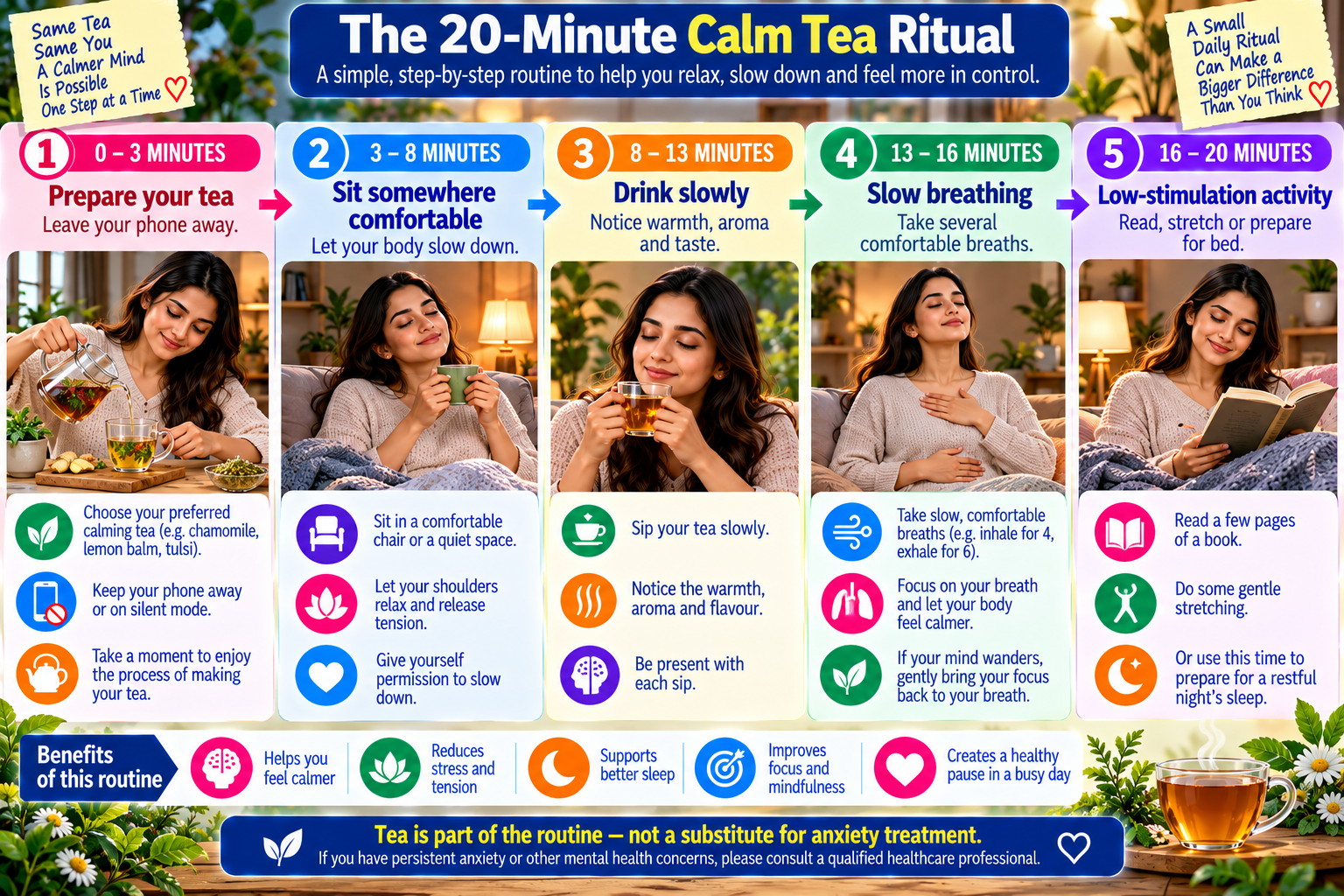
One of the most useful ideas in this entire article is simple:
Do not make the tea the whole strategy. Make it the beginning of a routine.
For example, create a 20-minute evening wind-down.
The 20-Minute Calm Tea Routine
Minute 0–3: Prepare the tea.
Leave your phone away from the kitchen if possible.
Minute 3–8: Sit somewhere comfortable.
Let the tea cool enough to drink comfortably rather than rushing through it.
Minute 8–13: Drink slowly.
Pay attention to the smell, warmth, flavor, and your breathing.
Minute 13–20: Do something low stimulation.
You could read a few pages, stretch gently, write tomorrow’s priorities, or prepare your bedroom for sleep.
The tea becomes a cue for slowing down, rather than something expected to chemically switch off anxiety.
NCCIH’s sleep guidance emphasizes healthy sleep habits and notes that evidence for herbal products such as chamomile and valerian remains inconclusive or inconsistent. NCCIH: Sleep Disorders and Complementary Health Approaches
A Unique Strategy: Match the Tea to the Problem
Instead of asking:
“Which tea is the most powerful?”
ask:
“What problem am I trying to solve?”
If your problem is late-day caffeine, replacing your usual caffeinated drink with a caffeine-free infusion may be more useful than choosing an unfamiliar herb.
If your problem is racing thoughts, combine tea with five minutes of slow breathing.
If your problem is working continuously, use tea preparation as a scheduled break.
If your problem is late-night screen use, keep the phone away while drinking your tea.
If your problem is persistent anxiety, do not keep adding more herbs. Consider whether professional assessment would be more appropriate.
This approach is more sustainable because it addresses the behavior surrounding the tea.
My Personal Experience With Herbal Tea
There was a period when I had difficulty switching off at night and found that my mind stayed active when I wanted to sleep.
I tried several changes rather than relying on one solution.
One of those changes was making herbal tea part of my evening routine.
The first difference I noticed was not an instant disappearance of stress. Instead, the preparation gave me a reason to stop working and slow down.
Over time, the routine became a signal that the day was coming to an end.
That personal experience does not prove that herbal tea treats anxiety or insomnia. It simply shows how a small, repeatable ritual can become part of a healthier evening pattern.
That distinction is important.
Personal experience can tell us what worked for one person. It cannot replace controlled clinical research.
Common Mistakes People Make With Calming Herbal Teas
1. Assuming “natural” means harmless
Herbs contain biologically active compounds.
Some can interact with medicines or cause side effects. NCCIH specifically notes that dietary supplements may have side effects and undesirable interactions with medicines. NCCIH: Anxiety and Complementary Health Approaches
2. Expecting one cup to fix chronic anxiety
A relaxing drink may be pleasant, but persistent anxiety deserves more attention than simply adding another herb.
3. Confusing extracts with tea
This is one of the biggest mistakes.
A study involving a standardized extract cannot automatically be used to claim that the same effect occurs from a normal cup of tea.
4. Drinking caffeine late at night
Green tea is still caffeinated.
If your goal is bedtime relaxation and you are sensitive to caffeine, choose a caffeine-free herbal infusion instead.
5. Mixing several herbs together without checking the ingredients
A commercial “sleep tea” may contain several botanicals.
If you take medication, it becomes harder to know which ingredient might interact with it.
6. Adding large amounts of sugar
A calming drink can quietly become a sugary beverage if you add several teaspoons of sugar or honey.
You do not need a sweetener for the tea to become part of a relaxing routine.
7. Ignoring persistent symptoms
If anxiety, poor sleep, low mood, panic symptoms, or excessive worry continues to interfere with daily life, self-care alone may not be enough.
What the Latest Research Says
The research landscape is becoming more nuanced.
Researchers are increasingly examining which preparation was used, how much was taken, how long it was used, which population was studied, and what outcome was measured.
Chamomile remains promising but not definitive.
A systematic review of randomized and quasi-randomized trials found some evidence supporting chamomile for generalized anxiety disorder and sleep quality, but it also found limited evidence for some other anxiety and insomnia outcomes. PubMed: Chamomile Systematic Review and Meta-analysis
NCCIH remains cautious and describes evidence for chamomile supplements and generalized anxiety disorder as preliminary rather than conclusive. NCCIH: Chamomile—Usefulness and Safety
Ashwagandha research continues to expand
The 2026 meta-analysis included 22 studies and reported promising effects on stress and anxiety, while emphasizing the need for higher-quality trials and better standardization. PubMed: 2026 Ashwagandha Mental Health Meta-analysis
NCCIH nevertheless states that evidence for ashwagandha’s effects on anxiety remains unclear and highlights several important safety considerations. NCCIH: Ashwagandha — Usefulness and Safety
Evidence is not the same for every herb.
NCCIH’s current overview illustrates this clearly: preliminary evidence exists for some herbs, while evidence is insufficient or inconclusive for others. NCCIH: Anxiety and Complementary Health Approaches
This is why a responsible article should not put ten herbs into one category and call all of them “proven calming teas.”
When Herbal Tea Is Not Enough
Herbal tea can be part of self-care.
It should not become a reason to delay professional help.
Consider speaking with a healthcare professional if anxiety:
- continues for weeks or months
- interferes with work or relationships
- repeatedly disrupts sleep
- causes panic symptoms
- makes you avoid normal activities
- becomes difficult to control
- occurs with significant depression or thoughts of self-harm
NCCIH notes that effective conventional treatments for anxiety disorders include psychotherapy and medication, while complementary approaches should not automatically be treated as replacements for established care. NCCIH: 7 Things to Know About Complementary Health Approaches for Anxiety
Who Should Talk With a Healthcare Professional Before Using Herbal Tea?
Extra caution is appropriate if you:
- are pregnant or breastfeeding
- take prescription medicines
- take sedatives or sleep medicines
- take blood thinners
- have liver disease
- have thyroid disease
- have an autoimmune condition
- are preparing for surgery
- have significant allergies
- are giving herbal products to a child
The exact concern depends on the herb.
For example, chamomile can cause allergic reactions and may interact with some medicines, passionflower may cause drowsiness and interact with anesthesia, and ashwagandha has important medication and health-condition cautions. NCCIH: Chamomile—Usefulness and Safety NCCIH: Passionflower — Usefulness and Safety NCCIH: Ashwagandha — Usefulness and Safety
Simple 7-Day Herbal Tea and Relaxation Plan
| Day | Tea idea | Add one calming habit. |
|---|---|---|
| Monday | Chamomile | Five minutes without your phone |
| Tuesday | Lemon balm | Slow breathing |
| Wednesday | Peppermint | Short walk after dinner |
| Thursday | Tulsi | Write tomorrow’s priorities. |
| Friday | Lavender | Read instead of scrolling. |
| Saturday | Ginger | Relax after your evening meal. |
| Sunday | Chamomile | Prepare for a consistent bedtime. |
You do not need to drink a different tea every day.
The purpose of this plan is to experiment with which routine feels sustainable, not to consume as many herbs as possible.
Frequently Asked Questions
What are the best herbal teas for calming the mind naturally?
Chamomile, lemon balm, lavender, and passionflower are among the commonly used options with some human research related to anxiety, relaxation, or sleep. However, the evidence varies, and research on concentrated extracts does not automatically prove that ordinary tea has the same effects. NCCIH: Anxiety and Complementary Health Approaches
Which tea is best before bed?
Caffeine-free options such as chamomile may fit well into a bedtime routine. However, NCCIH notes that clinical evidence for chamomile’s effect on insomnia is not conclusive, so it should not be presented as a proven insomnia treatment. NCCIH: Sleep Disorders and Complementary Health Approaches
Can herbal tea cure anxiety?
No. Herbal tea should not be described as a cure for an anxiety disorder. Some herbs have preliminary or promising evidence for particular anxiety outcomes, but the evidence is not strong enough to treat all anxiety conditions as if they respond to tea. NCCIH: 7 Things to Know About Complementary Health Approaches for Anxiety
Is green tea good for calming the mind?
Green tea contains L-theanine but also caffeine. Because caffeine can be stimulating, green tea may be more appropriate during the daytime than immediately before bed, particularly for people who are caffeine-sensitive.
Can I drink calming herbal tea every day?
That depends on the herb and your health situation. Some herbs are commonly consumed as beverages, but long-term safety is not established for every herbal product. NCCIH specifically notes that long-term safety information for valerian is uncertain and that ashwagandha has important safety limitations. NCCIH: Valerian—Usefulness and Safety NCCIH: Ashwagandha — Usefulness and Safety
Can herbal tea replace anxiety medication?
No. Do not stop prescribed medication and replace it with herbal tea without speaking with the prescribing healthcare professional.
Is chamomile tea safe?
Chamomile is generally considered safe in amounts commonly found in foods and teas, but allergic reactions and drug interactions are possible. People taking medicines should check with a healthcare professional before using it regularly for therapeutic purposes. NCCIH: Chamomile—Usefulness and Safety
Is valerian tea safe?
Valerian appears reasonably safe for short-term use by most adults, but long-term safety is uncertain. It may cause side effects, and its usefulness for anxiety has not been established. NCCIH: Valerian—Usefulness and Safety
Key Takeaways
The best way to think about herbal teas for calming the mind naturally is not as a collection of miracle drinks.
Think of them as potential tools within a broader routine.
Chamomile has some encouraging research, but the evidence remains preliminary. Passionflower has limited evidence, while valerian does not have enough evidence to determine whether it helps anxiety. Lavender research is promising in some preparations but does not establish that lavender tea treats anxiety. NCCIH: Anxiety and Complementary Health Approaches
Ashwagandha is more complicated because much of the research involves supplements or extracts rather than ordinary tea, and its safety profile deserves careful attention. NCCIH: Ashwagandha — Usefulness and Safety
The most sensible approach is therefore not to search for the strongest tea.
Choose a tea that fits your preferences and health situation, use it as part of a consistent relaxation routine, and keep your expectations realistic.
For many people, the real value may come from what happens around the cup: stepping away from work, putting down the phone, breathing more slowly, and giving the mind permission to stop for a while.
Author’s Note
I believe health information should be practical without making promises that science cannot support.
Herbal remedies can be interesting and useful parts of everyday wellness, but “natural” should never be used as a substitute for evidence.
This article separates personal experience from scientific evidence and distinguishes research on teas from research on concentrated herbal preparations.
Medical Disclaimer
This article is for general educational purposes only. It is not a diagnosis or a substitute for individualized medical advice, diagnosis, or treatment.
Herbal products can interact with medicines and may not be appropriate for everyone. If you are pregnant, breastfeeding, taking medication, preparing for surgery, or managing a medical condition, speak with a qualified healthcare professional before using herbal products regularly.
Do not stop prescribed medication because of information in this article.
If you experience severe anxiety, persistent sleep problems, significant depression, panic symptoms, or thoughts of self-harm, seek appropriate professional help.
Fitness Disclaimer
Herbal tea does not replace regular physical activity, adequate nutrition, sleep, or appropriate treatment.
If you use tea as part of a stress-management routine, combine it with activities appropriate for your fitness level. Stop exercise and seek medical advice if you experience concerning symptoms such as chest pain, fainting, severe shortness of breath, or unusual dizziness.
Research Methodology
This article prioritizes evidence from NCCIH and PubMed-indexed systematic reviews, meta-analyses, and randomized controlled trials.
Particular attention was given to whether research studied an actual tea, a standardized extract, or a supplement. This distinction is important because evidence from one preparation cannot automatically be transferred to another.
The research was reviewed and updated in September 2026.
Sources
- NCCIH — Anxiety and Complementary Health Approaches
- NCCIH — Chamomile: Usefulness and Safety
- NCCIH — Passionflower: Usefulness and Safety
- NCCIH — Valerian: Usefulness and Safety
- NCCIH — Lavender: Usefulness and Safety
- NCCIH — Ashwagandha: Usefulness and Safety
- PubMed—Chamomile Systematic Review and Meta-analysis
- PubMed — 2024 Ashwagandha Stress and Anxiety Meta-analysis
- PubMed — 2026 Ashwagandha Mental Health Meta-analysis
- NCCIH — Sleep Disorders and Complementary Health Approaches
Conclusion
A warm cup of herbal tea can be a simple way to create a pause in a busy day.
Some herbs also have promising scientific evidence, but the research is not equally strong for every plant. Chamomile has preliminary evidence related to anxiety, passionflower has limited evidence, valerian lacks sufficient evidence for anxiety, and lavender research does not establish that lavender tea itself treats anxiety. NCCIH: Anxiety and Complementary Health Approaches
Ashwagandha research is particularly important to interpret carefully because many studies involve concentrated preparations rather than ordinary tea, while safety considerations can be significant. NCCIH: Ashwagandha — Usefulness and Safety
The most sensible approach is therefore not to search for the strongest tea.
Choose an option that fits your preferences and health situation, use it as part of a consistent relaxation routine, and keep your expectations realistic.
For many people, the real value may come from what happens around the cup: stepping away from work, putting down the phone, breathing more slowly, and giving the mind permission to stop for a while.
That is a small habit, but small habits become meaningful when they are repeated consistently.
Related Posts
- 10 Best Herbal Remedies to Control Diabetes
- Aromatherapy for Stress Relief and Relaxation: A Comprehensive Guide
- 12 Benefits Of Green Tea For Weight Loss
- 22 Natural Remedies for Anxiety: What Really Works?
- 7 Natural Ways to Reduce Anxiety and Stress Daily: A Comprehensive Guide
- Home
- Category Mind & Mood Care
Post Views: 2,458







[…] 10 Best Herbal Teas for Calming the Mind:A Comprehensive Guide Natural Stress Relief […]
[…] 10 Best Herbal Teas for Calming the Mind:A Comprehensive Guide Natural Stress Relief […]
[…] 10 Best Herbal Teas for Calming the Mind:A Comprehensive Guide Natural Stress Relief […]
[…] 10 Best Herbal Teas for Calming the Mind:A Comprehensive Guide Natural Stress Relief […]
[…] 10 Best Herbal Teas for Calming the Mind:A Comprehensive Guide Natural Stress Relief […]
[…] 10 Best Herbal Teas for Calming the Mind:A Comprehensive Guide Natural Stress Relief […]
[…] 10 Best Herbal Teas for Calming the Mind:A Comprehensive Guide Natural Stress Relief […]
[…] 10 Best Herbal Teas for Calming the Mind:A Comprehensive Guide Natural Stress Relief […]
[…] 10 Best Herbal Teas for Calming the Mind:A Comprehensive Guide Natural Stress Relief […]
[…] 10 Best Herbal Teas for Calming the Mind:A Comprehensive Guide Natural Stress Relief […]
[…] 10 Best Herbal Teas for Calming the Mind:A Comprehensive Guide Natural Stress Relief […]