







































































































































































HIIT or LISS for Fat Loss: Which Workout Is Better for You?
Author: RVLNSV PRASAD
Updated On: October 2026
About Us
Author Bio
Editorial Policy
Contact Us
Introduction
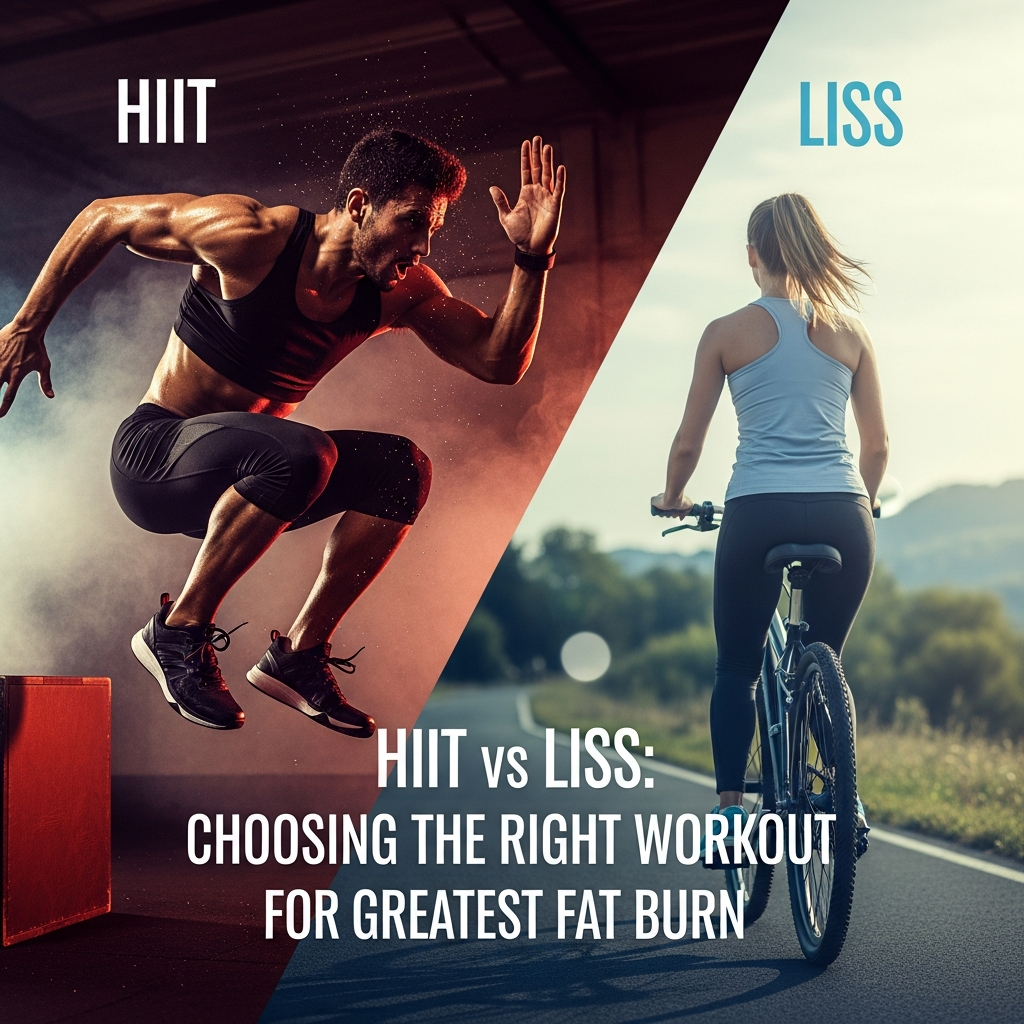
If you are trying to lose body fat, you have probably heard two very different opinions.
One person says HIIT is the fastest way to burn fat.
Another says LISS is better because you can do it for longer.
Then there is the “fat-burning zone,” the afterburn effect, fasted cardio, calorie counting, and countless workout plans that promise faster results.
It can become confusing very quickly.
The good news is that you do not have to choose a workout because it is trending.
The better question is this: Which type of cardio can you perform consistently while fitting your fitness level, recovery, schedule, nutrition, and overall health?
That is where the real HIIT or LISS for fat loss decision begins.
High-intensity interval training can provide a time-efficient way to exercise vigorously. Lower-intensity steady-state activity can make it easier to accumulate movement without creating the same level of fatigue.
Current research does not support the idea that one method is a universal fat-loss winner. A systematic review and meta-analysis comparing HIIT with moderate-intensity continuous training found that both approaches can improve body composition and cardiorespiratory fitness, although outcomes vary according to the population and training protocol. PubMed: HIIT vs Moderate-Intensity Continuous Training Meta-analysis
That is important because online fitness advice often turns a complicated research question into a simple “winner.”
Real life is rarely that simple.
Quick Answer: Is HIIT or LISS Better for Fat Loss?
Neither HIIT nor LISS is automatically better for everyone.
HIIT may be useful if you have limited time, already have a reasonable fitness base, enjoy harder workouts, and can recover well between sessions.
LISS or other moderate, steady-state activity may be useful if you are new to exercise, prefer lower-intensity movement, need more recovery, or want a form of cardio that is easier to repeat frequently.
For many people, the most practical solution is not choosing one forever.
You can use a mixture of moderate activity, occasional vigorous exercise, strength training, and everyday movement.
NIDDK explains that physical activity can help you use more calories and maintain weight loss, while a healthy eating plan that you can maintain over time is an important part of weight management. NIDDK: Eating & Physical Activity to Lose or Maintain Weight
Key Takeaways
- HIIT means alternating harder periods of exercise with recovery periods.
- LISS generally refers to continuous, easier-paced activity performed for a longer period.
- Burning a higher percentage of fat during an individual workout does not automatically mean losing more body fat over time.
- HIIT can be time-efficient but usually creates a greater recovery demand.
- LISS can be easier to repeat and can help you accumulate more physical activity.
- Your total activity, food intake, recovery, sleep, and consistency all matter.
- Beginners do not need HIIT to lose fat.
- Strength training is important when the goal is to lose fat while maintaining muscle.
- A combination of approaches can work well when it fits the person’s life.
- The best workout is one that you can perform safely and continue over time.
What Is HIIT?
HIIT stands for high-intensity interval training.
It involves alternating periods of relatively hard exercise with periods of easier movement or rest.
For example, a workout might include:
- 30 seconds of faster cycling
- 60–90 seconds of easy cycling
- Repeat several times
- Finish with a cool-down
The exact structure can vary.
HIIT does not have to mean sprinting until you feel exhausted.
Intervals can be performed on a stationary bike, rowing machine, elliptical, treadmill, or with selected bodyweight movements.
The important feature is the repeated change between higher-effort and recovery periods.
One reason people like HIIT is efficiency.
A shorter session can provide vigorous exercise without requiring a long continuous workout.
Current U.S. physical-activity guidance recognizes vigorous-intensity exercise as one way adults can accumulate their weekly aerobic activity. ODPHP: Physical Activity Guidelines Questions & Answers
What Is LISS?
LISS commonly means low-intensity steady-state cardio.
It is usually performed at a comfortable, continuous pace.
Examples include
- Brisk or easy walking
- Comfortable cycling
- Easy swimming
- Gentle treadmill walking
- Light elliptical exercise
There is an important terminology issue here.
Scientific research often uses the term moderate-intensity continuous training, or MICT, rather than LISS.
These categories are not always identical.
That distinction matters because many online articles treat LISS as though it were a precisely defined scientific exercise prescription.
It is better to think of LISS as a practical fitness term for relatively easy, steady movement.
Walking is an especially useful example because it requires little equipment and can be incorporated into everyday life.
CDC guidance recommends that adults accumulate at least 150 minutes of moderate-intensity physical activity each week, or 75 minutes of vigorous activity, together with muscle-strengthening activity on at least two days. CDC: Adult Activity Guidelines
HIIT vs LISS: The Main Differences
| Feature | HIIT | LISS / Steady-State Activity |
|---|---|---|
| Intensity | High during work intervals | Low to moderate |
| Workout structure | Work and recovery intervals | Continuous pace |
| Time efficiency | High | Moderate |
| Recovery demand | Usually higher | Usually lower |
| Beginner accessibility | May need modification | Generally easier to begin |
| Equipment | Not always required | Usually minimal |
| Duration | Often shorter | Often longer |
| Effort | Challenging | Comfortable to moderate |
| Best advantage | Time-efficient vigorous exercise | Sustainable activity volume |
| Fat-loss winner | No universal advantage | No universal advantage |
This table should not be interpreted as saying one method is universally superior.
Your training history, personal goals, and enjoyment all influence which approach is likely to work best for you.
How HIIT Can Help With Fat Loss
HIIT can contribute to fat loss because it increases energy expenditure and can improve cardiorespiratory fitness.
It may also be attractive to people who struggle to find long periods of free time.
Imagine two people.
One can exercise for 20 minutes.
The other can comfortably walk for 50 minutes.
The first person may prefer intervals because they can complete a demanding workout within a smaller time window.
That does not make the second person’s approach ineffective.
It simply means their circumstances are different.
A recent systematic review comparing HIIT and sprint interval training found that both interval approaches improved cardiorespiratory fitness and reduced body fat compared with control conditions, although the relative effects varied according to participants’ baseline health and training status. PubMed: HIIT and Sprint Interval Training Meta-analysis
What About the HIIT Afterburn Effect?
This is where many fitness articles exaggerate.
Hard exercise can increase oxygen consumption after the workout. This is known as excess post-exercise oxygen consumption, or EPOC.
The phenomenon is real.
But it should not be treated as a magic fat-loss mechanism.
The calories used after exercise are only one part of the larger energy picture.
If you choose HIIT because you believe the afterburn effect will eliminate the need for sensible nutrition and regular activity, you are likely to be disappointed.
Think of EPOC as a supporting effect rather than the reason to choose HIIT.
How LISS Can Help With Fat Loss
LISS works through a different practical pathway.
It allows you to remain active at a relatively comfortable intensity for longer periods.
That can make it easier to accumulate weekly activity.
Walking is a good example.
You could walk for 30 minutes before work, take a short walk after lunch, or walk in the evening.
Those activities may not feel like a dramatic workout.
They still count as movement.
NIDDK notes that regular physical activity can help with weight management and recommends activities such as brisk walking as part of a healthy lifestyle. NIDDK: Staying Active at Any Size
The important point is that fat loss is not determined by how much fat your body uses as fuel during one specific minute of exercise.
Your longer-term energy balance and behavior matter much more.
Does LISS Burn More Fat Because It Uses More Fat for Fuel?
This is one of the most misunderstood parts of the HIIT vs. LISS discussion.
At lower exercise intensities, a greater proportion of energy may come from fat oxidation.
That does not automatically mean the workout causes more body fat loss.
Your body constantly changes which fuel sources it uses.
What matters for body-fat reduction is the broader energy balance over time.
Think of it this way:
Fat used during exercise ≠ automatic body-fat loss.
NIDDK explains that physical activity increases the calories your body uses and that losing weight requires using more calories than you take in over time. NIDDK: Benefits of Physical Activity
That is why focusing only on the “fat-burning zone” can distract people from the bigger picture.
HIIT or LISS for Fat Loss: What Does the Research Say?
The evidence is more balanced than social media often suggests.
A 2023 systematic review and meta-analysis examined randomized trials comparing HIIT with moderate-intensity continuous training. Both approaches improved body composition and cardiorespiratory fitness, although some outcomes favored HIIT and the magnitude of differences varied. PubMed: HIIT vs MICT Systematic Review and Meta-analysis
A 2025 systematic review examined low-volume interval training, including low-volume HIIT and sprint interval training, in adults with higher weight or obesity. It included 56 studies involving 1,831 participants and found reductions in whole-body fat mass, body-fat percentage, abdominal fat, and visceral fat compared with non-exercise controls. However, the authors noted that the certainty of evidence was low for some comparisons. PubMed: Low-Volume Interval Training and Fat Meta-analysis
This is important because it shows that shorter interval training can be useful.
It does not prove that everyone should replace walking or moderate cardio with HIIT.
The right interpretation is more practical:
HIIT is one effective tool within a larger exercise strategy.
The Most Important Question: Which One Can You Repeat?
This is the people-first part that is often missing from online HIIT vs LISS comparisons.
Suppose HIIT produces a high energy expenditure during a short workout.
But you dislike it.
You dread every session.
Your legs remain sore.
You start skipping workouts.
Your weekly activity falls.
Now compare that with a 40-minute walk that you genuinely enjoy.
You perform it four or five times each week.
Over several months, the easier option may become much more useful because you actually perform it.
That is not laziness.
It is behavior design.
NIDDK emphasizes that healthy eating and physical activity habits need to be sustainable over time and notes that setbacks are normal when people are changing their lifestyle. NIDDK: Eating & Physical Activity to Lose or Maintain Weight
HIIT or LISS for Beginners
If you are completely new to exercise, you do not need to start with all-out intervals.
Start with activities you can control.
Walking is an excellent example.
You might begin with 15–20 minutes and gradually increase the duration.
Once regular exercise becomes comfortable, you can introduce short periods of faster movement if appropriate.
NIDDK’s beginner guidance suggests starting with manageable activity, using the talk test for moderate exercise, and gradually building activity. NIDDK: Tips for Starting Physical Activity
That principle is more useful for beginners than copying an advanced HIIT workout from social media.
A Simple Beginner Progression
Weeks 1–2
Walk 15–25 minutes on most active days.
Weeks 3–4
Increase walking time or pace gradually.
Weeks 5–6
If you feel comfortable, introduce shorter, faster intervals during one session.
After that
Adjust the frequency and intensity according to recovery and goals.
There is no requirement to rush.
HIIT or LISS When You Have Only 20 Minutes
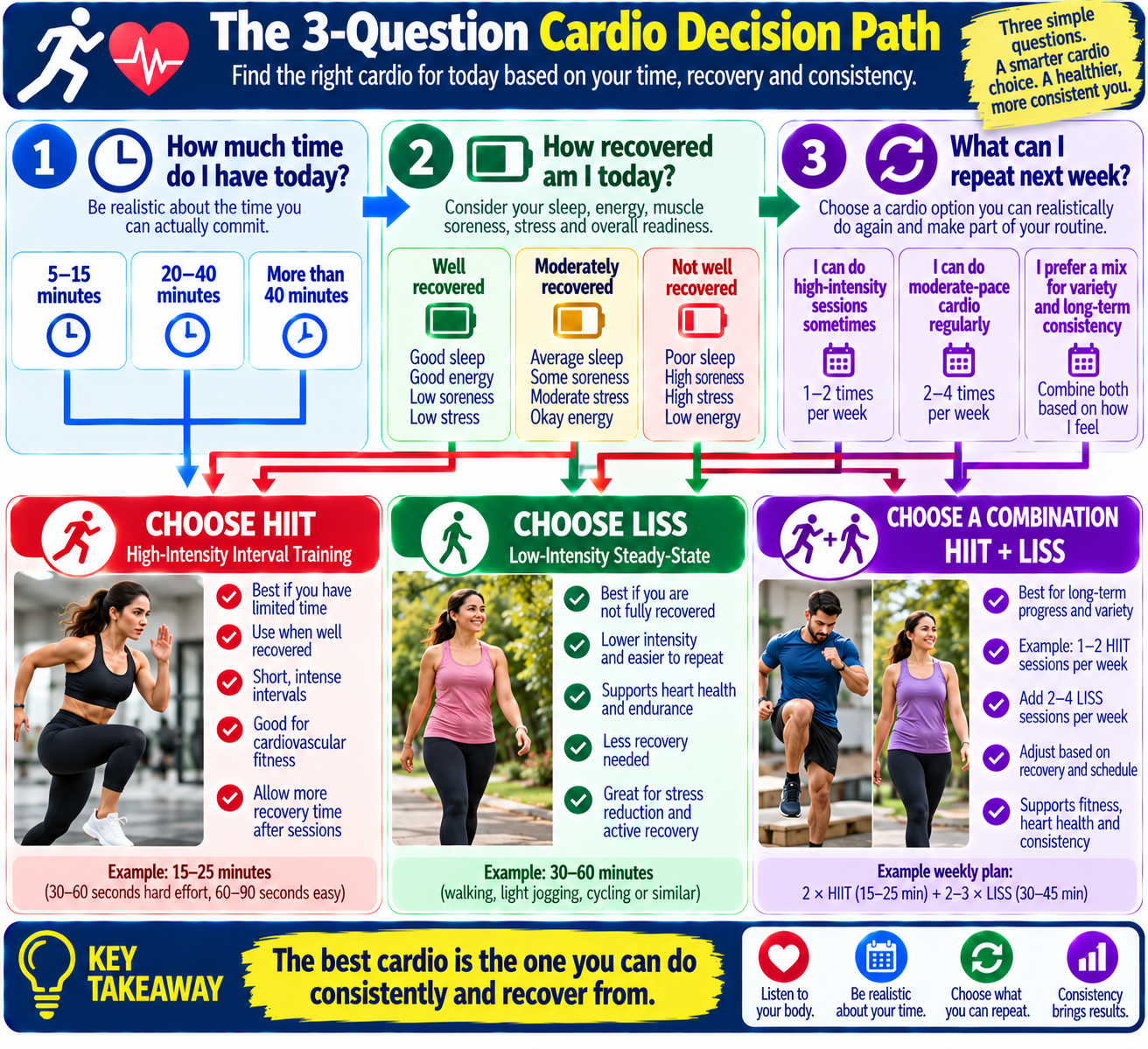
Time pressure is one situation where HIIT may have a practical advantage.
But there is another option that many people overlook.
You can spend those 20 minutes on brisk walking, cycling, stair climbing, or another moderate activity, without turning every short workout into a maximum-effort session.
A 20-minute workout that you perform four times per week may be more useful than a 30-minute HIIT session that you attempt once and abandon.
CDC notes that adults do not have to complete their weekly activity all at once. CDC: Adult Activity Guidelines
HIIT or LISS When Recovery Is Poor
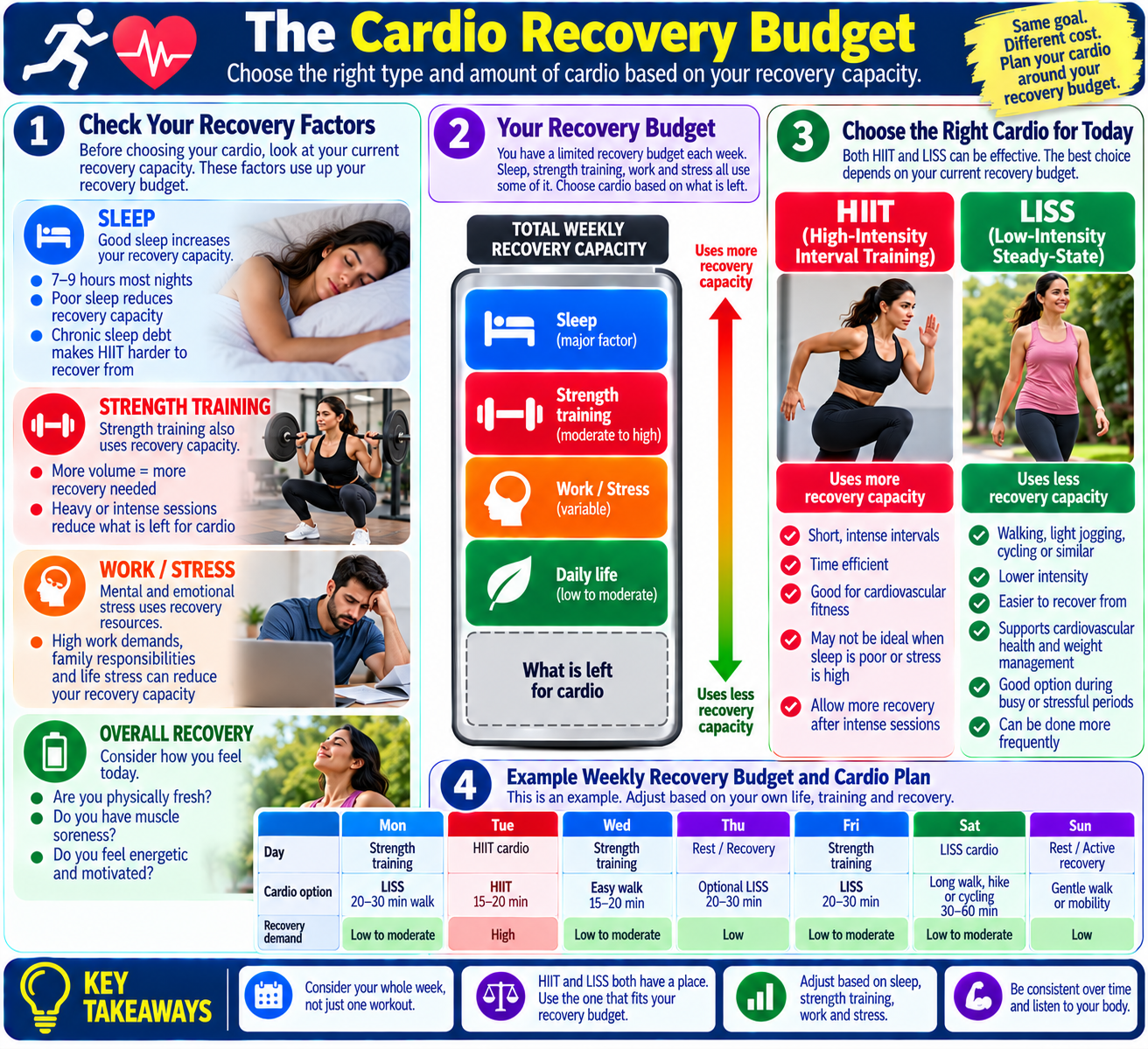
Recovery should influence your decision.
If you are sleeping badly, dealing with significant work stress, or already performing demanding strength workouts, adding repeated high-intensity sessions may not be the smartest move.
That does not mean exercise is bad when you are stressed.
It means the dose matters.
On a difficult week, a walk may be exactly what helps you maintain your routine.
The Green, Yellow, Red Cardio Rule
Green day:
You feel recovered and energetic.
A planned HIIT session may be appropriate if you already have an appropriate fitness base.
Yellow day:
You feel tired but functional.
Choose moderate walking, cycling, or an easier workout.
Red day:
You feel unwell, unusually exhausted, injured, or unable to exercise safely.
Skip the hard workout and address recovery or medical needs.
This simple decision system is more realistic than forcing yourself to follow the same workout regardless of how your body feels.
A People-First Fat-Loss Strategy: Use the Minimum Effective Choice
One of the biggest mistakes in online fitness advice is making every workout complicated.
- You do not need six different cardio machines.
- You do not need a special fat-burning supplement.
- You do not need to train until you are exhausted.
Instead, ask:
What is the smallest amount of exercise I can perform consistently while still moving toward my goal?
- For one person, that may be three brisk walks each week.
- For another, it may be two interval sessions.
- For someone else, it may be a mixture of walking, cycling, and strength training.
This is not about doing less forever.
It is about creating a routine you can actually maintain before increasing the workload.
NIDDK specifically notes that successful weight-management programs should include physical activity plans suited to a person’s health and ability, along with specific goals and support for maintaining healthier habits. NIDDK: Choosing a Safe & Successful Weight-Loss Program
Three Easy Cardio Strategies That Many People Overlook
1. The Walking-After-Meals Strategy
Instead of trying to find one large block of free time, attach short walks to meals.
For example:
- Walk after lunch.
- Walk after dinner.
- Walk while making a phone call.
This turns movement into part of your daily routine.
NIDDK specifically gives walking before work or at lunch as an example of a practical physical-activity goal. NIDDK: Eating & Physical Activity to Lose or Maintain Weight
2. The Commute Upgrade
If practical and safe, walk part of a commute.
Park farther away.
Take stairs when appropriate.
Walk to a nearby shop instead of driving.
These actions may look too small to matter.
Their value is that they can add movement without requiring a separate workout appointment.
WHO’s physical-activity guidance recognizes movement across leisure, transportation, work, and household activities rather than limiting physical activity to formal gym workouts. WHO: Guidelines on Physical Activity and Sedentary Behaviour
3. The Low-Energy Workout Option
Create a workout specifically for days when you do not feel motivated.
For example:
10–20 minutes of comfortable walking.
If you feel better as you exercise, you can continue; if you remain exhausted, it is better to stop and allow your body to recover.
This protects consistency without turning exercise into punishment.
What Should You Eat With HIIT or LISS?
There is no special HIIT diet or LISS diet required for fat loss.
Your eating pattern should support your goals while providing enough nutrients and energy for your activity.
NIDDK recommends a healthy eating pattern that includes vegetables, whole fruits, whole grains, protein foods, nuts, seeds, and other nutrient-dense foods. NIDDK: Eating & Physical Activity to Lose or Maintain Weight
A practical meal can be built around:
- A protein source
- Vegetables or fruit
- A high-fiber carbohydrate when appropriate
- A source of healthy fats
- Water or another suitable beverage
- You do not need to eliminate carbohydrates simply because you are doing HIIT.
- You also do not need to eat special “fat-burning” foods because you are doing LISS.
The Simple Plate Check
Before worrying about supplements, ask:
- Did this meal give me protein?
- Did I include a plant food?
- Will it keep me satisfied?
- Does it fit my overall calorie needs?
This is usually more useful than chasing complicated nutrition rules.
Do You Need Strength Training for Fat Loss?
Cardio is only one part of a complete fitness plan.
Strength training deserves attention because weight loss can involve changes in both fat mass and lean mass.
CDC recommends that adults perform muscle-strengthening activities on at least two days each week in addition to aerobic activity. CDC: Adult Activity Guidelines
NIDDK also notes that muscle-strengthening activity can help maintain muscle mass during aging and weight loss. NIDDK: Health Tips for Adults
Your strength routine does not need to be complicated.
It might include:
- Squats or a squat variation
- A pushing movement
- A pulling movement
- A hip-hinge movement
- Core work
The goal is not to turn every workout into a bodybuilding session.
The goal is to give your muscles a reason to remain strong while you work toward better overall fitness.
Can You Combine HIIT and LISS?
Yes.
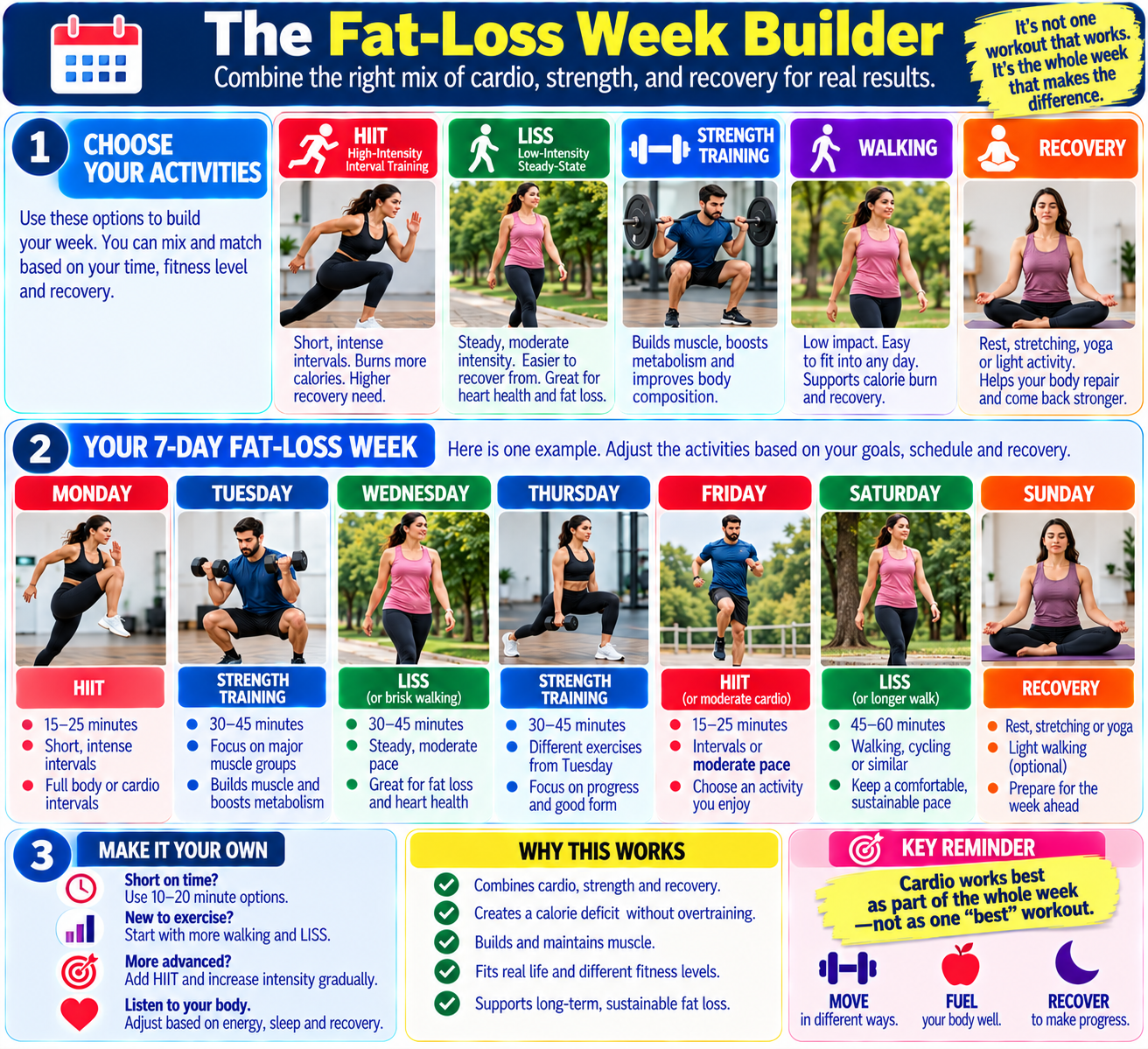
You can combine different forms of aerobic exercise across the week.
For example:
Monday: Strength training + easy walking
Tuesday: HIIT
Wednesday: Easy walking
Thursday: Strength training
Friday: Moderate cycling or brisk walking
Saturday: Optional HIIT or longer walk
Sunday: Rest or gentle movement
This is only an example.
It is not a prescription for every reader.
The amount of exercise should reflect your fitness level, schedule, health status, and ability to recover, with the broader aim of building enough regular activity to support overall health and, when appropriate, weight management.
Common HIIT and LISS Mistakes
Doing HIIT Every Day
More intensity is not automatically better.
Hard training creates a recovery demand.
If every workout becomes a maximum-effort session, fatigue can accumulate.
Believing Sweat Equals Fat Loss
Sweating is a cooling response.
It is not a direct measurement of body fat loss.
Chasing the Fat-Burning Zone
Using more fat as fuel during one workout does not guarantee greater long-term fat loss.
Look at the entire week and your overall energy balance.
Ignoring Strength Training
Cardio is useful.
It should not necessarily replace resistance exercise.
Copying an Advanced HIIT Workout
A workout designed for a trained athlete may be inappropriate for someone who has been inactive for months.
Scale the exercise to your current ability.
Eating Back Every Exercise Calorie
Wearable devices and exercise machines estimate energy expenditure.
They are not perfect calorie meters.
Treat their numbers as estimates rather than automatically consuming every calorie shown.
Changing the Workout Every Few Days
Constantly switching programs makes it difficult to judge what is actually working.
Give a sensible routine enough time to become a habit.
How to Know Your Cardio Plan Is Working
Do not judge success only by the scale.
Look for several signals.
Fitness
- Can you walk farther without becoming as tired?
- Can you complete the same interval session more comfortably?
- Has your endurance improved?
Daily Function
Do stairs feel easier?
Can you stay active longer?
Are you less hesitant about physical activity?
Recovery
Can you recover between sessions?
Are you sleeping reasonably well?
Do you feel capable of completing your next workout?
Body Composition
If fat loss is your goal, look at longer-term trends rather than one morning’s weight.
Waist measurements, clothing fit, progress photographs, body-weight trends, and performance can all provide useful context.
Consistency
This may be the most important measurement.
A moderate routine performed consistently can be more useful than a perfect workout performed occasionally.
NIDDK recommends continuing regular physical activity as part of long-term weight management and notes that tracking progress can help people stay focused. NIDDK: Eating & Physical Activity to Lose or Maintain Weight
What About Belly Fat?
You cannot choose exactly where your body loses fat.
That means neither HIIT nor LISS can selectively remove abdominal fat simply because you performed a particular exercise.
Overall fat loss is influenced by energy balance and many individual factors.
Exercise can still be very valuable.
Regular physical activity provides health benefits even when a person does not achieve the amount of weight loss they hoped for. NIDDK specifically notes that people can still gain important health benefits from regular physical activity even when weight loss or weight maintenance is difficult. NIDDK: Staying Active at Any Size
What About Older Adults?
Older adults can benefit from aerobic and muscle-strengthening activity, but exercise should be appropriately scaled.
CDC includes aerobic activity and muscle-strengthening exercise in its recommendations for adults aged 65 and older, along with balance activities for people with poor mobility. CDC: What You Can Do to Meet Physical Activity Recommendations
That does not mean every older adult should avoid HIIT.
It means intensity should match ability and health status.
Someone who has trained for years may tolerate vigorous intervals very differently from someone who has been inactive.
Individualization matters more than age alone.
When HIIT May Not Be the Best Starting Point
Talk with a healthcare professional before beginning vigorous exercise if you have a medical condition, significant symptoms, or concerns about whether high-intensity activity is appropriate for you.
NIDDK advises people with conditions such as heart disease, high blood pressure, or diabetes to discuss appropriate physical activity with a healthcare professional. NIDDK: Eating & Physical Activity to Lose or Maintain Weight
Stop exercise and seek appropriate medical attention for concerning symptoms such as chest pain, fainting, severe unexplained shortness of breath, or other symptoms that feel abnormal for you.
A fitness goal is never more important than safety.
Latest Research Developments in HIIT and Fat Loss
The most useful development in recent research is not a new “best” workout.
It is a better understanding of context.
Low-Volume HIIT Is Receiving More Attention
A 2025 systematic review and meta-analysis examined 56 studies involving 1,831 adults with higher weight or obesity. Low-volume interval training was associated with reductions in whole-body fat mass, body-fat percentage, abdominal fat, and visceral fat compared with non-exercise controls. The review also found that low-volume HIIT had a greater effect on visceral fat than moderate-intensity continuous training in one comparison, but the authors rated the certainty of evidence as low. PubMed: 2025 Low-Volume Interval Training and Fat Meta-analysis
This is interesting because it challenges the assumption that every effective workout must be long.
The amount of exercise should reflect your fitness level, schedule, health status, and ability to recover, with the broader aim of building enough regular activity to support overall health and, when appropriate, weight management..
HIIT and Sprint Interval Training Continue to Be Studied
A 2025 systematic review and meta-analysis involving nine randomized controlled trials and 666 participants found that both HIIT and sprint interval training improved cardiorespiratory fitness and reduced body-fat mass compared with controls. The relative effects differed according to baseline health and training status. PubMed: HIIT and Sprint Interval Training Meta-analysis
That finding reinforces an important point:
Interval training is useful, but the response depends partly on who is doing it.
HIIT Versus Continuous Training Remains a Nuanced Question
The 2023 systematic review comparing HIIT with moderate-intensity continuous training found improvements from both approaches. PubMed: HIIT vs MICT Systematic Review and Meta-analysis
That makes the strongest evidence-based conclusion less dramatic than many fitness headlines.
There is no reason to tell every reader that HIIT has made steady-state cardio obsolete.
Public-Health Guidance Still Emphasizes Total Activity
CDC recommends at least 150 minutes of moderate-intensity aerobic activity or 75 minutes of vigorous activity per week, plus muscle-strengthening activity on at least two days for adults. CDC: Adult Activity Guidelines
WHO similarly recommends 150–300 minutes of moderate aerobic activity or 75–150 minutes of vigorous aerobic activity for adults, along with muscle-strengthening activities on two or more days each week. WHO: Guidelines on Physical Activity and Sedentary Behaviour
This matters because public health guidance does not require everyone to perform HIIT.
You can achieve meaningful health benefits through different combinations of movement.
My Personal Experience With Choosing Between Hard and Easy Training
I have learned that the hardest workout is not always the most useful workout.
This does not mean HIIT is suitable for everyone; rather, shorter interval protocols can be considered for appropriate people when they fit the individual’s fitness level, health status, and training program.
The difference is not about being lazy.
It is about understanding that training has to fit real life.
A demanding workout can feel productive because it leaves you tired.
But tiredness is not the same thing as progress.
For me, the most useful question is:
Can I recover from this and still want to move tomorrow?
That question changes the way you look at HIIT and LISS.
Instead of searching for the most exhausting workout, you begin searching for the most sustainable one.
That is a much healthier way to build long-term fitness.
A Practical Weekly Framework for Fat Loss
| Day | Activity | Purpose |
|---|---|---|
| Monday | Strength + easy walk | Muscle and movement |
| Tuesday | HIIT or vigorous intervals | Cardiorespiratory fitness |
| Wednesday | Moderate walking | Active recovery |
| Thursday | Strength training | Muscle fitness |
| Friday | Brisk walking or cycling | Aerobic activity |
| Saturday | Optional HIIT or longer walk | Flexible conditioning |
| Sunday | Rest or gentle movement | Recovery |
You do not have to follow this exact schedule.
- If you are a beginner, remove the HIIT sessions initially.
- If you are highly trained, your program may require more sophisticated planning.
The point is to demonstrate how different forms of activity can coexist.
A Better Way to Think About HIIT or LISS for Fat Loss
Instead of asking:
“Which burns more fat?”
Ask:
“Which one helps me create a sustainable weekly routine?”
Then ask:
“Can I recover from it?”
Then:
“Does it fit my schedule?”
Then:
“Do I enjoy it enough to continue?”
Then:
“Does it work alongside my nutrition and strength training?”
This sequence is much more useful than choosing a workout based on calorie-burn claims.
Frequently Asked Questions
Is HIIT or LISS better for fat loss?
Neither is universally better. Both can contribute to fat loss. HIIT can be time-efficient, while LISS or moderate steady-state activity can be easier to repeat.
Does HIIT burn more calories than LISS?
HIIT can produce high energy expenditure in a shorter period because the exercise intensity is higher. However, total energy expenditure depends on duration, intensity, body size, fitness, and the specific activity.
Is LISS better for beginners?
It can be a practical starting point because the intensity is easier to control. Beginners can gradually increase duration and intensity rather than immediately performing demanding intervals.
Can I lose fat with walking?
Yes. Walking contributes to physical activity and energy expenditure. Its effect on body weight depends on your overall diet and activity pattern.
Do I need HIIT to lose belly fat?
No. HIIT is not required for reducing abdominal body fat. Fat loss does not occur only in the body part being exercised.
How many HIIT workouts should I do each week?
There is no universal number. Beginners should first establish a basic activity routine. More experienced people can use interval training according to their goals and recovery capacity.
Can I do HIIT and LISS in the same week?
Yes. Combining vigorous intervals with moderate or easier activity can provide variety and allow you to distribute training stress across the week.
Does LISS burn more fat because it uses fat as fuel?
Not necessarily. Using a higher proportion of fat as an exercise fuel source does not automatically translate into greater long-term body-fat loss.
Is HIIT safe for beginners?
HIIT can be modified, but beginners do not need maximum-effort intervals. Starting with manageable exercise and gradually increasing intensity is a more sensible approach.
What is better for weight loss: HIIT or LISS?
The better choice is the one that helps you maintain an appropriate overall activity level while supporting a sustainable eating pattern and recovery.
Conclusion
The HIIT or LISS for fat loss debate becomes much simpler when you stop looking for a single winner.
HIIT can provide an efficient way to perform vigorous exercise.
LISS and moderate steady-state activity can help you accumulate movement without the same intensity or recovery demands.
Neither method is a magic fat-loss shortcut.
Your results depend on the bigger picture.
That includes your food intake, total physical activity, strength training, sleep, recovery, fitness level, and ability to maintain the routine.
NIDDK emphasizes that long-term weight management is supported by sustainable eating habits and regular physical activity rather than a single short-term intervention. NIDDK: Healthy Eating & Physical Activity for Life
- If you are a beginner, start with manageable movement.
- If you are short on time and already conditioned, HIIT may be useful.
- If you prefer walking or cycling, use them.
- If you enjoy both, combine them.
- The goal is not to find the workout that leaves you exhausted.
- The goal is to build a routine that helps you become healthier and fitter while still fitting into your actual life.
The best cardio for fat loss is not necessarily the hardest one. It is the one you can perform safely, recover from, and continue consistently.
Author Note
I believe fitness advice should make people’s lives easier, not more confusing.
HIIT and LISS are useful tools, but neither should be treated as a miracle solution.
This article focuses on practical exercise choices supported by current research and public health guidance. Individual responses to exercise can differ, so readers should adapt the approach to their fitness level, health status, preferences, and goals.
Author: RVLNSV PRASAD
Medical Disclaimer
This article is for general educational purposes and does not provide individual medical advice, diagnosis, or treatment.
Exercise recommendations may need to be modified for people with cardiovascular disease, metabolic conditions, injuries, disabilities, pregnancy, or other health concerns.
If you have a medical condition, have been inactive for a long period, or are unsure whether vigorous exercise is appropriate for you, speak with a qualified healthcare professional before starting a demanding exercise program.
If exercise causes chest pain, fainting, severe unexplained shortness of breath, or another concerning symptom, stop and seek appropriate medical care.
Fitness Disclaimer
This article does not replace individualized exercise programming from a qualified fitness professional.
The sample schedules are examples, not prescriptions.
Do not copy an advanced HIIT workout simply because it appears online.
Increase exercise gradually and allow adequate recovery.
Your appropriate workout intensity depends on your current fitness, training history, health, age, goals, and ability to recover.
Sources
- NIDDK — Eating & Physical Activity to Lose or Maintain Weight
- NIDDK — Keep Active & Eat Healthy to Improve Well-being
- NIDDK — Tips to Help You Get Active
- NIDDK — Tips for Starting Physical Activity
- NIDDK — Treatment for higher weight & Obesity
- CDC — Adult Activity: An Overview
- WHO — Physical Activity Guidelines
- WHO — Guidelines on Physical Activity and Sedentary Behaviour
- WHO — Evidence Profiles for Physical Activity Guidelines
Related Articles
- Active Living
- Balancing Health: The Key to Sustainable Energy and Health
- 10 Best Exercises to Lose Belly Fat
- 7 Effective Cardio Exercises for Weight Loss: The Ultimate Guide
- Train Smarter, Not Harder: Optimizing Workouts for Maximum Results
- HIIT Workouts for Beginners: How to Start and See Results Fast










[…] HIIT vs LISS: Choosing the Right Workout for Greatest Fat Burn […]
[…] HIIT vs LISS: Choosing the Right Workout for Greatest Fat Burn […]
[…] HIIT vs LISS: Choosing the Right Workout for Greatest Fat Burn […]
[…] HIIT vs LISS: Choosing the Right Workout for Greatest Fat Burn […]
[…] HIIT vs LISS: Choosing the Right Workout for Greatest Fat Burn […]