




























































































































































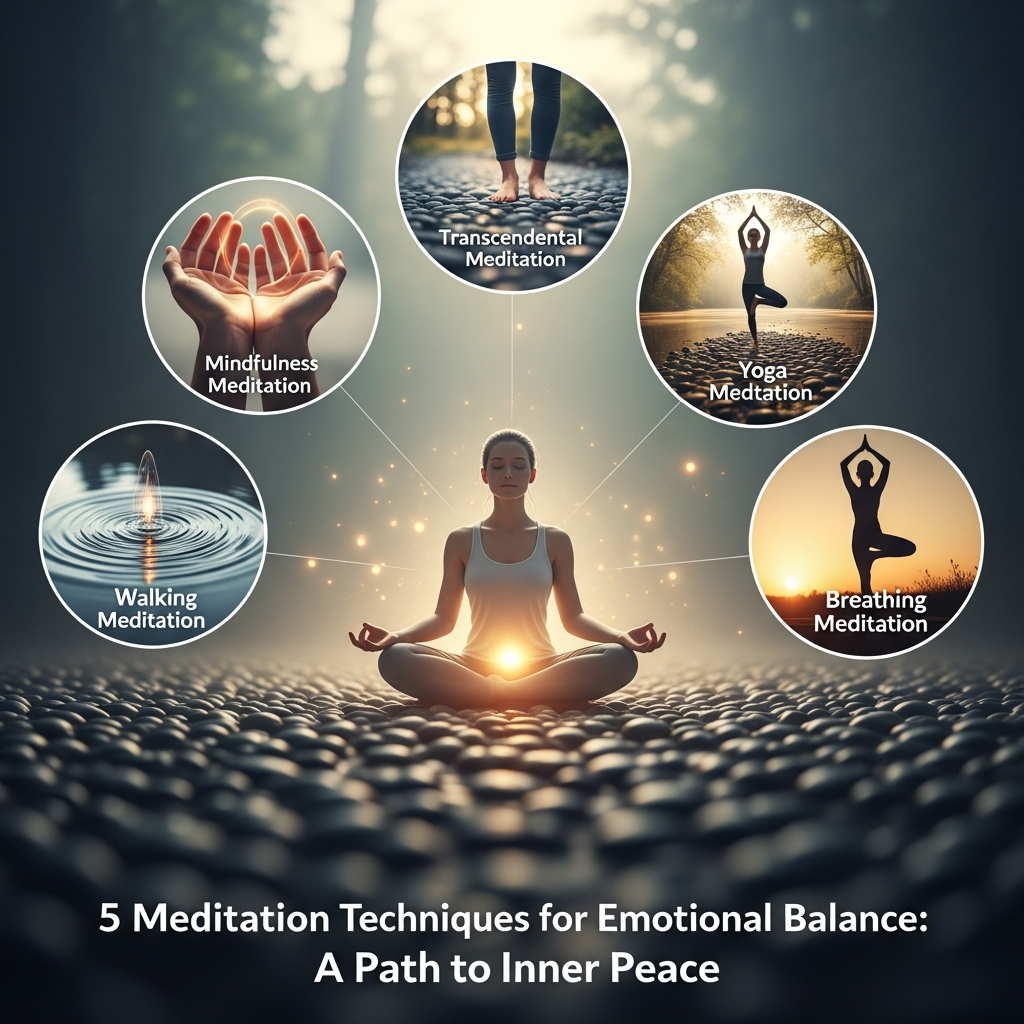
5 Meditation Techniques for Managing Emotions: An Evidence-Based Guide
Author: RVLNSV PRASAD
Updated On: September 2026
About Us
Author Bio
Editorial Policy
Contact Us
Introduction
Emotions are not a problem that needs to disappear. Anger, worry, sadness, frustration, fear, and excitement are normal parts of being human. The challenge is what happens after an emotion appears.
You may react immediately to an angry message, keep replaying an embarrassing conversation, become overwhelmed by worry, or say something you later regret. In these moments, the goal is not to force yourself to “think positive.” A more useful skill is learning to notice what is happening before automatically reacting.
That is where meditation techniques for managing emotions can become useful.
Meditation does not mean sitting perfectly still with an empty mind. Many practices involve paying attention to breathing, bodily sensations, thoughts, or feelings without immediately judging or acting on them. The National Center for Complementary and Integrative Health explains that meditation and mindfulness include a range of mind-body practices rather than one single technique. NCCIH — Meditation and Mindfulness: Effectiveness and Safety
Importantly, the research is becoming more specific. A 2026 systematic review and meta-analysis of 19 randomized controlled trials examined mindfulness-based interventions and emotional regulation. The researchers reported improvements in cognitive reappraisal and reductions in overall emotional dysregulation, while also noting important limitations in the available evidence. PubMed—2026 Systematic Review and Meta-analysis of Mindfulness and Emotion Regulation
That does not mean meditation instantly controls emotions or replaces professional treatment. It suggests that certain mindfulness-based practices may help people develop a different relationship with difficult thoughts and feelings.
This guide focuses on five practical techniques you can try at home, explains which technique may fit different emotional situations, and separates promising evidence from claims that go beyond the research.
Quick Answer: What Are the Best Meditation Techniques for Managing Emotions?
Five practical options are
- Mindful breathing for emotional intensity, worry, or mental overload.
- Body scan meditation for physical tension and emotions that feel difficult to identify.
- Loving-kindness meditation for self-criticism, resentment, or emotional harshness.
- Observing thoughts meditation for rumination and repetitive thinking.
- Guided visualization for creating a calmer mental focus when you feel overwhelmed.
No single technique is best for everyone.
The useful question is not, “Which meditation is the most powerful?”
Instead, ask:
“What is happening in my mind and body right now?”
Then choose a practice that matches the situation.
Key Takeaways
- Meditation can help develop awareness of thoughts, feelings, and bodily sensations.
- Mindfulness-based interventions may improve some aspects of emotion regulation.
- The 2026 evidence is encouraging but does not justify claiming that meditation works for everyone.
- Mindful breathing is a practical starting point during emotional overload.
- Body scans can help you notice physical signs of stress before they become overwhelming.
- Loving-kindness meditation may be particularly useful when self-criticism dominates.
- Observing thoughts can help create distance from repetitive thinking.
- Guided visualization gives some beginners a structured alternative to silent meditation.
- Meditation should not be used as a replacement for appropriate mental health treatment.
- If meditation repeatedly increases distress, modify the practice or seek professional guidance.
What Does “Managing Emotions” Actually Mean?
Managing emotions does not mean suppressing them.
Suppression means trying to push an emotion away or pretending that you do not feel it. Emotional regulation is broader. It can involve noticing an emotion, understanding what is happening, changing your response, tolerating discomfort, or choosing an action that fits your goals.
For example, imagine receiving an upsetting message.
The first reaction might be anger.
The automatic response could be sending an aggressive reply.
A regulated response might look different. You notice the anger, feel the tension in your body, pause for a moment, and decide to respond later.
The emotion has not necessarily disappeared.
Your response has changed.
This distinction is important because meditation should not be marketed as a way to eliminate normal emotions.
How Meditation May Help With Emotional Regulation
Meditation practices differ, but many involve three basic skills:
Notice → Pause → Choose
You first notice what is happening.
Then you create a small pause before automatically reacting.
Finally, you choose what to do next.
Mindfulness research has proposed several possible pathways through which these practices may influence emotional regulation, including greater awareness of thoughts and bodily sensations and less automatic reactivity. Research examining mindfulness and mind-body interventions has also investigated the relationship between bodily awareness and emotional regulation. PubMed—Research on Mindfulness, Interoception, and Emotion Regulation
This is why meditation can be more useful when practiced regularly rather than only during a crisis.
You are essentially practicing the pause when the emotional stakes are low.
1. Mindful Breathing Meditation
Mindful breathing is one of the simplest meditation techniques for managing emotions because you do not need special equipment or a complicated routine.
The basic idea is straightforward: place attention on the natural movement of your breathing and return to it whenever your attention wanders.
Mayo Clinic describes mindfulness exercises that use attention to breathing and present-moment awareness as practical ways to develop mindfulness. Mayo Clinic — Mindfulness Exercises
How to practice
Sit comfortably.
Let your shoulders relax without forcing them downward.
Notice the sensation of breathing.
You might feel air moving through your nose, your chest expanding, or your abdomen moving.
There is no need to change your breathing pattern.
When thoughts appear, notice them.
Then gently return your attention to the breath.
Try this for 2 to 5 minutes initially.
If that feels comfortable, gradually extend the practice.
When it may help
Mindful breathing can be particularly practical when you are:
- Mentally overloaded
- Worried about an upcoming event
- Irritated after an argument
- Stuck in repetitive thoughts
- Having difficulty shifting attention
- Feeling emotionally overwhelmed
NCCIH explains that mindfulness and meditation have been studied for stress and anxiety, although the evidence varies according to the specific practice, condition, and research design. NCCIH — Stress and Mindfulness
For anxiety specifically, NCCIH summarizes evidence on meditation and other complementary approaches and emphasizes that these practices should not automatically be treated as substitutes for established treatment. NCCIH — Anxiety and Complementary Health Approaches
A useful real-life version
You do not always need a 20-minute meditation session.
Before answering an upsetting message, try three slower, comfortable breaths while noticing the physical sensation of breathing.
Then ask:
“Do I want to react right now or respond after I have settled?”
That small pause is often more realistic than trying to become completely calm.
2. Body Scan Meditation
Some emotions first appear in the body.
You may notice a tight jaw when angry, a heavy chest when worried, tense shoulders during stress, or an unsettled stomach before an important event.
A body scan helps you notice these sensations without immediately trying to eliminate them.
How to practice
Sit or lie somewhere comfortable.
Bring attention to your feet.
Notice sensations such as warmth, pressure, tingling, tension, or heaviness.
Slowly move your attention upward through your legs, hips, abdomen, chest, shoulders, arms, neck, and face.
You do not need to decide whether a sensation is good or bad.
Simply notice it.
If you discover tension, try softening the surrounding muscles rather than forcing the sensation away.
What does the evidence say?
A systematic review and meta-analysis examined body-scan meditation and found evidence of a small effect on mindfulness compared with passive controls. However, the researchers also reported substantial variation and limitations in the available studies. PubMed—Body Scan Meditation Systematic Review and Meta-analysis
That distinction matters.
The body scan is better presented as a practical awareness exercise rather than a guaranteed treatment.
Try the “emotion location” method.
This is one simple variation that deserves more attention in everyday meditation.
When an emotion appears, ask:
“Where do I feel this emotion in my body?”
Instead of repeatedly thinking:
“I am angry.”
You might notice:
“My jaw is tight, my shoulders are raised, and my stomach feels tense.”
This can make an abstract emotional experience more concrete.
3. Loving-Kindness Meditation
Loving-kindness meditation involves deliberately directing feelings or phrases of kindness toward yourself and other people.
It can be especially relevant when your emotional difficulty involves self-criticism, resentment, shame, or interpersonal tension.
A simple practice
Sit comfortably.
Take a few natural breaths.
Then silently repeat phrases such as
- “May I be safe.”
- “May I be healthy.”
- “May I meet this difficult moment with kindness?”
After a few repetitions, you can extend similar wishes toward someone you care about.
You do not need to force yourself to feel loving or forgiving.
The practice is about intentionally cultivating a kinder mental attitude.
What does research show?
Research on loving-kindness meditation is interesting but should not be exaggerated.
A 2024 systematic review and meta-analysis examined 23 randomized controlled studies and reported positive effects compared with passive controls on several outcomes, including mindfulness, compassion, positive affect, negative affect, and psychological symptoms. However, several effects were not significant when loving-kindness meditation was compared with active controls or alternative treatments. PubMed — 2024 Loving-Kindness Meditation Systematic Review and Meta-analysis
An earlier meta-analysis of 24 studies also found improvements in positive emotions while emphasizing the need for additional research to clarify the mechanisms and components responsible for the effects. PubMed — Loving-Kindness Meditation and Positive Emotions Meta-analysis
When to use it
Try loving-kindness meditation when you notice:
- Harsh self-talk
- Regret
- Self-blame
- Difficulty forgiving yourself
- Interpersonal resentment
- Emotional exhaustion
You do not have to forgive someone immediately.
A more realistic goal is to reduce the amount of mental energy you spend repeatedly attacking yourself or another person.
4. Observing Thoughts Meditation
This technique is particularly useful when the problem is not one strong emotion but a stream of repetitive thoughts.
Perhaps you keep replaying an argument.
Maybe you are predicting everything that could go wrong.
You may repeatedly criticize yourself over something that happened yesterday.
Observing-thoughts meditation teaches you to notice these mental events without automatically treating every thought as a fact.
How to practice
Sit comfortably and close your eyes if that feels safe.
Allow thoughts to come and go.
When a thought appears, mentally label it in a simple way:
“Planning.”
“Worrying.”
“Remembering.”
“Judging.”
“Comparing.”
Then return to your breath or another neutral point of attention.
Why this can be useful
A thought such as
“I always make mistakes.”
can feel like a fact when you are emotionally overwhelmed.
Observing it as
“I am having the thought that I always make mistakes.”
creates a little distance.
That does not prove the thought is false.
It simply separates the thought from your identity.
The 2026 systematic review and meta-analysis is relevant here because it found improvements in cognitive reappraisal and reductions in emotional dysregulation following mindfulness-based interventions. PubMed—2026 Systematic Review and Meta-analysis of Mindfulness and Emotion Regulation
5. Guided Visualization Meditation
Silent meditation is not comfortable for everyone.
If your mind becomes busier when you sit quietly, guided visualization may provide more structure.
The practice involves deliberately creating a calm mental image or following a structured verbal guide.
You might imagine:
- Sitting beside a quiet lake
- Walking through a peaceful garden
- Sitting somewhere familiar and safe
- Watching clouds move across the sky
- Moving through a familiar, relaxing evening routine
The purpose is not to pretend that your problems do not exist.
Instead, the visualization gives attention something structured to work with.
A five-minute version
Close your eyes if comfortable.
Imagine a place where you feel relatively safe and undisturbed.
Notice three details.
Perhaps you can imagine the temperature, sounds, and surroundings.
Take slow, comfortable breaths while maintaining attention on the scene.
If worries appear, acknowledge them and return to the image.
After five minutes, open your eyes and identify one practical action you can take next.
This final step is important.
Calmness should support action rather than become an escape from necessary action.
Which Meditation Should You Choose?
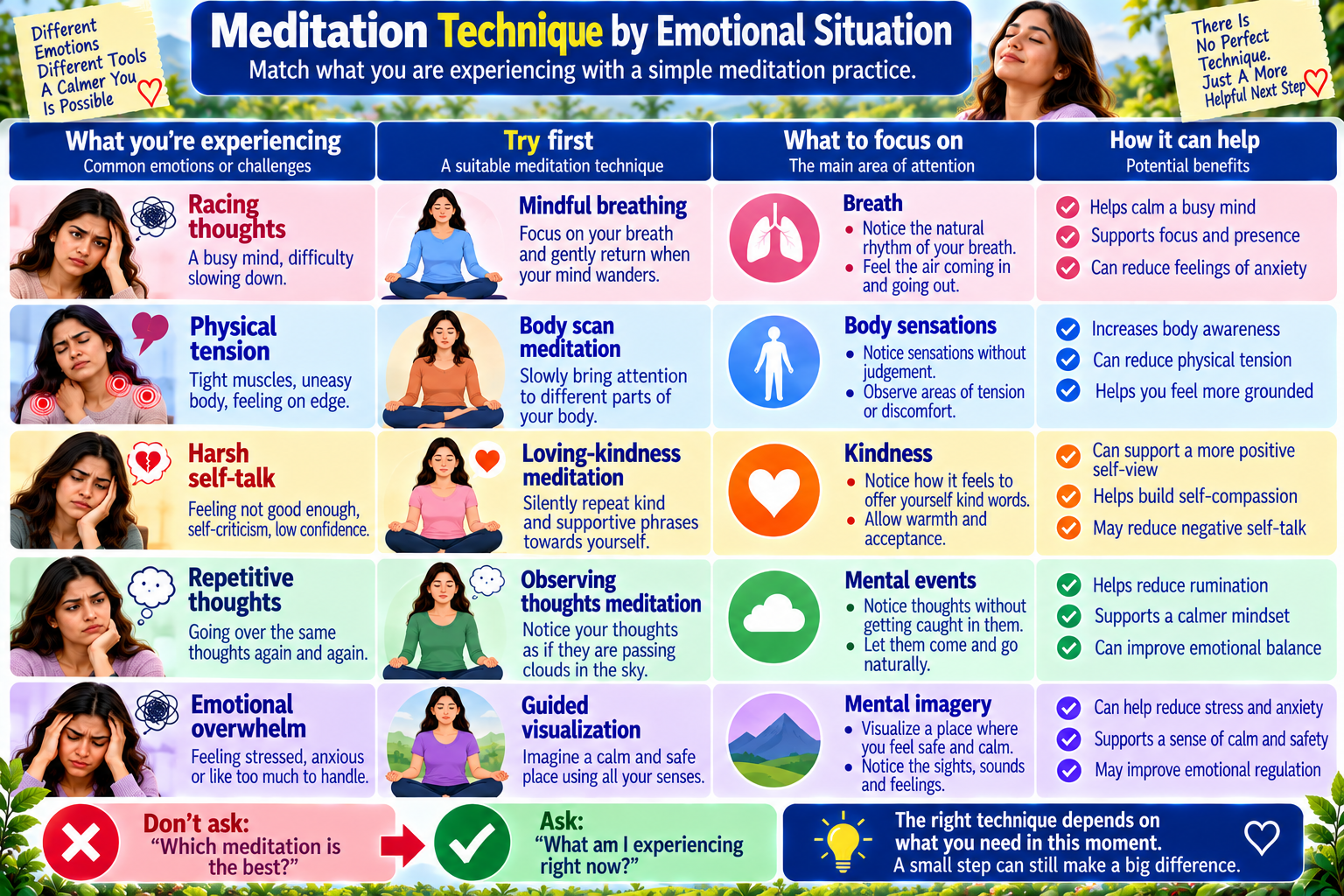
| Emotional situation | Technique to try | Simple starting point |
|---|---|---|
| Racing thoughts | Mindful breathing | 2–5 minutes |
| Physical tension | Body scan | 5–10 minutes |
| Harsh self-criticism | Loving-kindness | 5 minutes |
| Repetitive thinking | Observing thoughts | 5 minutes |
| Feeling overwhelmed | Guided visualization | 5 minutes |
| Mild everyday stress | Mindful breathing | 2–10 minutes |
| Difficulty identifying feelings | Body scan | 5–10 minutes |
This table is not a medical treatment algorithm.
Think of it as a practical starting point.
A Better Approach: Match the Practice to the Emotion
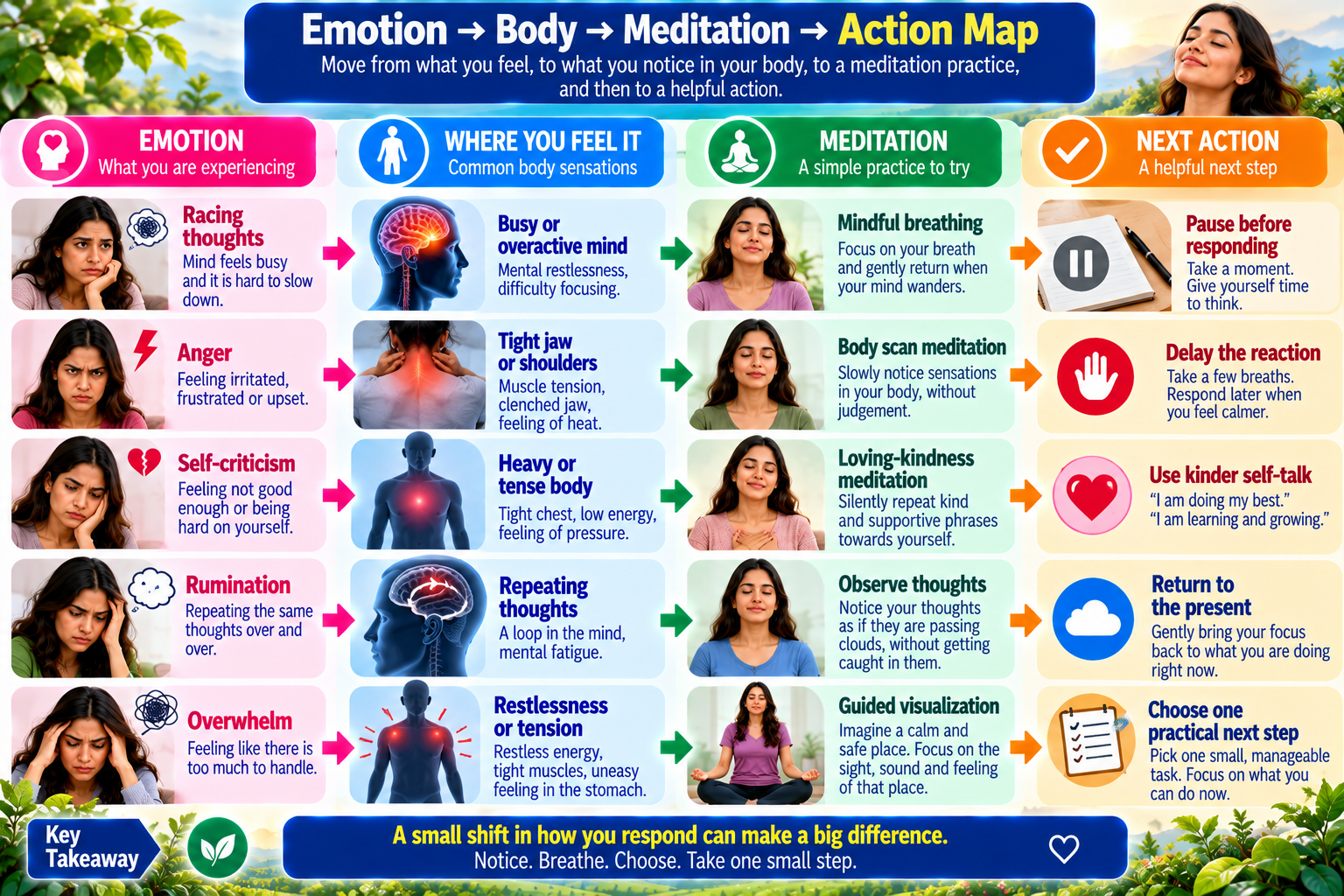
One weakness of many meditation articles is that they give everyone the same routine.
Real life is more complicated.
The meditation that helps during anger may not be the one that feels useful during self-criticism.
Try this simple Emotion → Body → Practice → Action method.
Step 1: Name the emotion.
Ask:
“What am I feeling?”
You might choose one word such as “anger,” “fear,” “sadness,” “frustration,” “shame,” “jealousy,” or “worry.”
Step 2: Locate it.
Ask:
“Where do I notice it physically?”
Look for tension, heaviness, warmth, restlessness, or pressure.
Step 3: Choose the meditation.
- Use breathing for intensity.
- Use body scanning for physical tension.
- Use loving-kindness for harsh self-talk.
- Use observing thoughts for rumination.
- Use visualization when you need more structure.
Step 4: Decide what happens next
Ask:
“What response would help rather than make this situation worse?”
This final question turns meditation into a practical emotional skill.
The 2-Minute Emotional Reset
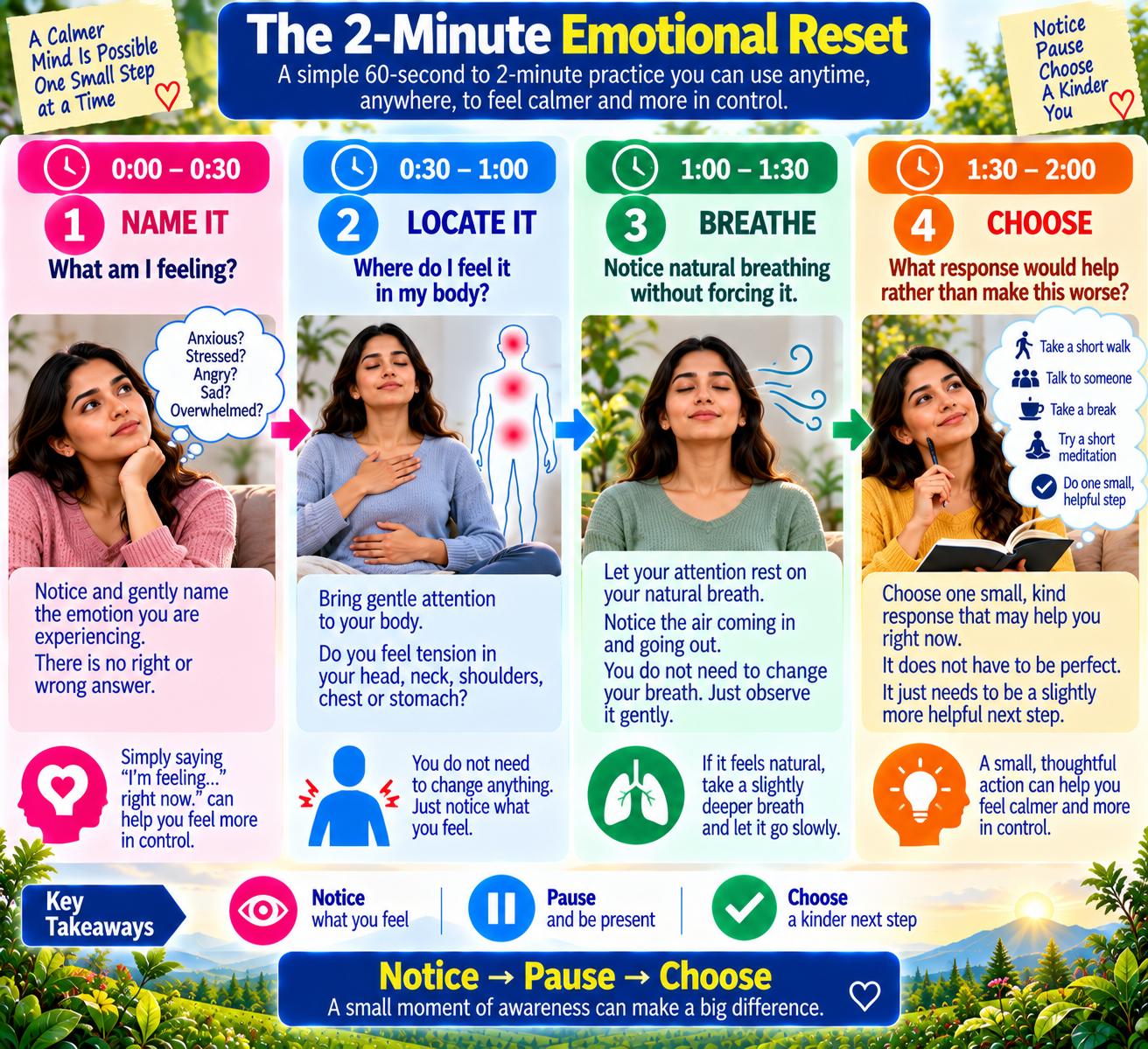
You do not need to meditate for an hour.
Try this short routine when emotions rise.
- First 30 seconds: Identify the emotion.
- Next 30 seconds: Notice where you feel it in your body.
- Next 30 seconds: Follow your natural breathing.
- Final 30 seconds: Ask what response fits your values and the situation.
For example, after receiving an angry email, you might identify irritation, notice tension in your shoulders, follow three comfortable breaths, and decide to draft a response without sending it immediately.
That is not emotional suppression.
It is creating space between an emotional trigger and an automatic action.
What the Latest Research Says About Meditation and Emotional Regulation
The research has moved beyond the simple question of whether meditation “relaxes you.”
Researchers are increasingly studying specific processes such as emotion regulation, cognitive reappraisal, emotional dysregulation, attention, interoception, and brain activity.
2026 systematic review: emotion regulation
One of the most relevant recent developments is the 2026 systematic review and meta-analysis of mindfulness-based interventions in people with mental health conditions.
Researchers identified 19 randomized controlled trials and included 16 studies in their meta-analyses, representing 988 participants.
They found significant improvements in cognitive reappraisal and reductions in overall emotional dysregulation. Improvements were also reported in areas involving goal-directed behavior, impulsivity, and access to emotion-regulation strategies. However, expressive suppression did not show a statistically significant effect, and the authors highlighted limitations involving study quality, younger populations, and self-report measures. PubMed — 2026 Systematic Review and Meta-analysis of Mindfulness and Emotion Regulation
That is a more useful interpretation than saying:
“Meditation controls your emotions.”
The evidence suggests potential benefits for certain aspects of emotional regulation, but it does not prove that every meditation technique will produce the same result for every person.
2026 research on the brain
Another 2026 systematic review and whole-brain meta-analysis examined functional neuroimaging research across meditation practices.
The analysis included 34 primary studies involving 700 people and examined practices including focused attention, open monitoring, mantra meditation, and loving-kindness meditation. PubMed—2026 Meta-analysis of Meditation Neuroimaging Research
Brain-imaging findings can help researchers investigate possible mechanisms, but they should not be converted into simplistic claims such as “meditation permanently rewires your brain” or “meditation activates one specific emotion-control center.”
Brain research is useful for understanding mechanisms.
It is not proof that an individual will experience a particular emotional outcome.
Meditation Is Not the Same as “Stopping Negative Thoughts”
This is an important misconception.
A beginner may sit down and think:
“I am supposed to stop thinking.”
Then thoughts continue.
The person concludes:
“I’m bad at meditation.”
That is the wrong standard.
The practice is often the return, not the absence of distraction.
Your mind wanders.
You notice the thought, then gently bring your attention back to the present.
It happens again.
You return again.
That repeated process is part of the practice.
Common Mistakes That Can Reduce the Benefit
Trying to force yourself to feel calm
Meditation is not a command to become calm immediately.
Some sessions may feel peaceful.
Others may feel restless.
Both experiences can happen.
Using meditation to avoid a real problem
Meditation can help you respond more thoughtfully, but it cannot replace an overdue conversation, a medical appointment, a financial decision, or professional mental health care.
Starting with very long sessions
A 30-minute routine may look impressive, but a two-minute practice that you actually repeat can be more realistic for a beginner.
Judging every session
A difficult meditation session is not necessarily a failed meditation session.
Expecting immediate transformation
Some people feel more settled after a short practice. Others notice changes gradually.
There is no scientifically reliable “two-week” deadline by which everyone should experience emotional balance.
Turning meditation into another performance test
You do not need perfect posture, perfect concentration, or a completely silent mind.
The goal is to build a repeatable practice.
A 7-Day Beginner Plan
| Day | Practice | Time | Goal |
|---|---|---|---|
| 1 | Mindful breathing | 2 minutes | Notice the breath |
| 2 | Mindful breathing | 3 minutes | Practice returning attention. |
| 3 | Body scan | 5 minutes | Notice physical sensations. |
| 4 | Observing thoughts | 5 minutes | Notice thoughts without chasing them. |
| 5 | Loving-kindness | 5 minutes | Practice kinder self-talk. |
| 6 | Guided visualization | 5 minutes | Develop a calm mental focus |
| 7 | Choose your preferred method. | 5–10 minutes | Build a repeatable routine. |
Do not increase the duration simply because the schedule says so.
Consistency matters more than creating an impressive routine that you abandon after several days.
A Practical Morning-to-Night Emotional Balance Routine
You can also integrate meditation into existing parts of your day.
Morning
Spend two to five minutes with mindful breathing before checking your phone.
During work
Before responding to an irritating message, pause for three comfortable breaths.
Afternoon
If you notice physical tension, spend a few minutes scanning your body.
Evening
Use observing-thoughts meditation if your mind repeatedly replays the day’s events.
Before sleep
If visualization feels comfortable, use a short guided practice rather than scrolling through emotionally stimulating content.
This approach avoids treating meditation as a separate chore.
Instead, it becomes part of ordinary life.
People-First Insight: Use Meditation Before the Emotion Peaks
One practical lesson that is often missed is timing.
Many people only try meditation when they are already extremely angry, frightened, or overwhelmed.
That can be difficult.
A better approach is to practice when emotions are manageable.
For example, spend five minutes practicing mindful breathing when you feel reasonably calm.
Then use a shorter version when stress rises.
It is similar to learning a physical skill.
Personal Experience
In my experience with meditation-style practices, one of the biggest beginner mistakes is expecting the mind to become completely quiet.
A more realistic goal is to notice when attention has wandered and gently bring it back.
That shift makes the practice feel less like a test.
It also makes it easier to continue.
If you use this personal section on your website, keep the details genuinely based on your own experience. Avoid claiming clinical experience, patient outcomes, or professional credentials unless those statements are accurate and documented.
When Meditation May Not Be Enough
Meditation can be a useful self-care practice, but persistent emotional symptoms deserve proper attention.
Consider speaking with a qualified healthcare or mental-health professional if you have:
- Persistent sadness
- Severe or ongoing anxiety
- Frequent panic attacks
- Major sleep disruption
- Difficulty functioning at work or home
- Repeated thoughts of self-harm
- Severe emotional reactions that interfere with relationships
- Symptoms that continue despite self-care efforts
NCCIH specifically advises people not to use meditation or mindfulness as a reason to postpone conventional medical care. NCCIH — Meditation and Mindfulness: Effectiveness and Safety
If you are in immediate danger or thinking about harming yourself, seek urgent local emergency or crisis support rather than relying on meditation.
Can Meditation Make Anxiety or Emotions Worse?
Usually, meditation is considered to have relatively few risks, but “natural” does not mean “risk-free.”
NCCIH notes that research on adverse effects is limited. It also discusses a review in which some participants reported negative experiences, including anxiety and depression. NCCIH — Meditation and Mindfulness: Effectiveness and Safety
Some people may experience increased anxiety, intrusive thoughts, or distress during meditation or relaxation practices.
- If closing your eyes makes you uncomfortable, keep them open.
- If focusing on breathing increases anxiety, try focusing on sounds or external objects instead.
- If meditation repeatedly makes symptoms worse, stop the practice and discuss the experience with a qualified professional.
Meditation vs. Other Ways to Manage Difficult Emotions
| Approach | Main purpose | Useful when |
|---|---|---|
| Meditation | Awareness and response flexibility | You need a pause before reacting. |
| Exercise | Physical activity and stress management | You feel restless or physically tense. |
| Journaling | Organizing thoughts | You need to clarify what happened. |
| Talking with someone | Social support | You feel isolated. |
| Psychotherapy | Structured treatment | Emotional problems are persistent or impairing. |
| Sleep routine | Supporting recovery | Poor sleep worsens emotional reactivity |
Meditation does not have to compete with these approaches.
It can complement them.
NCCIH notes that mindfulness-based practices may help with some anxiety and depression symptoms, while emphasizing that evidence varies and that meditation should not replace appropriate treatment. NCCIH — Anxiety and Complementary Health Approaches
Frequently Asked Questions
What is the best meditation for managing emotions?
There is no single technique that has been established as the best choice for everyone. Mindful breathing, body scanning, loving-kindness, observing thoughts, and guided visualization each target somewhat different experiences.
How long should I meditate for emotional balance?
Start with a duration you can repeat consistently. Two to five minutes can be enough for a beginner. You can gradually increase the time if it feels comfortable.
Can meditation stop anger?
Meditation should not be presented as a way to eliminate anger. It may help you notice emotional and physical reactions and create more space before responding.
Can meditation help with overthinking?
Mindfulness practices may help you notice repetitive thoughts without automatically following them. However, persistent rumination can be associated with mental-health difficulties and may require more than meditation alone.
Is meditation good for anxiety?
Research suggests mindfulness-based practices can provide benefits for anxiety-related symptoms, but results vary. NCCIH summarizes the evidence while emphasizing that meditation should not automatically be treated as a replacement for conventional treatment of anxiety disorders. NCCIH — Anxiety and Complementary Health Approaches
Should I meditate when I am extremely upset?
You can try a brief, gentle practice if it feels comfortable. If focusing inward increases distress, switch to an externally focused activity such as noticing sounds, looking around the room, or speaking with someone you trust.
Does meditation change your personality?
That is too broad a claim. Research examines specific outcomes such as mindfulness, emotion regulation, anxiety, depression, attention, and well-being rather than proving that meditation simply changes someone’s personality.
Author Note
This article is written from a people-first perspective and focuses on practical meditation skills rather than promising instant emotional transformation.
The goal is simple: help readers understand what meditation can reasonably offer, how to practice it safely, and when additional support may be appropriate.
The article has been updated using recent research, including 2026 systematic reviews examining mindfulness-based interventions and emotional regulation. PubMed—2026 Systematic Review and Meta-analysis of Mindfulness and Emotion Regulation
Medical Disclaimer
This article is for educational purposes only and does not provide medical or mental health diagnosis or treatment.
Meditation and mindfulness may support general well-being, but they are not substitutes for professional assessment or evidence-based treatment when symptoms are persistent, severe, or interfering with daily life.
If you have a diagnosed mental health condition, are taking medication, have experienced trauma, or notice that meditation worsens your symptoms, discuss your situation with an appropriately qualified healthcare professional.
Fitness Disclaimer
Meditation is generally low-impact, but some practices involve sitting, kneeling, stretching, walking, or other physical positions.
Choose a comfortable position and modify it according to your physical abilities.
Stop if you experience pain, dizziness, or other concerning symptoms.
Research Methodology
For this article, emphasis was placed on systematic reviews, meta-analyses, randomized controlled trials, PubMed-indexed research, and information from the U.S. National Center for Complementary and Integrative Health.
Particular attention was given to recent research examining emotion regulation, rather than relying only on general claims about relaxation.
The 2026 systematic review of mindfulness-based interventions was especially relevant because it directly examined emotional regulation and dysregulation across diagnosed mental health conditions. PubMed — 2026 Systematic Review and Meta-analysis of Mindfulness and Emotion Regulation
Research involving brain imaging was also considered, but those findings were interpreted cautiously because neuroimaging results explain possible mechanisms rather than guaranteeing individual outcomes. PubMed—2026 Meta-analysis of Meditation Neuroimaging Research
The evidence was interpreted conservatively because meditation studies vary considerably in technique, duration, population, comparison group, and outcome measurement.
Final Thoughts
Learning to manage emotions does not require becoming emotionless.
The more realistic goal is to recognize what is happening before an emotion automatically controls your next action.
Mindful breathing gives you a simple pause.
Body scanning helps you notice physical signals.
Loving-kindness meditation can soften harsh self-talk.
Observing thoughts helps you recognize repetitive thinking without automatically following it.
Guided visualization gives beginners a structured way to settle attention.
The latest evidence is encouraging, particularly around mindfulness-based interventions and aspects of emotional regulation. The 2026 evidence shows meaningful potential while also making clear that research limitations remain. PubMed—2026 Systematic Review and Meta-analysis of Mindfulness and Emotion Regulation
That balanced view is important.
Meditation is not a magic solution.
It is a skill.
Start small. Choose a technique that fits your situation. Practice when life is relatively calm, not only when emotions are already overwhelming. Most importantly, use meditation as one part of a broader approach to emotional well-being rather than expecting it to solve every problem.
Sources
- NCCIH — Meditation and Mindfulness: Effectiveness and Safety
- NCCIH — Anxiety and Complementary Health Approaches
- NCCIH — Stress and Mindfulness
- Mayo Clinic — Mindfulness Exercises
- PubMed—2026 Systematic Review and Meta-analysis of Mindfulness and Emotion Regulation
- PubMed — 2026 Meta-analysis of Meditation Neuroimaging Research
- PubMed — 2024 Loving-Kindness Meditation Systematic Review and Meta-analysis
- PubMed — Loving-Kindness Meditation and Positive Emotions Meta-analysis
- PubMed—Body Scan Meditation Systematic Review and Meta-analysis
Related Articles
- 10 Stress Management Techniques and Strategies
- How to Achieve Balance Holistic Wellness Practices
- 6 Mindfulness Practices for Mental Well-being: A Path to Inner Peace and Emotional Resilience
- 7 Natural Ways to Reduce Anxiety and Stress Daily: A Comprehensive Guide
- 22 Natural Remedies for Anxiety: What Really Works?
- Category Mind $ Mood Care
- Home









[…] 5 Meditation Techniques for Emotional Balance: A Path to Inner Peace […]
[…] 5 Meditation Techniques for Emotional Balance: A Path to Inner Peace […]
[…] 5 Meditation Techniques for Emotional Balance: A Path to Inner Peace […]
[…] 5 Meditation Techniques for Emotional Balance: A Path to Inner Peace […]
[…] 5 Meditation Techniques for Emotional Balance: A Path to Inner Peace […]
[…] 5 Meditation Techniques for Emotional Balance: A Path to Inner Peace […]
[…] 5 Meditation Techniques for Emotional Balance: A Path to Inner Peace […]
[…] 5 Meditation Techniques for Emotional Balance: A Path to Inner Peace […]
[…] 5 Meditation Techniques for Emotional Balance: A Path to Inner Peace […]