

























































































































































Table of Contents
Toggle10 Healthy Habits to Improve Your Mood Naturally
Updated On: September 2026
About Us
Author Bio
Editorial Policy
Contact Us
Introduction
Your mood can change for many reasons. A poor night’s sleep, a stressful workday, too little movement, social isolation, or simply having too much on your mind can make an ordinary day feel harder.
That does not mean something is necessarily wrong with you.
Mood naturally changes from day to day. However, your everyday routine can influence how you feel and how well you handle stress.
The National Institute of Mental Health recommends several basic self-care practices that support mental health, including regular exercise, healthy meals, adequate sleep, relaxation activities, gratitude, setting priorities, and staying connected with supportive people. It also emphasizes that self-care looks different for everyone. National Institute of Mental Health: Caring for Your Mental Health
This is an important point because improving your mood does not require a perfect lifestyle.
You do not need to exercise for an hour every morning, meditate for 30 minutes, completely eliminate your favorite foods, or follow a complicated wellness routine.
A better approach is to identify a few habits that fit your real life and repeat them often.
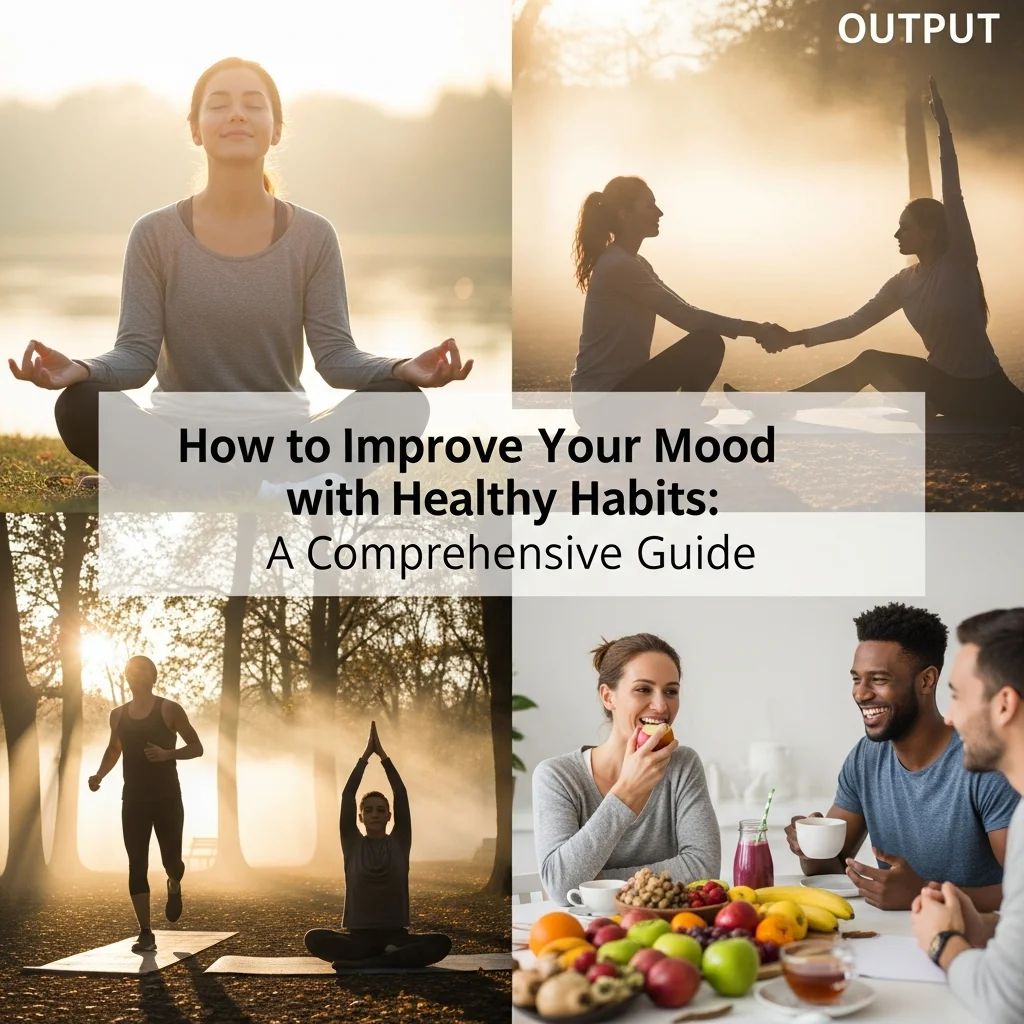
In this guide, we will look at 10 healthy habits to improve mood, what current research says about them, practical ways to use them, common mistakes, and situations in which lifestyle changes should not replace professional help.
Quick Answer
The most practical healthy habits to improve mood include:
- Get regular physical activity.
- Protect your sleep routine.
- Eat regular, balanced meals.
- Spend time outdoors and get appropriate daylight.
- Stay socially connected.
- Practice mindfulness or relaxation.
- Make time for enjoyable activities.
- Manage excessive screen and social media use.
- Keep your environment reasonably organized.
- Set realistic daily priorities.
These habits can support mental well-being, but they are not guaranteed treatments for depression or other mental health conditions. If low mood is persistent, severe, or interfering with everyday life, professional evaluation is important. NIMH: Caring for Your Mental Health
Key Takeaways
- Your mood is influenced by many factors, including sleep, activity, stress, relationships, and overall health.
- Regular physical activity has some of the strongest evidence among lifestyle approaches for improving symptoms of depression and anxiety.
- Sleep should be treated as part of your mental-health routine rather than an afterthought.
- Healthy eating supports overall health, although no single food is a guaranteed mood booster.
- Social connection is an important part of emotional well-being.
- Small enjoyable activities can help create positive experiences during difficult periods.
- Reducing excessive screen use may be useful when digital habits interfere with sleep, activity, or relationships.
- A simple routine is usually easier to maintain than a complicated wellness plan.
- Lifestyle habits can complement professional treatment but should not automatically replace it.
Why Your Daily Habits Can Affect Your Mood
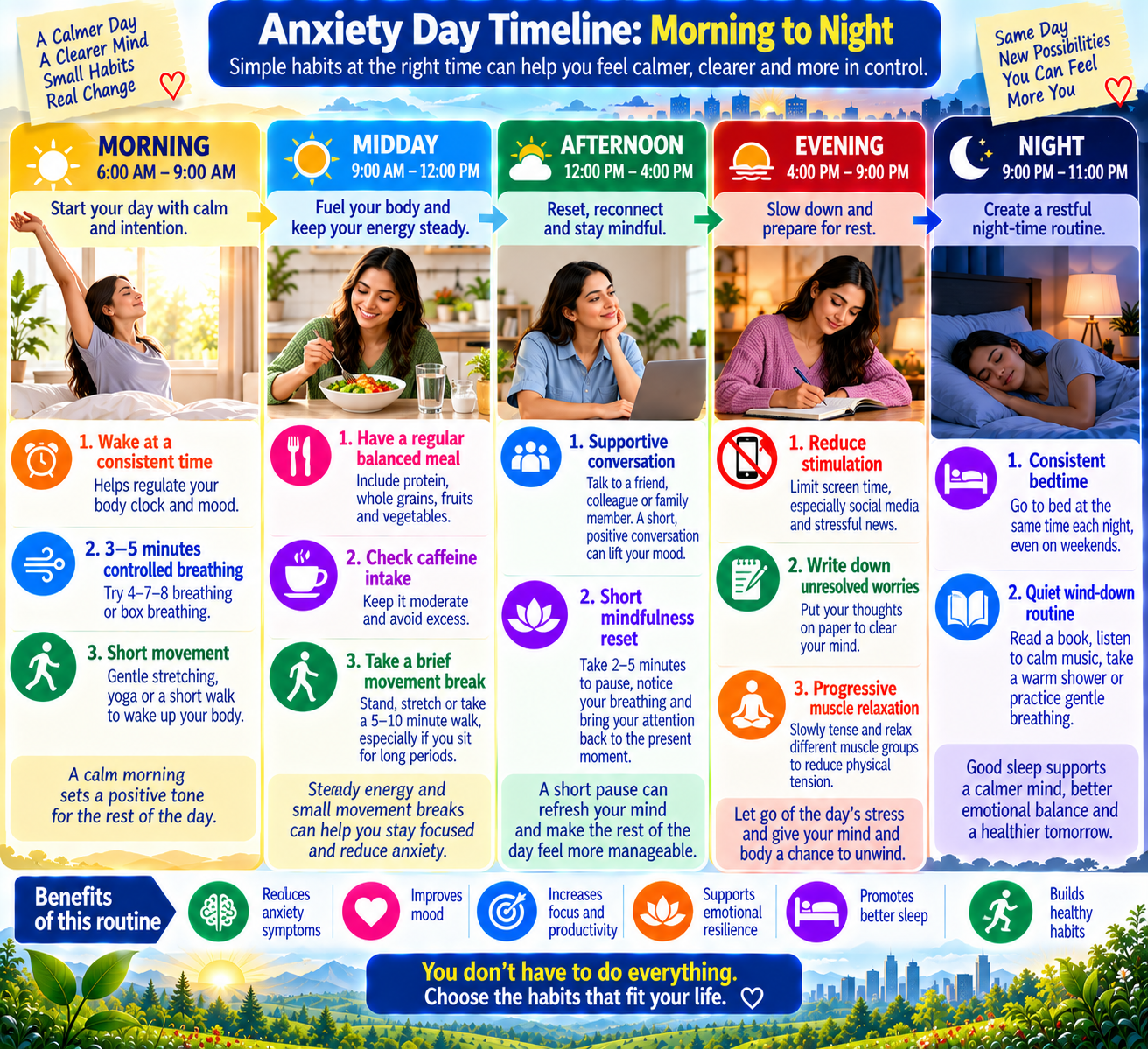
Mood is not controlled by one factor.
Sleep, physical activity, nutrition, stress, social connection, health conditions, medications, environment, and psychological factors can interact in complicated ways.
This is why it is misleading to say that one habit will automatically make everyone happier.
Current research increasingly looks at combinations of healthy behaviors rather than isolated habits. A 2025 systematic review and meta-analysis found that clusters of healthy lifestyle behaviors were associated with symptoms of depression, anxiety, and psychological distress, although much of this evidence came from observational studies and therefore cannot prove that lifestyle behaviors alone caused the differences. PubMed: Healthy Lifestyle Behaviors and Mental Health
The practical lesson is simple: look at your routine as a whole.
If you sleep poorly, rarely move, eat irregularly, spend most of the day alone, and remain online late into the night, changing one small part of the routine may help, but addressing several manageable factors may be more useful.
1. Move Your Body Regularly
Physical activity is one of the most useful habits to include when you want to improve your mood naturally.
You do not have to begin with running or a demanding gym program.
Walking, cycling, swimming, dancing, yoga, resistance training, or another activity you enjoy can count.
A major 2026 umbrella review and meta-meta-analysis combined 63 systematic reviews involving 79,551 participants and found that exercise reduced symptoms of depression and anxiety. Aerobic exercise showed particularly substantial effects, although the researchers also emphasized differences between populations and exercise programs. PubMed: 2026 Exercise and Depression/Anxiety Umbrella Review
The CDC also notes that physical activity can improve mood, reduce feelings of anxiety, support sleep, and reduce the long-term risk of depression. CDC: 10 Reasons to Get Moving
You do not need a perfect workout.
Try matching activity to your current energy.
| How you feel | Try |
|---|---|
| Very tired | 5–10 minute easy walk |
| Mentally stressed | Comfortable outdoor walk |
| Moderate energy | Brisk walking or cycling |
| High energy | Running, swimming, or a workout |
| Prefer home exercise | Dance, yoga, or bodyweight exercise |
| Prefer social activity | Walking group or recreational sport |
A useful principle is minimum effective effort.
If you planned a 30-minute walk but have very little energy, walking for 10 minutes is still a meaningful choice.
A people-first tip
Attach movement to something you already do.
Walk after lunch. Stretch while listening to music. Take the stairs when practical. Walk while making a phone call.
The easier the habit is to attach to your existing day, the less you have to depend on motivation.
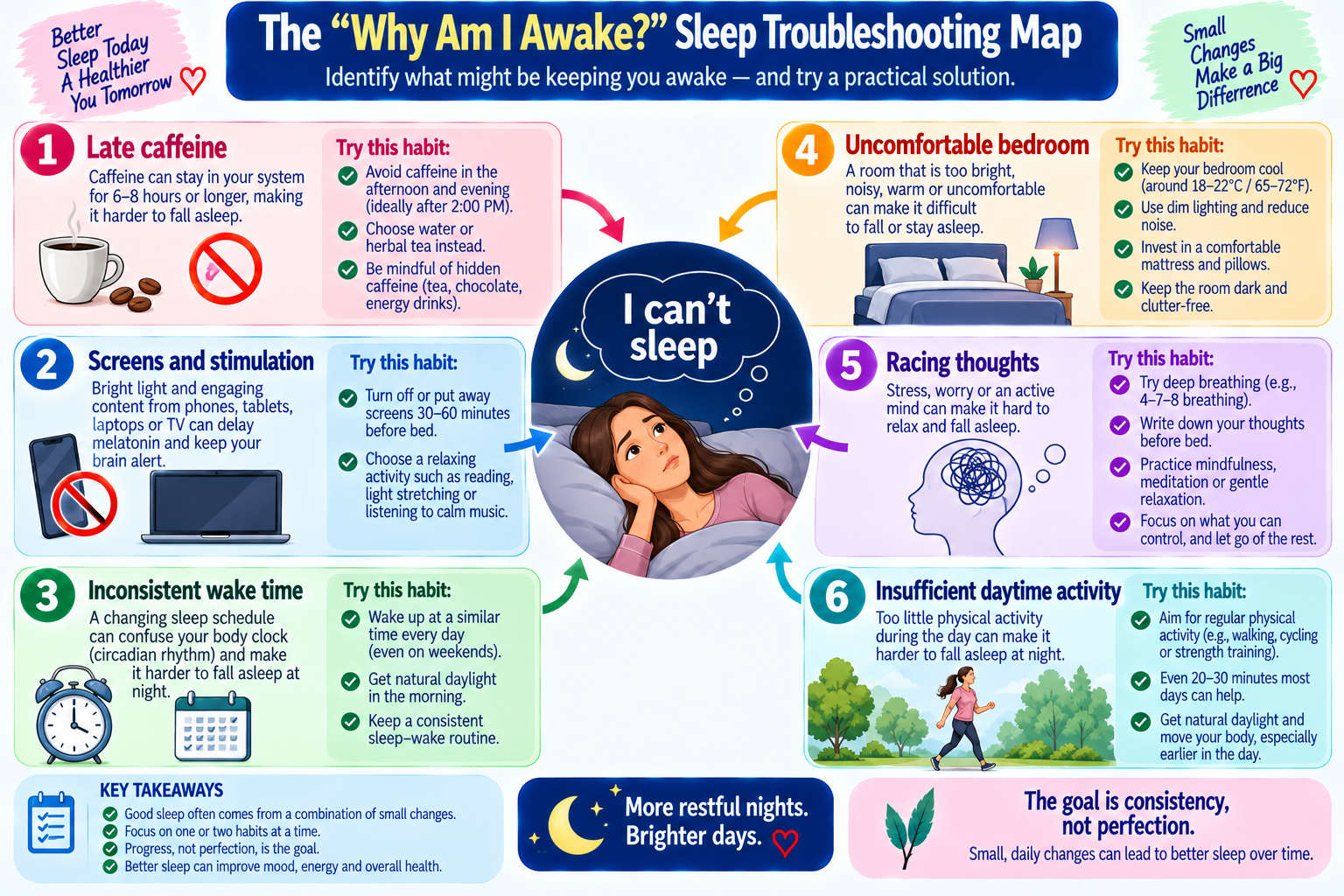
2. Protect Your Sleep
A good mood is difficult to maintain when your sleep routine is constantly disrupted.
Poor sleep can affect concentration, energy, emotional regulation, and your ability to cope with everyday stress.
NIMH recommends making sleep a priority, maintaining a schedule, and reducing exposure to screens before bedtime when they interfere with sleep. NIMH: Caring for Your Mental Health
Build a realistic sleep routine.
You could:
- Keep your bedtime and wake time reasonably consistent.
- Create a quiet wind-down period.
- Reduce stimulating activities close to bedtime.
- Keep your bedroom comfortable and dark.
- Avoid excessive caffeine late in the day.
- Write down tomorrow’s tasks before going to bed.
The last idea is particularly practical.
If your mind repeatedly says, “I must remember to do this tomorrow,” write it down.
You are not solving the problem at midnight.
You are simply giving yourself permission to stop holding the reminder in your head.
Don’t chase perfect sleep.
Another common mistake is becoming anxious about sleep itself.
A healthy routine does not mean that every night will be perfect.
If persistent sleep problems continue or significantly affect daytime functioning, discuss them with a healthcare professional.
3. Eat Regular, Balanced Meals
Food does not work like a switch that turns a bad mood into a good one.
However, your overall eating pattern matters for physical health, energy, and general well-being.
NIMH recommends healthy, regular meals and adequate hydration as part of basic mental-health self-care. NIMH: Caring for Your Mental Health
Research is also examining the relationship between diet quality and mental health.
A 2025 systematic review and meta-analysis examined 21 randomized clinical trials and 92 prospective cohort studies involving more than 700,000 participants. The findings suggested an association between healthier dietary patterns and lower depression risk, although the authors highlighted limitations in the intervention evidence. PubMed: Diet Quality and Depression Risk
A newer 2026 meta-analysis examining more than 633,000 people across low- and middle-income countries found that healthier dietary patterns were associated with lower symptoms of depression, anxiety, and stress. However, the researchers also identified important evidence gaps and noted that many studies were observational. PubMed: Healthy Diets, Depression, Anxiety, and Stress
What should you eat?
Think about overall balance rather than a magical “mood food.”
Include foods such as:
- Vegetables
- Fruits
- Whole grains
- Beans and lentils
- Nuts and seeds
- Eggs or other protein sources
- Fish where appropriate
- Healthy sources of dietary fat
A simple Indian meal approach
You do not need to abandon familiar foods.
A balanced meal might include:
dal + vegetables + roti or rice + curd + fruit
The exact combination can vary according to your nutritional needs and preferences.
The goal is a sustainable eating pattern, not a restrictive diet.
4. Spend Time Outdoors and Get Daylight
Your environment can influence your daily rhythm.
Spending time outside can also combine several potentially helpful behaviors at once: daylight exposure, movement, a change of environment, and sometimes social interaction.
This makes an outdoor walk particularly useful.
Rather than thinking of daylight as a miracle mood treatment, think of it as one part of a healthy daily routine.
Try an outdoor morning reset.
After waking:
- Get dressed.
- Step outdoors if practical.
- Spend a few minutes in natural daylight.
- Walk gently or simply sit outside.
- Begin your normal morning routine.
The exact duration does not need to become another rigid rule.
Also remember that sunlight contains ultraviolet radiation, so outdoor time should be balanced with appropriate sun-safety measures.
A useful combination
Instead of saying:
“I need to exercise.”
tell yourself:
“I am going outside for ten minutes.”
That change in wording can make the habit feel easier.
5. Stay Connected With Supportive People
Mood can become heavier when you feel that everything has to be handled alone.
Social connection does not necessarily mean having a large social circle.
One trustworthy person can be more valuable than dozens of superficial interactions.
The CDC notes that social connection can support the ability to manage stress, anxiety, and depression, while supportive relationships can also encourage healthy behaviors. CDC: Social Connection
A 2024 review in World Psychiatry also describes a substantial evidence base linking social connection with mental and physical health, while noting that much of the research is observational and that loneliness and social isolation are related but distinct concepts. PubMed: Social Connection and Mental and Physical Health
Make connections easier.
You could:
- Call a family member.
- Have tea with a friend.
- Join a walking group.
- Speak with a colleague.
- Attend a community activity.
- Volunteer.
- Eat a meal with someone rather than alone.
If you do not feel like having a long conversation, start small.
Send:
“How are you doing?”
Sometimes a short connection is enough to break a long period of isolation.
6. Practice Mindfulness or Relaxation
Your mind does not need to be positive every minute.
Trying to force yourself to think positively can sometimes become exhausting.
Mindfulness offers a different approach.
Instead of fighting every thought, notice it and return your attention to the present.
NIMH includes relaxation activities such as meditation, muscle relaxation, and breathing exercises among self-care options that people can explore. NIMH: Caring for Your Mental Health
Try a five-minute practice.
Sit comfortably and notice:
- Your breathing
- Your feet touching the floor
- Sounds around you
- Sensations in your body
- Thoughts that appear
When your attention wanders, gently return to the present.
There is no need to judge whether you are doing it “correctly.”
Another option: progressive muscle relaxation.
If sitting quietly feels difficult, try progressive muscle relaxation.
You gently tense and relax different muscle groups while paying attention to the difference between tension and relaxation.
This can be particularly useful as part of an evening wind-down routine.
7. Make Time for Activities You Actually Enjoy
Healthy routines can become too serious.
You may exercise, eat carefully, sleep on schedule, and still forget to do anything simply because you enjoy it.
That is a problem.
Pleasure and interest are legitimate parts of well-being.
NIMH specifically includes enjoyable activities such as listening to music, reading, spending time in nature, and low-stress hobbies among possible self-care activities. NIMH: Caring for Your Mental Health
Create a “small pleasure list.”
Write down five activities that usually make an ordinary day better.
For example:
- Listening to favorite music
- Gardening
- Cooking
- Watching a favorite film
- Reading
- Drawing
- Photography
- Spending time with a pet
- Talking with a friend
- Visiting a peaceful outdoor place
Then choose one small activity each day.
It does not have to take an hour.
Even 10–20 minutes can give your day a deliberate enjoyable moment.
Important distinction
Enjoyable activities can support well-being.
They are not a substitute for treatment when someone has depression.
A person with depression may experience loss of interest or pleasure even when activities that previously felt enjoyable are available. That is one reason persistent low mood deserves proper attention.
8. Manage Excessive Screen and Social-Media Use
Your phone is not automatically bad for your mood.
The problem is what happens when digital use starts replacing sleep, movement, face-to-face connection, work, or activities you value.
Research examining social media use and health continues to find complex relationships involving mental health, sleep, social functioning, body image, and mood. A 2025 systematic review examined evidence from 21 countries and highlighted that these relationships are multifaceted rather than simply “social media is good” or “social media is bad.” PubMed: Social Media, Mental Health, Sleep and Mood
Try a “friction rule.”
Instead of promising:
“I will never use social media again.”
make unnecessary use slightly harder.
For example:
- Remove distracting apps from the home screen.
- Turn off nonessential notifications.
- Keep the phone away during meals.
- Charge the phone away from your bed.
- Avoid opening social media immediately after waking.
- Choose specific times to check feeds.
You do not need to eliminate technology.
You need to make room for real life.
9. Keep Your Environment Reasonably Organized
A messy environment can make everyday tasks feel harder, particularly when you are already stressed.
But “clean your entire house” is not a useful mental-health recommendation.
Instead, use a 10-minute reset.
The 10-minute environment reset
- Minutes 1–3: Clear the surface you use most.
- Minutes 4–6: Put obvious items back where they belong.
- Minutes 7–8: Prepare something you need tomorrow.
- Minutes 9–10: Open the curtains, ventilate the room if appropriate, and take a few comfortable breaths.
Then stop.
You don’t need to turn the process into another demanding task.
This is one of the more practical ways to improve mood naturally because it reduces small sources of friction without requiring a major lifestyle transformation.
10. Set Realistic Priorities
An overloaded day can make you feel as though you are failing before you have even started.
One way to reduce this pressure is to divide your tasks into three groups:
| Category | Question |
|---|---|
| Must do | What genuinely needs attention today? |
| Should do | What would be useful if time allowed? |
| Can wait | What does not need to happen today? |
NIMH recommends setting goals and priorities, deciding what needs attention now, and learning to say no when you are taking on too much. NIMH: Caring for Your Mental Health
This is not laziness.
It is a way of making your workload more realistic.
The “three important things” rule
At the beginning of the day, choose three meaningful tasks.
If you finish them, the day will be productive.
Additional tasks are a bonus.
This approach can be especially helpful for people who create long daily lists and then feel discouraged when half the list remains unfinished.
A Simple Mood-Supportive Daily Routine
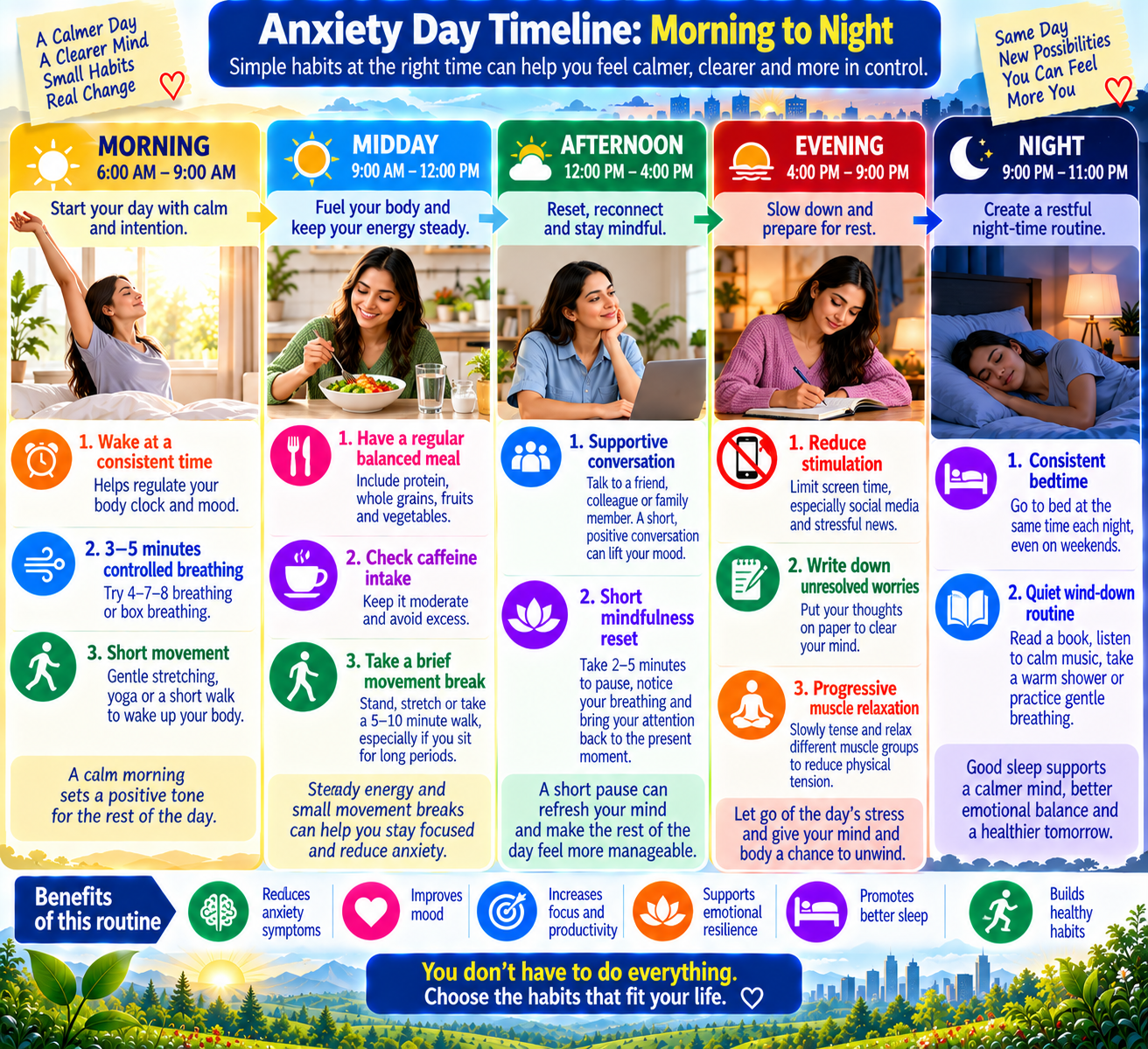
You don’t have to practice all ten habits separately.
Several can be combined.
| Time | Simple habit | What it can combine |
|---|---|---|
| Morning | Outdoor walk | Daylight + movement |
| Breakfast | Balanced meal | Nutrition + hydration |
| Work period | Priority list | Stress management |
| Lunch | Eat away from the screen. | Nutrition + digital break |
| Afternoon | Short movement break | Activity + mental reset |
| Evening | Talk with someone. | Social connection |
| Night | Relaxation practice | Mindfulness + transition |
| Bedtime | Consistent routine | Sleep support |
This is one of the most important people-first insights in this article.
You do not need ten separate habits.
One activity can support several areas of your life at once.
A walk with a friend, for example, can combine physical activity, outdoor time, social connection, and a break from screens.
That is more realistic than creating ten separate tasks.
The “Mood Ladder” for Difficult Days
Not every day will have the same amount of energy.
On a good day, you may be able to exercise, cook a healthy meal, meet someone, and complete your work.
On a difficult day, even getting started may feel hard.
Use a three-level ladder.
Level 1: Very difficult day
Choose just one:
- Shower
- Drink water
- Step outside
- Eat a simple meal
- Message someone
Level 2: Average day
Add:
- 10–20 minutes of movement
- Regular meals
- A short relaxation practice
- One enjoyable activity
Level 3: Good-energy day
Add:
- Longer exercise
- Meal preparation
- Social activity
- Hobbies
- Household tasks
- Outdoor time
This approach avoids the common mistake of believing that a healthy routine must look identical every day.
Latest Research Developments
Research in this area has become more sophisticated.
Instead of asking whether one habit “makes people happy,” researchers increasingly examine combinations of behaviors and their relationships with depression, anxiety, psychological distress, and overall mental health.
Exercise remains one of the strongest lifestyle areas.
The 2026 umbrella review mentioned earlier included 63 studies, 81 meta-analyses, 1,079 component studies, and 79,551 participants. Exercise was associated with reductions in depression and anxiety symptoms, with aerobic exercise showing particularly substantial effects. PubMed: 2026 Exercise Umbrella Review
Another 2025 systematic review and meta-analysis of randomized trials found beneficial effects of aerobic exercise, resistance exercise, and combined exercise for adults with diagnosed depression or anxiety. PubMed: Aerobic and Resistance Exercise
This does not mean exercise is a universal replacement for therapy or medication.
It means physical activity has become an increasingly well-supported component of mental health care.
Healthy lifestyle patterns matter.
A 2025 systematic review examined clusters of lifestyle behaviors such as physical activity, diet, sleep, and substance-related behaviors. Healthier lifestyle clusters were associated with fewer symptoms of depression, anxiety, and psychological distress, although the observational nature of much of the evidence limits conclusions about cause and effect. PubMed: Healthy Lifestyle Behavior Clusters
This supports an important practical idea:
Do not focus on one perfect habit. Build a reasonable pattern.
Diet research is expanding.
Research into diet and mental health is also developing.
A 2025 review found evidence connecting better diet quality with lower depression risk, while a 2026 analysis involving more than 633,000 people in low- and middle-income countries found healthier diets associated with lower depression, anxiety, and stress symptoms. PubMed: Diet Quality and Depression PubMed: Healthy Diets and Mental Health
The evidence does not justify calling any specific food a guaranteed antidepressant.
The stronger message is about dietary patterns.
Social connection is increasingly recognized as a health issue.
Social connection is not simply a lifestyle luxury.
The CDC identifies social connection as an important factor associated with mental and physical well-being, including the ability to manage stress, anxiety, and depression. CDC: Social Connection
A large body of research also connects loneliness and social isolation with poorer health outcomes. World Psychiatry: Social Connection and Health
This makes social connection an important part of a comprehensive approach to mood.
5 Common Mistakes That Can Work Against Your Mood
Trying to change everything overnight
A completely new lifestyle can become exhausting.
Choose two habits first.
Treating food as medicine
A healthy eating pattern is valuable, but no single food should be promoted as a cure for depression or anxiety.
Exercising too hard
More exercise is not automatically better.
Your routine should match your fitness level, health status, and ability to recover.
Using positive thinking to suppress genuine emotions
Feeling sad, frustrated, disappointed, or angry does not mean you are failing.
Healthy emotional regulation is different from pretending everything is fine.
Ignoring persistent symptoms
This is the most important mistake.
If low mood continues, becomes severe, or interferes with everyday life, don’t rely exclusively on lifestyle changes.
My Personal Experience With Small Habit Changes
If you are using first-person experience in this article, this section should remain strictly based on your genuine experience.
For example, if you personally experienced periods when poor sleep, excessive phone use, or inactivity affected your mood, you can explain what happened and what you changed.
A useful personal story should answer:
- What did your routine look like before?
- Which habit did you change first?
- What was difficult?
- What became easier?
- What did you notice over time?
- Did any strategy fail to help?
That is more valuable than simply saying:
“These habits worked for me.”
Personal experience can demonstrate authenticity, but it should not be presented as scientific proof that the same result will happen to every reader.
When Healthy Habits Are Not Enough
Lifestyle changes can be helpful, but sometimes low mood is a sign of a mental health condition or another health problem.
NIMH recommends seeking professional help when severe or distressing symptoms last two weeks or more, including persistent difficulty sleeping, changes in appetite, difficulty getting out of bed, problems concentrating, loss of interest in usual activities, inability to complete normal tasks, or significant irritability/restlessness. NIMH: Caring for Your Mental Health
Consider speaking with a healthcare or mental health professional if:
- Low mood continues for weeks.
- You lose interest in things you normally enjoy.
- Work or school performance is affected.
- Relationships are suffering.
- Sleep or appetite changes significantly.
- Anxiety becomes difficult to manage.
- You feel hopeless or overwhelmed.
- Daily functioning becomes difficult.
Healthy habits can complement treatment.
They should not become a reason to delay appropriate care.
If you are experiencing thoughts of suicide or self-harm, seek immediate emergency or crisis support in your country rather than relying on self-care strategies.
Frequently Asked Questions
What are the best healthy habits to improve mood?
Regular physical activity, adequate sleep, balanced meals, social connection, relaxation practices, enjoyable activities, sensible screen habits, outdoor time, and realistic daily priorities are useful areas to focus on.
How can I improve my mood naturally?
Start with one or two manageable habits rather than trying to change your entire lifestyle. A short walk, consistent sleep routine, regular meals, time with a supportive person, or a brief relaxation practice can be reasonable starting points.
Can exercise improve mood?
Yes. Research supports physical activity as a useful intervention for symptoms of depression and anxiety. Recent evidence suggests aerobic exercise can be particularly beneficial, although exercise should be considered part of a broader approach rather than a universal replacement for treatment. PubMed: 2026 Exercise Umbrella Review
Can sleep improve mood?
Adequate, consistent sleep supports mental health and daily functioning. If sleep problems persist despite improving your routine, consider discussing them with a healthcare professional.
What foods improve mood?
There is no single food guaranteed to improve mood. Research increasingly focuses on overall dietary patterns rather than individual “mood foods.” Healthier dietary patterns have been associated with better mental-health outcomes, although the evidence varies by study design. PubMed: Diet Quality and Depression
Does talking to people help your mood?
Supportive social connection can contribute to mental and physical well-being. If you are feeling isolated, starting with one trusted person can be easier than trying to become highly social immediately. CDC: Social Connection
How quickly can healthy habits improve mood?
There is no universal timeline. Some changes may feel useful relatively quickly, while other benefits develop with consistent practice. Persistent or worsening low mood should not be judged solely by how quickly a lifestyle change works.
Can healthy habits treat depression?
Healthy habits can support mental health and complement treatment, but they should not be assumed to treat clinical depression on their own. Depression may require professional evaluation and evidence-based treatment.
Key Takeaways
Improving your mood naturally is less about finding one perfect remedy and more about creating a supportive daily environment.
Move your body regularly.
Protect your sleep.
Eat balanced meals.
Spend some time outdoors.
Stay connected with people who matter to you.
Give yourself opportunities to relax.
Make room for activities you genuinely enjoy.
Keep digital habits under control when they interfere with real-life priorities.
Create an environment that reduces unnecessary friction.
Most importantly, make your routine realistic.
A 10-minute walk you repeat several times a week is more useful than an ambitious exercise plan that lasts three days.
A simple balanced meal is more sustainable than a restrictive diet.
A short conversation with someone you trust may be more meaningful than collecting hundreds of mental-health tips online.
The goal is not perfection.
The goal is a routine that supports you.
Author’s Note
This article was written with a people-first approach to everyday mental well-being.
The recommendations focus on practical habits that can fit into ordinary life rather than promising quick fixes or miracle remedies.
Research on lifestyle and mental health continues to develop. Some areas have stronger evidence than others, and many studies cannot prove that a particular lifestyle behavior directly caused a change in mood.
For that reason, this article distinguishes between evidence-supported habits, reasonable practical strategies, and areas where research is still developing.
Medical Disclaimer
This article is for educational purposes only and is not intended to diagnose, treat, cure, or prevent depression, anxiety, or any other medical condition.
Lifestyle habits can support general mental well-being, but they should not automatically replace professional assessment or treatment.
If you have persistent low mood, significant anxiety, loss of interest, major changes in sleep or appetite, difficulty functioning, or thoughts of self-harm, seek appropriate professional help promptly.
Fitness Disclaimer
Physical activity can support physical and mental health, but the appropriate exercise type and intensity differ between individuals.
If you have a medical condition, injury, significant physical symptoms, or have been inactive for an extended period, consider discussing your exercise plans with a qualified healthcare professional.
Start gradually and stop exercise if you develop concerning symptoms such as severe chest pain, fainting, or severe unexplained shortness of breath.
Research Methodology
This article was developed using guidance from authoritative health organizations and recent peer-reviewed research.
Priority was given to:
- Systematic reviews
- Meta-analyses
- Umbrella reviews
- Randomized controlled trials
- National Institutes of Health resources
- CDC guidance
- Established medical and public-health organizations
Recent research from 2025 and 2026 was included where available, particularly for exercise, diet, lifestyle behavior patterns, and social connection.
Where evidence was observational, the article avoids presenting association as proof of causation.
Where research remains uncertain, the language has been intentionally cautious.
Sources
- National Institute of Mental Health — Caring for Your Mental Health
- CDC — Social Connection
- CDC — 10 Reasons to Get Moving
- PubMed — 2026 Exercise Umbrella Review
- PubMed — Aerobic and Resistance Exercise Meta-Analysis
- PubMed — Healthy Lifestyle Behaviors and Mental Health
- PubMed — Diet Quality and Depression Risk
- PubMed—Healthy Diets, Depression, Anxiety and Stress
- PubMed — Social Connection and Mental and Physical Health
- NIMH—When to Seek Mental-Health Help
Conclusion
Learning healthy habits to improve mood does not mean trying to create a perfect life.
Real life includes stressful days, poor sleep, unexpected problems, low motivation, and periods when you simply do not feel your best.
A useful routine gives you something to return to.
Walk when you can.
Eat regular, balanced meals.
Protect your sleep.
Spend time outside.
Talk with people you trust.
Make room for activities that bring genuine interest or enjoyment.
Give your mind a chance to slow down.
And when a day is difficult, reduce the goal instead of abandoning the routine completely.
Most importantly, don’t use lifestyle advice to blame yourself for feeling low. Depression, anxiety, grief, chronic stress, and other conditions can have many causes, and needing professional help is not a personal failure.
Healthy habits are tools.
Use the ones that fit your life, build them gradually, and seek appropriate care when your symptoms need more than self-care.
Similar Content
-
- Healthy Daily Habits for Stress Reduction: A Comprehensive Guide
- 22 Natural Remedies for Anxiety: What Really Works?
- 10 Effective Treatments for Depression Without Medication
- 8 Effective Habits to Boost Mental Clarity and Focus
- 7 Natural Ways to Reduce Anxiety and Stress Daily: A Comprehensive Guide
- Home
- Category Mind & Mood Care
Post Views: 1,775








[…] How to Improve Your Mood with Healthy Habits: A Comprehensive Guide […]