






































































































































































How to Optimize Your Workouts: 12 Science-Backed Ways to Train Smarter
Author: RVLNSV PRASAD
Updated On: October 2026
About Us
Author Bio
Editorial Policy
Contact Us

Introduction
If you regularly exercise but feel that your results do not match the effort you are putting in, the answer may not be to train harder.
It may be to train more intelligently.
Many people increase workout duration when progress slows. They add more exercises, more sets, more cardio, or more training days. Sometimes that works. In other situations, it simply creates more fatigue without solving the underlying problem.
Effective workout optimization is different.
It asks better questions.
- Are you training toward a clear goal?
- Are your exercises appropriate for that goal?
- Are you progressing gradually?
- Are you recovering between sessions?
- Are you getting enough sleep? Are you eating adequately?
- Are you spending your training time on activities that actually matter?
These questions are particularly relevant because the latest resistance-training evidence does not support the idea that complicated programs are automatically better. The 2026 American College of Sports Medicine Position Stand synthesized 137 systematic reviews involving more than 30,000 participants and found that resistance training improved strength, muscle size, power, endurance, balance, gait speed, and other physical-function outcomes. The broader message was that effective training does not require unnecessary complexity. ACSM: 2026 Resistance Training Guidelines
I learned a similar lesson from my experience.
There was a period when I thought longer workouts would automatically produce better results. I spent more time exercising but did not always feel stronger or fitter. When I began paying more attention to exercise quality, recovery, consistency, and progression, my approach became much more sustainable.
That experience changed my understanding of the phrase “train smarter, not harder.”
It does not mean avoiding hard work.
It means making hard work count.
Quick Answer: How Can You Optimize Your Workouts?
To optimize your workouts, start by identifying your main goal and then match your training to it.
Use appropriate exercises, enough training volume, manageable intensity, progressive overload, adequate rest, and sufficient recovery. Combine resistance training with aerobic activity, sleep well, eat enough nutritious food, and track meaningful changes rather than judging every workout by how exhausted you feel.
For general health, adults should aim for at least 150 minutes of moderate-intensity aerobic activity each week or 75 minutes of vigorous activity, together with muscle-strengthening activity on at least two days. The CDC also emphasizes that activity can be divided into smaller periods and that some activity is better than none. CDC: Adult Activity Guidelines
The WHO similarly recommends 150–300 minutes of moderate aerobic activity or 75–150 minutes of vigorous activity each week, plus muscle-strengthening activity on two or more days. It also recommends gradually increasing activity when you are starting from a low level. WHO: Physical Activity Guidelines
You do not need to make every workout harder; instead, focus on making your overall training more purposeful and sustainable.
Key Takeaways
- Choose a clear training goal before choosing exercises.
- Prioritize exercises that directly support your goal.
- Progressive overload matters more than random exercise changes.
- More training is not automatically better training.
- You do not need to reach muscular failure on every set.
- Recovery is part of the training process.
- Combine strength and aerobic exercise rather than treating them as competing choices.
- Short exercise sessions can still be useful when your schedule is limited.
- Sleep and nutrition influence your ability to train and recover.
- Track performance, consistency, recovery, and function rather than relying only on appearance.
- Adjust your program when fatigue repeatedly exceeds recovery.
- The best workout plan is one you can follow consistently.
What Does “Train Smarter, Not Harder” Actually Mean?
Training smarter does not mean exercising less simply because exercise feels difficult.
It means allocating your effort where it is most useful.
Imagine two people performing the same exercise.
One person adds weight every session without considering technique, recovery, or whether the increase is appropriate.
The other gradually increases resistance, tracks performance, maintains good technique, and adjusts training when recovery is poor. That does not necessarily mean the second person is working less; it means the training is more structured and purposeful.
They are managing the training process better.
That is the central idea behind workout optimization.
A useful program balances:
| Training factor | What it controls |
|---|---|
| Exercise selection | Which muscles and movement patterns receive attention |
| Intensity | How demanding the work is |
| Volume | How much total training do you perform? |
| Frequency | How often do you train |
| Technique | How efficiently and safely you perform movements |
| Recovery | How well you adapt between sessions |
| Nutrition | Energy and nutrients available for training |
| Sleep | Recovery and overall health |
| Progression | How training becomes more challenging over time |
| Consistency | Whether the plan actually continues |
There is no universal perfect combination.
The appropriate balance depends on your goal, experience, age, health, schedule, and recovery capacity.
1. Start With One Clear Goal
The first step in learning how to optimize your workouts is deciding what you are actually trying to improve.
Your primary goal might be:
- Building muscle
- Increasing strength
- Improving cardiovascular fitness
- Losing body fat
- Improving endurance
- Maintaining physical function
- Improving athletic performance
- Becoming more active
- Supporting general health
These goals overlap, but they are not identical.
- Someone training for maximal strength may emphasize heavier resistance and specific movement patterns.
- Someone primarily interested in cardiovascular health may devote more time to aerobic exercise.
- Someone trying to improve general fitness may benefit from a combination.
- This is why copying another person’s routine can be inefficient.
Their program may be designed around a completely different objective.
A simple question to ask
Before starting a workout, ask:
“What adaptation am I trying to create?”
If you cannot answer that question, you may be spending training time without a clear purpose.
2. Choose Exercises That Give You a Good Return on Time
You do not need dozens of exercises.
For general strength training, prioritize movements that train major muscle groups and useful movement patterns.
Examples include
- Squatting
- Hinging
- Pushing
- Pulling
- Carrying
- Lunging
- Rotating or resisting rotation
The exact exercise can change according to ability, equipment, injury history, and preference.
A beginner might perform a bodyweight squat.
Another person may use a goblet squat.
An experienced lifter might use a barbell squat.
The movement pattern can remain similar while the exercise is adapted to the individual.
The 2026 ACSM resistance-training update found broad evidence that resistance training improves multiple aspects of physical performance and that effective programming can take many forms. PubMed: ACSM Resistance Training Position Stand
The practical lesson is simple:
Choose exercises you can perform well and progress over time.
3. Use Progressive Overload Instead of Randomly Harder Workouts
Progressive overload means gradually increasing the challenge placed on your body.
You can progress by:
- Adding a small amount of weight.
- Performing additional repetitions.
- Adding a set.
- Increasing exercise difficulty.
- Improving range of motion.
- Improving technique.
- Increasing training frequency when appropriate.
You do not need to increase everything at once.
For example, suppose you can comfortably perform three sets of 10 squats with a particular resistance.
Instead of dramatically increasing the load, you might first improve technique or perform 11 repetitions.
The following week, you could add a small amount of resistance.
This creates a measurable progression.
The latest ACSM review reinforces the value of resistance training across different prescriptions while emphasizing that the program should match the individual’s goal rather than becoming unnecessarily complicated. ACSM: 2026 Resistance Training Update
The progression rule I prefer
Change gradually enough that you can repeat the improvement.
That is more useful than chasing a dramatic personal record every week.
4. Stop Assuming Every Set Must Reach Failure
One of the most useful developments in recent resistance-training research concerns training to failure.
Many gym programs encourage people to perform every set until they cannot complete another repetition.
That approach can have a place in some programs.
It is not mandatory for everyone.
A 2026 systematic review and meta-analysis of 20 studies involving 556 participants found that non-failure resistance training was superior for dynamic strength in the pooled analysis, while there were no significant differences between failure and non-failure training for hypertrophy, muscular endurance, or power. The authors concluded that reaching failure is not necessary to maximize most neuromuscular adaptations. PubMed: Resistance Training to Failure vs Non-Failure
Earlier systematic reviews reached a similar general conclusion: training to momentary failure does not appear to be required for gaining strength or muscle size. PubMed: Failure vs Non-Failure Resistance Training
This is valuable for people who want to train effectively without making every session exhausting.
You can often finish a set while maintaining good technique and still make progress.
5. Give Recovery the Same Attention as Training
A workout is a stimulus.
Recovery is the period in which your body responds to that stimulus.
If you repeatedly train hard without enough recovery, your next workout may suffer.
Signs that your current workload may be too demanding can include:
- Persistent fatigue
- Declining performance
- Poor sleep
- Unusual irritability
- Persistent muscle soreness
- Loss of motivation
- Repeated difficulty completing normal workouts
One difficult day does not automatically mean you are overtraining.
Look for patterns.
If performance and recovery remain poor for several sessions, your program may need adjustment.
A smarter recovery strategy
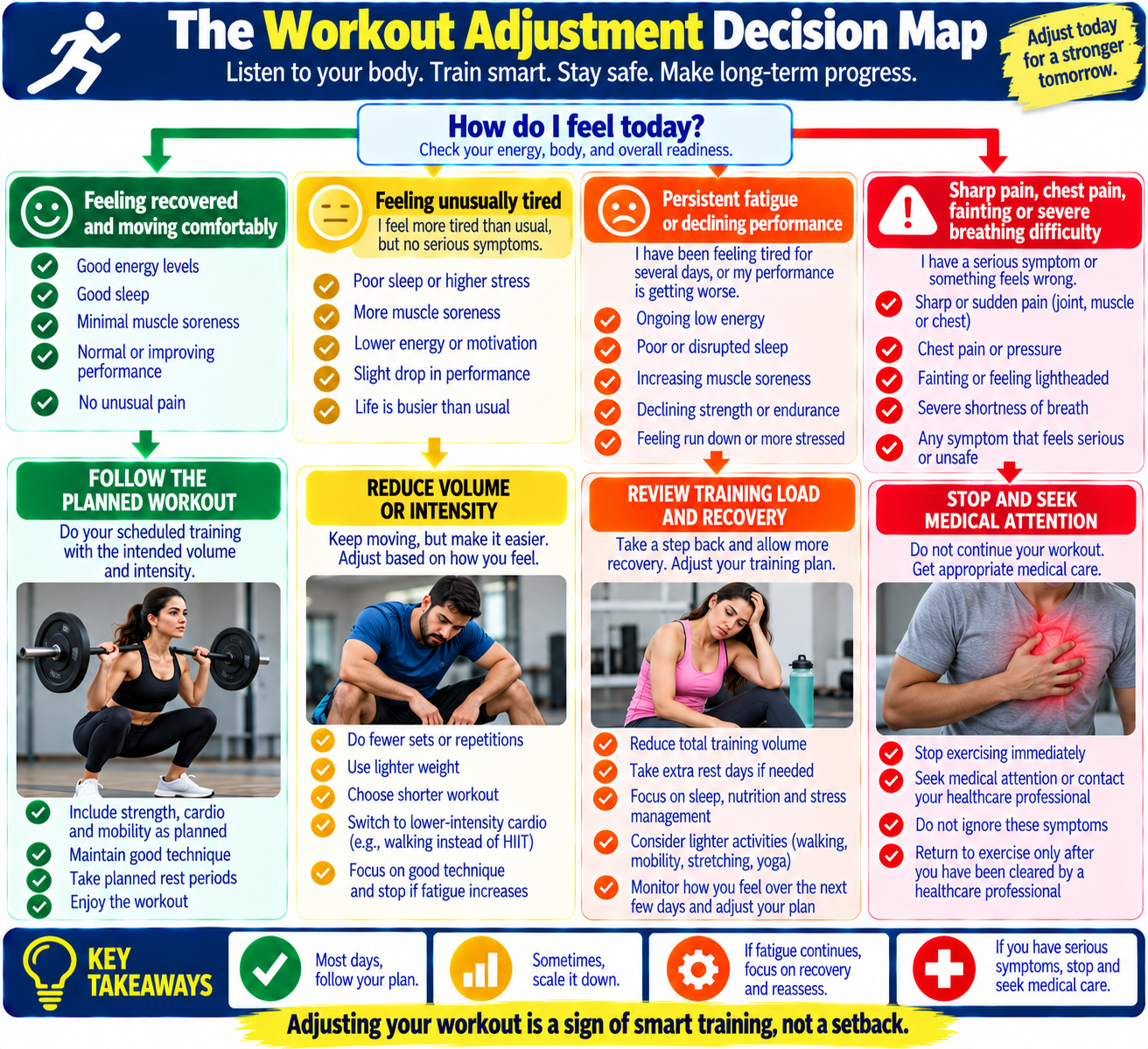
Instead of automatically taking complete rest every time you feel tired, consider matching the activity to your recovery level.
Feeling good: planned training
Moderately tired: reduce volume or intensity
Very fatigued: easy movement or recovery
Pain or concerning symptoms: stop and seek appropriate advice.
This is more flexible than following a rigid calendar regardless of how your body is responding.
6. Improve Your Rest Between Sets
Rest periods are easy to overlook.
Some people rush from one exercise to another because they believe shorter rest automatically makes a workout more effective.
That is not necessarily true.
If your goal is strength, allowing enough recovery between sets can help you maintain appropriate force and technique, whereas shorter rest periods may be useful when your focus is general conditioning.
The correct rest period depends on the exercise, training goal, intensity, and individual fitness level.
This is another reason that workout optimization is better than following one universal rule.
Rather than asking:
“How little rest can I take?”
Ask:
“How much rest allows me to perform the next set effectively?”
That small change in thinking can improve workout quality.
7. Combine Strength and Cardio Instead of Choosing One
Some people worry that cardio will automatically destroy their muscle-building progress.
The relationship is more nuanced.
A 2026 umbrella review of 17 meta-analyses involving 144 studies and 1,492 healthy participants found that combined aerobic and resistance training produced comparable aerobic improvements to endurance training alone and comparable strength, power, and hypertrophy outcomes to resistance training alone in the analyzed comparisons. The researchers found some trends suggesting that performing resistance training before endurance work may favor strength, although sequence findings were not uniformly conclusive. PubMed: Concurrent Training Umbrella Review
This is good news for general fitness.
You do not necessarily have to choose between being strong and having good cardiovascular fitness.
A balanced routine can include both.
A practical combination
For example:
2–3 days: resistance training
2–4 days: walking, cycling, jogging, swimming, or another aerobic activity
Most days: ordinary movement
At least some days: easier recovery-focused activity
The exact schedule should match your goals and recovery.
8. Use Short Workouts When Time Is Limited
A common fitness mistake is believing that a workout only counts if it lasts 45–60 minutes.
That mindset can create unnecessary barriers.
Recent research on exercise snacks is particularly interesting.
A 2025 systematic review and meta-analysis of 11 randomized controlled trials involving 414 participants found that brief exercise bouts performed throughout the day improved cardiorespiratory fitness in adults, although the researchers rated the certainty of evidence as moderate for that outcome. PubMed: Exercise Snacks and Fitness
Even newer 2026 research, including 21 studies and 921 participants, found improvements in maximal oxygen uptake and peak power output with exercise-snack approaches, while effects on body composition and blood lipids remained less consistent. PubMed: 2026 Exercise Snacks Meta-Analysis
That distinction is important.
Exercise snacks are not a magical replacement for every type of training.
They are a useful strategy when time is limited.
Try the 5-minute opportunity
You might:
- Walk briskly for five minutes.
- Climb stairs for a few minutes.
- Perform several bodyweight movements.
- Walk during a work break.
- Do a short mobility routine.
Small opportunities can help make an active lifestyle easier to maintain.
9. Do Not Ignore Daily Movement
Structured exercise is only one part of physical activity.
Walking to a shop, climbing stairs, doing household work, gardening, moving around at work, and other forms of movement contribute to overall activity.
WHO emphasizes that all physical activity counts and recommends limiting sedentary behavior while replacing sitting with movement where possible. WHO: Guidelines on Physical Activity and Sedentary Behaviour
This creates an easy strategy for people who do not enjoy traditional workouts.
Instead of thinking:
“I have to exercise.”
Try:
“How can I make today less sedentary?”
That could mean walking during a phone call, standing periodically during computer work, taking stairs when practical, or adding a short walk after meals.
10. Eat to Support the Work You Are Doing
Exercise performance does not exist separately from nutrition.
Your body needs energy and nutrients to support normal physiological functions and training adaptation.
A practical meal pattern can include:
- Protein-rich foods
- Vegetables
- Fruits
- Whole grains or other carbohydrate sources
- Healthy fats
- Adequate fluids
Protein deserves particular attention when muscle growth or strength is a major goal.
A large systematic review and meta-analysis of 49 studies involving 1,863 participants found that protein supplementation modestly increased gains in strength, fat-free mass, and muscle size during prolonged resistance training. PubMed: Protein Supplementation and Resistance Training Meta-Analysis
However, that does not mean everyone needs protein powder.
A person who already obtains sufficient protein from foods may not gain much practical benefit from adding another product.
Recent research also continues to investigate different protein sources and supplementation strategies. A 2026 network meta-analysis involving 78 studies and 4,755 participants found benefits for some protein supplements when combined with resistance training, but supplement comparisons should not be interpreted as evidence that supplements are necessary for everyone. PubMed: 2026 Protein Supplement Network Meta-Analysis
Food should remain the foundation.
11. Treat Sleep as Part of Workout Optimization
If your training program is excellent but your sleep is consistently poor, the overall plan may still be incomplete.
Sleep supports recovery, daily functioning, and general health.
Adults generally need at least seven hours of sleep per night, although individual needs vary. The NIH provides sleep guidance that emphasizes adequate sleep as an important component of health. NIH: Healthy Sleep
You can make sleep easier by:
- Keeping a consistent sleep schedule.
- Allowing enough time for sleep.
- Keeping your bedroom comfortable and dark.
- Reducing unnecessary late-night screen use.
- Avoiding caffeine too close to bedtime.
- Adjusting late training if intense exercise interferes with your sleep.
The goal is not perfection.
It is to create an environment in which your body can recover.
12. Track the Right Things
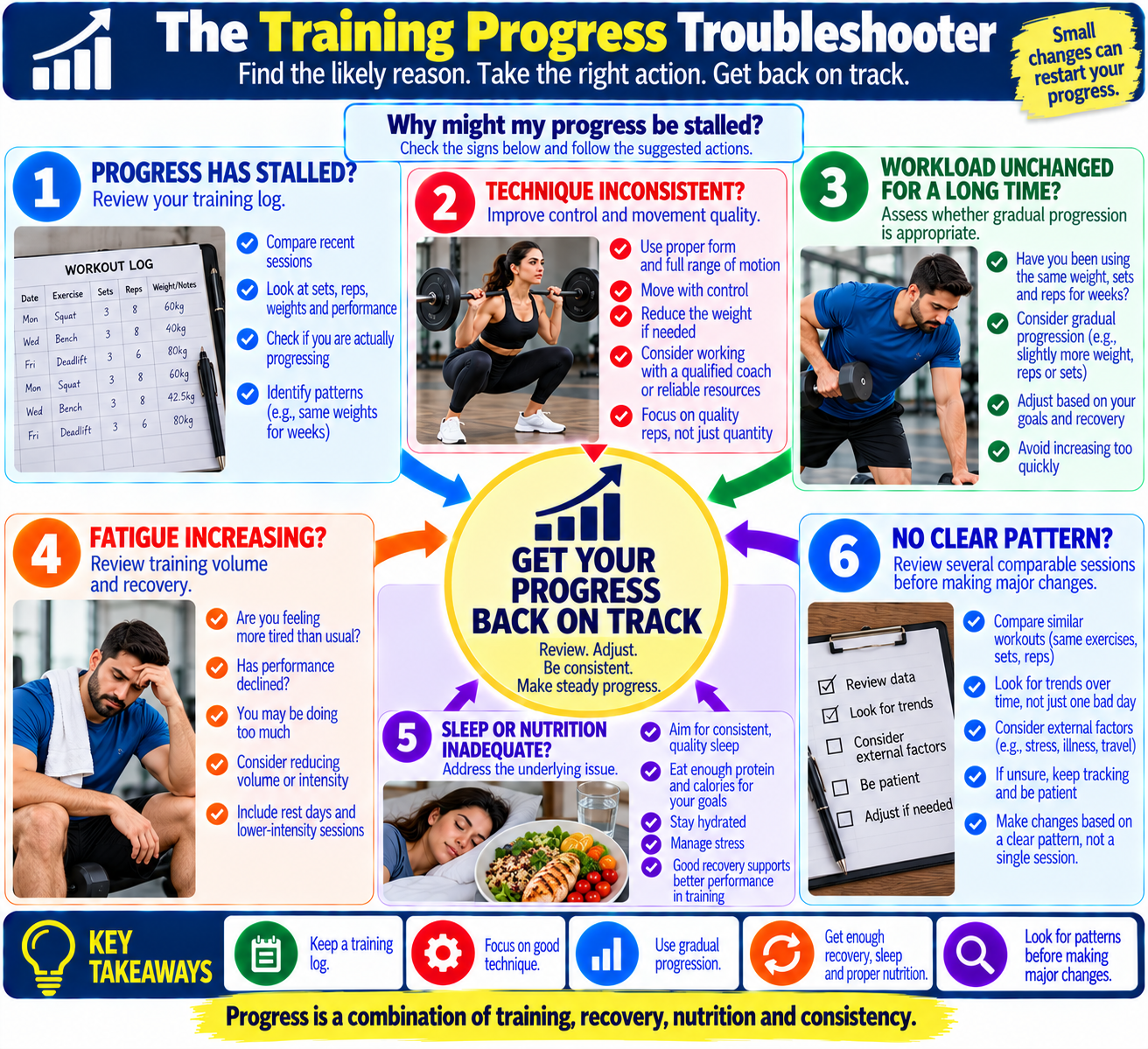
If you only track body weight, you may miss important improvements.
Instead, monitor several indicators.
| What to track | Useful question |
|---|---|
| Strength | Can I perform more weight or repetitions? |
| Endurance | Can I exercise longer or more comfortably? |
| Technique | Are my movements becoming more controlled? |
| Consistency | How often am I completing planned sessions? |
| Recovery | Am I recovering between workouts? |
| Daily movement | Am I spending less time inactive? |
| Mobility | Are everyday movements becoming easier? |
| Energy | How do I generally feel during the day? |
| Body composition | Are measurements changing over time? |
This approach is especially useful because progress is rarely perfectly linear.
You might have a week where your weight does not change but your strength improves.
Another week may bring better endurance.
A later month may show changes in body composition.
Fitness is multidimensional.
The 80% Effort Question
One of the most useful practical ideas is to stop judging every workout by maximum effort.
Ask:
“Could I recover from this and perform well again?”
That question can help prevent the common cycle of:
Train extremely hard → become exhausted → miss workouts → restart → repeat.
Training should create enough stimulus to encourage adaptation without making recovery impossible.
This does not mean every workout should feel easy.
Some sessions should be challenging.
The point is that a challenge should have a purpose.
A People-First Workout Optimization Method
Most fitness articles tell you what workout to perform.
A more useful approach is to help you decide what to do today.
Use this five-question check before training:
1. Question: What is today’s goal?
Strength? Cardio? Mobility? General movement?
2. Question: How recovered am I?
- If recovery is good, follow the plan.
- If recovery is poor, consider reducing volume or intensity.
3. Question: What is the minimum effective version?
- If you have 60 minutes, use your planned session.
- If you have 20 minutes, select the highest-value exercises.
- If you have five minutes, move rather than skipping the day completely.
4. Question: What did I do last time?
Use your training log.
Do not randomly repeat or increase everything.
5. Question: Can I recover from today’s workload?
If the answer is uncertain, avoid unnecessary intensity.
This decision process is more adaptable than a rigid workout calendar.
The “One Change at a Time” Rule
People often change several variables simultaneously.
They increase weight.
Add sets.
Start running.
Change exercises.
Add HIIT.
Reduce rest.
Then they wonder why they feel exhausted.
Instead, change one major training variable at a time.
For example:
- Week 1: maintain the program.
- Week 2: add a small amount of resistance.
- Week 3: maintain the new resistance.
- Week 4: evaluate recovery and performance.
This makes progress easier to understand.
It also makes it easier to identify what caused a problem.
Common Workout Optimization Mistakes
Mistake 1: Believing longer workouts are automatically better
Duration is only one training variable.
A longer session can be useful when the additional work serves a purpose.
Otherwise, it may simply add fatigue.
Mistake 2: Changing exercises every week
Variety can be useful, but constantly changing exercises makes progression harder to measure.
Keep important movements long enough to evaluate progress.
Mistake 3: Training to failure every session
Current evidence does not support failure as a requirement for most resistance-training adaptations. PubMed: 2026 Failure vs Non-Failure Meta-Analysis
Mistake 4: Ignoring recovery
A training plan without recovery is incomplete.
Mistake 5: Copying professional athletes
Elite athletes have different goals, resources, training histories, and recovery demands.
Their routine may not be appropriate for a beginner.
Mistake 6: Chasing soreness
Soreness can occur after unfamiliar exercise, but it is not a reliable measurement of workout quality.
Mistake 7: Using supplements before fixing basics
Sleep, food, training consistency, and appropriate programming should come first.
Mistake 8: Starting too aggressively
WHO recommends starting with small amounts of activity and gradually increasing frequency, intensity, and duration when necessary. WHO: Physical Activity Guidelines
A Simple Weekly Workout Optimization Framework
The following is a general example rather than a prescription.
| Day | Focus | Example |
|---|---|---|
| Monday | Strength | Full-body resistance training |
| Tuesday | Cardio | Brisk walking, cycling, or similar |
| Wednesday | Recovery | Easy movement + mobility |
| Thursday | Strength | Full-body resistance training |
| Friday | Cardio | Moderate aerobic activity |
| Saturday | Optional | Sport, hiking, cycling, or short workout |
| Sunday | Recovery | Easy walking and preparation |
For general adult health, the weekly total should move toward guideline recommendations rather than treating this example as a fixed prescription. CDC: Adult Activity Guidelines
People who are already active may need a different structure based on their goals.
A Smarter Busy-Day Routine
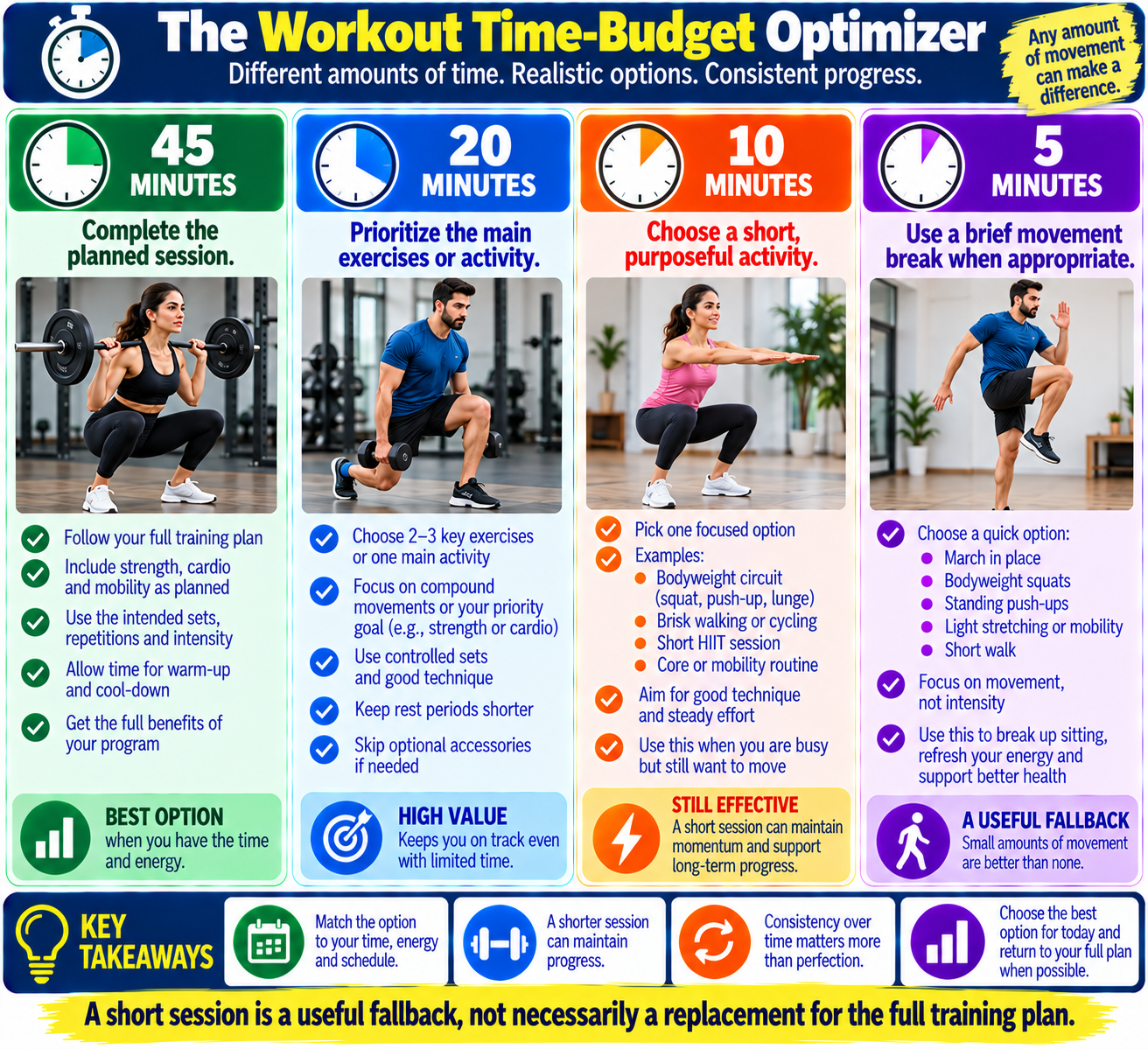
One of the easiest ways to make a fitness plan more sustainable is to create a fallback routine.
If you have 45 minutes
Perform the planned workout.
If you have 20 minutes
Choose the two or three highest-value exercises.
If you have 10 minutes
Walk briskly or perform a short full-body movement routine.
If you have 5 minutes
Move instead of abandoning the day completely.
This approach is supported by the emerging exercise-snack literature, which suggests that brief activity bouts can improve cardiorespiratory fitness in some populations. PubMed: Exercise Snacks Meta-Analysis
The important qualification is that five minutes is not automatically equivalent to a full training session.
It is a strategy for keeping movement possible when circumstances are difficult.
Latest Research Developments in Workout Optimization
Fitness research continues to move away from simplistic ideas such as “more is always better.”
1. Resistance training does not need to be complicated.
The 2026 ACSM Position Stand is one of the most important recent developments for resistance training. Its review of 137 systematic reviews and more than 30,000 participants supports resistance training for improvements across strength, hypertrophy, power, endurance, balance, gait speed, and physical function. PubMed: ACSM 2026 Position Stand
The practical message is encouraging:
A simple program performed consistently can be effective.
2. Failure is not mandatory.
The 2026 meta-analysis of 20 studies and 556 participants found no significant advantage for failure training across several outcomes and found a small dynamic-strength advantage for non-failure training. PubMed: Non-Failure Resistance Training
This gives everyday exercisers another reason not to turn every set into a maximum-effort test.
3. Exercise snacks are becoming a practical research area.
Recent systematic reviews are examining short exercise bouts spread across the day.
A 2026 review of 21 studies involving 921 participants found improvements in VO2max and peak power, while body-composition effects were less consistent. PubMed: 2026 Exercise Snacks Review
This could be particularly useful for people with demanding schedules.
4. Combined training can work.
Current evidence suggests that combining aerobic and resistance training can improve both areas without automatically eliminating strength or hypertrophy benefits. PubMed: Concurrent Training Umbrella Review
That supports a more balanced definition of fitness.
My Personal Training Insight
I once believed that a workout had to feel difficult to be worthwhile.
That mindset made me add unnecessary exercises and spend more time training than I could comfortably maintain.
The biggest improvement came when I stopped asking:
“How hard can I train today?”
and started asking:
“What training will help me progress and still allow me to train well next time?”
That change made my routine more sustainable.
I began paying closer attention to form, rest, recovery, and gradual progression. I also became more comfortable with shorter workouts on busy days.
The result was not a magical transformation.
It was something more useful.
I became more consistent.
And consistency gave me more opportunities to improve.
When Should You Reduce Training?
There are days when pushing harder makes sense.
There are other days when reducing intensity is smarter.
Consider adjusting your workout if you repeatedly experience:
- Unusual fatigue
- Persistent soreness
- Declining performance
- Poor sleep
- Loss of motivation
- Difficulty completing normal workouts
- Worsening technique
However, do not interpret serious symptoms as ordinary training fatigue.
Chest pain, fainting, severe breathing difficulty, significant injury, or other concerning symptoms require appropriate medical attention.
Who Should Seek Professional Guidance?
Most healthy adults can begin with manageable physical activity and gradually progress.
However, individualized advice may be appropriate if you have a chronic medical condition, significant injury, disability affecting movement, or other health concerns.
The CDC provides activity recommendations for adults with chronic conditions and disabilities, while emphasizing that activity should be appropriate to the individual’s abilities and circumstances. CDC: Physical Activity for Adults With Chronic Conditions
If you have been inactive for a long time and plan to begin vigorous exercise, discussing an appropriate starting point with a healthcare professional can also be sensible.
Frequently Asked Questions
What does “train smarter, not harder” mean?
It means using your training time purposefully rather than automatically increasing workout duration or intensity. Smart training considers goals, exercise selection, progression, recovery, nutrition, sleep, and consistency.
How can I optimize my workouts?
Start with a clear goal, select appropriate exercises, use progressive overload, manage training volume and intensity, recover adequately, and track meaningful progress.
Do longer workouts produce better results?
Not automatically. Longer sessions can be useful when the additional training serves your goal, but extra exercise can also create unnecessary fatigue.
Do I need to train to failure?
No. Current evidence suggests that reaching muscular failure is not necessary for most strength and hypertrophy outcomes. PubMed: 2026 Resistance Training Failure Meta-Analysis
How many days a week should I work out?
There is no universal number. For general adult health, current guidelines recommend aerobic activity throughout the week plus muscle-strengthening activity on at least two days. CDC: Adult Physical Activity Guidelines
Can I combine cardio and strength training?
Yes. Current evidence supports combining aerobic and resistance training for general fitness, with the exact structure depending on your goals. PubMed: Concurrent Training Umbrella Review
Is a 20-minute workout worthwhile?
Yes. A 20-minute session can contribute to your overall activity and may be useful when a longer workout is not practical. Short exercise bouts are also being studied as a way to improve fitness. PubMed: Exercise Snacks Systematic Review
How important is progressive overload?
Progressive overload is an important principle for improving resistance-training performance because your body needs an appropriate training stimulus that develops over time.
Should I change my exercises frequently?
Not necessarily. Some variety can be useful, but keeping key movements stable long enough to measure progression can make training easier to evaluate.
Is soreness a sign of a good workout?
Not necessarily. Soreness can happen after unfamiliar or demanding exercise, but it is not a reliable measure of training effectiveness.
Conclusion
Learning how to optimize your workouts is not about finding a secret exercise.
It is about improving the decisions surrounding your training.
Choose a clear goal.
Select exercises that support that goal.
Progress gradually.
Use enough training volume without automatically chasing more.
Do not assume every set must reach failure.
Give yourself enough recovery to perform well again.
Combine strength and cardiovascular exercise.
Use short movement sessions when your schedule is busy.
Eat enough nutritious food.
Protect your sleep.
Track progress using more than appearance or body weight.
The latest research supports this less extreme approach. The 2026 ACSM resistance-training review found broad benefits from resistance training without suggesting that complicated programming is required for everyone. ACSM: 2026 Resistance Training Guidelines
Emerging exercise-snack research also gives busy people another option: activity does not always have to happen in one long block to be worthwhile. PubMed: Exercise Snacks and Fitness
That is the real meaning of training smarter, not harder.
The goal is not to finish every workout exhausted.
The goal is to become stronger, fitter, healthier, and more capable while building a routine you can continue.
Train with purpose. Progress gradually. Recover seriously. Keep coming back.
Author Note
I have personally experienced the difference between simply exercising more and training with a clearer strategy.
This article combines that personal perspective with current research and recommendations from recognized health and sports-science organizations. Personal experience is presented as personal experience, while scientific claims are supported with research or authoritative health guidance wherever appropriate.
My goal is not to tell every reader to follow the same workout.
It is to help readers make better decisions about their own training.
Medical Disclaimer
This article is for general educational purposes and does not replace medical diagnosis, treatment, or individualized medical advice.
People with heart disease, high blood pressure, diabetes, significant injuries, disabilities affecting exercise, or other medical conditions should discuss an appropriate exercise plan with a qualified healthcare professional.
Stop exercise and seek appropriate medical attention for concerning symptoms such as chest pain, fainting, severe shortness of breath, or significant injury.
Fitness Disclaimer
The workout examples in this article are general educational suggestions rather than an individualized training program.
Exercise tolerance differs between people. Beginners should start at an appropriate level and increase training gradually. Experienced exercisers should also adjust volume and intensity according to their goals and recovery.
More exercise is not automatically better exercise.
The most effective program is one that is appropriate, progressive, recoverable, and sustainable.
Sources
- ACSM — 2026 Resistance Training Guidelines Update
- PubMed — ACSM Resistance Training Position Stand 2026
- CDC — Adult Physical Activity Guidelines
- WHO — Physical Activity Guidelines
- WHO — Guidelines on Physical Activity and Sedentary Behaviour
- PubMed — 2026 Resistance Training Failure vs Non-Failure Meta-Analysis
- PubMed — Resistance Training to Failure vs Non-Failure
- PubMed — Concurrent Training Umbrella Review
- PubMed — Exercise Snacks and Fitness Meta-Analysis
- PubMed — 2026 Exercise Snacks Meta-Analysis
- PubMed — Exercise Snacks and Sedentary Behaviour Review
- PubMed — Protein Supplementation and Resistance Training Meta-Analysis
- PubMed — 2026 Protein Supplement Network Meta-Analysis
- NIH — Healthy Sleep
Related Topics
- Category
- HIIT vs. LISS: Choosing the Right Workout for Greatest Fat Burn
- 12 Dynamic Yoga Poses For Rapid Weight Loss
- HIIT Workouts for Beginners: How to Start and See Results Fast
- 3 Best Tips To Maintain Fitness
- Integrating Holistic Wellness Into Your Daily Routine: A Comprehensive Guide to Total Well-Being










[…] Train Smarter, Not Harder: Optimizing Workouts for Maximum Results […]
[…] Train Smarter, Not Harder: Optimizing Workouts for Maximum Results […]