



































































































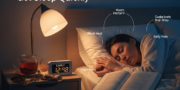

















































How to Get Sleep Quickly: 13 Evidence-Based Ways to Fall Asleep Faster
Author: RVLNSV PRASAD
Updated On: September 2026
About Us
Author Bio
Editorial Policy
Contact Us
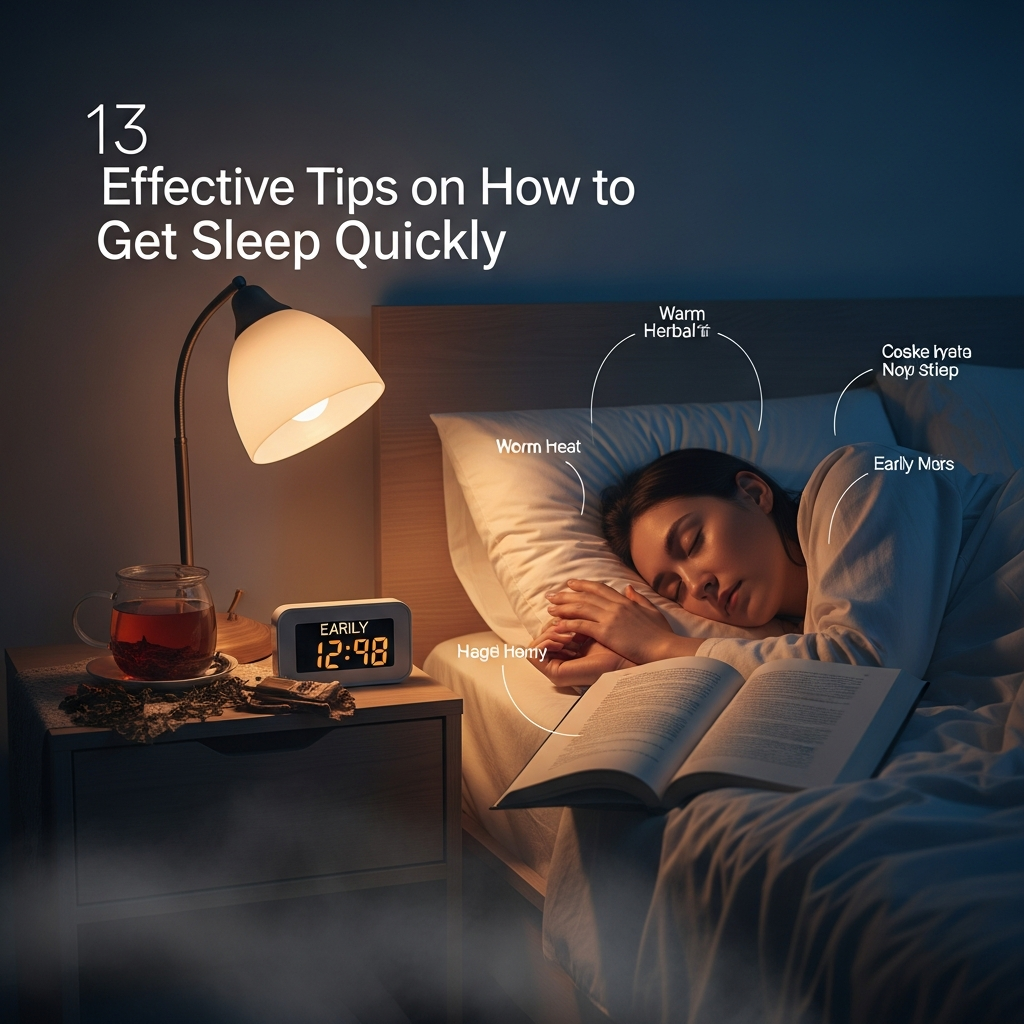
Introduction
You are tired.
You turn off the lights, get into bed, and expect sleep to come naturally. Instead, your mind starts reviewing the day. You think about tomorrow’s work, an unfinished task, a conversation, or something you wish had gone differently.
Then you look at the clock.
Twenty minutes have passed.
You check your phone.
Another thirty minutes disappear.
This is when how to get sleep quickly becomes more than a simple search. You want something practical that you can actually use tonight.
The good news is that falling asleep faster does not usually depend on one magical trick. Sleep is influenced by your body clock, sleep pressure, light exposure, stress, caffeine, physical activity, your bedroom environment, and what you do when you cannot sleep.
Current sleep guidance also emphasizes an important point: you should not become obsessed with forcing yourself to fall asleep within a specific number of minutes. Cleveland Clinic notes that around 10 to 20 minutes is a commonly cited sleep-latency range, but it is not a strict rule for every person. Cleveland Clinic: How Long Should It Take to Fall Asleep?
In this guide, I will explain 13 practical ways to fall asleep faster, including several strategies that are often overlooked in basic sleep-hygiene articles.
Quick Answer: How to Get Sleep Quickly
If you want to fall asleep faster tonight, start with the basics.
Make your bedroom dark, quiet, and comfortable. Put stimulating phone activity aside. Avoid caffeine and heavy meals close to bedtime. Follow a predictable wind-down routine. Use slow breathing or progressive muscle relaxation if your body feels tense.
If your mind is crowded with tomorrow’s tasks, spend five minutes writing them down before bed. Research has found that writing a specific to-do list before bedtime may help people fall asleep faster than writing about completed activities. PubMed: Bedtime Writing and Sleep Onset
If you are lying awake and becoming increasingly frustrated, do not keep fighting sleep. Get out of bed, keep the light low, do something quiet, and return when you feel sleepy.
For persistent sleep difficulties, lifestyle changes alone may not be enough. Cognitive behavioral therapy for insomnia, known as CBT-I, is a recommended evidence-based treatment for chronic insomnia. NHLBI: Insomnia Treatment
Key Takeaways
- Falling asleep quickly is influenced by both nighttime and daytime habits.
- A consistent wake-up time can be more useful than simply trying to force an earlier bedtime.
- A cool, dark, quiet bedroom can remove common environmental barriers to sleep.
- Caffeine can affect sleep even when consumed several hours before bedtime.
- Exercise during the day can support sleep quality.
- Morning light helps regulate the body’s circadian timing.
- Writing tomorrow’s tasks down may reduce mental clutter at bedtime.
- A warm shower or bath 1 to 2 hours before bed may help shorten the time needed to fall asleep.
- If you cannot sleep, getting out of bed temporarily can be more useful than repeatedly checking the clock.
- Chronic insomnia should not be treated as simply a lack of willpower.
How Quickly Should You Fall Asleep?
Sleep latency is the amount of time between getting into bed and actually falling asleep.
Around 10 to 20 minutes is often described as a typical range, but this should not become a target that you have to achieve every night. Cleveland Clinic’s sleep specialists emphasize that people naturally differ, and taking somewhat longer does not automatically mean something is wrong. Cleveland Clinic: Sleep Latency Explained
A single restless night is also different from chronic insomnia.
According to the National Heart, Lung, and Blood Institute, chronic insomnia involves difficulty falling asleep, staying asleep, or getting good-quality sleep at least three nights a week for more than three months, when the problem cannot be fully explained by another health condition. NHLBI: What Is Insomnia?
So the goal should not be:
“I must fall asleep in exactly 10 minutes.”
A healthier goal is
“I will create conditions that allow my body and brain to become sleepy.”
That small change can remove some of the pressure surrounding bedtime.
1. Build a 30-to-60-Minute Wind-Down Routine
Your brain does not always switch instantly from daytime activity to sleep.
If you work until 11 PM, watch exciting videos, answer messages, and immediately expect yourself to sleep, your body may not be ready.
Instead, create a predictable transition.
For example:
60 minutes before bed: Finish demanding work.
45 minutes before bed: Lower household lighting and put away unnecessary screens.
30 minutes before bed: Take a warm shower, read, stretch gently, or listen to quiet audio.
10 minutes before bed: Write down tomorrow’s important tasks.
Bedtime: Enter the bedroom when you feel sleepy.
The idea is not to create a complicated ritual. It is to repeat a sequence that tells your brain that the active part of the day is ending.
Cleveland Clinic sleep specialists similarly emphasize creating a gradual rest period rather than expecting the body to move from full activity to sleep like a light switch. Cleveland Clinic: How to Fall Asleep More Easily at Bedtime
2. Keep Your Wake-Up Time Consistent
Many people focus entirely on their bedtime.
Your wake-up time also matters.
The body’s circadian system works on a roughly 24-hour cycle. Regular daily timing gives that system predictable signals.
Try waking at approximately the same time each morning, including most weekends.
You may notice that your body begins becoming sleepy around a more predictable time in the evening.
The NHLBI recommends maintaining a regular sleep schedule and avoiding large variations that can disrupt the sleep-wake cycle. NHLBI: Healthy Sleep Habits
A practical example
If you normally wake at 7 AM on workdays but sleep until noon on weekends, Sunday night may become difficult.
Rather than trying to solve Sunday night’s problem by forcing yourself to sleep early, keeping your wake time reasonably consistent can help stabilize the pattern.
3. Make Your Bedroom Dark, Quiet, and Comfortable
Your bedroom should make sleep easier rather than harder.
Check three things first:
| Bedroom factor | What to try |
|---|---|
| Light | Blackout curtains, eye masks, or reduced artificial light |
| Noise | Earplugs, fan, or consistent background sound |
| Temperature | Keep the room comfortably cool rather than excessively warm. |
| Bedding | Use pillows and bedding that feel comfortable. |
| Phone | Keep it away from the bed if it encourages checking. |
The NHLBI recommends a cool, quiet, dark sleeping environment and advises limiting electronic-device exposure around bedtime. NHLBI: Insomnia Treatment
You do not need an expensive mattress, smart device, or sleep gadget.
Start with the environment you already have.
4. Stop Watching the Clock
This is a surprisingly useful change.
Imagine you lie down at 10:30 PM.
At 10:50, you check the clock.
At 11:10, you check again.
At 11:35, you start calculating how many hours remain before your alarm.
Now sleep has become a performance test.
The more you calculate, the more alert you may become.
Turn the clock away from your direct view.
Your goal is not to monitor sleep every few minutes.
Your goal is to create an environment in which sleep can happen without constant evaluation.
Current sleep guidance also emphasizes reducing the pressure associated with trying to force sleep. Cleveland Clinic: How to Fall Asleep Fast
5. Use Slow Breathing Instead of Trying to Force Sleep
Breathing exercises can be useful as a relaxation tool.
One commonly used technique is 4-7-8 breathing:
- Breathe in gently for 4 seconds.
- Hold for 7 seconds.
- Exhale slowly for 8 seconds.
- Repeat several times if comfortable.
However, do not treat 4-7-8 breathing as a guaranteed “sleep switch.”
The useful part may be the deliberate slowing of breathing and attention away from stressful thoughts.
You can also try a simpler approach.
Breathe in gently.
Then make your exhalation slightly longer than your inhalation.
Keep your shoulders relaxed.
Do not strain or hold your breath if that feels uncomfortable.
NCCIH notes that relaxation approaches can form part of behavioral approaches to sleep problems, although evidence varies among individual techniques. NCCIH: Psychological and Physical Approaches for Sleep Disorders
6. Try a Warm Shower or Bath 1–2 Hours Before Bed
This is one of the practical strategies that deserves more attention.
A warm shower or bath before bed may help the body transition toward sleep.
A systematic review and meta-analysis found that passive body heating with a warm bath or shower at approximately 40–42.5°C, when performed around 1–2 hours before bedtime, was associated with improvements in sleep quality and shorter sleep-onset time. The researchers also noted that more research is needed regarding the ideal timing and duration. PubMed: Warm Shower or Bath and Sleep
You do not need extremely hot water.
A comfortably warm shower is enough.
A simple evening experiment
Try a warm shower approximately 60–120 minutes before your usual bedtime.
Afterward, keep the lights relatively low.
Avoid immediately switching into stimulating activities on your phone.
The purpose is to create a complete wind-down period rather than relying on the shower alone.
7. Put Tomorrow’s Tasks on Paper
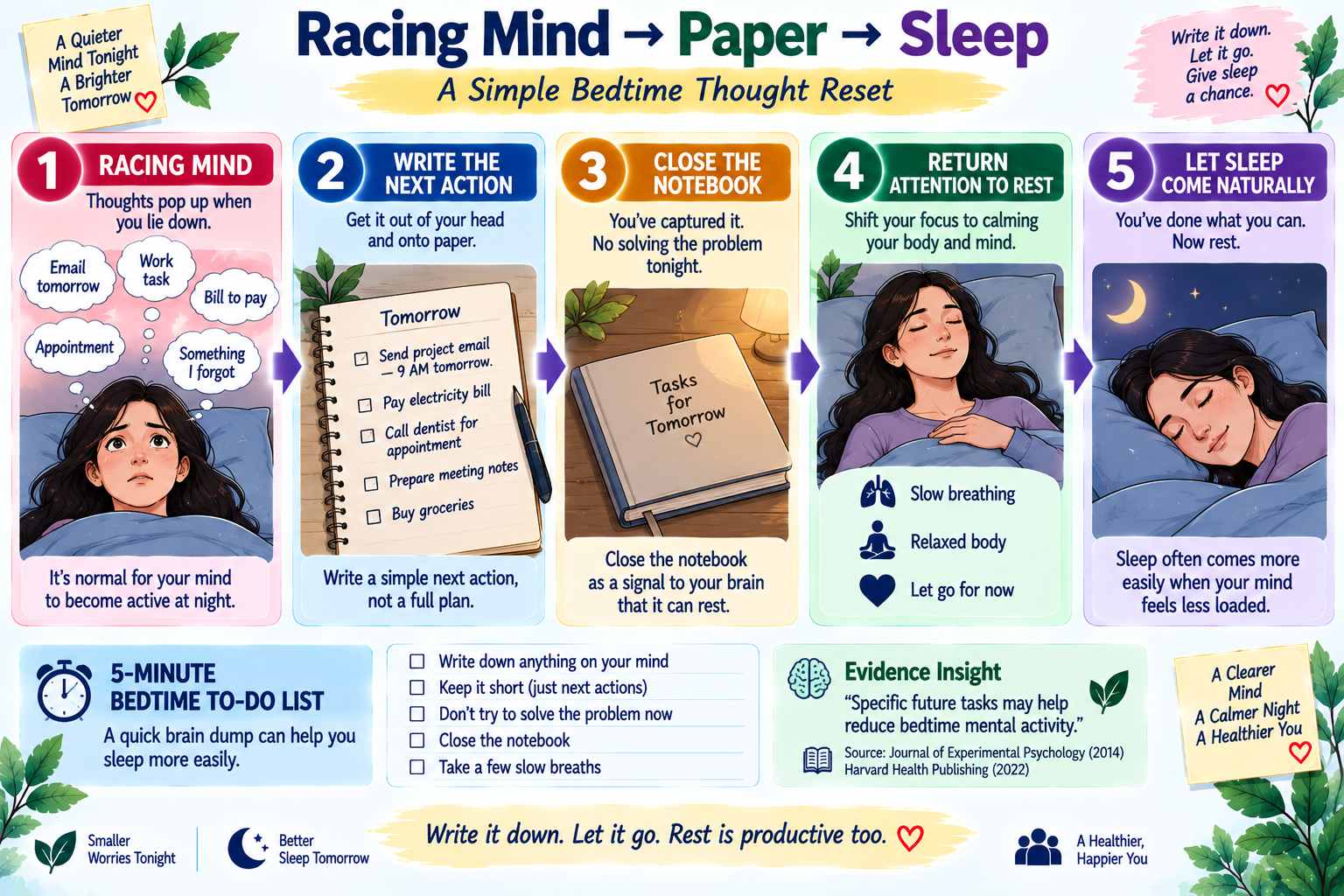
A racing mind is one of the most common reasons people struggle to settle at bedtime.
You may remember:
- an email you need to send
- a bill you need to pay
- something you need to buy
- a meeting tomorrow
- an unfinished work task
- a personal responsibility
Instead of repeatedly rehearsing these tasks mentally, write them down.
A particularly interesting study compared bedtime writing about future tasks with writing about completed activities. The participants who spent five minutes making a specific to-do list fell asleep faster than those who wrote about completed activities. PubMed: Bedtime Writing and Sleep Onset
This gives you a simple strategy:
Do not solve tomorrow’s problems in bed.
Write the next action down before you go to sleep.
For example:
Instead of:
“Work is stressful.”
Write:
“Tomorrow at 9 AM, send the project email.”
The second statement gives your brain a concrete next step.
8. Manage Caffeine Earlier Than You Think
Coffee is not the only source of caffeine.
Tea, energy drinks, cola, chocolate, pre-workout products, and some medications can also contribute caffeine.
One controlled study found that 400 mg of caffeine could significantly disrupt sleep even when consumed six hours before bedtime. PubMed: Caffeine and Sleep
That does not mean everyone needs to stop caffeine at exactly 3 PM.
People differ in their sensitivity, dose, metabolism, and bedtime.
A more useful rule is:
If you struggle to fall asleep, experiment with moving your last caffeinated drink earlier in the day.
If you normally drink strong tea at 7 PM, try moving it to the afternoon for a couple of weeks and observe whether your sleep changes.
This is more practical than assuming one universal cutoff works for everybody.
9. Get Daylight During the Morning
Good sleep preparation begins after you wake up.
Light is one of the strongest environmental signals controlling the circadian system.
A systematic review found that the timing and intensity of light exposure can influence sleep timing, with morning light generally associated with shifts toward earlier sleep timing and improvements in some subjective sleep outcomes. PubMed: Light Exposure and Sleep Outcomes
You do not have to stare directly at the sun.
Instead, spend some time outdoors in ordinary daylight.
You could:
- walk outside after breakfast
- sit on a balcony
- take an outdoor morning walk
- have your morning tea outside
- walk part of your commute
Morning daylight is especially useful because it gives your body a clear “daytime” signal.
Important distinction
Morning daylight is not the same as deliberately using a medical light box.
If you have a diagnosed circadian rhythm disorder or are considering bright-light therapy, discuss appropriate timing and safety with a healthcare professional.
10. Exercise During the Day
Exercise is not just useful for fitness.
It can also support sleep.
A 2024 systematic review and meta-analysis of exercise interventions in people with insomnia found improvements in both objective and subjective sleep measures, although the researchers noted substantial variation between studies. PubMed: Exercise Interventions for Insomnia
More recent research continues to examine which forms of exercise may help different groups of people with insomnia. A 2025 network meta-analysis included 22 randomized controlled trials involving 1,348 participants and examined several exercise approaches, including yoga, Tai Chi, walking or jogging, aerobic exercise, and strength training. PubMed: Exercise Interventions in Insomnia
You do not need an extreme workout.
A practical routine could be
Morning: 15–30 minute walk
Afternoon: strength training or another workout
Evening: gentle stretching if comfortable
If vigorous exercise close to bedtime makes you feel energized, move it earlier.
The NHLBI also recommends regular daytime physical activity and notes that exercising too close to bedtime may make falling asleep harder for some people. NHLBI: Insomnia Treatment
11. Use the “Get Out of Bed” Rule When Sleep Is Not Coming
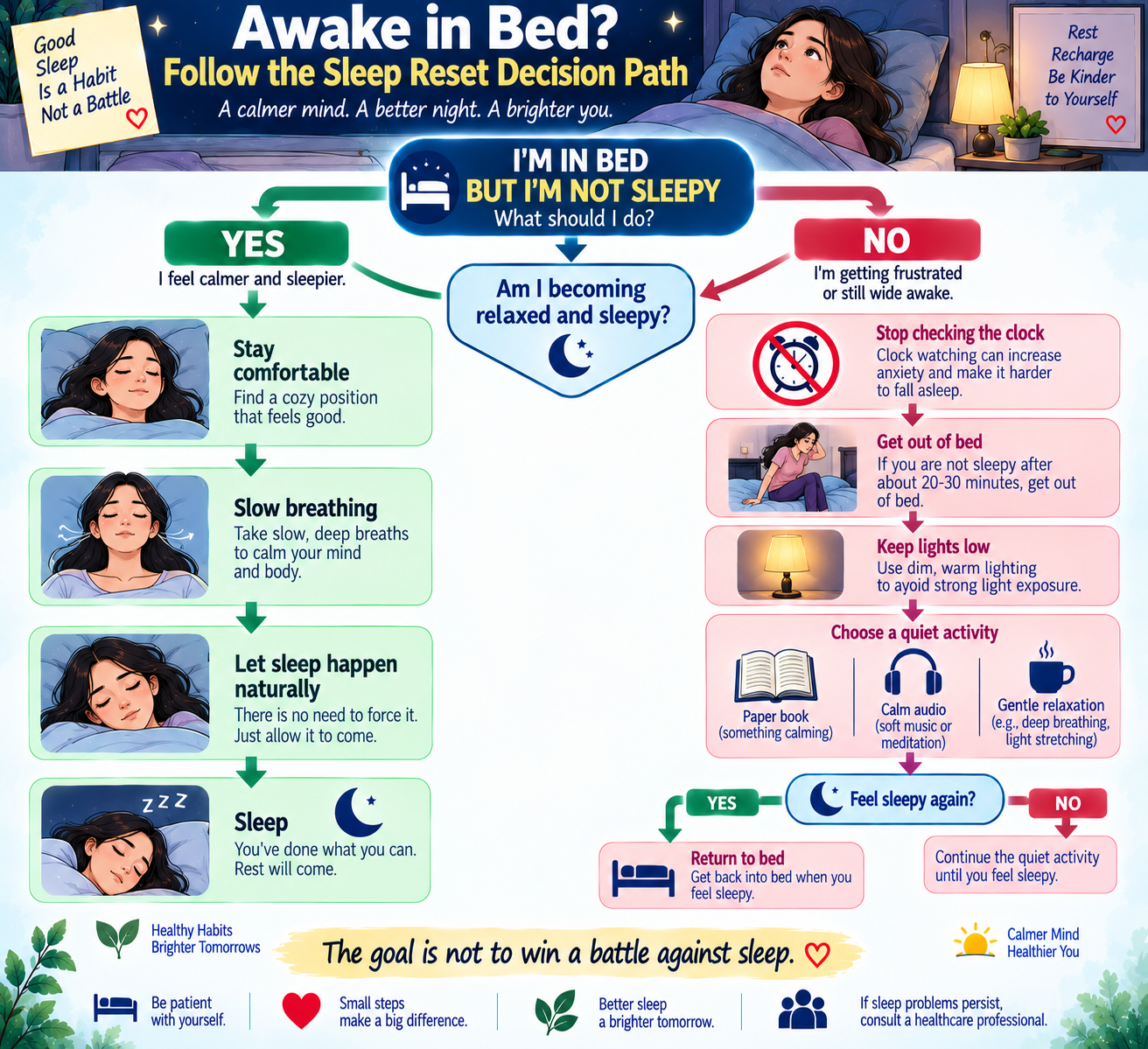
This is one of the most important strategies for people who repeatedly lie awake.
If you remain awake and increasingly frustrated, continuing to lie in bed can teach your brain that the bed is a place for worrying, thinking, scrolling, or watching the clock.
Stimulus control therapy takes the opposite approach.
Go to bed when you are sleepy.
If you cannot sleep, get out of bed and do something quiet in low light.
Return when you feel sleepy again.
The NHLBI describes this as part of stimulus control therapy, which helps strengthen the association between the bed and sleep. NHLBI: CBT-I and Stimulus Control
You can:
- read a calm paper book
- listen to quiet audio
- sit quietly
- practice gentle breathing
- write down a thought that keeps returning
Avoid turning the break into another screen session.
12. Try Progressive Muscle Relaxation
Sometimes the mind feels calm but the body remains tense.
Your jaw may be tight.
Your shoulders may be raised.
Your hands may be clenched.Your legs may feel restless after a stressful day.
Progressive muscle relaxation involves gently tensing and then relaxing muscle groups.
For example:
Hands: Gently tighten, then release.
Shoulders: Raise them slightly, then let them drop.
Face: Relax the forehead, jaw, and eyes.
Legs: Gently tense, then release.
The objective is not to make yourself fall asleep immediately.
Instead, you are reducing physical tension and shifting attention away from active thinking.
Relaxation approaches are included among behavioral strategies used for insomnia, although they should not be presented as a substitute for evidence-based treatment of chronic insomnia. NCCIH: Sleep Disorders and Behavioral Approaches
13. Stop Trying So Hard to Sleep
This may be the most counterintuitive tip in this article.
You cannot command your body:
“Sleep now.”
The more pressure you put on yourself, the more you may monitor whether sleep is happening.
That monitoring can create frustration.
Cleveland Clinic’s sleep guidance similarly warns that trying too hard to make sleep happen can work against you. Cleveland Clinic: How to Fall Asleep Fast
Try replacing:
“I have to fall asleep immediately.”
with:
“I am going to rest quietly and allow sleep to come when my body is ready.”
This does not mean ignoring persistent sleep problems.
It means removing unnecessary performance pressure from an ordinary night.
A Simple “Fall Asleep Faster Tonight” Routine
If you want a practical routine rather than 13 separate tips, try this sequence.
| Time | What to do |
|---|---|
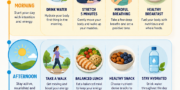
| Morning | Get outdoor daylight and wake at a consistent time. |
| Daytime | Stay physically active. |
| Afternoon | Avoid excessive caffeine later in the day. |
| 2 hours before bed | Finish large meals and begin reducing stimulation. |
| 1–2 hours before bed | Consider a warm shower or bath. |
| 30–60 minutes before bed | Dim the lights and start your relaxing routine. |
| 5 minutes before bed | Write tomorrow’s important tasks. |
| Bedtime | Enter bed when sleepy. |
| If awake and frustrated | Leave bed and do something quiet. |
| When sleepy again | Return to bed. |
The goal is not perfection.
The goal is repetition.
What Is Different About This Approach?
Many sleep articles give a long list of tips.
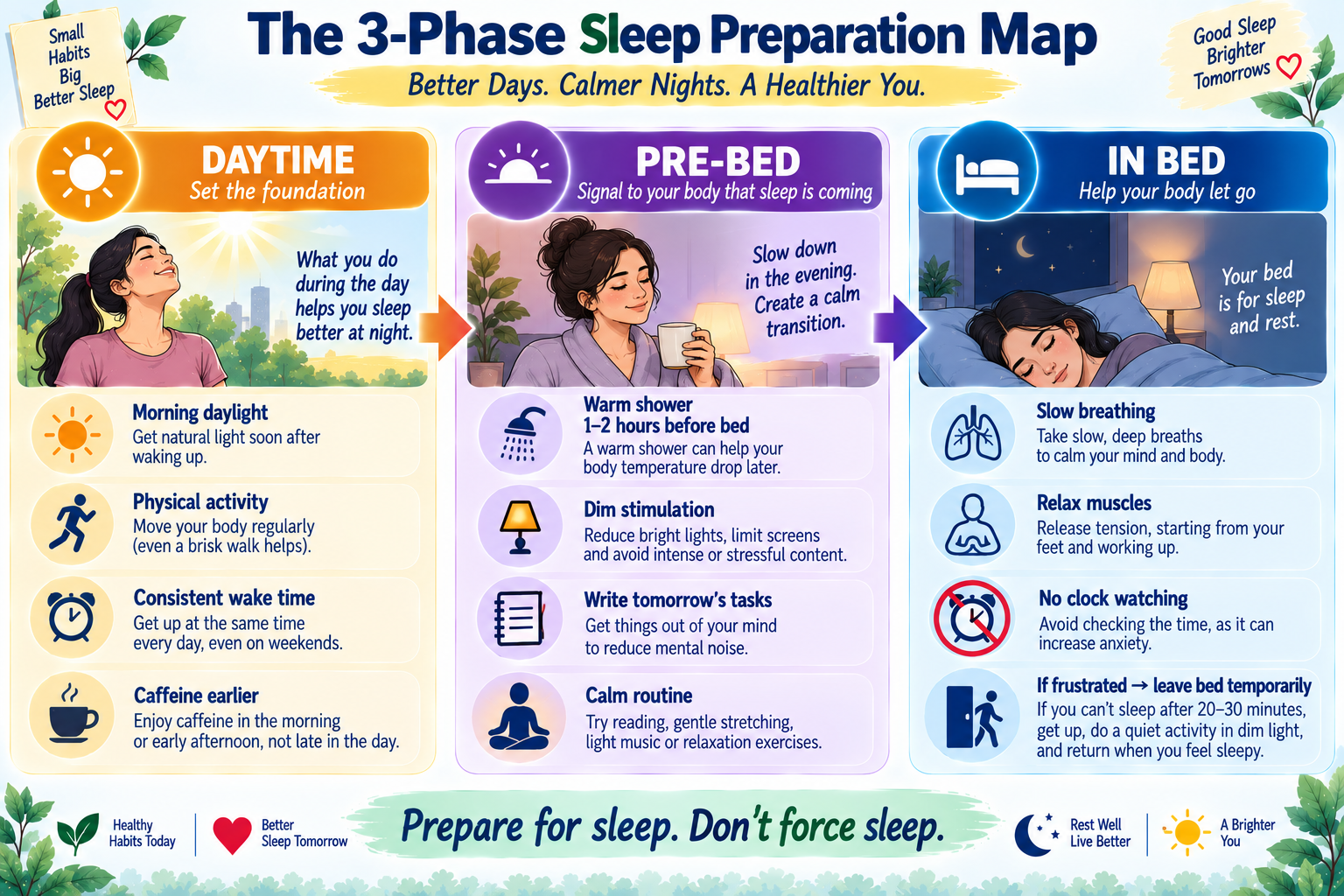
The more useful approach is to organize the advice around three separate periods.
During the day
Build sleep pressure and strengthen your body clock through regular activity, consistent waking, and daylight exposure.
Before bed
Reduce stimulation, manage caffeine, lower light exposure, finish demanding tasks, and create a predictable wind-down routine.
When you are actually in bed
Do not turn sleep into a competition.
Use relaxation techniques.
If you remain awake and frustrated, temporarily leave the bed.
This three-stage approach makes the advice easier to apply.
What About Phone and Screen Use?
The relationship between screens and sleep is more complicated than simply saying:
“Blue light causes insomnia.”
The content itself can be stimulating.
A late-night conversation can make you emotionally activated.
Social media can encourage endless scrolling.
Work messages can keep your mind focused on tomorrow.
A 2025 systematic review and meta-analysis examining screen time and sleep found an association between greater screen exposure and shorter sleep duration, although observational research cannot prove that screen exposure alone caused the sleep problems. PubMed: Screen Time and Sleep Outcomes
So a useful rule is
Reduce stimulating screen activity before bed.
If you use your phone for a calming audiobook or relaxation recording, the situation is different from scrolling through stressful news for an hour.
What About the Military Sleep Method?
You may have seen claims that a military technique can make you fall asleep within two minutes.
Be careful with those claims.
Relaxation, breathing, and muscle release can certainly be useful components of a bedtime routine.
But there is no good evidence that a particular “military sleep method” reliably makes everyone fall asleep within two minutes.
Cleveland Clinic specifically notes that the military sleep method has not been scientifically established as a guaranteed rapid-sleep technique. Cleveland Clinic: How to Fall Asleep Fast
Do not turn a relaxation exercise into another performance test.
What About Melatonin?
Melatonin is often marketed as a simple answer to the question of how to get sleep quickly.
But it is not appropriate to treat it as a universal solution.
Melatonin is involved in regulating the sleep-wake cycle, and its usefulness depends partly on why someone is having difficulty sleeping.
The NHLBI notes that research has not established melatonin as an effective treatment for insomnia in general and recommends discussing supplements with a healthcare provider. NHLBI: Insomnia Treatment
This is especially important if you take medications, have another health condition, are pregnant, or experience persistent sleep problems.
Common Mistakes That Can Make Falling Asleep Harder
Going to bed too early
If you are not sleepy, getting into bed simply because the clock says bedtime may lead to prolonged wakefulness.
Sleeping very late on weekends
Large changes to your schedule can make Sunday-night sleep more difficult.
Using caffeine to compensate for poor sleep
This can create a cycle in which poor sleep leads to more caffeine, which then interferes with the following night’s sleep.
Taking long afternoon naps
Long or late naps can reduce sleep pressure at night.
Checking the clock repeatedly
This can turn bedtime into a countdown.
Scrolling in bed
Even relaxing content can become stimulating when it turns into an hour of scrolling.
Trying too many techniques at once
You do not need ten breathing methods, three supplements, an expensive device, and a complicated sleep tracker.
Start with two or three changes.
A People-First 7-Day Sleep Experiment
Instead of trying to change your entire life overnight, run a simple seven-day experiment.
Day 1
Choose your consistent wake-up time.
Day 2
Move your phone away from your bed.
Day 3
Add morning outdoor light.
Day 4
Move caffeine earlier.
Day 5
Try a warm shower before bed.
Day 6
Write tomorrow’s tasks for five minutes.
Day 7
Review your sleep diary.
Record:
- bedtime
- approximate time you became sleepy
- estimated time you fell asleep
- nighttime awakenings
- wake-up time
- caffeine timing
- exercise
- naps
- how rested you felt
Do not obsess over individual nights.
Look for patterns.
When Trouble Sleeping May Be Insomnia
Occasional difficulty falling asleep is common.
Persistent problems are different.
NHLBI explains that chronic insomnia involves symptoms at least three nights a week for more than three months, with daytime effects and without another condition fully explaining the problem. NHLBI: Insomnia Symptoms and Diagnosis
You should consider speaking with a healthcare professional if you regularly:
- struggle to fall asleep
- wake repeatedly during the night
- wake up too early and cannot return to sleep
- feel exhausted during the day
- have difficulty concentrating
- feel sleepy while driving
- depend on sleep medicines regularly
A sleep diary can also help your healthcare professional understand the pattern. NHLBI: Insomnia Symptoms
Don’t Ignore Possible Sleep Apnea
Not every sleep problem is caused by poor bedtime habits.
Sleep apnea can interfere with restorative sleep.
Warning signs can include loud snoring, gasping or choking during sleep, repeated awakenings, morning headaches, and excessive daytime sleepiness.
If someone sleeping near you notices that you stop breathing or repeatedly gasp during sleep, discuss it with a healthcare professional.
This is particularly important because trying more bedtime tricks will not correct an untreated breathing disorder.
What Is the Evidence-Based Treatment for Chronic Insomnia?
This is one of the most important points missing from many “fall asleep fast” articles.
If someone has chronic insomnia, simply being told to “practice better sleep hygiene” may not be enough.
Cognitive behavioral therapy for insomnia, or CBT-I, is a structured treatment that addresses thoughts, behaviors, sleep timing, and the relationship between the bed and wakefulness.
The American Academy of Sleep Medicine gives a strong recommendation for multicomponent CBT-I for adults with chronic insomnia disorder. American Academy of Sleep Medicine Guideline via PubMed
NHLBI describes CBT-I as a treatment that can include cognitive therapy, relaxation, sleep education, sleep restriction, and stimulus control. NHLBI: CBT-I for Insomnia
This is an important distinction:
Sleep tips are useful for healthy sleep habits.
Chronic insomnia may require structured treatment.
My Personal Sleep Insight
One thing I have learned from dealing with difficult nights is that the biggest mistake is making sleep another task to complete.
When I have treated bedtime like a deadline, every minute awake has felt important.
That created more frustration.
A better approach is to prepare the environment, remove obvious obstacles, and let the body do what it is designed to do.
The practical lesson is simple:
Prepare for sleep. Do not fight for sleep.
That distinction can make the entire bedtime experience feel different.
Author Note
This article was written to provide practical, evidence-based information about falling asleep faster and improving sleep habits.
The recommendations are based on guidance from established health organizations and peer-reviewed research. Individual responses can vary, and a technique that helps one person may not work equally well for another.
Personal experiences described in this article should be understood as practical observations rather than medical evidence.
Medical Disclaimer
This article is for general educational purposes and is not a substitute for medical diagnosis or treatment.
Persistent difficulty falling asleep can have many possible causes, including insomnia, anxiety, medications, chronic pain, restless legs syndrome, sleep apnea, circadian rhythm disorders, and other medical conditions.
If sleep problems are persistent, worsening, or affecting your daytime functioning, speak with a qualified healthcare professional.
Do not start, stop, or change prescription medicines or supplements based solely on information in this article.
Fitness Disclaimer
Physical activity can support sleep and overall health, but exercise recommendations should be adapted to your age, fitness level, medical history, and physical limitations.
If you have a medical condition, significant pain, dizziness, chest symptoms, or another health concern, seek appropriate professional advice before starting a new exercise program.
Frequently Asked Questions
What is the fastest way to fall asleep?
There is no guaranteed method that makes everyone fall asleep immediately. A combination of a consistent sleep schedule, a comfortable dark bedroom, reduced evening stimulation, relaxation, appropriate caffeine timing, and daytime activity can create better conditions for sleep.
How can I fall asleep quickly when my mind is racing?
Write tomorrow’s important tasks on paper, then use a quiet relaxation technique such as slow breathing or progressive muscle relaxation. A bedtime writing study found that specific to-do lists may help reduce the time needed to fall asleep. PubMed: Bedtime Writing Study
Does a warm shower help you sleep?
It may. A systematic review found that warm bathing or showering approximately 1–2 hours before bedtime was associated with shorter sleep-onset time and improved sleep-related measures, although the evidence base remains limited. PubMed: Warm Bathing and Sleep
Should I use my phone if I cannot sleep?
Avoid stimulating phone use. If you need an audio relaxation exercise, keep the activity calm and avoid scrolling, social media, work messages, and emotionally stimulating content.
Does exercise help you fall asleep faster?
Regular physical activity can improve sleep quality and may reduce insomnia symptoms. Recent systematic reviews have found beneficial effects, although the optimal exercise type and intensity can vary between people. PubMed: Exercise and Insomnia Meta-Analysis
Is it normal to take 30 minutes to fall asleep?
Occasionally, yes. Sleep latency varies between individuals and from night to night. Taking longer than 10–20 minutes does not automatically mean you have a sleep disorder. Persistent difficulty that affects daytime functioning deserves further evaluation. Cleveland Clinic: Sleep Latency
Should I get out of bed if I cannot sleep?
If you are awake and becoming frustrated, getting out of bed and doing something quiet until you become sleepy can be useful. This is part of stimulus control, an evidence-based behavioral approach used in insomnia treatment. NHLBI: Insomnia Treatment
Does caffeine affect sleep even if I drink it in the afternoon?
It can. Caffeine has a long enough effect that afternoon consumption may affect some people’s nighttime sleep. Individual sensitivity varies, so moving caffeine earlier can be a useful personal experiment. PubMed: Caffeine and Sleep
Is morning sunlight useful for sleep?
Morning daylight provides an important timing signal for the circadian system. Research suggests that the timing and intensity of light exposure can influence sleep timing and sleep-related outcomes. PubMed: Light Exposure and Sleep
When should I see a doctor about difficulty sleeping?
Seek professional advice when difficulty falling asleep happens regularly, continues for months, causes daytime impairment, or occurs with symptoms such as loud snoring, gasping during sleep, severe daytime sleepiness, or other concerning symptoms.
Conclusion
Learning how to get sleep quickly is not about discovering one secret technique.
It is about creating the conditions in which sleep can happen naturally.
Start with the fundamentals.
Wake at a consistent time. Get daylight during the morning. Stay physically active during the day. Be thoughtful about caffeine. Create a calm transition into bedtime. Keep your bedroom dark, quiet, and comfortable.
When your mind is busy, write tomorrow’s tasks down.
When your body is tense, try slow breathing or progressive muscle relaxation.
A warm shower before bed may also help you transition toward sleep.
And when you are lying awake becoming frustrated, remember that forcing sleep is rarely helpful. Get out of bed, do something quiet, and return when you become sleepy.
Most importantly, do not judge your sleep based on one difficult night.
If falling asleep remains difficult night after night, look beyond simple sleep tips. Persistent insomnia may need structured treatment such as CBT-I, while symptoms such as loud snoring, gasping, or severe daytime sleepiness may point toward another sleep disorder.
The goal is not to force your body to sleep on command.
The goal is to give your body and brain the right conditions to sleep.
Sources
- NHLBI — Insomnia Treatment and CBT-I
- NHLBI — What Is Insomnia?
- American Academy of Sleep Medicine Guideline — CBT-I
- NCCIH — Psychological and Physical Approaches for Sleep Disorders
- PubMed — Exercise Interventions for Insomnia
- PubMed — Exercise Network Meta-Analysis, 2025
- PubMed — Warm Shower or Bath and Sleep
- PubMed — Bedtime To-Do Lists and Sleep Onset
- PubMed — Caffeine and Sleep
- PubMed — Light Exposure and Sleep Outcomes
- PubMed — Screen Time and Sleep Outcomes
- Cleveland Clinic — How to Fall Asleep Fast
- Cleveland Clinic — How Long Should It Take to Fall Asleep?
- Sleep Foundation — How to Fall Asleep Fast
Similar Content
- 10 Stress Management Techniques and Strategies
- How To Lose Your Weight Fast And Safely
- 5 Meditation Techniques for Emotional Balance: A Path to Inner Peace
- Simple Habits for Better Sleep at Night: A Comprehensive Guide
- 9 Benefits Of Regular Exercise And Fitness
- Category Holistic Welness
- Home








[…] 13 Effective Tips on How to Get Sleep Quickly […]
[…] 13 Effective Tips on How to Get Sleep Quickly […]
[…] 13 Effective Tips on How to Get Sleep Quickly […]
[…] 13 Effective Tips on How to Get Sleep Quickly […]
[…] 13 Effective Tips on How to Get Sleep Quickly […]
[…] 13 Effective Tips on How to Get Sleep Quickly […]
[…] 13 Effective Tips on How to Get Sleep Quickly […]
[…] 13 Effective Tips on How to Get Sleep Quickly […]
[…] 13 Effective Tips on How to Get Sleep Quickly […]
[…] 13 Effective Tips on How to Get Sleep Quickly […]
[…] 13 Effective Tips on How to Get Sleep Quickly […]
[…] 13 Effective Tips on How to Get Sleep Quickly […]
[…] 13 Effective Tips on How to Get Sleep Quickly […]
[…] 13 Effective Tips on How to Get Sleep Quickly […]
[…] 13 Effective Tips on How to Get Sleep Quickly […]
[…] 13 Effective Tips on How to Get Sleep Quickly […]
[…] 13 Effective Tips on How to Get Sleep Quickly […]
[…] 13 Effective Tips on How to Get Sleep Quickly […]
[…] 13 Effective Tips on How to Get Sleep Quickly […]
[…] 13 Effective Tips on How to Get Sleep Quickly […]
[…] 13 Effective Tips on How to Get Sleep Quickly […]
[…] 13 Effective Tips on How to Get Sleep Quickly […]
[…] 13 Effective Tips on How to Get Sleep Quickly […]
[…] 13 Effective Tips on How to Get Sleep Quickly […]
[…] 13 Effective Tips on How to Get Sleep Quickly […]
[…] 13 Effective Tips on How to Get Sleep Quickly […]