








































































































































Keto Diet for Indian Beginners: What to Eat, How It Works, and What to Know for Weight Loss
Author: RVLNSV PRASAD
Last Updated: August 2026
Sources Reviewed: Harvard T.H. Chan School of Public Health, NIH/NIDDK, CDC, WHO, and peer-reviewed research
Author Bio | About Us | Contact Us
Introduction
If you are searching for a keto diet for Indian beginners, you may already know the basic idea: eat very few carbohydrates and replace them with more fat and an appropriate amount of protein.
But following keto in an Indian household can be more complicated than simply removing sugar.
Rice, roti, dosa, idli, poha, potatoes, sweets, and many traditional snacks are carbohydrate-rich foods. At the same time, Indian cooking offers plenty of foods that can fit into a lower-carbohydrate eating pattern, including eggs, fish, chicken, paneer, tofu, vegetables, nuts, seeds, and unsweetened dairy.
The bigger question is whether keto is actually a good fit for you.
A ketogenic diet can lead to nutritional ketosis, a state in which the body produces more ketones because carbohydrate availability is greatly reduced. Some people lose weight while following keto, but ketosis itself does not guarantee body-fat loss. Harvard T.H. Chan School of Public Health — Ketogenic Diet Review
This guide takes a practical approach.
You will learn what keto is, how it may affect weight, which Indian foods can fit into a ketogenic pattern, what foods can make strict keto difficult, how to build simple meals, what beginners commonly get wrong, and when professional advice is important.
The goal is not to convince you that keto is the best diet.
The goal is to help you understand it well enough to make an informed decision.
Quick Answer
What is the keto diet for Indian beginners?
The keto diet for Indian beginners is a very low-carbohydrate eating pattern that emphasizes foods such as non-starchy vegetables, protein foods, nuts, seeds, and sources of fat. By greatly reducing carbohydrate intake, the body can increase ketone production and enter ketosis. Harvard T.H. Chan School of Public Health — Ketogenic Diet
Keto may help some people lose weight, but it is not a guaranteed solution. Early changes on the scale can include water loss, and long-term results depend on factors such as food intake, physical activity, sleep, health conditions, medications, and how consistently a person can follow the eating pattern. CDC—Steps for Losing Weight
For Indian beginners, the biggest challenge is often adapting familiar carbohydrate-rich foods while still creating meals that are nutritious, satisfying, and realistic.
Key Takeaways
- Keto is a very low-carbohydrate eating pattern, not simply a high-fat diet.
- Reducing carbohydrates substantially can increase ketone production and lead to nutritional ketosis.
- Ketosis does not automatically guarantee weight loss.
- Rice, roti, dosa, idli, poha, potatoes, sweets, and sugary drinks can make strict keto difficult.
- Indian keto meals can include vegetables, eggs, fish, chicken, paneer, tofu, nuts, seeds, and other suitable foods.
- A healthy keto approach should still pay attention to food quality, fiber, protein, and fat sources.
- Keto is restrictive and may not be suitable for everyone.
- Long-term sustainability matters more than achieving ketosis for a few days.
Author Note
By RVLNSV PRASAD
I created this guide to make the ketogenic diet easier to understand for Indian beginners.
Many online keto guides use foods and meal examples that may not reflect everyday Indian eating. Someone who normally eats rice, roti, dal, dosa, idli, vegetables, curd, and traditional home-cooked meals may have different practical questions from someone following a typical Western meal plan.
This guide focuses on those questions.
I have used established nutrition guidance and reputable health sources to explain the science while keeping the practical examples relevant to Indian meals.
This article does not claim that keto is the right choice for everyone. Individual nutritional requirements, health conditions, medications, food preferences, and weight-management goals can differ considerably.
What Is the Keto Diet?
The ketogenic diet is a very low-carbohydrate, higher-fat eating pattern that usually provides an appropriate amount of protein while substantially restricting carbohydrates.
Under ordinary conditions, carbohydrates are an important source of glucose for the body.
When carbohydrate intake becomes very low, the body has less carbohydrate available and increases the production of compounds called ketones.
These ketones can be used as an alternative fuel source.
This metabolic state is called nutritional ketosis. Harvard T.H. Chan School of Public Health — Ketogenic Diet Review
A typical ketogenic eating pattern therefore emphasizes foods such as
- Non-starchy vegetables
- Eggs
- Fish
- Chicken
- Meat
- Tofu
- Paneer
- Nuts
- Seeds
- Avocado
- Certain dairy foods
- Unsaturated oils
At the same time, foods containing substantial amounts of carbohydrate are significantly reduced.
That can include:
- Rice
- Wheat-based breads
- Roti
- Pasta
- Potatoes
- Sugary foods
- Sweetened drinks
- Many traditional grain-based snacks
However, keto is more complicated than simply asking:
“Is this food healthy?”
A food can be nutritious but still contain enough carbohydrate to make it difficult to fit into a strict ketogenic diet.
That distinction is especially important for Indian beginners.
What Does “Ketosis” Mean?
Ketosis is a metabolic state in which the body produces increased amounts of ketones.
It generally occurs when carbohydrate availability becomes sufficiently low.
The liver produces ketones from fat, and those ketones can provide energy for the brain and other tissues.
This is different from diabetic ketoacidosis, which is a dangerous medical condition associated primarily with insufficient insulin and very high ketone levels.
Therefore, nutritional ketosis and diabetic ketoacidosis should never be treated as the same thing.
For a beginner, the simplest way to understand ketosis is
Less available carbohydrate → greater reliance on fat and increased ketone production.
But reaching ketosis does not mean that every person will automatically lose body fat.
That distinction is essential when discussing keto and weight loss.
How Does Keto Work for Weight Loss?
There are several reasons why some people may lose weight while following a ketogenic diet.
One is that substantially reducing carbohydrate-rich foods can change what a person eats overall.
For example, removing:
- Sugary drinks
- Sweets
- Biscuits
- Desserts
- Large servings of rice
- Bread
- Other refined carbohydrate foods
can reduce overall energy intake for some people.
Keto may also affect appetite and food choices.
Some people report feeling fuller after eating meals containing adequate protein and fat. Others find the restrictive nature of keto difficult to maintain.
The important point is that ketosis itself is not a guarantee of fat loss.
If someone regularly consumes large portions of calorie-dense foods such as cheese, butter, cream, nuts, oils, or other high-energy foods, they can still consume more energy than their body needs.
Weight management depends on much more than just one nutrient. The CDC notes that physical activity, sleep, stress, medications, health conditions, genetics, age, environment, and eating patterns can all affect weight. CDC—Steps for Losing Weight
So the better question is not
“Does ketosis burn fat?”
It is:
“Can I follow this eating pattern in a nutritionally adequate and sustainable way that supports my overall goals?”
Keto Weight Loss in the First Few Weeks
One of the biggest mistakes beginners make is expecting the scale to behave in a predictable way.
When carbohydrate intake falls substantially, the body uses stored carbohydrate called glycogen.
Glycogen is stored together with water.
As glycogen stores decrease, some of the initial change on the scale can therefore come from water rather than body fat.
This is why early weight loss can appear faster than later progress.
After the initial period, the rate of weight change can slow.
That is normal.
Do not assume that a slower rate means the diet has suddenly stopped working.
Weight changes depend on:
- Food intake
- Activity
- Fluid balance
- Sleep
- Stress
- Hormonal factors
- Medications
- Health conditions
- Individual metabolism
The CDC recommends focusing on gradual, sustainable weight loss rather than expecting rapid changes to continue indefinitely. CDC—Steps for Losing Weight
How Many Carbohydrates Does Keto Usually Include?
There is no single carbohydrate target that works identically for every person.
However, many ketogenic diets use a very low-carbohydrate approach, often below 50 grams per day, with some approaches using around 20 grams per day. Harvard T.H. Chan School of Public Health — Ketogenic Diet Review
This is considerably lower than the carbohydrate intake found in many traditional Indian diets.
That is why keto can require substantial changes for people who regularly eat:
- Rice
- Chapati
- Roti
- Dosa
- Idli
- Poha
- Upma
- Potatoes
- Sweets
You should not assume that exactly 20 grams of carbohydrate is medically appropriate for every person.
Individual needs and responses differ.
If you have a medical condition or take medication that could be affected by major dietary changes, speak with a healthcare professional before starting keto and discuss your approach with a healthcare professional.
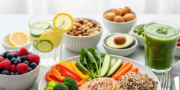
The Indian Keto Plate
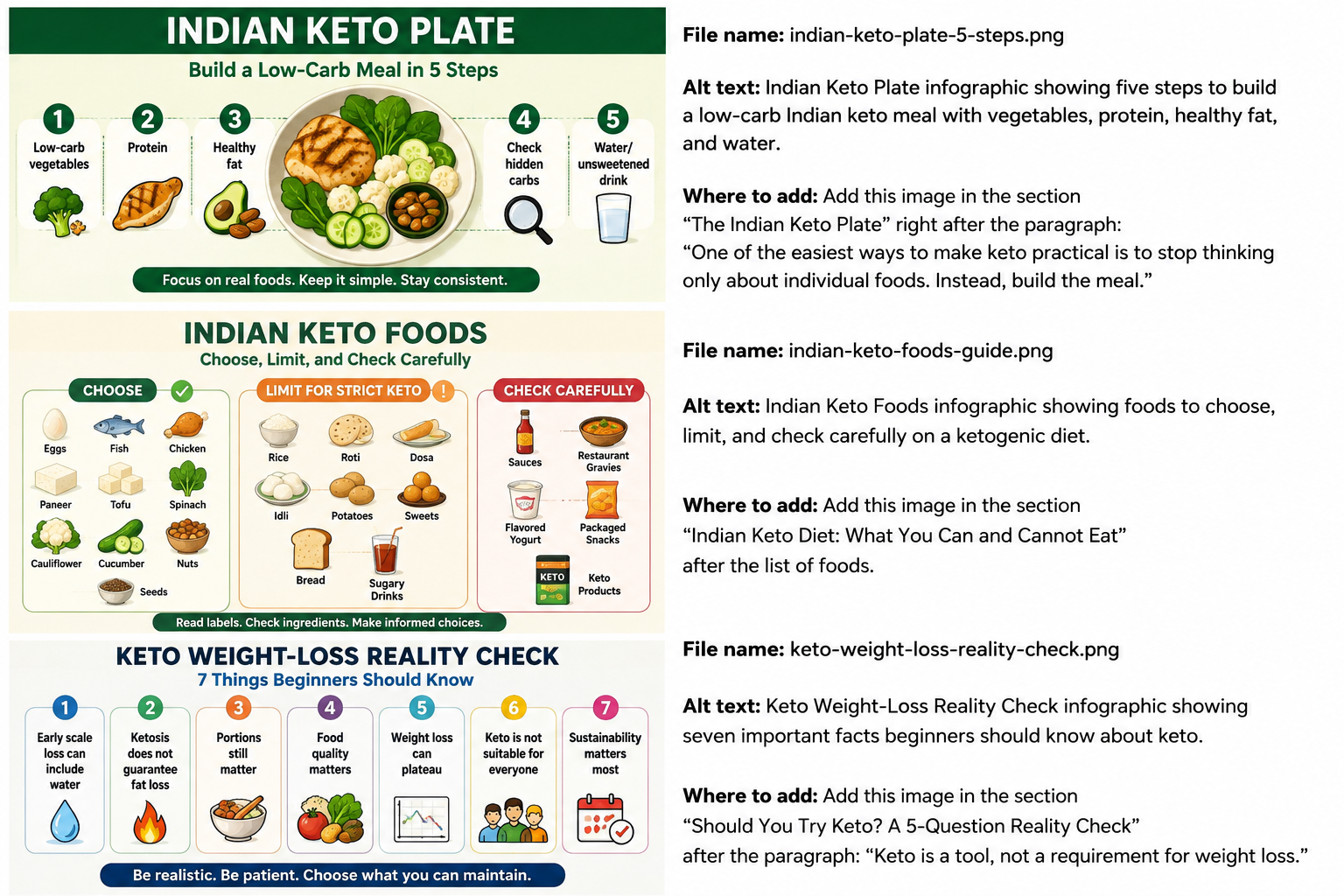
One of the easiest ways to make keto practical is to stop thinking only about individual foods.
Instead, build the meal.
I call this the Indian Keto Plate.
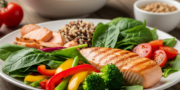
Step 1: Start With Low-Carbohydrate Vegetables
Fill a substantial part of the meal with suitable non-starchy vegetables.
Examples include:
- Spinach
- Cauliflower
- Cabbage
- Cucumber
- Broccoli
- Green beans
- Mushrooms
- Bell peppers
- Zucchini
- Leafy greens
Vegetables add variety, fiber, vitamins, and minerals without contributing as much carbohydrate as grains or starchy vegetables.
Step 2: Add Protein
Choose a suitable protein source.
Examples include:
- Eggs
- Fish
- Chicken
- Tofu
- Paneer
- Unsweetened Greek yogurt
- Other suitable protein foods
Protein needs vary, so avoid assuming that more protein is always better.
Step 3: Add a Suitable Fat Source
Choose a moderate amount of fat.
Options can include:
- Nuts
- Seeds
- Avocado
- Olive oil
- Other suitable unsaturated plant oils
Keto does not mean you need to add unlimited butter, ghee, or oil.
Step 4: Check for Hidden Carbohydrates
Before eating, ask:
Is there added sugar?
Check:
- Sauces
- Ketchup
- Packaged dressings
- Sweetened yogurt
- Restaurant gravies
- Processed snacks
- Sweetened tea or coffee
A meal can look “keto” while still containing unexpected carbohydrates.
Step 5: Choose Your Beverage
Water is the simplest choice.
Unsweetened tea or coffee can also fit many ketogenic approaches.
Sugary drinks and fruit juices can quickly increase carbohydrate intake.
Step 6: Consider Your Individual Needs
The plate is a guide.
It is not a prescription.
Your needs may differ based on your:
- Age
- Body size
- Activity
- Hunger
- Health
- Medications
- Dietary preferences
- Weight-management goals
Indian Keto Foods for Beginners
A successful Indian keto diet does not require expensive imported foods.
Many familiar ingredients can be used.
Low-Carbohydrate Vegetables
Good options can include:
- Spinach
- Cabbage
- Cauliflower
- Cucumber
- Brinjal
- Okra in suitable portions
- Mushrooms
- Bell peppers
- Bottle gourd in appropriate portions
- Green leafy vegetables
Try to use a variety rather than eating only one or two vegetables.
Protein Foods
Depending on your dietary pattern, options include:
- Eggs
- Fish
- Chicken
- Paneer
- Tofu
- Unsweetened dairy
- Meat
- Seafood
- Nuts and Seeds
Nuts and Seeds
Examples include:
- Almonds
- Walnuts
- Peanuts
- Chia seeds
- Flaxseeds
- Pumpkin seeds
- Sunflower seeds
Remember that nuts and seeds are nutritious but energy-dense.
A large handful can contain considerably more energy than a small portion.
Healthy Fat Sources
Consider:
- Nuts
- Seeds
- Avocado
- Olive oil
- Other unsaturated plant oils
The quality of fat still matters. WHO recommends emphasizing unsaturated fats and limiting excessive saturated fat as part of a healthy dietary pattern. World Health Organization — Healthy Diet
Indian Foods That May Not Fit a Strict Keto Pattern
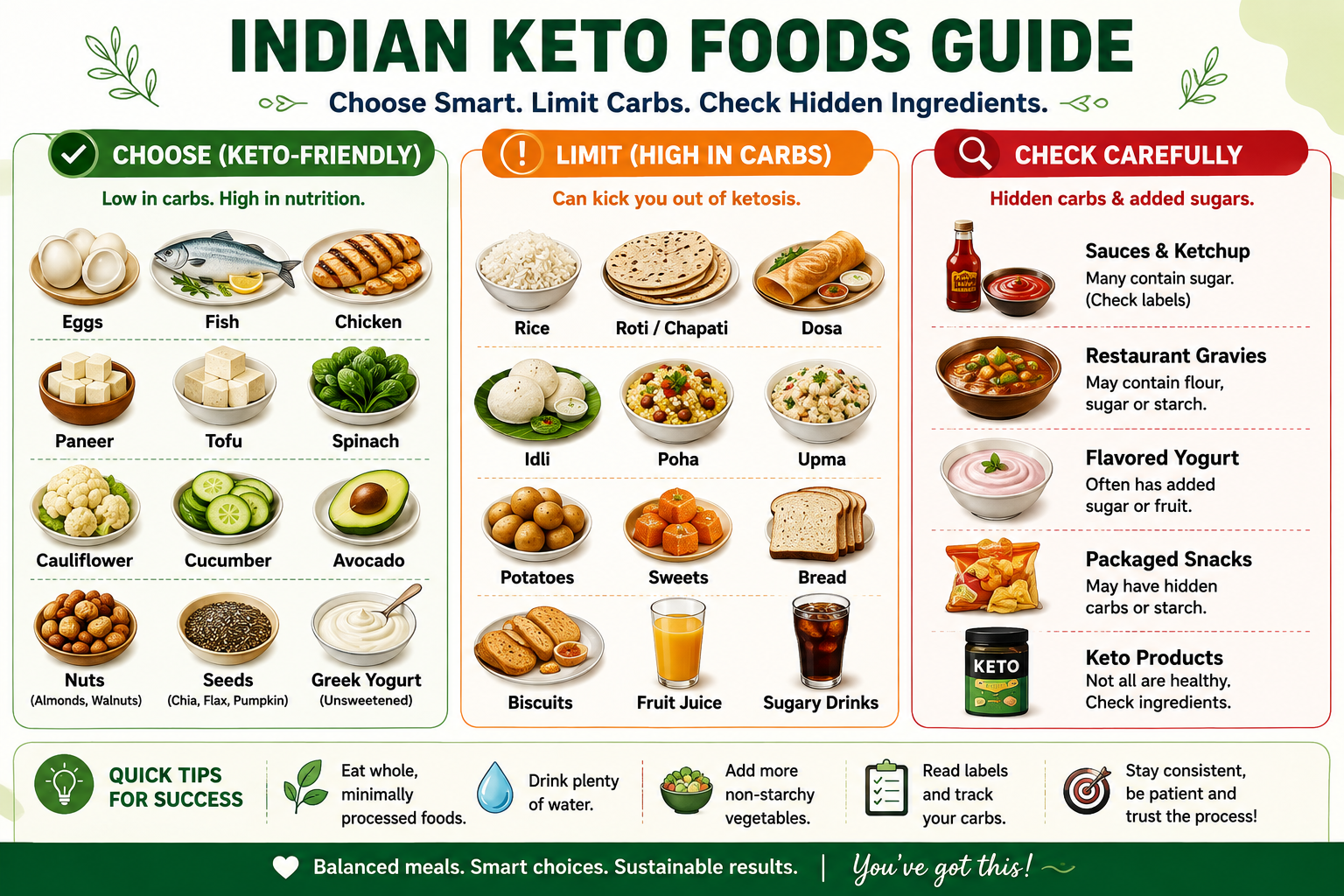
Many foods that are perfectly normal parts of a balanced Indian diet are difficult to fit into a strict ketogenic diet because they contain substantial carbohydrates.
These include:
- Rice
- Roti
- Chapati
- Naan
- Dosa
- Idli
- Poha
- Upma
- Potatoes
- Sweets
- Biscuits
- Bread
- Sugary drinks
- Fruit juice
This does not mean these foods are inherently unhealthy.
It simply means their carbohydrate content can make strict ketosis difficult.
That distinction matters.
A person does not need to label traditional Indian foods as “bad” simply because they do not fit keto.
Can You Eat Rice on Keto?
For a strict ketogenic diet, regular portions of white or brown rice can be difficult to fit because rice is carbohydrate-rich.
The issue is not that rice is poisonous or inherently unhealthy.
The issue is its carbohydrate content.
If you decide to follow strict keto, you may need to substantially reduce or avoid traditional rice portions.
If you prefer eating rice regularly, however, a different balanced eating pattern may be more practical for you.
That is an important part of choosing a diet.
The best diet is not necessarily the most restrictive one.
Can You Eat Roti on Keto?
Traditional wheat roti contains carbohydrates and can therefore be difficult to fit into a strict ketogenic diet.
The same applies to many:
- Chapatis
- Naans
- Parathas
- Wheat breads
Some commercially marketed “keto rotis” use alternative ingredients, but check their nutrition labels rather than assuming that every product marketed as keto is nutritionally superior.
Can You Eat Dosa or Idli on Keto?
Traditional dosa and idli are generally made from ingredients such as rice and lentils.
Because both contribute carbohydrates, standard versions may not fit easily into a strict ketogenic eating pattern.
This does not make dosa or idli unhealthy foods.
It simply means they may not fit the carbohydrate restriction required for nutritional ketosis.
Can You Eat Fruit on Keto?
Fruit does not need to be treated as unhealthy.
However, carbohydrate levels vary considerably between fruits.
Whole fruit also differs from fruit juice because whole fruit contains fiber and usually requires more chewing.
For someone following strict keto, portions and fruit selection become important.
Small portions of lower-carbohydrate fruits may fit better than larger portions of high-carbohydrate fruits.
Rather than simply saying:
“Never eat fruit.”
A better approach is
“Understand the carbohydrate content and choose portions that fit your dietary pattern.”
Simple Indian Keto Breakfast Ideas
Keto breakfast does not need to be complicated.
1. Option
- Eggs
- Spinach
- Tomatoes
- Unsweetened tea
2. Option
- Paneer
- Cucumber
- Sauteed vegetables
3. Option
- Vegetable omelet
- Avocado or suitable nuts
- Unsweetened coffee
4. Option
- Tofu scramble
- Leafy vegetables
5. Option
Unsweetened Greek yogurt
A small portion of nuts and seeds
These are examples, not mandatory meal plans.
Simple Indian Keto Lunch Ideas
Vegetarian
- Paneer with mixed non-starchy vegetables
- Cucumber salad
- Unsweetened curd
Non-Vegetarian
- Grilled fish
- Cauliflower or cabbage
- Green salad
Another Option
- Chicken
- Sauteed spinach
- Cucumber
- Small serving of suitable nuts or seeds
Focus on building the meal rather than searching for complicated “keto recipes.”
Simple Indian Keto Dinner Ideas
Dinner 1
Grilled fish + spinach + cauliflower
Dinner 2
Chicken + mixed vegetables + cucumber salad
Dinner 3
Paneer + cabbage + green vegetables
Dinner 4
Tofu + mushrooms + spinach
Dinner 5
Eggs + sauteed vegetables + salad
Keep the cooking methods simple.
Grilling, steaming, roasting, boiling, and light sauteing can make meal preparation easier.
Vegetarian Keto Diet for Indians
Vegetarian keto can require more planning.
Why?
Many vegetarian protein sources are also carbohydrate-containing foods.
For example:
- Lentils
- Beans
- Chickpeas
- Rajma
- Chana
are nutritious foods, but their carbohydrate content can make a strict ketogenic diet difficult.
Vegetarian keto may therefore rely more heavily on foods such as
- Paneer
- Tofu
- Eggs, if included
- Unsweetened dairy
- Nuts
- Seeds
- Low-carbohydrate vegetables
This is one area where nutritional planning becomes important.
A highly restrictive vegetarian keto diet can reduce food variety, so nutritional adequacy should not be ignored.
Hidden Carbohydrates in Indian Meals
One of the easiest ways to accidentally increase carbohydrate intake is to focus only on obvious foods such as rice and roti.
Hidden carbohydrates can come from:
Sweetened Tea
Sugar added to several cups of tea each day can add up.
Sauces
Ketchup and some packaged sauces may contain added sugar.
Restaurant Gravies
Some gravies use sugar, starches, or other carbohydrate-containing ingredients.
Sweetened Yogurt
Flavored yogurt may contain substantially more sugar than plain unsweetened yogurt.
Packaged Snacks
A product may look “healthy” while still containing substantial carbohydrate.
Keto Products
“Keto” on the package does not automatically mean the food is nutritious.
Check the ingredient list and nutrition information.
What Is Keto Flu?
Some people experience temporary symptoms after substantially reducing carbohydrate intake.
These symptoms are often referred to as keto flu.
Possible symptoms include:
- Headache
- Fatigue
- Dizziness
- Constipation
- Muscle cramps
- Irritability
- Difficulty concentrating
Not everyone experiences these symptoms.
And “keto flu” is not a formal medical diagnosis.
Possible causes can include changes in fluid and electrolyte balance, dietary changes, and the body’s adjustment to a very low-carbohydrate eating pattern.
If symptoms are severe, persistent, or concerning, seek medical advice rather than assuming they are simply part of keto adaptation.
Keto and Electrolytes
Electrolytes such as sodium, potassium, and magnesium are important for normal body function.
Changes in carbohydrate intake can affect fluid balance.
However, this does not mean that everyone following keto should automatically take electrolyte supplements.
Too much of certain minerals can also be harmful.
Instead:
- Stay adequately hydrated.
- Eat a varied selection of appropriate foods.
- Avoid unnecessary high-dose supplementation.
- Discuss supplementation with a healthcare professional when
- appropriate.
This is especially important if you have a medical condition or take medication that affects fluid or electrolyte balance.
Do You Need Intermittent Fasting With Keto?
No.
Intermittent fasting is not required to follow a ketogenic diet.
Some people combine fasting with keto because they believe it makes their routine easier.
Others find fasting unnecessary or difficult.
You should not assume that combining two restrictive approaches automatically produces better results.
For some people, a straightforward eating schedule may be easier to maintain.
The priority should be a nutritionally adequate pattern that you can realistically follow.
Can You Exercise While Following Keto?
Yes, many people can remain physically active while following a ketogenic diet.
Start according to your current fitness level.
Examples include:
- Walking
- Cycling
- Swimming
- Resistance training
- Yoga
- Light aerobic activity
If you are new to exercise, you do not need to start with intense workouts.
Give your body time to adapt.
If you experience unusual dizziness, weakness, chest pain, fainting, or other concerning symptoms during exercise, stop and seek appropriate medical attention.
Physical activity is also an important part of overall weight management. CDC—Steps for Losing Weight
Sleep, Stress, and Weight Management on Keto
It is easy to focus so much on carbohydrates that you forget the rest of your lifestyle.
Sleep matters.
Stress matters.
Movement matters.
Your overall eating pattern matters.
Keto cannot compensate for every unhealthy lifestyle factor.
The CDC includes healthy eating, physical activity, adequate sleep, and stress management among important components of healthy weight management. CDC—Steps for Losing Weight
Think of keto as one possible dietary strategy rather than the entire weight-management plan.
Why Am I Not Losing Weight on Keto?
If your weight loss slows, do not immediately assume that you need to remove more food.
First look at the bigger picture.
1. Portions May Have Increased
Cheese, nuts, oils, butter, cream, and other high-energy foods can be easy to overeat.
2. Snacks May Be Adding Up
Small snacks throughout the day can contribute significant energy.
3. Drinks May Contain Calories
Sweetened coffee, tea, shakes, and other beverages can be overlooked.
4. Hidden Carbohydrates May Be Present
Check sauces, packaged foods, restaurant meals, and flavored dairy.
5. Activity May Have Decreased
A change in daily movement can affect energy expenditure.
6. Your Body Weight May Be Fluctuating
Water changes can temporarily hide changes in body fat.
7. You May Be Experiencing a Normal Plateau
Weight loss rarely follows a perfectly straight line.
The solution is not always to make the diet more restrictive.
Keto Weight Loss Plateau: What Should You Check?
When progress slows, use this checklist.
Food
Are your meals still based mainly on whole or minimally processed foods?
Portions
Have portions of nuts, cheese, oils, or other calorie-dense foods increased?
Drinks
Are you drinking calories without noticing?
Snacks
Are you eating more frequently than before?
Activity
Has your daily movement decreased?
Sleep
Are you consistently getting enough sleep?
Stress
Has stress changed your eating habits?
Consistency
Are you following the plan consistently, or only on certain days?
Health
Could a medication or health condition be affecting your weight?
If the final question concerns you, discuss it with a healthcare professional rather than making increasingly restrictive dietary changes on your own.
10 Common Keto Mistakes Indian Beginners Make
1. Treating Ghee and Butter as Unlimited
Keto does not mean unlimited fat.
2. Eating Too Much Cheese
Cheese can fit into some keto diets, but portions still matter.
3. Ignoring Vegetables
Very-low-carb does not mean zero vegetables.
4. Forgetting Fiber
A restrictive diet can make it harder to consume enough fiber.
5. Depending on Packaged Keto Foods
“Keto” does not automatically mean nutritious.
6. Assuming Ketosis Guarantees Fat Loss
It does not.
7. Starting Aggressive Fasting Immediately
You do not need fasting to begin keto.
8. Ignoring Hidden Carbohydrates
Sauces, drinks, dairy products, and packaged foods can contribute carbohydrates.
9. Ignoring Medical Conditions
Keto is not appropriate for everyone.
10. Expecting Rapid Weight Loss Forever
Early changes can be faster than later progress.
Is Keto Healthy?
There is no simple yes-or-no answer.
It depends on:
- What foods you choose
- How restrictive your diet becomes
- Whether you obtain enough nutrients
- Your health status
- Your medications
- How long you follow the diet
- Whether you can maintain it
A keto diet based heavily on processed meats, butter, cheese, and packaged foods is very different from one that includes vegetables, appropriate protein, nuts, seeds, fish, and healthier fat sources.
Harvard notes both potential short-term benefits and important concerns surrounding nutritional adequacy, side effects, saturated fat, and long-term sustainability.
Keto vs. a Balanced Eating Pattern for Weight Loss
Keto is only one possible approach to weight management.
A balanced eating pattern may allow a wider variety of foods, including whole grains, fruits, legumes, and other carbohydrate-containing foods.
Keto restricts carbohydrates much more aggressively.
Neither approach needs to be presented as universally best.
The better question is
Which eating pattern can provide adequate nutrition and fit your health needs, preferences, lifestyle, and ability to maintain it?
For some people, keto may be workable.
For others, a less restrictive approach may be easier to maintain.
Should You Try Keto? A Practical Indian Beginner Reality Check
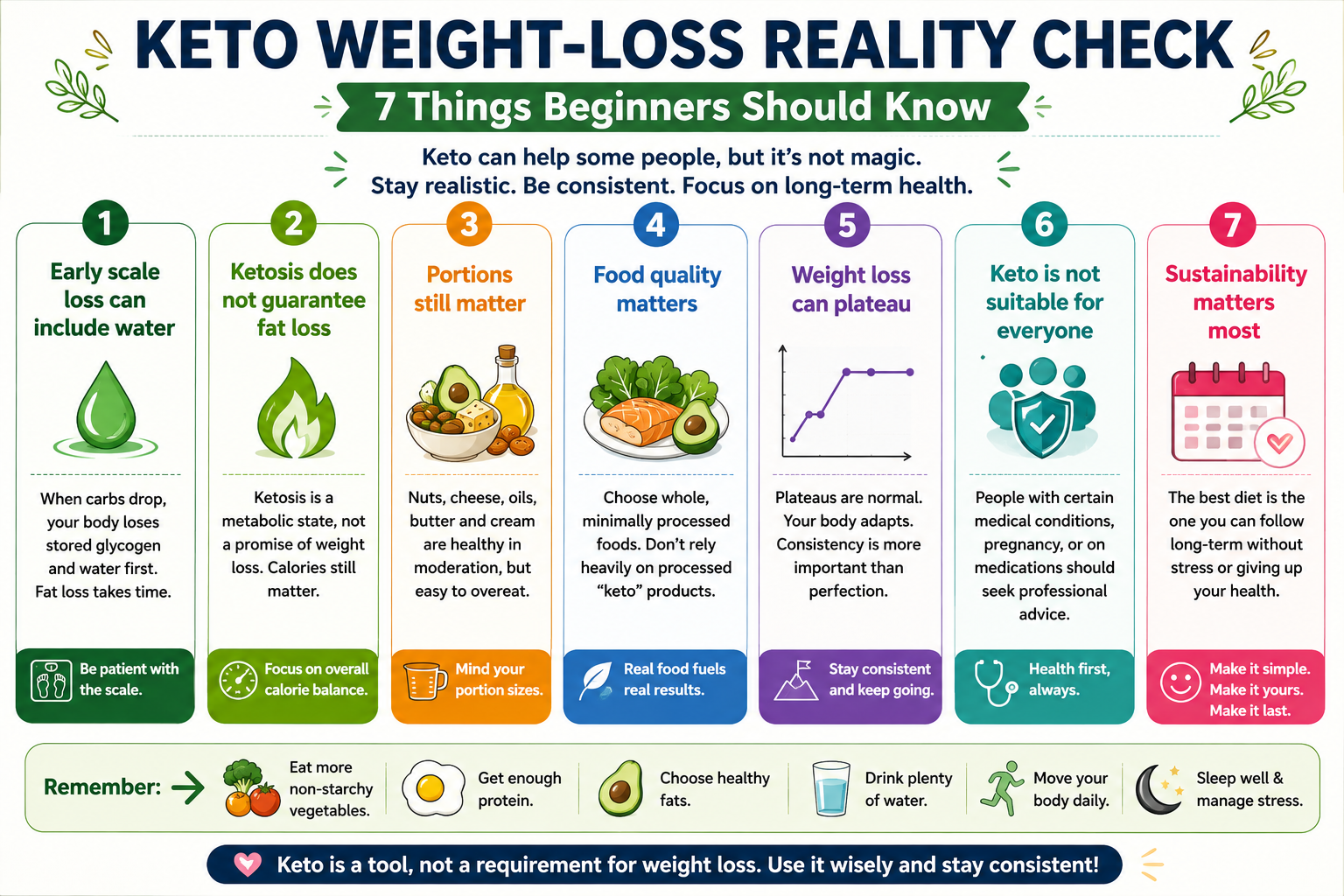
Before starting, ask yourself:
1. Can I realistically reduce rice, roti, dosa, and other carbohydrate-rich foods?
If these foods are central to your daily meals, keto may require significant changes.
2. Can I eat enough vegetables?
A restrictive diet should not become an excuse to ignore nutrient-rich foods.
3. Can I choose healthier fat sources?
Keto should not mean unlimited butter, ghee, or processed meat.
4. Can I follow it for months rather than days?
A diet that works for five days but becomes impossible after two weeks may not be a sustainable solution.
5. Do I have a medical reason to seek professional guidance?
If you have a health condition, take certain medications, are pregnant or breastfeeding, or have other nutritional concerns, discuss major dietary changes with a qualified healthcare professional.
Keto is a tool, not a requirement for weight loss.
- Do you eat rice every day?
- Can you reduce roti/dosa/idli?
- Are you vegetarian?
- Can you afford and prepare suitable protein foods?
- Can you maintain the diet socially?
- Do you have a medical reason to seek professional advice?
My 5-Minute Indian Keto Meal Check
Before eating, ask:
- Where are my low-carbohydrate vegetables?
- What is my protein source?
- What fat source am I using?
- Could there be hidden carbohydrates?
- Is this meal realistic enough for me to repeat?
If you can answer these questions consistently, meal planning becomes much simpler.
Frequently Asked Questions
1. What is the keto diet for Indian beginners?
The keto diet is a very low-carbohydrate eating pattern that emphasizes appropriate protein, fat, and low-carbohydrate foods. For Indian beginners, the main challenge is adapting carbohydrate-rich staples such as rice, roti, dosa, and idli.
2. Can keto help with weight loss?
Keto may help some people lose weight, particularly in the short term. However, it does not guarantee weight loss, and long-term success depends on overall food intake, adherence, activity, health factors, and sustainability. Harvard T.H. Chan School of Public Health — Ketogenic Diet Review
3. How many carbs can I eat on keto?
Many ketogenic diets use very low carbohydrate intake, often below 50 grams per day, with some approaches using around 20 grams. Individual responses differ, so one number should not be treated as a universal prescription.
4. Can I eat rice on keto?
Regular rice portions can be difficult to fit into a strict ketogenic diet because rice is relatively high in carbohydrates. This does not mean rice is unhealthy; it means it may not fit a strict keto carbohydrate target.
5. Can I eat roti on keto?
Traditional wheat roti contains carbohydrates and may therefore be difficult to include regularly in a strict ketogenic diet.
6. Can vegetarians follow keto?
Yes, but vegetarian keto may require careful planning because many vegetarian protein foods, including beans and lentils, also contain carbohydrates. Paneer, tofu, eggs (if included), nuts, seeds, and suitable vegetables can provide alternatives.
7. What is keto flu?
Keto flu is an informal term for temporary symptoms some people experience after substantially reducing carbohydrate intake. Symptoms can include headache, fatigue, dizziness, constipation, and muscle cramps.
8. Is keto safe for everyone?
No. Keto is restrictive and may not be appropriate for everyone. People with certain medical conditions, medication use, pregnancy, breastfeeding, or other nutritional concerns should seek professional advice before making major dietary changes.
Medical Disclaimer
This article is provided for general educational and informational purposes only. It is not a substitute for medical diagnosis, treatment, or individualized nutrition advice.
The ketogenic diet may not be appropriate for everyone. People with diabetes, kidney disease, liver disease, certain metabolic conditions, pregnancy, breastfeeding, a history of eating disorders, or those taking medications that may be affected by major dietary changes should speak with a qualified healthcare professional before starting a ketogenic diet.
Do not stop, reduce, or change prescribed medication based on information in this article.
Conclusion
The keto diet for Indian beginners can be one possible approach to weight management, but it is not a magic solution.
The basic concept is straightforward: substantially reduce carbohydrate intake, choose appropriate protein and fat sources, and include suitable low-carbohydrate vegetables.
The practical side is more difficult.
Indian staples such as rice, roti, dosa, idli, poha, and many traditional snacks contain carbohydrates that can make strict keto challenging.
You do not need to label these foods as “bad.”
Instead, understand why they may not fit a strict ketogenic pattern.
If you choose keto, focus on food quality rather than simply eating as much fat as possible. Include vegetables, appropriate protein, healthier fat sources, and enough variety to support nutritional adequacy.
Most importantly, ask whether you can realistically maintain the approach.
Keto is not the only way to lose weight.
A sustainable eating pattern that fits your health, lifestyle, preferences, and nutritional needs may ultimately be more valuable than following the most restrictive diet possible.
Trusted References
Harvard T.H. Chan School of Public Health — Ketogenic Diet Review
CDC—Steps for Losing Weight
CDC — Healthy Eating for a Healthy Weight
World Health Organization — Healthy Diet
Related Articles
- Balancing Health: The Key to Sustainable Energy and Health
- 14 Ways to Increase Protein Intake Daily Tips
- Healthy Eating Meal Plan for Wellness
- 4 Week Diet Plan for Weight Loss
- 12 Best Diets to Lose 100 Pounds