
















































































































































How to Reduce Skin Cancer Risk: 5 Evidence-Based Tips
Author: RVLNSV PRASAD
Updated On: September 2026
About Us
Author Bio
Editorial Policy
Contact Us
Introduction
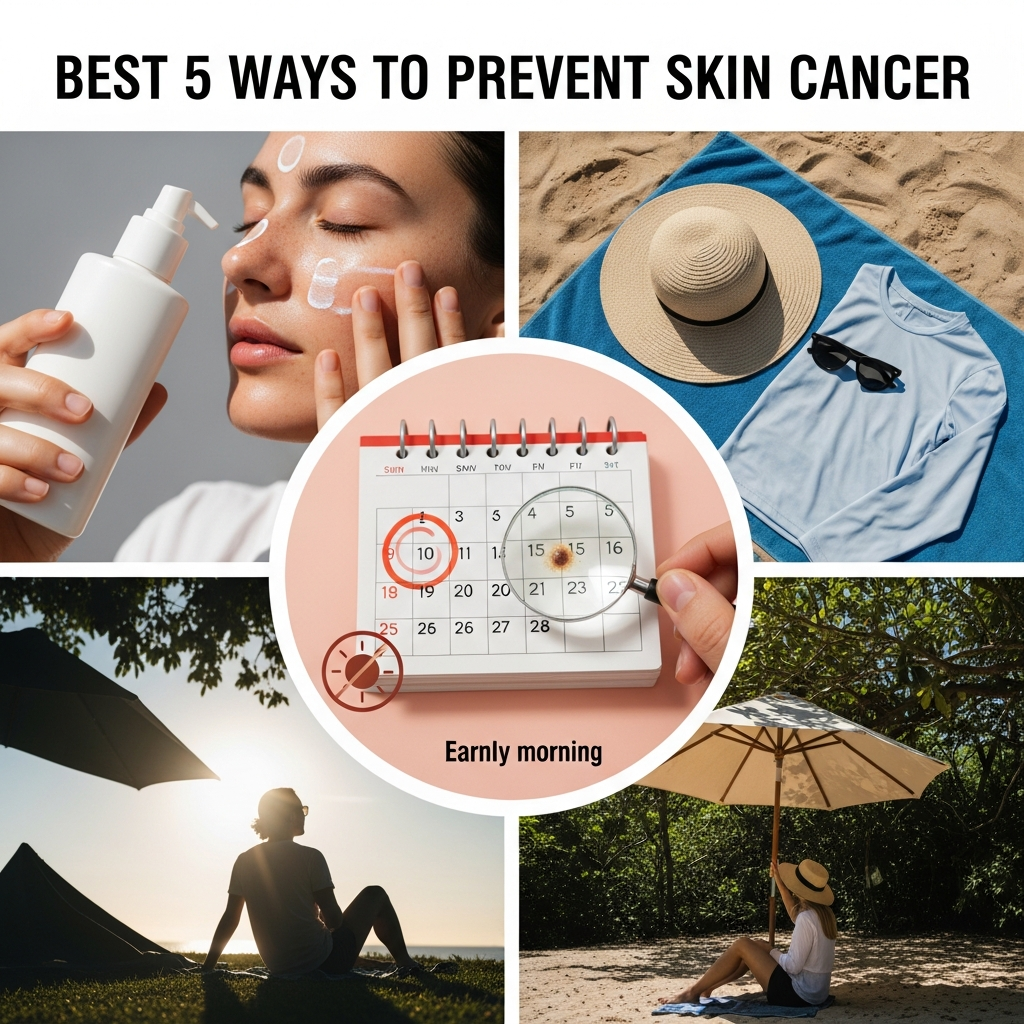
Learning how to reduce skin cancer risk does not mean avoiding the outdoors completely. It means reducing unnecessary ultraviolet (UV) exposure, avoiding indoor tanning, using practical forms of sun protection, and paying attention to changes in your skin.
UV radiation is an important risk factor for skin cancer, and it can come from both sunlight and artificial sources such as tanning beds. The National Cancer Institute explains that UV exposure and sensitivity to UV radiation are important skin-cancer risk factors. National Cancer Institute: Skin Cancer Prevention
The good news is that several everyday habits can reduce avoidable UV exposure. Current CDC guidance recommends protecting your skin from excessive sun exposure and avoiding tanning beds as practical ways to lower skin-cancer risk. CDC: Reducing Risk for Skin Cancer
The goal is not perfection. If you work outdoors, exercise outside, travel, garden, or simply enjoy spending time in the sun, you can still do those things while making UV protection part of your normal routine.
Quick Answer
The most practical ways to reduce skin cancer risk are to limit excessive UV exposure, seek shade, wear protective clothing and a wide-brimmed hat, use an appropriate broad-spectrum sunscreen, and avoid tanning beds.
The CDC recommends several layers of sun protection, including shade, clothing, a wide-brimmed hat, sunglasses that block UVA and UVB radiation, and sunscreen when appropriate. CDC: Reducing Risk for Skin Cancer
The American Academy of Dermatology also recommends broad-spectrum, water-resistant sunscreen with SPF 30 or higher, along with shade and sun-protective clothing. American Academy of Dermatology: Sun Protection
No single habit provides complete protection. A layered approach is more practical because clothing, shade, sunscreen, and avoiding artificial UV exposure address different sources and situations.
Key Takeaways
- Excessive UV exposure is an important risk factor for skin cancer.
- Protect your skin throughout the year rather than only during summer.
- Use shade, clothing, hats, sunglasses, and sunscreen together.
- When choosing sunscreen, the AAD recommends broad-spectrum, water-resistant SPF 30 or higher.
- Reapply sunscreen according to product directions, especially after swimming or sweating.
- Avoid tanning beds and indoor tanning devices.
- Remember areas such as the ears, scalp, neck, hands, and feet.
- People of all skin colors can develop skin cancer.
- Learn what is normal for your skin and pay attention to new or changing lesions.
- A suspicious skin change should be evaluated rather than treated at home.
Why Skin Cancer Prevention Matters
Skin cancer occurs when abnormal cells in the skin grow out of control. Major types include basal cell carcinoma, squamous cell carcinoma, and melanoma.
The National Cancer Institute explains that UV radiation is a skin-cancer risk factor and that both natural sunlight and artificial sources such as tanning beds can expose the skin to UV radiation. National Cancer Institute: Skin Cancer Prevention
The relationship between sunlight and cancer is important because UV radiation can damage skin cells. The NCI explains that exposure to ultraviolet radiation from sunlight is associated with skin damage and skin-cancer risk. National Cancer Institute: Sunlight and Cancer Risk
UV exposure is not only a summer concern. The CDC notes that UV rays can reach you on cloudy and cool days and can reflect from surfaces such as water, sand, cement, and snow. CDC: Reducing Risk for Skin Cancer
Prevention therefore works best as a routine rather than something you think about only during vacations or beach trips.
What Causes Skin Cancer?
Skin cancer has multiple risk factors, but UV radiation is one of the most important avoidable exposures.
The NCI lists prolonged exposure to natural or artificial sunlight among risk factors for both nonmelanoma skin cancer and melanoma. Other risk factors can include fair skin that burns easily, certain types or numbers of moles, a family or personal history of melanoma, previous blistering sunburns, and certain medical or treatment-related factors. National Cancer Institute: Skin Cancer Prevention
Having one or more risk factors does not mean you will definitely develop skin cancer. Likewise, having fewer obvious risk factors does not provide complete protection.
5 Evidence-Based Ways to Reduce Skin Cancer Risk
1. Protect Your Skin From Excessive UV Exposure
The first step is to reduce unnecessary exposure to strong UV radiation.
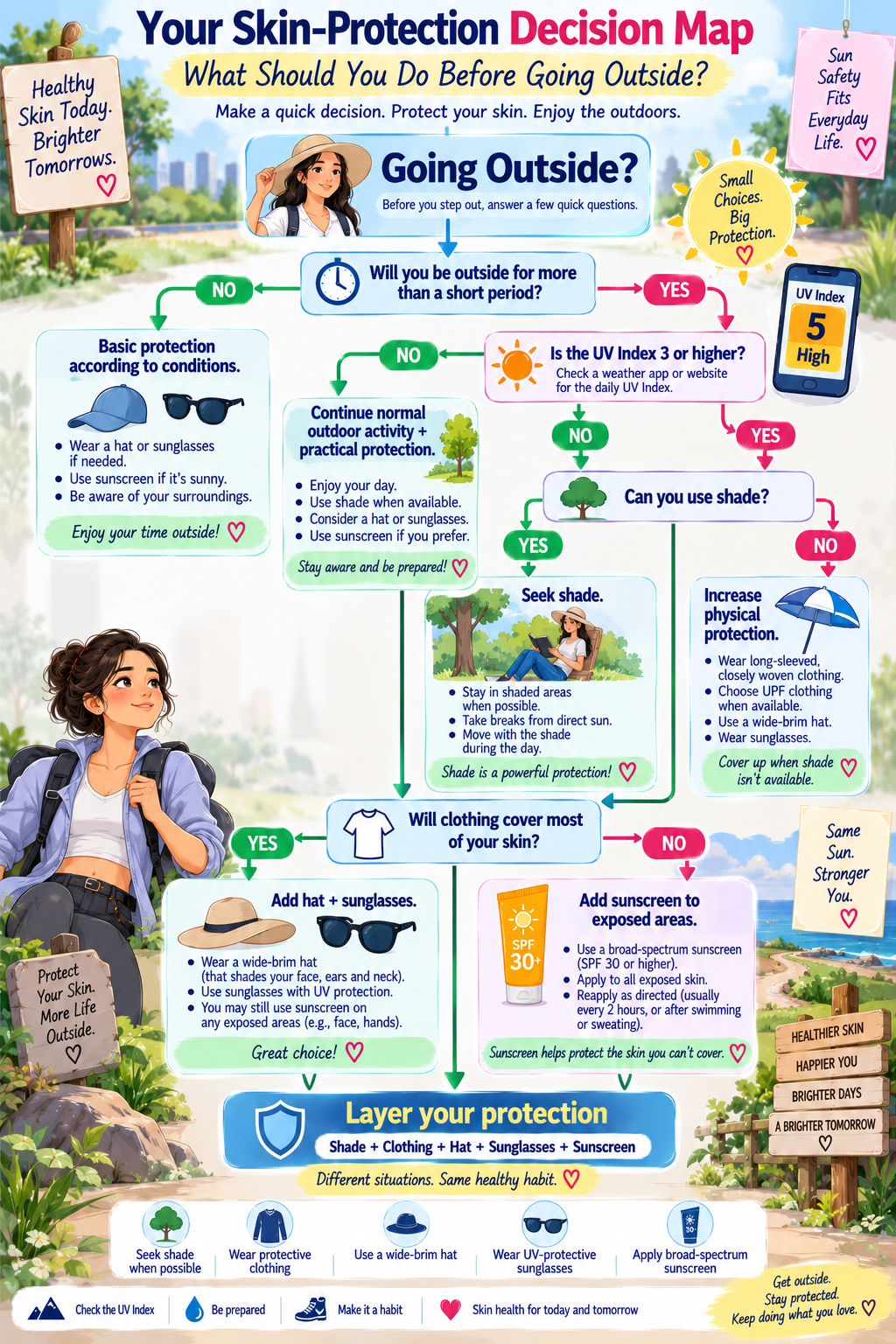
When you are outside for prolonged periods, look for shade whenever possible. You can also plan outdoor activities around periods of lower UV intensity when practical.
The CDC recommends using several forms of protection when the UV Index is 3 or higher, including shade, protective clothing, wide-brimmed hats, sunglasses, and sunscreen. CDC: Reducing Risk for Skin Cancer
The AAD similarly recommends seeking shade and wearing sun-protective clothing, including long sleeves, pants, a wide-brimmed hat, and sunglasses. American Academy of Dermatology: Sun Protection
This layered approach is more useful than depending on sunscreen alone.
For example, if you are going for a long walk, sunscreen can protect exposed areas while a long-sleeved shirt and hat reduce the amount of skin exposed to sunlight in the first place.
2. Use Sunscreen Correctly
Sunscreen is an important part of sun protection, but it should not be viewed as permission to remain in intense sunlight indefinitely.
The American Academy of Dermatology recommends choosing a sunscreen that is broad-spectrum, water-resistant, and SPF 30 or higher. Broad-spectrum sunscreen helps protect against both UVA and UVB radiation. American Academy of Dermatology: How to Select a Sunscreen
The AAD also emphasizes that sunscreen works best as part of a broader protection strategy that includes shade and protective clothing. American Academy of Dermatology: Sun Protection
Apply sunscreen to exposed skin before going outdoors and reapply according to the product directions, particularly after swimming or sweating.
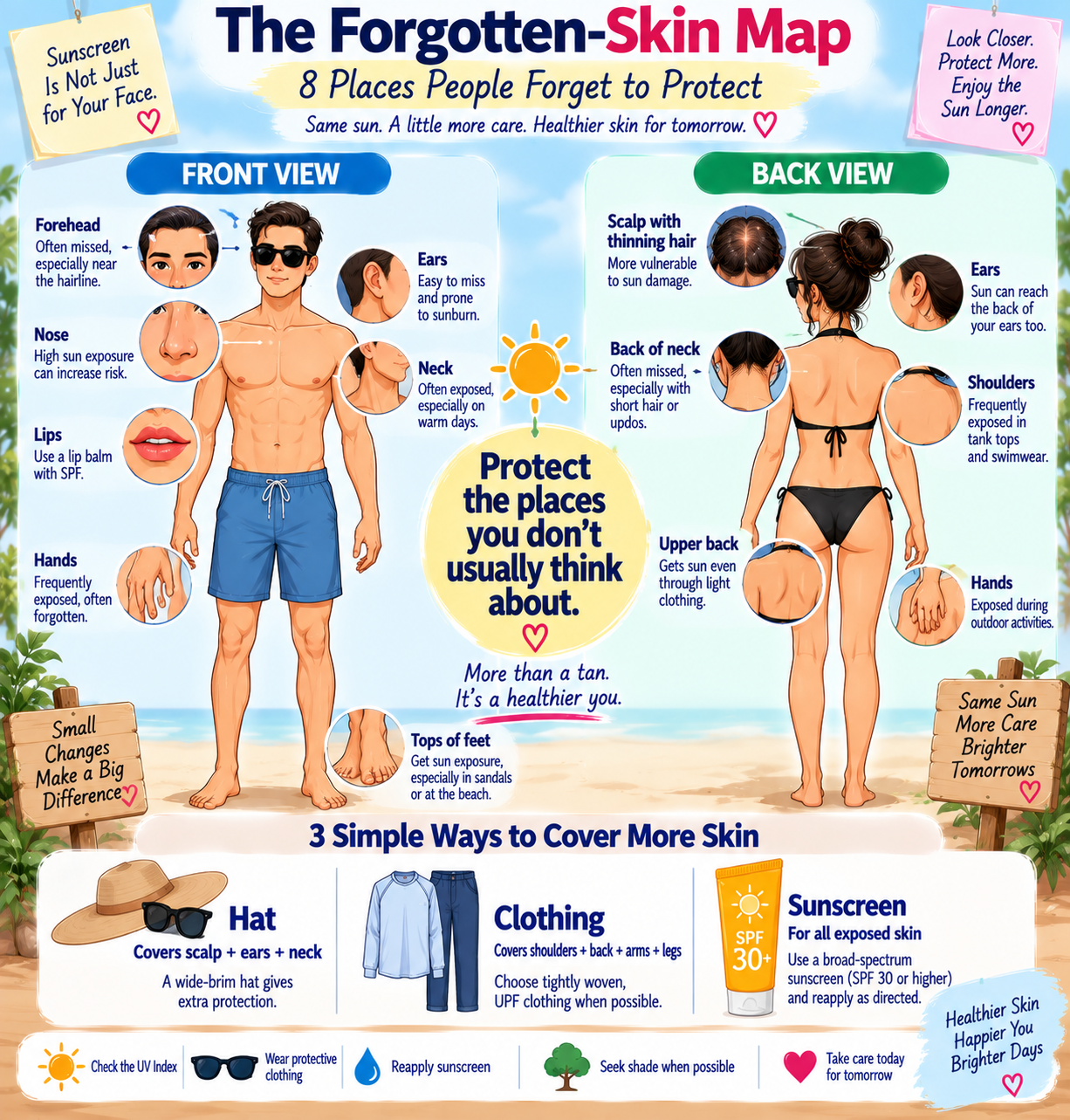
Do not forget commonly missed areas such as:
- Ears
- Back of the neck
- Face
- Scalp when hair is thin
- Hands
- Tops of the feet
- Lips, using an appropriate lip product with sun protection
There is an important evidence nuance here. The NCI notes that sunscreen has been shown to prevent sunburn and actinic keratoses, while the evidence is not definitive that sunscreen or sun avoidance lowers the risk of every type of skin cancer. Nevertheless, skin experts recommend UV protection as part of a broader strategy for reducing harmful exposure. National Cancer Institute: Skin Cancer Prevention
This is why it is more accurate to say “use sunscreen as part of skin-cancer risk reduction” rather than claiming that sunscreen alone guarantees prevention.
3. Use Clothing as Your First Physical Barrier
Clothing can provide a simple physical barrier between your skin and UV radiation.
When practical, wear lightweight long-sleeved shirts, long pants, a wide-brimmed hat, and UV-protective sunglasses.
The AAD recommends sun-protective clothing, including lightweight long-sleeved shirts, pants, wide-brimmed hats, and sunglasses as part of a comprehensive sun-protection strategy. American Academy of Dermatology: Sun Protection
This can be especially useful when you spend long periods outdoors.
For example, someone working outside may find that a hat and long-sleeved shirt are easier to maintain consistently than repeatedly relying on sunscreen for every exposed area.
The best prevention strategy is often the one that fits naturally into your daily life.
4. Use Shade and Pay Attention to the UV Index
Shade is one of the easiest ways to reduce direct exposure to sunlight.
When the UV Index is high, look for trees, covered walkways, umbrellas, buildings, or other forms of shade.
The CDC recommends using multiple forms of protection when the UV Index reaches 3 or higher. Its guidance includes staying in the shade, covering the arms and legs, wearing a wide-brimmed hat, using appropriate sunglasses, and applying sunscreen to exposed skin. CDC: Reducing Risk for Skin Cancer
Shade does not necessarily eliminate UV exposure because reflected and scattered radiation can still reach the skin. This is another reason to combine shade with clothing and sunscreen.
The UV Index provides a practical way to judge how strong UV radiation is expected to be. Making it part of your outdoor planning can help you decide when additional protection is particularly important.
5. Avoid Tanning Beds
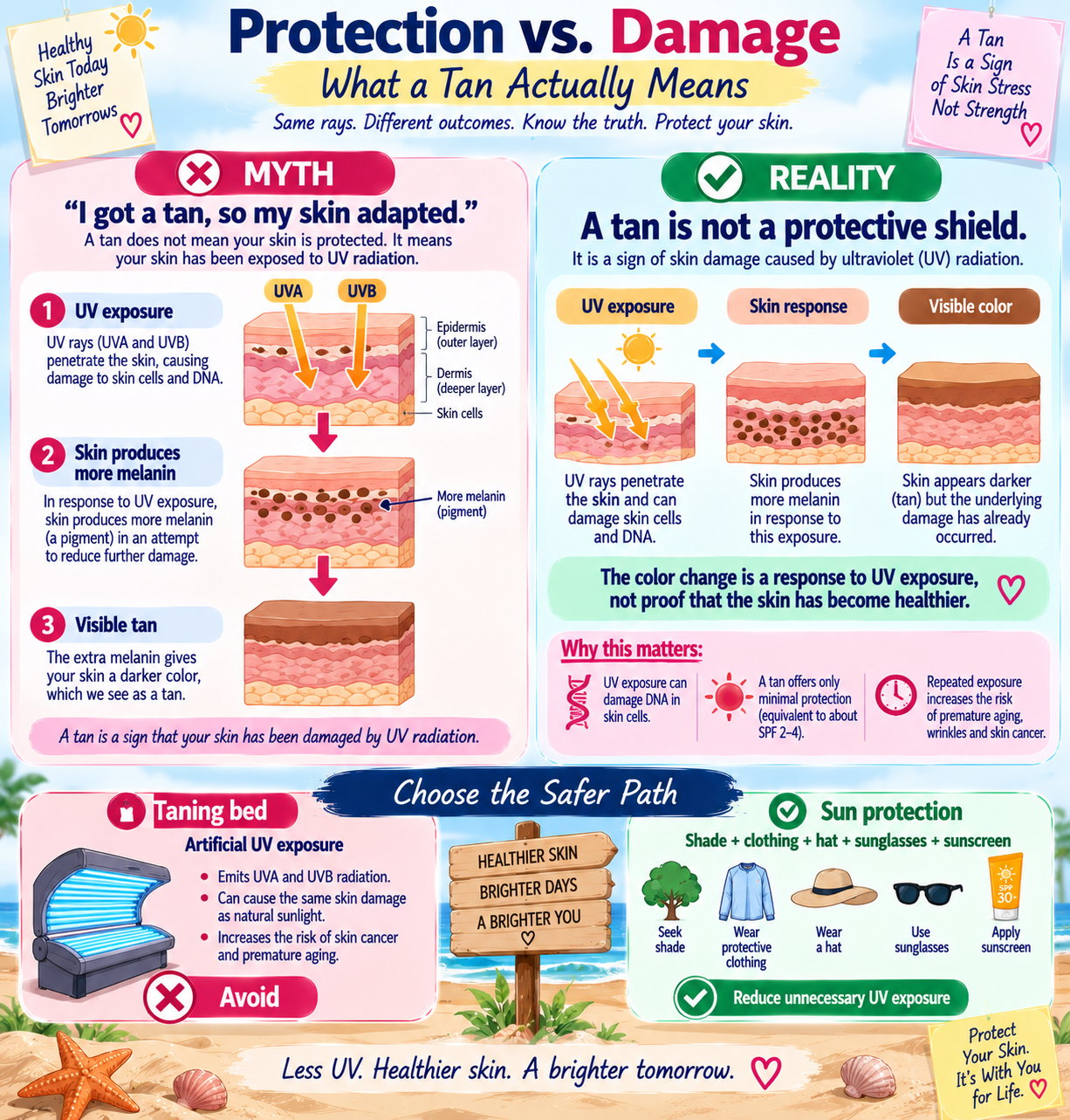
If you want to reduce skin cancer risk, avoiding indoor tanning is one of the clearest choices you can make.
Tanning beds and booths expose the skin to UV radiation. The CDC states that indoor tanning exposes users to high levels of UV radiation and that excessive UV exposure can cause skin cancer. CDC: Reducing Risk for Skin Cancer
The CDC also makes an important point about tanning: a change in skin color after UV exposure represents a response to injury rather than evidence of improved health. A so-called “base tan” does not provide reliable protection against sunburn. CDC: Reducing Risk for Skin Cancer
The NCI likewise identifies artificial sunlight from tanning beds as a source of UV exposure and a risk factor for skin cancer. National Cancer Institute: Skin Cancer Prevention
A Practical Sun-Protection Table
| Situation | Practical protection |
|---|---|
| Short outdoor activity | Hat, shade when available, sunscreen on exposed skin |
| Long outdoor activity | Protective clothing, hat, sunglasses, shade, sunscreen |
| High UV Index | Reduce direct exposure and use several protection methods |
| Beach or pool | Shade, protective clothing, sunscreen and appropriate reapplication |
| Outdoor work | Protective clothing, hat, shade breaks and sunscreen on exposed areas |
| Driving or commuting | Consider exposed areas such as hands, arms, face and neck |
| Indoor tanning | Avoid tanning beds and booths |
The important principle is layered protection, rather than searching for one perfect product.
Don’t Forget Your Scalp, Ears, Neck, and Hands
People often remember their face and arms but overlook other exposed areas.
The CDC specifically recommends applying sunscreen to exposed areas including the ears and back of the neck when protective clothing and a wide-brimmed hat are not practical. CDC: Reducing Risk for Skin Cancer
If your hair is thinning, consider a hat or another practical form of scalp protection when spending significant time outdoors.
The face, neck, hands, and arms are among the areas where skin cancer commonly occurs because they receive substantial sunlight exposure. National Cancer Institute: Skin Cancer Prevention
What About Darker Skin?
Skin cancer can occur in people of every skin tone.
The NCI explicitly states that although fair complexion is a risk factor for several types of skin cancer, people of all skin colors can get skin cancer. National Cancer Institute: Skin Cancer Prevention
That means sun protection should not be presented as something only fair-skinned people need.
Risk is not identical for everyone, however. Personal history, family history, UV exposure, previous sunburns, certain types or numbers of moles, and other factors can influence individual risk. National Cancer Institute: Skin Cancer Prevention
Know Your Personal Risk Factors
Some people need to be particularly attentive to skin protection and suspicious skin changes.
Risk factors can include:
- Previous skin cancer
- A family or personal history of melanoma
- Frequent or prolonged UV exposure
- A history of blistering sunburns
- Indoor tanning
- Certain types or larger numbers of moles
- Skin that burns or freckles easily
- Certain eye and hair characteristics
- Some medical conditions or treatments that weaken the immune system
The NCI provides a detailed breakdown of risk factors for melanoma and nonmelanoma skin cancer. National Cancer Institute: Skin Cancer Prevention
If you have previously had skin cancer or have been told that you are at higher risk, ask your healthcare professional whether you need a personalized skin-monitoring plan.
Know Your Skin: What Changes Should You Watch?
Prevention and early detection are related but different.
Sun protection aims to reduce avoidable UV exposure. Skin awareness helps you notice a suspicious lesion that may already be developing.
One commonly used melanoma warning framework is the ABCDE approach:
| Letter | What to look for |
|---|---|
| A — Asymmetry | One half does not look like the other |
| B — Border | Border is irregular, uneven or poorly defined |
| C — Color | Color varies within the lesion |
| D — Diameter | The lesion is larger than about 6 mm, although melanoma can be smaller |
| E — Evolution | The spot changes over time |
Evolution is particularly important because a changing lesion deserves attention.
The American Academy of Dermatology provides information about melanoma risk and emphasizes the importance of recognizing suspicious changes. American Academy of Dermatology: Melanoma
A new, unusual, changing, itching, bleeding, or otherwise suspicious spot should not simply be covered with a home remedy. It is better to have it assessed by a qualified healthcare professional.
Important Difference: Prevention vs. Screening
It is easy to confuse skin self-awareness with routine professional screening.
The U.S. Preventive Services Task Force states that there is currently insufficient evidence to determine whether routine visual skin examination by a clinician provides a net benefit for asymptomatic adolescents and adults. This recommendation does not mean that suspicious lesions should be ignored. U.S. Preventive Services Task Force: Skin Cancer Screening
That distinction matters.
If you notice a suspicious or changing lesion, do not interpret the screening recommendation as a reason to ignore it. A concerning skin change is a reason to seek medical evaluation.
People at increased risk may also need individualized advice from a dermatologist.
Can Food Prevent Skin Cancer?
A healthy diet supports overall health, but it would be misleading to present a particular food as a proven way to prevent skin cancer.
The NCI notes that some protective factors may lower the risk of certain cancers, but cancer prevention is complex and no single food should be treated as a guaranteed preventive treatment. National Cancer Institute: Skin Cancer Prevention
Tomatoes, leafy vegetables, fruits, nuts, tea, and other nutrient-rich foods can be part of a balanced eating pattern. They should not replace established sun-protection behaviors.
If your goal is specifically to reduce skin cancer risk, focus first on reducing unnecessary UV exposure and avoiding tanning beds rather than searching for a single “anti-skin-cancer” food.
What About Aloe Vera, Turmeric, Coconut Oil, or Tomato Pulp?
These products may have roles in general skin care or soothing minor irritation, but they should not be presented as proven methods for preventing skin cancer.
Aloe vera, turmeric, coconut oil, tomato pulp, green tea, or similar home remedies cannot replace UV protection, sunscreen, protective clothing, or medical assessment of suspicious skin changes.
This distinction is important because a home remedy might make a skin lesion look temporarily different without addressing the underlying problem.
If a spot is changing, bleeding, persistently itching, crusting, or otherwise concerning, seek medical advice rather than attempting to treat it yourself.
Latest Research: What Is Changing in Skin-Cancer Prevention?
Modern prevention guidance increasingly emphasizes layered UV protection rather than relying on a single intervention.
Current CDC guidance recommends protecting skin from excessive sunlight, using shade, protective clothing, hats, sunglasses and sunscreen, while avoiding tanning beds. CDC: Reducing Risk for Skin Cancer
The American Academy of Dermatology similarly recommends broad-spectrum, water-resistant SPF 30+ sunscreen, shade, protective clothing, hats, and sunglasses. American Academy of Dermatology: Sun Protection
At the same time, the NCI presents an important evidence distinction: although UV exposure is a recognized risk factor and experts recommend protecting the skin, the evidence is not definitive that sunscreen or sun avoidance has been proven to lower every form of skin-cancer risk. National Cancer Institute: Skin Cancer Prevention
This is a better way to communicate the science than making an absolute claim that sunscreen alone “prevents skin cancer.”
Three Easy Prevention Habits Most People Can Actually Maintain
The Doorway Check
Before leaving home, ask yourself three quick questions:
Will I be outside for a while? Is UV exposure likely to be significant? What protection am I going to use?
That small pause can make sun protection more automatic.
The Two-Layer Rule
Instead of relying only on sunscreen, combine two or more forms of protection.
For example:
Hat + sunscreen
or
Long sleeves + shade
or
Protective clothing + sunscreen
Layering can reduce the amount of UV exposure reaching uncovered skin.
The UV-Index Habit
If you regularly spend time outdoors, check the UV Index as part of your daily planning.
When UV levels are higher, increase your use of shade, protective clothing, hats, sunglasses and sunscreen.
Common Skin-Cancer Prevention Mistakes
Mistake 1: Using sunscreen but ignoring shade
Sunscreen is useful, but it should not encourage prolonged exposure to intense sunlight.
Mistake 2: Applying sunscreen once and forgetting about it
Reapply according to product directions, particularly after swimming or sweating. The AAD recommends reapplication as part of effective sunscreen use. American Academy of Dermatology: How to Select a Sunscreen
Mistake 3: Protecting only the face
The ears, neck, scalp, hands and feet can also be exposed.
Mistake 4: Thinking darker skin needs no protection
People of all skin colors can develop skin cancer. National Cancer Institute: Skin Cancer Prevention
Mistake 5: Believing a tanning bed is safer than sunlight
Tanning beds expose the skin to UV radiation and are not a safe alternative to tanning outdoors. CDC: Reducing Risk for Skin Cancer
Mistake 6: Treating suspicious spots at home
A changing or suspicious lesion deserves proper medical evaluation rather than repeated home treatment.
People-First Insight: Make Prevention Fit Your Real Life
The best prevention plan is not necessarily the most complicated one.
A person who works outdoors may need protective clothing and scheduled shade breaks. Someone who exercises outside may find a hat, sunscreen and a change in workout timing easier to maintain. Someone who spends only short periods outside may simply need sunscreen on exposed areas and a habit of choosing shade when available.
The goal is to build protection around your actual routine.
Instead of thinking, “I need to completely avoid the sun,” think:
“How can I reduce unnecessary UV exposure while still doing the things I enjoy?”
That mindset makes prevention easier to maintain over years rather than just for a few days.
My Personal Insight
One practical lesson from reviewing the evidence is that prevention becomes easier when it is treated as a routine rather than an emergency response.
People often remember sunscreen when they go to a beach or take a vacation. A more useful approach is to think about everyday exposure too, particularly if your work, commute, exercise, or hobbies keep you outdoors regularly.
A hat near the door, sunscreen that you actually like using, lightweight protective clothing, and a habit of seeking shade can make prevention much less complicated.
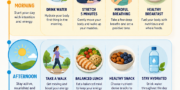
A Simple Daily Skin-Protection Routine
Morning
If you expect to spend time outdoors, apply a broad-spectrum, water-resistant SPF 30+ sunscreen to exposed skin and consider protective clothing and a hat. American Academy of Dermatology: How to Select a Sunscreen
During Outdoor Time
Use shade whenever practical, particularly during periods of stronger UV exposure. Keep protective clothing and sunglasses available.
After Swimming or Heavy Sweating
Reapply sunscreen according to the product instructions.
Evening
If you regularly monitor your skin, pay attention to new or changing spots rather than trying to diagnose them yourself.
When Should You See a Dermatologist?
Consider medical evaluation if you notice a skin lesion that is:
- New and unusual
- Changing in size, shape, or color
- Bleeding
- Persistently itching
- Crusting or repeatedly scabbing
- Not healing normally
- Different from your other spots
The AAD provides information about melanoma and the importance of recognizing concerning skin changes. American Academy of Dermatology: Melanoma
If you have a personal or family history of skin cancer, many moles, significant cumulative sun exposure, or another recognized risk factor, ask a healthcare professional whether you need individualized surveillance.
Quick Comparison: What Helps and What Does Not Replace Prevention
| Approach | Useful? | What it can and cannot do |
|---|---|---|
| Shade | Yes | Reduces direct sun exposure |
| Protective clothing | Yes | Provides a physical barrier against UV |
| Broad-spectrum sunscreen | Yes | Helps protect exposed skin |
| Wide-brimmed hat | Yes | Helps protect the face, head, ears and neck |
| UV-protective sunglasses | Yes | Helps protect the eyes and surrounding area |
| Avoiding tanning beds | Yes | Removes an artificial UV exposure source |
| Healthy diet | Supports overall health | Does not replace UV protection |
| Aloe vera | May soothe some skin irritation | Not a proven skin-cancer prevention method |
| Turmeric or tomato pulp | Food/skin-care uses | Not a substitute for sun protection |
| Home treatment of suspicious spots | No | Can delay appropriate medical assessment |
Frequently Asked Questions
Can you completely prevent skin cancer?
No. Cancer prevention measures can lower risk but cannot guarantee that a person will never develop cancer. The NCI specifically notes that avoiding risk factors and increasing protective factors may lower cancer risk but does not mean cancer cannot occur. National Cancer Institute: Skin Cancer Prevention
What is the best way to reduce skin cancer risk?
There is no single perfect method. A practical approach combines shade, protective clothing, a hat, sunglasses, appropriate sunscreen and avoidance of tanning beds. CDC: Reducing Risk for Skin Cancer
Is SPF 30 enough?
The AAD recommends choosing a broad-spectrum, water-resistant sunscreen with SPF 30 or higher. Sunscreen should be combined with other protective measures rather than treated as the only defense. American Academy of Dermatology: How to Select a Sunscreen
Do I need sun protection on cloudy days?
Yes, UV radiation can still reach you on cloudy and cool days. The CDC recommends protecting your skin throughout the year rather than only during sunny summer weather. CDC: Reducing Risk for Skin Cancer
Are tanning beds safer than the sun?
No. Tanning beds and booths expose users to UV radiation. The CDC identifies indoor tanning as an important avoidable source of UV exposure. CDC: Reducing Risk for Skin Cancer
Can people with darker skin get skin cancer?
Yes. The NCI states that people of all skin colors can develop skin cancer. National Cancer Institute: Skin Cancer Prevention
Should I check my skin regularly?
Knowing what is normal for your skin can help you notice changes. A new or changing lesion should be assessed by a healthcare professional rather than treated at home.
The AAD provides information about melanoma risk and recognizing concerning changes. American Academy of Dermatology: Melanoma
Does a healthy diet prevent skin cancer?
A healthy diet can support overall health, but specific foods should not be presented as replacements for established UV-protection measures.
Final Skin-Cancer Prevention Checklist
Before spending significant time outdoors, ask:
Do I have sunscreen available?
Is it broad-spectrum and SPF 30+?
Do I have protective clothing?
Can I use shade?
Do I have a wide-brimmed hat?
Do I have UV-protective sunglasses?
Have I checked the UV Index when relevant?
Will I need to reapply sunscreen?
Am I avoiding tanning beds?
Have I noticed any new or changing skin lesions?
You do not need to change your entire lifestyle overnight. Start with the habits you can repeat consistently.
Strong Sources
For readers who want to verify the medical information in this article, the primary sources used include the CDC, National Cancer Institute, American Academy of Dermatology, and U.S. Preventive Services Task Force.
Author Note
Written by RVLNSV PRASAD and updated in September 2026.
This article is intended to provide evidence-based health information in an easy-to-understand format. Medical guidance can change as new evidence becomes available, so readers should consult qualified healthcare professionals for advice based on their individual risk factors and circumstances.
Medical Disclaimer
This article is for general educational purposes and is not a substitute for diagnosis, treatment, or individualized medical advice. A suspicious, changing, bleeding, or otherwise concerning skin lesion should be evaluated by a qualified healthcare professional.
Fitness Disclaimer
If you spend substantial time outdoors for running, cycling, walking, sports, hiking, or other physical activities, use appropriate sun-protection measures. Adjust your outdoor activity according to weather, UV exposure, hydration needs, and your individual health circumstances.
Conclusion
Learning how to reduce skin cancer risk does not require avoiding outdoor life. It requires making UV protection a normal part of it.
Use several layers of protection: seek shade, wear protective clothing, use a hat and sunglasses, apply appropriate sunscreen to exposed skin, and avoid tanning beds. Pay attention to your skin as well, because noticing a suspicious change can lead to medical evaluation.
The most useful prevention strategy is the one you can maintain consistently. Small protective choices repeated over years can be more practical than occasional attempts to compensate after heavy sun exposure.
Sources
- CDC: used throughout the introduction, UV protection, UV Index, tanning-bed, cloudy-day and prevention sections. CDC — Reducing Risk for Skin Cancer
- AAD Sun Protection: used in the sunscreen, clothing, shade and layered-protection sections. American Academy of Dermatology — Sun Protection
- NCI Skin Cancer Prevention: used for UV risk factors, darker skin, prevention evidence, sunscreen evidence nuance and FAQs. National Cancer Institute — Skin Cancer Prevention
- NCI Sunlight and Cancer Risk: used in the explanation of UV-related skin damage and cancer risk. National Cancer Institute — Sunlight and Cancer Risk
- AAD Melanoma: used in the skin-change, melanoma and dermatologist sections. American Academy of Dermatology — Melanoma
- USPSTF: used specifically in the prevention-versus-screening section. U.S. Preventive Services Task Force — Skin Cancer Screening
- AAD sunscreen selection: used directly where SPF, broad-spectrum and water-resistant sunscreen recommendations are discussed. American Academy of Dermatology — How to Select a Sunscreen
Related Content
- 11 Best Skin Lightening Treatments
- 7 Cancer Fighting Foods Include in Your Diet
- 12 Best Ways to Treat Acne
- Learn more about Cornerstone Content.
- Home








[…] Best 5 Ways to Prevent Skin Cancer […]
[…] Best 5 Ways to Prevent Skin Cancer […]
[…] Best 5 Ways to Prevent Skin Cancer […]
[…] Best 5 Ways to Prevent Skin Cancer […]
[…] Best 5 Ways to Prevent Skin Cancer […]