
































































































































































11 Interesting Facts About Walking That May Surprise You
Author: RVLNSV PRASAD
Updated: August 2026
[About Us]
[Author Bio]
[Editorial Policy]
[Contact Us]
Quick Answer
Walking is more than a way to get from one place to another. It can contribute to physical activity, cardiovascular fitness, mental well-being, weight management, and everyday mobility. It can also interrupt long periods of sitting and provide a practical way for beginners to become more active. The World Health Organization recognizes walking as physical activity and recommends regular movement throughout the week.
What makes walking particularly useful is its flexibility. A person can walk for transportation, recreation, work breaks, social time, or structured exercise. The appropriate amount and intensity depend on individual health, fitness, age, and circumstances.
Introduction
11 Interesting Facts About Walking can change the way we think about an activity that most of us perform without giving it much attention.
Walking rarely receives the same attention as running, strength training, cycling, or high-intensity workouts.
Yet it occupies a unique place in everyday life.
- You can walk to a shop.
- You can walk during a break from your computer.
- You can walk while talking with a friend.
- You can take a walk after work to create a transition between your professional and personal time.
These examples matter because physical activity does not have to happen exclusively inside a gym.
That broader definition gives walking a different role.
It can be an organized workout, but it can also be woven into ordinary life.
I became more interested in this distinction after noticing how much time I spent sitting during busy workdays. A short walk was easier to maintain than an ambitious workout schedule, and it gave me a reason to step away from the computer.
That experience led me to look beyond the usual claims about walking.
The facts below focus not only on what walking may do for health but also on how the activity fits into real life.
My Personal Experience With Walking
My interest in walking became more serious when I noticed how much of my day was spent sitting.
During busy periods, I could spend several hours working at a computer with very little movement. By the end of the day, I often felt physically stiff and mentally tired.
I decided to make one small change instead of starting a demanding exercise program.
I began taking regular walks.
At first, I focused more on making walking part of my day than on distance, speed, or step counts. Some days the walk was short. On other days, I had more time and walked longer.
What I noticed was less about a dramatic physical transformation and more about how the habit fitted into my routine. Walking gave me a reason to leave the desk, change my surroundings, and create a clear break between work and the rest of the day.
Over time, I also became more aware of how easy it was to add movement in ordinary situations—during a break, while making a suitable phone call, or when running a nearby errand.
That experience changed the way I think about walking.
I no longer see it only as a workout. I see it as one practical way of building more movement into everyday life.
Important: This is my personal experience, not medical evidence. Other people may experience different results depending on their health, fitness, lifestyle, and circumstances.
1. Walking Can Be Exercise and Everyday Movement
The first interesting point is that walking does not need a special setting to count as physical activity.
- A walk to the bus stop is movement.
- A walk around your neighborhood is movement.
- A walk during a lunch break is movement.
- A planned brisk walk is also exercise.
The difference is often the purpose, duration, and intensity, rather than the basic movement itself.
The WHO Guidelines on Physical Activity and Sedentary Behaviour encourage adults to reduce sedentary time and increase physical activity through the week.
Why this changes the way you approach fitness
If you think exercise only counts when you have a dedicated workout session, a busy schedule can become an obstacle.
Walking offers another option.
You can attach movement to activities already present in your day.
For example:
- Walk while making an appropriate phone call.
- Walk to a nearby destination when practical.
- Take a movement break between work tasks.
- Walk with family after dinner.
- Choose a walking route instead of a short vehicle journey when circumstances allow.
The goal is not to turn every daily activity into exercise.
It is to recognize opportunities that already exist.
2. Short Walks Can Be a Useful Starting Point
Someone who is already active may enjoy long walks.
Someone who has been inactive for months may find the same walk difficult.
That difference is important.
A beginner does not have to copy another person’s routine.
The WHO states that any amount of physical activity is better than none and recommends that adults gradually work toward recommended levels of activity.
This makes a short walk a reasonable starting point for many people.
It is not necessary to claim that exactly 10 minutes produces a specific medical benefit.
Instead, think of short walks as building blocks.
A flexible starting framework
| Time available | Possible activity | Main purpose |
|---|---|---|
| 5 minutes | Easy walk around the building | Add movement. |
| 10 minutes | Walk during a break | Interrupt sitting |
| 15 minutes | Neighborhood walk | Build a routine. |
| 20 minutes | Walk before or after work. | Increase activity. |
| 30 minutes | Longer continuous walk | Develop endurance. |
These are examples, not prescriptions.
If you currently do very little activity, start at a comfortable level and gradually increase the challenge.
For people with health conditions, mobility limitations, or concerns about exercising, professional guidance may be appropriate.
3. Walking Can Break Up Long Periods of Sitting
Here is a distinction that deserves more attention:
Exercise is not the same thing as avoiding prolonged sedentary behavior.
A person might exercise for 30 minutes and then spend the remaining part of the day sitting at a desk, driving, watching television, or using a phone.
The WHO describes sedentary behavior as waking activity involving very low energy expenditure while sitting, reclining, or lying down. Higher amounts of sedentary behavior are associated with poorer health outcomes.
That makes movement breaks particularly relevant to desk workers.
Try the “movement reset.”
For example:
Work
↓
Stand
↓
Walk briefly
↓
Return to work.
This does not need to become a formal workout.
The purpose is simply to introduce movement into a day dominated by sitting.
For people working at a computer
Consider:
- A short walk before starting work
- Walking during suitable phone calls
- A brief movement break between tasks
- Walking during part of a lunch break
- An evening walk after finishing work
The exact schedule is less important than finding opportunities that are realistic.
4. Walking Intensity Can Be Adjusted Without Running
A common misconception is that effective exercise must feel extremely difficult.
It does not.
Walking can be performed at different intensities.
An easy stroll and a brisk walk are not physiologically identical.
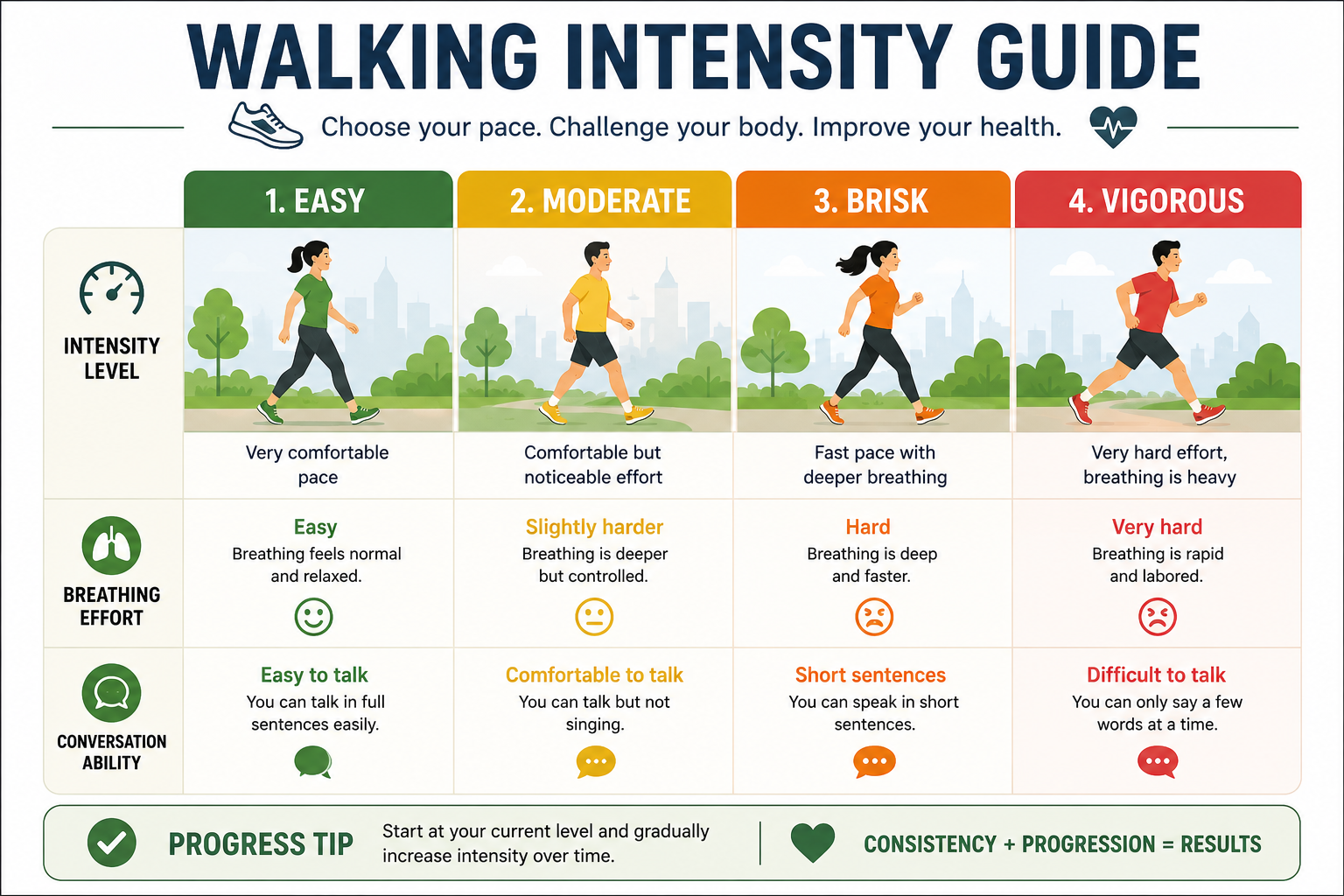
The CDC’s physical activity guidance describes moderate-intensity activity as activity that increases breathing and heart rate while still allowing a person to talk.
Walking intensity guide
| Level | How it may feel | Conversation |
| Easy | Comfortable | Easy to speak |
| Moderate | Noticeably more effort | You can talk. |
| Brisk | Faster breathing and effort | Conversation takes more effort |
| Vigorous | Challenging | Talking becomes difficult. |
Your experience will depend on your fitness and health.
A pace that feels moderate to one person may feel vigorous to another.
Why this matters
Instead of asking:
“What is the perfect walking speed?”
Ask:
“What intensity is appropriate for me today?”
That is a much more useful question.
Walking does not look demanding compared with many forms of exercise.
That does not make it irrelevant to the cardiovascular system.
Regular physical activity is associated with important cardiovascular benefits. The World Health Organization reports that physical activity can reduce the risk of cardiovascular disease and several other noncommunicable diseases.
Walking can therefore form part of an active lifestyle that supports heart health.
However, it is important not to overstate the evidence.
Walking does not make someone immune to heart disease.
Cardiovascular health is influenced by many factors, including:
- Blood pressure
- Cholesterol
- Smoking
- Diet
- Sleep
- Family history
- Age
- Medical conditions
- Overall physical activity
This is why walking should be viewed as one component of a larger health picture.
A practical application
If you currently spend most of your day sitting, adding regular walking can be a realistic way to increase your overall activity.
That may be more sustainable than starting an extremely demanding exercise program and abandoning it shortly afterward.
5. Walking Can Support Cardiovascular Health
Walking may look simple, but regular physical activity can place useful demands on the cardiovascular system.
When you walk at an appropriate intensity, your heart rate and breathing can increase. Over time, regular physical activity can contribute to better cardiovascular fitness and overall health.
That does not mean walking alone prevents heart disease.
Cardiovascular health is influenced by many factors, including:
- Blood pressure
- Cholesterol
- Smoking
- Diet
- Sleep
- Family history
- Age
- Existing medical conditions
- Overall physical activity
This is why walking should be viewed as one part of a larger approach to cardiovascular health.
Why regularity matters
You do not need every walk to be long or demanding.
For many people, the bigger challenge is creating a routine that can be repeated.
A short walk that becomes part of your regular week may be more practical than an intense exercise session that happens only occasionally.
For example, you might:
- Walk before work.
- Take a short walk during a break.
- Walk to nearby destinations when practical.
- Take an evening walk with family.
- Choose stairs and walking opportunities when appropriate.
The aim is to increase your overall movement rather than turn every walk into a test of fitness.
Walking and cardiovascular fitness
Your body adapts to regular physical activity.
As your fitness improves, an activity that once felt challenging may become easier.
You may then choose to gradually increase:
Duration → frequency → pace → terrain
There is no requirement to increase all four at once.
A beginner might first focus on walking consistently before worrying about speed.
Someone who already walks regularly might add hills or a faster pace when appropriate.
A practical perspective
Think of walking as a foundation rather than a complete fitness program.
Walking can contribute to aerobic activity, but a well-rounded exercise routine may also include muscle-strengthening and balance activities, depending on your age, abilities, and goals.
The CDC’s adult physical activity guidelines recommend at least 150 minutes of moderate-intensity aerobic activity per week and muscle-strengthening activities on at least two days per week.
You do not have to reach that amount immediately.
If you currently do little physical activity, building gradually can make the transition more manageable.
The goal is not to find the hardest walk you can complete. The goal is to build a level of activity that fits your life and can be maintained over time.
6. Walking Can Support Mental Well-Being
Physical activity affects more than physical fitness.
The WHO reports that regular physical activity can provide mental health benefits and is associated with reduced symptoms of depression and anxiety and improved overall well-being.
Walking may also create something that is difficult to measure with a simple fitness tracker: a change of environment.
Imagine spending three hours working at a computer.
Then you step outside.
The scenery changes.
A change in attention can subtly alter your posture and body language.
You are no longer staring at the same screen.
That transition can make a walk feel mentally refreshing.
An important distinction
Walking should not be presented as a treatment or cure for depression, anxiety, or other mental health conditions.
People experiencing persistent or severe symptoms should seek appropriate professional care.
Walking can instead be one healthy activity within a broader approach to mental well-being.
7. Walking Has Been Linked to Creative Thinking
This is one of the more surprising findings.
Researchers at Stanford University examined whether walking influenced creative thinking. Their research found that participants generated more creative responses while walking than while sitting in several of the experiments. Stanford University: Walking Improves Creativity.
The original research focused on divergent thinking, which involves generating multiple possible ideas.
That distinction matters.
The findings should not be interpreted as meaning that walking improves every type of thinking.
Instead, they suggest that movement may sometimes help when the task involves generating ideas.
Try it when brainstorming.
If you are struggling with a creative problem:
- Leave the desk if practical.
- Take a comfortable walk.
- Think about the problem without forcing an answer.
- Record useful ideas afterward.
This approach may be particularly suitable for writing, brainstorming, planning, or informal discussions.
It is a practical experiment rather than a guarantee.
8. Walking Can Fit Into a Weight-Management Strategy
Walking is often promoted as a weight-loss solution.
That description is too simplistic.
Walking contributes to physical activity and energy expenditure, but body weight is influenced by many factors.
This means walking can be useful without being treated as a magic calorie-burning tool.
Think about the larger pattern.
A realistic weight-management routine might combine:
- Balanced meals
- Regular walking
- Appropriate strength training
- Adequate sleep
- Stress management
- Consistent routines
The amount of walking that works for one person may be different for another.
A better question
Instead of asking:
“How many calories will this walk burn?”
Consider:
“How can walking help me become more physically active throughout the week?”
That question keeps the focus on sustainable behavior.
9. Walking After Eating Has an Interesting Physiological Effect
Walking after a meal is another area where research becomes interesting.
A systematic review and meta-analysis found that physical activity performed after eating can reduce post-meal blood glucose increases compared with remaining inactive, with activity performed relatively soon after eating showing particularly useful effects in the studies analyzed. Systematic review and meta-analysis.
This does not mean everyone needs to take a walk after every meal.
It also does not replace medical treatment for diabetes.
Instead, it gives healthy adults another way to think about the timing of movement.
A practical example
If you enjoy walking after dinner, a comfortable walk may be an easy way to add movement to your evening.
The activity can also create a useful transition:
Dinner → walk → evening routine
That is different from forcing yourself to complete an exhausting workout after eating.
People managing diabetes or taking glucose-lowering medication should follow individualized medical advice.
10. 10,000 Steps Is Not a Universal Requirement
Few numbers are more strongly associated with walking than 10,000 steps.
But 10,000 is not a universal daily medical requirement for every adult.
The WHO’s physical-activity recommendations focus on overall activity levels and intensity rather than requiring everyone to reach an identical step count. WHO Guidelines on Physical Activity and Sedentary Behavior.
Step counters can still be useful.
- They can help you understand how active you are.
- They can show patterns.
- They can motivate some people to move more.
The problem occurs when a tracking number becomes a source of unnecessary pressure.
Use steps as information.
| Approach | Healthier mindset |
| “I must hit 10,000.” | “I want to become more active.” |
| “I failed today.” | “Today was less active.” |
| “I need the same number every day.” | “My activity can vary.” |
| “More steps are always better.” | “The right amount depends on my circumstances.” |
For someone currently taking very few steps, increasing activity gradually may be more realistic than suddenly chasing a large target.
11. The Most Valuable Walking Habit May Be the One You Can Maintain
The final fact brings the entire discussion back to behavior.
People often search for the “best” exercise.
But the best theoretical exercise is not necessarily the best choice for your life.
If you dislike an activity, have limited time, or find it difficult to recover from, maintaining it can become challenging.
Walking can be adapted to many situations.
You can change:
- Duration
- Pace
- Route
- Terrain
- Time of day
- Social setting
That flexibility can make it easier to build into everyday life.
The WHO recommends adults engage in regular physical activity and notes that increasing activity gradually can be appropriate for people who currently do little. WHO Guidelines on Physical Activity and Sedentary Behaviour.
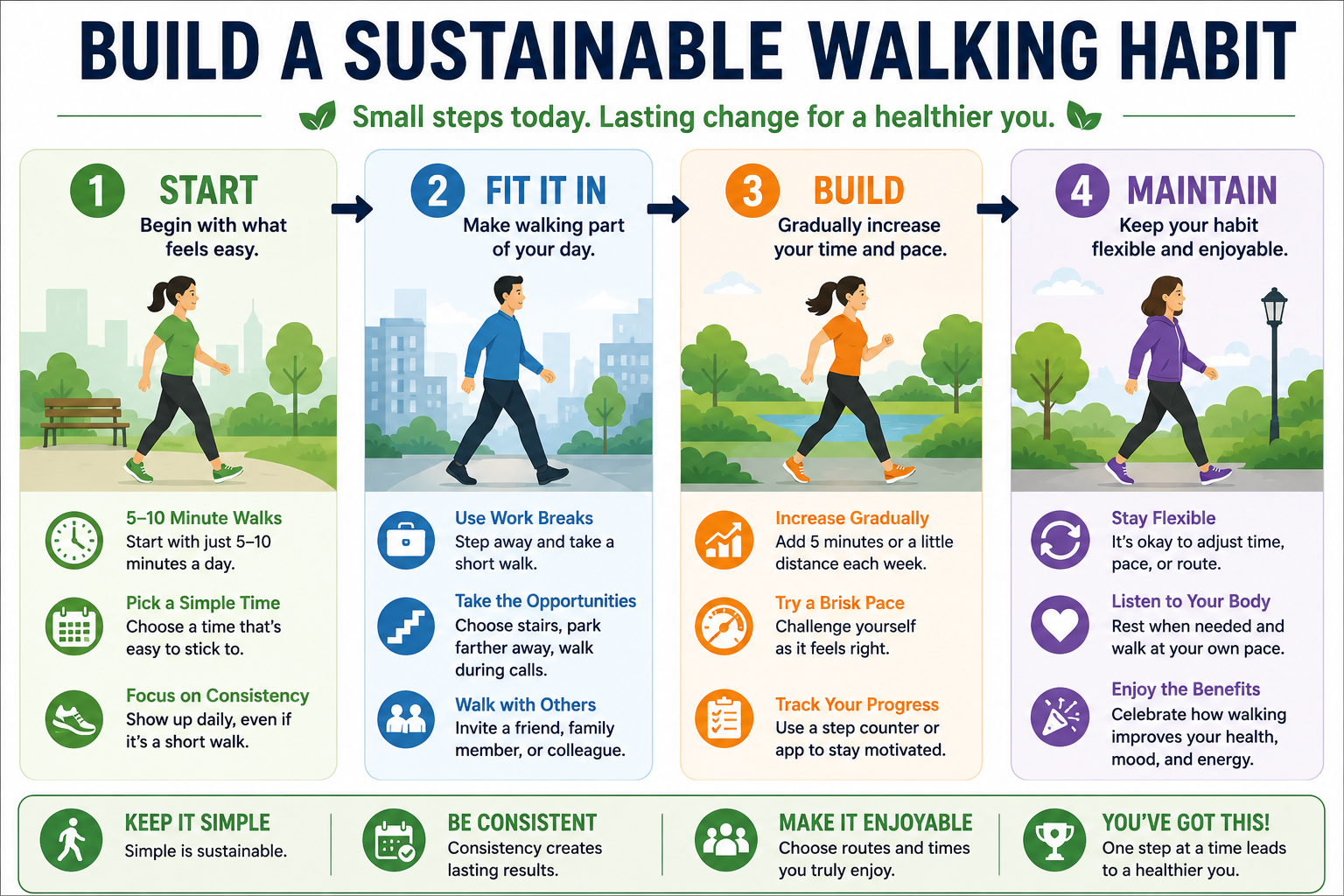
The Four-Part Walking Habit
For this article, use this simple framework:
Start
Choose an amount that fits your current ability.
↓
Fit It In
Connect walking with an existing part of your day.
↓
Build
Gradually increase duration or intensity when appropriate.
↓
Maintain
Choose a routine that can survive busy weeks, travel, weather changes, and ordinary setbacks.
This is a practical framework created for this article, not a clinical guideline.
How Much Walking Should a Beginner Start With?
There is no universal starting number.
A person who is already active can have a different starting point from someone who has spent months being sedentary.
A sensible approach is to begin at a level that feels manageable and increase gradually.
You do not need to reach that target on your first day.
Think of it as a destination rather than a starting requirement.
If walking causes unusual pain, dizziness, chest discomfort, severe breathlessness, or another concerning symptom, stop and seek appropriate medical advice.
A Practical Walking Plan for Busy People
Instead of creating a rigid seven-day schedule, use your available time.
| Available time | Example | How to use it |
| 5 minutes | Movement break | Walk around your workplace or home. |
| 10 minutes | Work break | Walk outside if practical |
| 15 minutes | Lunch break | Combine eating with a short walk afterward. |
| 20 minutes | Morning or evening | Take a neighborhood walk. |
| 30 minutes | Dedicated activity | Walk at a comfortable or brisk pace. |
The purpose is not to complete every row.
Choose the option that fits your day.
Walking for Different Lifestyles
| Situation | Practical strategy | What to prioritize |
| Desk worker | Short movement breaks | Reduce prolonged sitting. |
| Remote worker | Walking phone calls | Separate work and movement |
| Beginner | Comfortable short walks | Build confidence. |
| Older adult | Appropriate walking and balance work | Safety and function |
| Busy parent | Family walks | Combine activity with time together. |
| Traveler | Walk when practical. | Explore while staying active. |
| Returning to exercise | Gradual progression | Avoid doing too much too soon. |
The National Institute on Aging provides guidance on physical activity for older adults, including aerobic, muscle-strengthening, and balance activities. NIA: Exercise and Physical Activity.
Walking is valuable, but a complete activity program can include other forms of movement as well.
What Walking Can and Cannot Do
| Walking can contribute to | Walking cannot guarantee |
| Increasing daily physical activity | A specific amount of weight loss |
| Cardiovascular fitness | Protection from every disease |
| Mental well-being | A cure for depression or anxiety |
| Physical function | Identical results for everyone |
| Weight-management habits | A perfect body shape |
| Breaking up sedentary time | Replacement of every form of exercise |
| Creative idea generation in some situations | Better performance on every mental task |
| A sustainable movement routine | Perfect health by itself |
This distinction keeps walking in perspective.
It is valuable because it can contribute to a healthy lifestyle—not because it is a cure-all.
Common Walking Myths
Myth 1: You Must Walk 10,000 Steps Every Day
There is no universal requirement that every adult reach exactly 10,000 steps.
Use step counts as a personal tracking tool rather than a rigid medical rule.
Myth 2: A Walk Only Counts If It Lasts 30 Minutes
Physical activity can be accumulated in different ways. Shorter periods can be useful, particularly for people building activity from a low starting point.
Myth 3: You Have to Walk as Fast as Possible
Higher intensity is not automatically better for every person.
A suitable pace depends on your fitness and health.
Myth 4: You Must Sweat for Walking to Be Effective
Sweating depends on factors such as temperature, intensity, clothing, fitness, and individual physiology.
Sweat is not a measure of whether a walk was worthwhile.
Myth 5: Missing One Day Means You Lost Your Progress
It does not.
A sustainable routine allows for busy days and interruptions.
The goal is to return to your normal activity pattern when possible.
How to Make Walking More Enjoyable
Walking becomes easier to repeat when it fits your personality.
Try:
- Listening to music.
- Listening to a podcast.
- Walking with a friend.
- Taking a family walk.
- Exploring different safe routes.
- Walking in a suitable natural setting.
- Using a tracker if you enjoy data.
- Combining walking with errands.
Do not force yourself to use every strategy.
Choose the ones that make the activity more appealing.
Key Takeaways
- Walking is a practical form of physical activity that can be used for exercise, transportation, recreation, and everyday movement.
- You do not have to begin with long walks. Starting with a manageable amount and gradually increasing activity can make a routine easier to maintain.
- Walking can contribute to cardiovascular fitness and overall physical activity, particularly when performed at an appropriate intensity.
- Breaking up long periods of sitting with movement can be useful, especially for people who spend much of the day at a desk.
- Research suggests that walking can support creative thinking in some situations, particularly tasks involving divergent thinking.
- Walking can contribute to a weight-management strategy, but body weight is influenced by nutrition, activity, sleep, behavior, genetics, and other factors.
- A short walk after a meal may help reduce the rise in blood glucose after eating, according to research on post-meal physical activity.
- The 10,000-step number is not a universal requirement. Overall physical activity and intensity matter more than reaching one identical step count every day.
- Walking does not replace every form of exercise. A balanced routine can also include muscle-strengthening and, particularly for older adults, balance activities.
- The most useful walking routine is often the one you can realistically continue through ordinary weeks, busy periods, travel, and other interruptions.
Frequently Asked Questions About Walking
1. Is walking considered exercise?
Yes. Walking can be physical activity and, depending on pace and duration, can contribute to aerobic exercise. Brisk walking is specifically recognized as a moderate-intensity aerobic activity in current CDC guidance.
2. How much walking should I do each week?
There is no single amount that is appropriate for every person. For adults, current public-health guidance recommends at least 150 minutes of moderate-intensity aerobic activity per week, along with muscle-strengthening activities on at least two days each week.
If you currently do little physical activity, you do not have to reach that amount immediately. Building activity gradually can be a more realistic approach.
3. Is 10,000 steps a day necessary?
No. Ten thousand steps is not a universal medical requirement for every adult. Step counts can be useful for tracking activity, but overall movement, intensity, fitness, and individual circumstances are also important.
4. Can short walks be useful?
Yes. Short periods of activity can contribute to overall movement, and the CDC notes that adults do not have to complete their weekly activity all at once. Activity can be spread throughout the week and broken into smaller periods.
5. Can walking help with weight management?
Walking can contribute to physical activity and energy expenditure, which can be part of a weight-management strategy. However, walking by itself does not guarantee weight loss because body weight is influenced by many factors, including food intake, sleep, behavior, genetics, and overall activity.
6. Is walking good for the heart?
Regular physical activity supports cardiovascular health. Brisk walking can contribute to the aerobic activity recommended for adults, while maintaining an active lifestyle is associated with lower risks of several chronic diseases.
Walking should be viewed as one component of cardiovascular health rather than a guarantee against heart disease.
7. Can walking improve mental well-being?
Physical activity is associated with mental health benefits, including reduced symptoms of anxiety and depression and improved overall well-being.
Walking can also provide a change of environment and a break from prolonged screen-based work, although it should not be described as a treatment for a mental health condition.
8. Can walking improve creativity?
Research from Stanford found that walking increased creative ideation in several experiments, particularly on tasks involving divergent thinking. The researchers did not find that walking improved every type of thinking equally.
9. Is walking after a meal beneficial?
Research suggests that physical activity performed soon after a meal can reduce the rise in blood glucose after eating. A systematic review and meta-analysis found an acute benefit from post-meal exercise, including walking.
This does not mean everyone needs to walk after every meal, and people managing diabetes should follow individualized medical advice.
10. Is walking enough exercise by itself?
Walking can provide valuable aerobic activity, but it does not necessarily provide all types of physical activity a person may need.
Current guidelines also recommend muscle-strengthening activity, while older adults can benefit from including balance activities.
11. What is the best walking speed?
There is no universal best speed. Intensity should match your fitness, health, age, experience, and goals.
A moderate pace generally makes you breathe and work harder while still allowing conversation.
12. Should beginners start with long walks?
Not necessarily.
A beginner can start with a manageable amount of walking and gradually increase duration or intensity as fitness and confidence improve. The important goal is to establish a sustainable pattern rather than immediately copy someone else’s routine.
Walking Safety: When to Slow Down and Get Help
Walking is accessible to many people, but individual circumstances matter.
If you have been inactive for a long time, have a chronic health condition, have significant mobility limitations, or are unsure what type of physical activity is appropriate for you, consider speaking with a qualified health professional before making major changes to your exercise routine.
The National Institute on Aging notes that many people with chronic conditions can participate in physical activity, but the appropriate type and amount may need to be adapted to the individual’s condition.
During activity, stop and seek appropriate medical attention if you experience concerning symptoms such as chest pain, fainting, severe or unusual shortness of breath, or other symptoms that feel serious or unexpected.
Walking should challenge you appropriately, not force you to ignore warning signs from your body.
Walking Is More Than a Step Count
One of the biggest lessons from these 11 facts is that walking should not be reduced to a number on a fitness tracker.
A step count can tell you something about your movement.
It cannot tell you everything.
It does not explain:
- How you felt during the walk
- Whether you enjoyed it
- Whether the route was safe
- Whether you were able to maintain the habit
- Whether you were also doing strength training
- Whether your activity matched your current abilities
- Whether walking helped you spend less time sitting
This is why a people-first approach to walking focuses on behavior, consistency, enjoyment, and individual circumstances, rather than chasing a single number.
A Simple Way to Make Walking a Habit
If you want to make walking part of your routine, start with one realistic decision.
Choose your trigger.
Pick something that already happens every day.
For example:
Finish breakfast → short walk
Finish lunch → short walk
End work → evening walk
Take a work break → movement walk
The existing activity becomes a reminder for the new habit.
Keep the first goal manageable.
Do not make your first goal so ambitious that a busy day immediately destroys the routine.
A five-, ten-, or fifteen-minute walk may be a more practical starting point for some beginners than an unrealistic long-distance target.
Increase gradually.
Once walking becomes comfortable, you can consider increasing:
- Duration
- Frequency
- Pace
- Hills or terrain
You do not need to increase everything simultaneously.
Make the habit flexible.
A sustainable routine should survive imperfect days.
If you normally walk for 30 minutes but only have 10 minutes today, a shorter walk may still be preferable to abandoning the habit completely.
The CDC emphasizes that some physical activity is better than none and that activity can be distributed throughout the week.
Conclusion
Walking is easy to overlook because it is such a normal part of everyday life.
Yet that simplicity is also one of its greatest strengths.
You do not necessarily need a gym membership, specialized equipment, or a complicated training program to begin moving more. A walk can happen during a break, on the way to a nearby destination, after a meal, with family, or as part of a planned exercise routine.
The evidence also shows that walking can be connected with several aspects of a healthy lifestyle. Regular physical activity can support cardiovascular health, mental well-being, physical function, and the management of chronic-disease risk.
At the same time, walking should not be presented as a cure-all.
It cannot guarantee weight loss, eliminate disease risk, replace strength training, or produce identical results for everyone.
About the Author
RVLNSV PRASAD writes research-based, reader-focused content designed to explain health and lifestyle topics in clear, accessible language.
The approach used in this article combines authoritative public-health guidance, research findings, practical examples, and personal experience while distinguishing personal observations from scientific evidence.
Articles are reviewed and updated when important information changes or when corrections are needed.
Medical Disclaimer
This article is for general educational purposes only and is not a substitute for professional medical advice, diagnosis, or treatment. Walking and physical activity may affect people differently depending on their health, fitness, medications, age, and individual circumstances.
If you have a medical condition or are unsure what level of activity is appropriate for you, consult a qualified healthcare professional before making significant changes to your exercise routine.
Stop exercising and seek medical attention if you experience chest pain, fainting, severe shortness of breath, or other concerning symptoms.
Do not use this article to diagnose, treat, cure, or prevent any medical condition.
Sources
- World Health Organization (WHO) — Physical Activity — Physical activity recommendations and health benefits.
- CDC—Adult Physical Activity Guidelines—Recommended aerobic and muscle-strengthening activity.
- National Institute on Aging — Exercise and Physical Activity — Exercise, healthy aging, and physical activity guidance.
- Stanford University — Walking and Creative Thinking — Research on walking and creative thinking.
- PubMed Central — Post-Meal Exercise and Blood Glucose — Systematic review and meta-analysis of exercise after meals.
Related article
How to Burn 1000 Calories Daily
6 Mindfulness Practices for Mental Health: A Path to Inner Peace and Emotional Resilience
How Nature Walks Can Improve Physical Health: A Comprehensive Guide








[…] 11 Interesting Facts About Walking […]
[…] 11 Interesting Facts About Walking […]
[…] 11 Interesting Facts About Walking […]
[…] 11 Interesting Facts About Walking […]
[…] 11 Interesting Facts About Walking […]
[…] 11 Interesting Facts About Walking […]
[…] 11 Interesting Facts About Walking […]
[…] 11 Interesting Facts About Walking […]
[…] 11 Interesting Facts About Walking […]
[…] 11 Interesting Facts About Walking […]
[…] 11 Interesting Facts About Walking […]
[…] 11 Interesting Facts About Walking […]
[…] 11 Interesting Facts About Walking […]
[…] 11 Interesting Facts About Walking […]
[…] 11 Interesting Facts About Walking […]
[…] 11 Interesting Facts About Walking […]
[…] 11 Interesting Facts About Walking […]
[…] 11 Interesting Facts About Walking […]
[…] 11 Interesting Facts About Walking […]
[…] 11 Interesting Facts About Walking […]
[…] 11 Interesting Facts About Walking […]