




















































































































































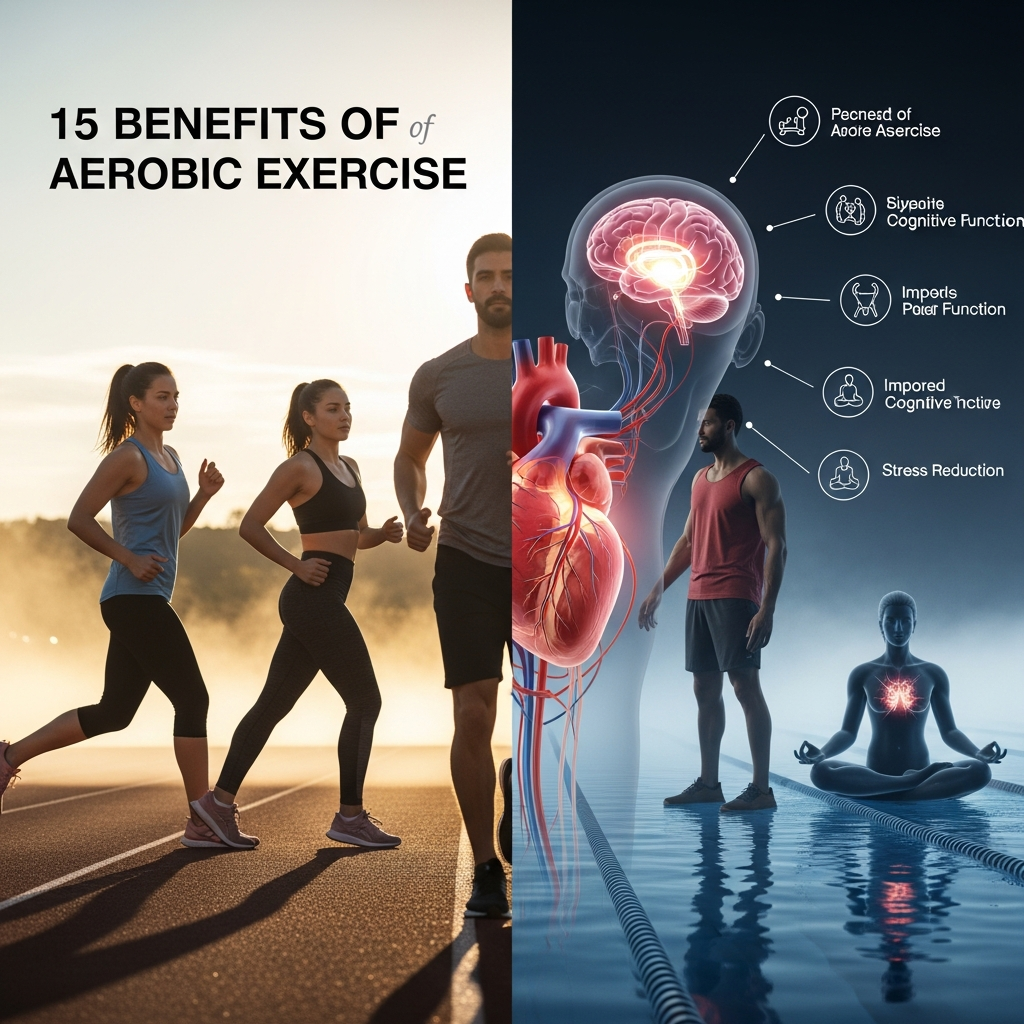
15 Benefits of Aerobic Exercise: Heart, Weight, Mood & More
Author: RVLNSV PRASAD
Updated On: September 2026
About Us
Author Bio
Editorial Policy
Contact Us
Quick Answer
The benefits of aerobic exercise extend far beyond burning calories.
Regular aerobic activity can improve cardiorespiratory fitness, support heart health, help manage blood pressure, contribute to healthy weight management, improve blood-sugar regulation, support better sleep, reduce anxiety, improve physical function, and lower the risk of several chronic diseases.
For most adults, the general target is 150–300 minutes of moderate-intensity aerobic activity each week, 75–150 minutes of vigorous-intensity activity, or an equivalent combination. Adults should also perform muscle-strengthening activities on at least two days each week. The World Health Organization’s physical activity guidelines and CDC adult activity recommendations both support these targets.
You do not need to reach that amount immediately.
If you are currently inactive, starting with 10 minutes of walking and gradually increasing the duration can be a sensible approach. WHO specifically recommends starting with small amounts and gradually increasing frequency, intensity, and duration. WHO physical activity guidelines
The best aerobic exercise is not necessarily the hardest one.
It is the activity you can perform safely and repeat consistently.
Key Takeaways
- Aerobic exercise improves cardiovascular and cardiorespiratory fitness.
- Brisk walking can count as moderate-intensity aerobic activity.
- Regular activity supports heart health and healthy blood pressure.
- Aerobic exercise can contribute to healthy weight management.
- Physical activity supports blood-sugar regulation and metabolic health.
- Exercise can improve sleep and reduce feelings of anxiety.
- Regular movement is associated with a lower risk of several chronic diseases.
- Aerobic exercise can support healthy aging and physical independence.
- Beginners do not need to start with running or high-impact workouts.
- Low-impact exercises can provide useful alternatives.
- You can divide your weekly exercise into smaller sessions.
- Aerobic exercise should complement, not replace, strength training.
- More exercise is not automatically better.
- Consistency usually matters more than choosing an impressive workout.
- Exercise should be adapted to the person’s health, fitness, age and circumstances.
Introduction: Why Aerobic Exercise Deserves More Attention
You do not need a treadmill, expensive gym membership, or complicated training program to benefit from aerobic exercise.
A brisk walk can count.
So can cycling, swimming, dancing, hiking, or an appropriately paced home workout.
That flexibility is one of the biggest strengths of aerobic exercise.
Yet many people approach cardio in an all-or-nothing way.
They may believe that exercise only counts if they run several kilometers, spend an hour in a gym, or finish completely exhausted.
That idea can discourage beginners.
Current guidance sends a different message.
The CDC explains that some physical activity is better than none, and adults can accumulate their weekly activity across different days and in smaller periods.
The WHO guidelines similarly emphasize that people who are not currently meeting activity recommendations can benefit by starting with smaller amounts and gradually progressing.
This matters because the most effective exercise routine is not necessarily the most intense.
It is the one that fits into real life.
A person who walks for 15 minutes most days may be building a more sustainable habit than someone who attempts an extremely difficult workout once a week and then stops because of exhaustion or soreness.
Current U.S. data also show that there is considerable room for improvement. According to the CDC National Center for Health Statistics 2026 report, only 47.2% of U.S. adults met federal aerobic physical-activity guidelines in 2024.
That makes the practical question more important:
How can ordinary people make aerobic exercise easier to start and easier to continue?
What Is Aerobic Exercise?
Aerobic exercise is rhythmic physical activity that uses large muscle groups and can be sustained over time while your cardiovascular and respiratory systems supply oxygen to working muscles.
Common examples include:
- Brisk walking
- Jogging
- Running
- Cycling
- Swimming
- Dancing
- Water aerobics
- Hiking
- Rowing
- Aerobic classes
- Some recreational sports
Aerobic exercise can be performed at different intensities.
For example, a relaxed stroll and a brisk uphill walk are both forms of walking, but they do not create the same physiological demand.
Aerobic Exercise vs. Strength Training
These two forms of exercise should not be treated as competitors.
They serve different purposes.
| Exercise type | Main focus | Examples |
|---|---|---|
| Aerobic | Cardiovascular endurance | Walking, cycling, swimming |
| Strength | Muscle strength and function | Squats, resistance bands, weights |
| Balance | Stability and fall prevention | Single-leg balance, controlled stepping |
| Flexibility/mobility | Range of motion | Stretching and mobility work |
For a well-rounded fitness routine, cardio should therefore be one part of the picture rather than the entire program.
15 Evidence-Based Benefits of Aerobic Exercise
1. Supports Heart Health
Heart health is one of the best-established reasons to stay physically active.
Regular aerobic exercise challenges the cardiovascular system and can improve cardiorespiratory fitness.
Over time, regular physical activity is associated with lower cardiovascular risk.
Aerobic exercise does not have to mean running.
Brisk walking, cycling, swimming, and dancing can all be useful options.
2. Helps Support Healthy Blood Pressure
Regular physical activity can help support healthier blood pressure levels.
This is particularly relevant because high blood pressure often produces no obvious symptoms.
Exercise, however, should not be presented as a replacement for prescribed treatment.
If you take blood-pressure medication, continue taking it as directed unless your healthcare professional tells you otherwise.
3. Supports Healthy Weight Management
Aerobic exercise increases energy expenditure and can be an important part of a weight-management strategy.
However, exercise should not be marketed as a guaranteed method of losing a particular number of kilograms.
Body weight is influenced by:
- Food intake
- Physical activity
- Sleep
- Medications
- Genetics
- Hormonal factors
- Medical conditions
- Environment
- Stress
- Age
The CDC lists regular physical activity as helping reduce the risk of weight gain.
A useful practical lesson is this:
Choose an exercise you can repeat rather than the exercise that supposedly burns the most calories.
A 25-minute brisk walk five days a week may be more useful in real life than an extreme workout that you abandon after three days.
4. Improves Cardiorespiratory Fitness
Cardiorespiratory fitness refers to how effectively your cardiovascular and respiratory systems support physical activity.
As fitness improves, ordinary tasks can become easier.
You may notice that:
- Stairs feel less difficult.
- You can walk farther.
- You recover faster after activity.
- Household work feels easier.
- You can remain active for longer.
This is one of the most practical benefits of aerobic exercise because it affects what you can do in daily life.
5. Supports Blood-Sugar Regulation
Physical activity helps working muscles use glucose for energy and contributes to overall metabolic health.
Regular physical activity is associated with a lower risk of developing type 2 diabetes.
The CDC lists reduced risk of type 2 diabetes among the long-term health benefits of physical activity.
People with diabetes may need to consider medication timing, blood-glucose monitoring, food intake, and exercise intensity.
That is particularly important for people using insulin or medications that can cause hypoglycemia.
6. May Improve Mood
Exercise is not simply a physical activity.
It can also affect emotional well-being.
The CDC identifies reduced anxiety as an immediate benefit of physical activity.
Recent research continues to investigate how aerobic exercise affects mood.
A 2026 systematic review and meta-analysis of randomized controlled trials found that acute aerobic exercise was associated with improvements in positive mood and reductions in negative mood, while longer-term aerobic exercise was associated with reduced negative mood. The researchers also emphasized that findings were not equally strong across all cognitive and sleep outcomes. Read the 2026 systematic review on PubMed.
That distinction is important.
Aerobic exercise can support mental well-being.
It should not be described as a universal treatment for depression or anxiety disorders.
7. Can Support Better Sleep
Sleep and physical activity are closely connected.
The CDC lists improved sleep as an immediate benefit of physical activity.
Research has also examined aerobic exercise as a possible non-drug approach for improving sleep quality.
A 2025 systematic review and meta-analysis examined aerobic exercise interventions and sleep-related outcomes, adding to the evidence that structured physical activity may help some people with sleep problems. Read the research on PubMed Central.
However, persistent insomnia can have many causes.
If sleep problems continue despite lifestyle changes, medical evaluation may be appropriate.
8. Supports Brain and Cognitive Health
Physical activity is increasingly being studied for its relationship with brain health.
However, this should not be exaggerated into claims that aerobic exercise “prevents dementia.”
Research is still examining which types, intensities, and durations of exercise provide the greatest cognitive benefit.
The 2026 systematic review mentioned earlier found mixed results for long-term cognitive outcomes, illustrating why responsible health writing should distinguish established evidence from emerging research. PubMed evidence.
9. Helps Maintain Physical Function With Age
Physical capacity becomes increasingly important as people get older.
Maintaining the ability to walk, climb stairs, shop, travel, and perform household activities can contribute to independence.
The CDC’s guidance for adults aged 65 and older highlights benefits involving heart health, bone health, brain health, balance, and independent living.
Older adults should also include strength and balance activities rather than relying entirely on aerobic exercise.
10. Supports Bone and Musculoskeletal Health
Physical activity can contribute to bone and musculoskeletal health.
Walking is a simple example of a weight-bearing activity.
Strength training provides additional benefits that aerobic exercise alone does not provide.
The CDC identifies improved bone health among the benefits of regular physical activity.
For people with osteoporosis, significant joint disease, or previous fractures, exercise selection should be individualized.
11. Can Improve Everyday Stamina
One of the first changes some beginners notice is not a dramatic change on the weighing scale.
It is that everyday activities feel easier.
You may be able to:
- Walk farther
- Carry groceries more comfortably
- Climb stairs
- Work in the garden
- Travel with less fatigue
- Play with children
- Complete household tasks
This is why fitness should not be measured only by body weight.
Functional capacity is a meaningful outcome in its own right.
12. Supports Healthy Aging
Regular physical activity is associated with lower risks of several chronic conditions.
The WHO physical activity guidelines identify benefits involving cardiovascular disease, hypertension, type 2 diabetes, some cancers, mental health, cognitive health, sleep, and mortality.
The important word is associated.
Exercise does not make a person immune to disease.
Instead, regular physical activity is one modifiable behavior that contributes to a healthier long-term risk profile.
13. Helps Reduce Sedentary Time
A workout does not completely cancel out spending most of the remaining day sitting.
That is why the modern approach is
Exercise regularly + sit less + move more throughout the day.
The CDC recommends moving more and sitting less.
Simple movement opportunities include:
- Walking during phone calls
- Taking short movement breaks
- Using stairs when appropriate
- Walking while waiting
- Doing household chores
- Walking to nearby destinations when practical
These activities may seem small.
Together, they can make daily life more active.
14. Supports Quality of Life
Health is not only about blood pressure, cholesterol, or body weight.
Being physically capable can make ordinary life more enjoyable.
You may be better able to:
- Travel
- Shop independently
- Play with family
- Participate in hobbies
- Walk outdoors
- Complete household work
- Spend time socially
The American Heart Association notes that endurance exercise can make everyday activities easier.
That practical benefit deserves more attention in fitness articles.
15. Can Help Build a Sustainable Health Habit
Aerobic exercise has one major advantage over many complicated fitness systems:
There are many ways to do it.
- If you dislike running, walk.
- If walking becomes boring, cycle.
- If impact bothers your joints, consider swimming or water exercise.
- If traditional workouts feel tedious, dance.
- If you have limited time, divide activity into shorter periods.
That flexibility can make aerobic exercise easier to maintain.
How Much Aerobic Exercise Should You Do?
For most adults, the general weekly target is
| Activity | General adult target |
|---|---|
| Moderate aerobic activity | 150–300 minutes/week |
| Vigorous aerobic activity | 75–150 minutes/week |
| Combination | Equivalent combination |
| Muscle strengthening | 2 or more days/week |
These recommendations are supported by both the WHO guidelines and the CDC adult activity guidelines.
You do not have to achieve the full target immediately.
WHO specifically recommends starting with small amounts and gradually increasing activity.
Can You Break Exercise Into Smaller Sessions?
Yes.
You can divide your activity across the week.
For example:
30 minutes × 5 days = 150 minutes
Or:
15 minutes × 2 sessions × 5 days = 150 minutes
This can be useful for people who cannot dedicate one continuous 30-minute period to exercise.
The CDC specifically notes that weekly activity can be broken into smaller chunks.
Moderate vs. Vigorous Aerobic Exercise
| Moderate | Vigorous |
|---|---|
| Brisk walking | Running |
| Comfortable cycling | Fast cycling |
| Dancing | Fast aerobic exercise |
| Water aerobics | Swimming laps |
| Breathing is faster. | Breathing is much harder. |
| You can generally talk. | Conversation becomes difficult. |
Intensity is relative.
A pace that feels moderate for a trained person may feel vigorous for a beginner.
Use the Talk Test.
The Talk Test is a simple way to estimate exercise intensity.
Moderate intensity
You can talk, but singing would be difficult.
Vigorous intensity
- You can usually speak only a few words before taking a breath.
- You do not need an expensive fitness tracker to begin understanding your effort level.
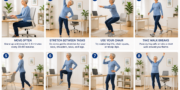
8 Easy Aerobic Exercises for Beginners
These are deliberately simple.
The goal is accessibility rather than showing off.
1. March-and-Reach
March in place while gently moving your arms.
Start slowly.
Increase the pace as comfortably as possible.
Beginner: 1–2 minutes
Progression: 5 minutes
2. Side-Step and Tap
Step to one side.
Bring the opposite foot toward it.
Repeat in the other direction.
Add gentle arm movements if comfortable.
This is a useful lower-impact alternative to jumping jacks.
3. Walk-and-Talk Intervals
Walk comfortably for two minutes.
Walk briskly for one minute.
Repeat several times.
This can turn an ordinary walk into a simple interval workout without requiring a stopwatch or complicated program.
4. Indoor Walking Loops
Walk around your home, corridor, or another safe indoor area.
Change direction periodically.
Increase the pace for short periods.
This is especially useful during poor weather.
5. Step-Touch Cardio
Step one foot to the side.
Bring the other foot toward it.
Continue rhythmically.
Add arm movements if comfortable.
6. Music-Based Cardio
Choose two or three songs.
Move continuously while the music plays.
You can:
- March
- Step side to side
- Walk around the room
- Move your arms
- Perform gentle knee lifts
The music provides a natural time structure.
7. Gentle Shadow Walking
Walk in different directions within a safe space.
Use:
- Forward walking
- Side stepping
- Marching
- Gentle direction changes
Avoid backward walking if balance is a concern.
8. Household Movement Circuit
Perform:
- Marching
- Walking
- Side steps
- Gentle knee lifts
Spend 30–60 seconds on each.
Repeat according to your fitness level.
This is especially useful for people who do not enjoy conventional workouts.
A Simple 4-Week Beginner Aerobic Exercise Plan
| Week | Frequency | Example |
|---|---|---|
| Week 1 | 4 days | 10–15 minutes of comfortable walking |
| Week 2 | 4–5 days | 15–20 minutes |
| Week 3 | 5 days | 20–25 minutes of moderate activity |
| Week 4 | 5 days | 25–30 minutes |
This is a general example, not an individualized prescription.
If your body is not ready to progress, repeat the previous week.
There is no prize for progressing faster.
Low-Impact Aerobic Exercise Options
If high-impact exercise is uncomfortable, consider:
- Brisk walking
- Stationary cycling
- Swimming
- Water aerobics
- Marching
- Low-impact dancing
- Step-touch movements
- Elliptical exercise
People with joint problems or other physical limitations should choose activities appropriate for their condition.
Aerobic Exercise at Home
You can create a simple 20-minute routine without expensive equipment.
3-minute warm-up
- Slow marching
- Easy walking
- Gentle arm movements
12-minute main session
Repeat three times:
- March in place—1 minute
- Side-step—1 minute
- Walk around the room—1 minute
- Easy movement — 1 minute
5-minute cool-down
Slow your walking gradually.
Allow your breathing to return toward normal.
The routine can be made easier or harder by changing pace and duration.
Common Mistakes
1. Starting Too Fast
Going from almost no exercise to intense daily workouts is unnecessary.
Start with an amount you can recover from.
2. Believing More Sweat Means Better Exercise
Sweating is not a reliable measure of workout quality.
Temperature, humidity, clothing, and individual physiology affect sweating.
3. Thinking Running Is Required
Running is one option.
It is not the definition of aerobic exercise.
4. Ignoring Strength Training
Cardio does not replace muscle-strengthening exercise.
Adults should generally include strength training at least two days per week. CDC recommendations
5. Exercising Only When Motivated
Motivation is unreliable.
A scheduled, manageable routine is usually easier to maintain.
6. Copying an Influencer’s Workout
Online fitness content often shows people who already have substantial conditioning.
Your starting point should reflect your current fitness.
7. Treating Exercise as Punishment for Eating
Exercise should support health rather than become punishment for food.
8. Ignoring Recovery
Fitness improves through repeated training and recovery.
If every session leaves you exhausted, the program may be too demanding.
9. Increasing Duration, Speed, and Intensity at the Same Time
Change gradually.
Increasing everything simultaneously makes the workout unnecessarily difficult.
10. Ignoring Warning Symptoms
Chest pain, fainting, severe breathlessness, or other serious symptoms should not be treated as ordinary exercise discomfort.
Who Should Talk With a Healthcare Professional Before Increasing Exercise?
Moderate activity is safe for most people, but individual circumstances matter.
Extra caution may be appropriate if you have:
- Known heart disease
- Significant lung disease
- Diabetes requiring medication
- Major arthritis or joint limitations
- Serious balance problems
- A recent operation
- A significant injury
- Symptoms occurring during exertion
- Another condition that limits physical activity
The CDC also recommends talking with a doctor before beginning vigorous activity if you have been inactive, have a disability, or are higher weight. CDC guidance
When Should You Stop Exercising?
Do not try to push through potentially serious symptoms.
Stop exercising and seek appropriate medical attention for concerning symptoms such as:
- Chest pain or pressure
- Severe shortness of breath
- Fainting
- Severe dizziness
- New severe palpitations accompanied by concerning symptoms
- Sudden weakness
- Confusion
- Serious injury
If symptoms are severe or potentially life-threatening, seek emergency medical care.
Latest Research: What Is Changing?
Modern exercise research is becoming more precise.
Researchers are studying not only whether exercise helps but also:
- Which intensity works best
- How exercise affects different age groups
- How physical activity influences cognition
- How exercise affects sleep
- Which exercise patterns improve adherence
- How sedentary time interacts with structured exercise
- How exercise affects people with chronic disease
A particularly useful 2026 systematic review examined aerobic exercise and cognition, sleep, and mood in healthy adults. It found clearer effects for some mood outcomes than for cognition or sleep, reinforcing that the evidence is not identical for every claimed benefit. Read the study on PubMed.
This is a valuable lesson for readers:
Evidence-based exercise advice should not promise that one workout improves every aspect of health.
Some benefits are strongly established.
Others are still being refined by research.
What the 2026 CDC Data Tell Us
A new CDC National Center for Health Statistics report published in April 2026 found that 47.2% of U.S. adults met federal aerobic-activity guidelines in 2024.
The proportion was lower among older adults and people with disabilities.
This reinforces an important practical point:
- The challenge is not simply knowing that exercise is beneficial.
- The challenge is making physical activity accessible and sustainable for different people.
That is why beginner-friendly options, low-impact alternatives, flexible schedules, and realistic progression deserve a place in an evidence-based aerobic exercise article.
People-First Insight: The “Minimum Useful Workout”
A common mistake is thinking:
“If I cannot exercise for an hour, there is no point.”
That mindset can prevent people from starting.
Instead, establish a minimum useful workout.
For example:
10 minutes of walking.
- If you have more time and energy, continue.
- If you do not, the 10-minute session still keeps the habit alive.
The CDC emphasizes that some physical activity is better than none.
This approach can be especially useful for:
- Busy parents
- Office workers
- Beginners
- Older adults
- People returning to exercise
- People with limited mobility
- People who struggle with motivation
The objective is not to make every workout impressive.
The objective is to make movement normal.
Personal Experience and Editorial Perspective
Author perspective: The most useful lesson from writing about exercise is that people often need a simpler starting point rather than a harder workout.
A beginner may look at a complicated exercise plan and immediately feel that it is impossible to maintain.
A short walk is different.
It is familiar, inexpensive, and easy to adjust.
Once walking becomes part of the routine, duration or intensity can be increased gradually.
If you have your own genuine experience with aerobic exercise, walking, or home workouts, you can add it here.
Do not publish an invented personal medical or fitness story.
A real first-hand experience is more valuable for readers and more credible than a fabricated anecdote.
Frequently Asked Questions
What are the biggest benefits of aerobic exercise?
The major benefits include improved cardiovascular fitness, support for heart health, healthier blood-pressure levels, improved metabolic health, weight-management support, better physical function, and lower risk of several chronic diseases. Physical activity can also benefit mood and sleep. CDC health benefits
Is walking considered aerobic exercise?
Yes.
Brisk walking is a common example of moderate-intensity aerobic activity. The intensity matters because a very slow stroll may not produce the same cardiovascular challenge as brisk walking.
Is 30 minutes of aerobic exercise enough?
Thirty minutes of moderate activity five days a week equals 150 minutes, which reaches the lower end of the general adult aerobic-activity recommendation. CDC adult guidelines
Can beginners do aerobic exercise every day?
Some people can safely perform light or moderate activity on most days.
However, beginners should increase activity gradually rather than assuming daily high-intensity workouts are necessary.
What is the best aerobic exercise for beginners?
There is no single best exercise.
Brisk walking is an excellent starting point for many people because it requires little equipment and can be adjusted easily.
Cycling, swimming, dancing, and low-impact home workouts are alternatives.
Can aerobic exercise help you lose weight?
It can contribute to energy expenditure and weight management.
However, weight change depends on multiple factors, including food intake, activity, sleep, medications, genetics, and health conditions.
Is aerobic exercise better than strength training?
No.
Aerobic exercise primarily develops cardiovascular endurance, while strength training develops muscle strength and function.
A balanced program can include both.
Can I do aerobic exercise without going to a gym?
Yes.
Walking, indoor marching, dancing, cycling, and many low-impact routines can be performed without a gym membership.
How long does it take to see results?
Some effects, such as changes in mood or sleep, may occur relatively quickly.
Improvements in cardiovascular fitness generally require repeated activity over time.
The timeline varies between individuals.
Is aerobic exercise safe for older adults?
Physical activity can provide substantial benefits for older adults, but exercise should be adapted to fitness, balance, medical conditions, and physical limitations. The CDC provides specific physical-activity guidance for adults 65 and older.
Conclusion
The benefits of aerobic exercise are not limited to calorie burning or weight loss.
Regular aerobic activity can support your heart, improve cardiorespiratory fitness, help manage blood pressure and blood sugar, support healthy weight management, improve physical function, contribute to better sleep and mood, and help reduce the risk of several chronic conditions.
But that recommendation should not become a reason to avoid exercise because you are currently inactive.
Start where you are.
Walk for 10 minutes.
Try a simple home routine.
Dance to two songs.
Cycle for a short period.
Then gradually build.
The most effective aerobic exercise is not necessarily the exercise that looks hardest on social media.
It is the activity that is appropriate for you, safe enough to repeat and enjoyable enough to become part of your life.
Fitness is not a one-day challenge.
It is a long-term relationship with movement.
Author Note
Author: RVLNSV PRASAD
This article was prepared as an evidence-based educational resource focusing on practical aerobic exercise, beginner-friendly movement, and current physical-activity recommendations.
- The information has been reviewed against guidance from major public health and cardiovascular organizations and recent scientific literature.
- The purpose is not to encourage extreme exercise.
It is to help ordinary people understand the evidence and find realistic ways to become more physically active.
Medical Disclaimer
This article provides general educational information and is not a substitute for individualized medical advice, diagnosis, or treatment.
Exercise recommendations can differ according to age, fitness level, pregnancy, medications, chronic diseases, injuries, and other individual circumstances.
If you have a medical condition, significant symptoms, have recently undergone surgery, or are uncertain whether a particular exercise is appropriate for you, consult a qualified healthcare professional before making major changes to your exercise routine.
Do not stop or change prescribed medication because of information provided in this article.
Fitness Disclaimer
The exercises in this article are general examples rather than personalized training instructions.
Start at an intensity appropriate for your current fitness level.
Increase duration and intensity gradually.
Stop exercise if you experience unusual or severe pain, chest discomfort, fainting, severe dizziness, severe shortness of breath, or other concerning symptoms, and seek appropriate medical care.
Exercises involving stairs, balance challenges, or impact should only be performed when they are appropriate and can be done safely.
Sources
- World Health Organization — Physical Activity Guidelines
https://www.who.int/publications/b/55518 - WHO—Guidelines on Physical Activity and Sedentary Behavior
https://iris.who.int/bitstream/handle/10665/336656/9789240015128-eng.pdf - CDC — Adult Activity: An Overview
https://www.cdc.gov/physical-activity-basics/guidelines/adults.html - CDC—Adding Physical Activity as an Adult
https://www.cdc.gov/physical-activity-basics/adding-adults/index.html - CDC — Health Benefits of Physical Activity
https://www.cdc.gov/physical-activity-basics/health-benefits/ - CDC — Physical Activity Benefits for Adults 65 or Older
https://www.cdc.gov/physical-activity-basics/health-benefits/older-adults.html - CDC National Center for Health Statistics—Aerobic Physical Activity Among Adults, 2024—2026 report
https://www.cdc.gov/nchs/products/databriefs/db555.htm - American Heart Association — Physical Activity Recommendations for Adults
https://www.heart.org/en/healthy-living/exercise-and-physical-activity/fitness-basics/aha-recs-for-physical-activity-in-adults - American Heart Association — Endurance/Aerobic Exercise
https://www.heart.org/en/healthy-living/exercise-and-physical-activity/fitness-basics/endurance-exercise-aerobic - 2026 Systematic Review—Aerobic Exercise, Cognition, Sleep and Mood
https://pubmed.ncbi.nlm.nih.gov/42294103/ - 2025 Systematic Review — Aerobic Exercise and Sleep
https://pmc.ncbi.nlm.nih.gov/articles/PMC12293783/
Similar Topics
- 9 Benefits of Yoga for Holistic Health and Well-Being
- Home
- Category Active Living
- 6 12 25 Workouts: The Muscle-Building Secret Behind This Brutal Hypertrophy Method
- 8 Lower Back Stretches That Actually Work for Pain and Mobility
- Full Abs Workout at Home: Daily Routine to See Results in 30 Days
- 12 Plyometric Workouts for Speed: Explosive Exercises to Boost Performance