






































































































































































9 Daily Yoga Benefits for Mental and Physical Wellness
Author: RVLNSV PRASAD
Updated On: October 2026
About Us
Author Bio
Editorial Policy
Contact Us
Medical Review: This article has not been independently reviewed by a qualified healthcare professional.
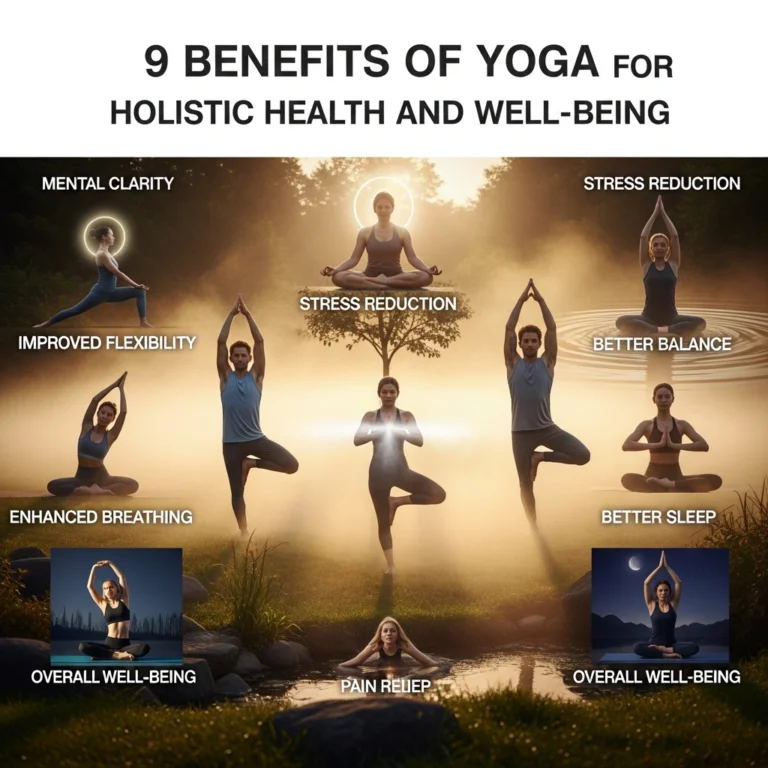
Introduction: Can a Few Minutes of Yoga Make a Difference?
A busy day can leave your body stiff, your mind restless, and your energy low. Long hours sitting at a desk, looking at a phone, or managing household responsibilities can make it difficult to find time for exercise. Yoga offers one practical way to include movement, breathing, and moments of quiet in your daily routine without needing an expensive gym membership or complicated equipment.
The daily yoga benefits people notice may include better flexibility, improved balance, stress management, greater body awareness, and support for sleep. However, yoga is not a miracle cure, and its effects differ from person to person. Your starting fitness level, health conditions, the style of yoga you choose, and how consistently you practice can all influence your experience.
Scientific evidence is also becoming more detailed. A June 2026 evidence map from the U.S. Department of Veterans Affairs reviewed 37 systematic reviews covering yoga and different adult health conditions. It found moderate-certainty evidence for selected outcomes, including sleep quality and certain aspects of physical function and mental well-being. Other conclusions remained uncertain, showing why individual benefits should not be exaggerated. Read the 2026 evidence map.
This guide explains nine potential benefits of regular yoga, what research can and cannot tell us, and how beginners can build a realistic routine. It also includes practical ways to adapt yoga to everyday life, common mistakes to avoid, and a simple method for tracking progress.
Quick Answer: What Are the Main Benefits of Daily Yoga?
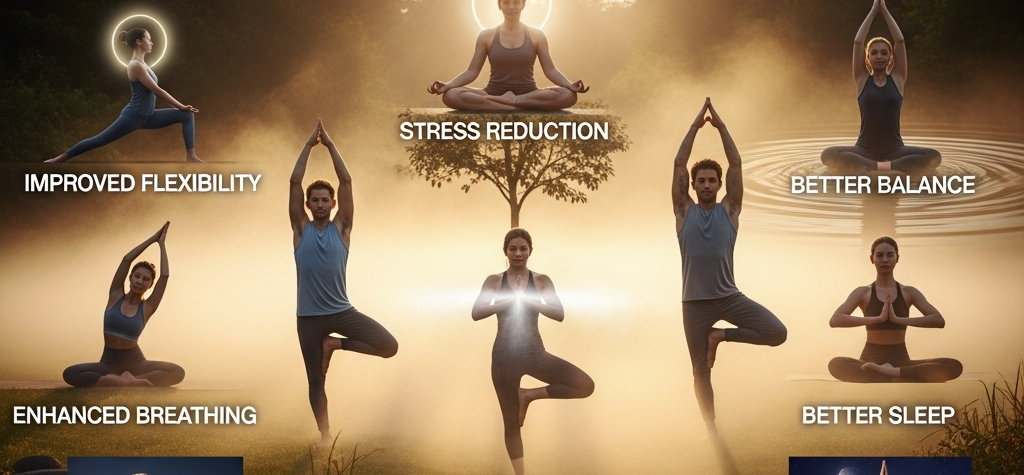
Regular yoga may help you manage everyday stress, improve flexibility, develop balance, support sleep quality, and become more aware of posture and movement. Depending on the style, it can also provide gentle strength-building activity and create a useful pause in a demanding day.
You do not need to begin with advanced poses or long sessions. A short, comfortable routine that combines gentle movement, natural breathing, and relaxation is a sensible starting point for many healthy beginners.
Key Takeaways
-
Yoga combines physical postures, breathing practices, and meditation or focused attention, although not every class includes all three.
-
Research supports some benefits for specific outcomes, but the certainty of evidence varies.
-
Gentle, consistent practice is generally more useful for beginners than forcing difficult poses.
-
Yoga may support stress management and sleep, but it should not replace appropriate medical or mental health treatment.
-
A chair, wall, folded blanket, or cushion can make practice more accessible.
-
Pain, dizziness, breathlessness, or unusual symptoms are signals to stop rather than push through.
What Does Current Research Say About Daily Yoga?
Yoga research covers different styles, session lengths, age groups, and health conditions. This variation matters because a gentle restorative class is not the same intervention as a demanding power-yoga session. Researchers also use different measurements, making direct comparisons difficult.
A 2026 systematic review and meta-analysis published in Frontiers in Psychology included 30 controlled studies with 2,288 participants. The researchers reported improvements in stress, anxiety, and depression measures among people receiving yoga interventions compared with control groups. However, the evidence for these outcomes was rated low certainty, so the results are promising rather than definitive proof that yoga will improve everyone’s mental health.
The National Center for Complementary and Integrative Health (NCCIH) also reports evidence suggesting that yoga may support general wellness, sleep, balance, mental and emotional health, and certain pain-related outcomes. The strength of the evidence differs by condition.
What this means for readers: Yoga is best viewed as a supportive wellness practice, not a guaranteed treatment. Choose a routine that fits your abilities and assess how it affects your own comfort, movement, mood, and daily functioning.
1. Yoga May Help You Manage Everyday Stress
Stress can build gradually. Work deadlines, financial worries, family responsibilities, and constant notifications may leave you feeling tense even after the immediate problem has passed. Yoga offers a structured opportunity to pause, move gently, and bring attention back to the present moment.
A session may combine comfortable movement, steady breathing, and focused attention. These elements can help some people feel calmer and more able to manage everyday pressures. The 2026 review discussed above reported improvements in stress measures, although its authors rated the evidence as low certainty.
A practical stress-reset routine
Try this simple sequence when you need a short break:
-
Sit in a comfortable chair with both feet supported.
-
Relax your shoulders without forcing them downward.
-
Breathe naturally and notice the movement of your abdomen or chest.
-
Gently turn your head from side to side within a comfortable range.
-
Finish by noticing how your body feels before returning to your task.
You do not need to control every breath or empty your mind. If focusing on breathing makes you uncomfortable, keep your eyes open and concentrate on your feet touching the floor instead.
A useful insight: Link your practice to an existing daily activity, such as finishing work or changing out of work clothes. This creates a clear cue to pause instead of relying on motivation alone.
For more practical approaches, explore daily habits to reduce stress naturally.
2. Yoga Can Improve Flexibility and Comfortable Movement
Flexibility is the ability of a joint or group of joints to move through a range of motion. It may become limited by inactivity, muscle stiffness, injury, aging, or other factors. Yoga uses controlled movements and sustained positions to help people practice moving within their available range.
For example, a gentle standing side stretch may help you explore movement through your trunk, while a comfortable seated forward hinge can help you practice bending at the hips. The aim is not to touch your toes or copy a photograph. It is to move with control and without forcing a joint beyond its comfortable limit.
The NCCIH overview of yoga research describes yoga as a practice that may support general wellness and physical function. The exact effect depends on the person, the poses used, and the type of practice.
Try a beginner-friendly flexibility check.
Instead of repeatedly testing how far you can stretch, choose one comfortable movement and notice its quality. Can you move smoothly? Do you feel less restricted after warming up? Can you complete the movement without holding your breath?
Repeat the same check after a few weeks under similar conditions. Small changes may be more meaningful than trying to achieve an advanced pose.
Avoid this mistake: Do not bounce, force a stretch, or ask another person to push your body deeper into a position. Stretching should create a manageable sensation, not sharp pain, numbness, or tingling.
3. Yoga May Support Better Sleep Quality
Sleep problems can arise from stress, inconsistent schedules, medical conditions, medications, environmental noise, and many other causes. Yoga may help some people wind down, especially when it becomes part of a predictable evening routine.
The 2026 VA evidence map identified moderate-certainty evidence for an effect on sleep quality in the specific evidence it reviewed. This is encouraging, but it does not mean yoga cures insomnia or that every yoga style produces the same result.
A gentle evening session may help you transition away from work and stimulating activities. You might choose comfortable seated movement, relaxed shoulder rolls, or a short guided relaxation practice. Vigorous sessions that leave you feeling energized may suit you better earlier in the day.
A simple evening yoga routine
-
Spend two minutes moving your shoulders and upper back gently.
-
Practice a comfortable seated or lying position for several minutes.
-
Let your breathing remain natural rather than taking exaggerated deep breaths.
-
End with a brief period of quiet before starting your usual bedtime routine.
Yoga works best alongside consistent sleep habits. Keep your sleep and wake times reasonably regular, and make your sleeping environment comfortable. The U.S. Centers for Disease Control and Prevention’s sleep guidance provides additional advice about healthy sleep habits.
If persistent insomnia, loud snoring, breathing pauses during sleep, or severe daytime sleepiness affects you, seek medical advice rather than relying on yoga alone.
4. Yoga Encourages Better Posture and Movement Awareness
Many people spend hours sitting, leaning toward a laptop, or looking down at a phone. Staying in one position for long periods can leave the neck, shoulders, hips, and back feeling uncomfortable. Yoga can encourage you to notice how you sit, stand, bend, and distribute your weight.
Posture is not about holding your back perfectly straight all day. The body benefits from comfortable movement and changing positions. Yoga can help you practice controlled transitions, gentle trunk movement, and awareness of your body position.
The everyday posture check
Before beginning a task at your desk, notice three things:
-
Are your feet supported?
-
Can your shoulders relax without slumping or being pulled rigidly backward?
-
Can you change position easily instead of remaining frozen in one posture?
After working for a while, stand up if you can, walk briefly, or perform a few comfortable shoulder movements. Yoga can complement these breaks, but it should not become another reason to sit still for long periods.
People with persistent back or neck pain should choose movements appropriate to their condition. The NCCIH review of yoga and health notes that yoga may provide modest benefits for some people with chronic low-back pain, although its effects may be similar to those of other forms of exercise.
5. Yoga Can Build Body Awareness
Body awareness means noticing sensations such as muscle tension, fatigue, balance, breathing, and the way you move. It does not mean interpreting every sensation as a warning sign. Instead, it helps you recognize when a movement feels comfortable and when you may need to modify it.
During a yoga pose, you might notice that one side feels tighter than the other or that you hold your breath when concentrating. This information can help you slow down, use support, or choose a simpler variation.
The three-question body scan
After a short session, ask yourself:
-
Where do I feel comfortable or less tense?
-
Which movement felt difficult, and did I modify it appropriately?
-
Do I feel settled, energized, tired, or unchanged?
There is no required answer. Feeling calmer is not the only sign of a useful session, and you do not have to experience a dramatic change every time.
A reader-first insight: Use body awareness to make safer choices, not to diagnose a medical problem. Persistent pain, unexplained weakness, numbness, or symptoms that interfere with daily life deserve professional assessment.
6. Yoga Can Add Gentle Strength and Balance Practice
Some yoga styles ask you to support part of your body weight, maintain a standing position, or move slowly between poses. These activities may challenge the muscles that help you stabilize your body. Standing poses can also provide opportunities to practice balance.
A 2026 systematic review and meta-analysis involving 21 studies and 1,471 older adults examined lower-limb strength, balance, and quality of life. The initial analyses suggested possible benefits for dynamic balance, lower-extremity strength, and quality of life. However, the balance and strength findings became weaker after statistical adjustment, while the quality-of-life finding remained more robust. Read the study on older adults and yoga.
This is an important distinction: yoga may contribute to strength and balance, but the evidence does not establish that every yoga routine prevents falls or replaces other forms of exercise.
Beginner options
-
Supported mountain pose: Stand near a wall or sturdy chair and practice distributing your weight evenly.
-
Chair-supported mini squat: Hold a stable chair and bend your knees slightly only if comfortable.
-
Seated knee extension: Sit securely and straighten one knee within a comfortable range.
-
Heel raises: Hold a support and slowly lift and lower your heels if your balance allows.
Choose movements that match your abilities. If you have a history of falls, severe balance problems, or difficulty standing safely, consult a healthcare professional or qualified physiotherapist before attempting unsupported balance poses.
Yoga can complement walking and other physical activities. It does not automatically replace aerobic exercise or a well-rounded strength program.
7. Yoga May Help You Build a More Consistent Wellness Routine
One useful feature of yoga is its adaptability. You can practice at home, attend a class, follow a suitable video, or use a chair when getting down to the floor is difficult. This flexibility can make it easier to find an approach that fits your schedule.
The benefit is not that yoga automatically changes every health habit. Rather, a regular session can become a practical anchor for other routines, such as taking a movement break, preparing for bed, or setting aside time away from screens.
Make the habit easier to maintain.
Start with a small minimum. Decide that your first goal is five minutes of comfortable movement rather than a demanding 45-minute session.
Prepare your space. Keep a mat or folded blanket somewhere accessible. If you need a chair or wall for support, position it before starting.
Use a reliable cue. Link yoga to a habit you already have, such as getting dressed in the morning or finishing your evening meal.
Create a low-energy version. On busy days, use seated movement and a brief relaxation period instead of abandoning the habit completely.
Review; do not punish. If you miss several days, restart with a short session. There is no need to make up for missed practice by doubling your next workout.
This approach focuses on consistency rather than perfection. A manageable routine that fits your real life is more practical than a complicated plan that repeatedly gets postponed.
8. Yoga Can Support Overall Mental and Emotional Well-Being
Yoga brings movement and focused attention together. For some people, this combination offers a useful way to step away from daily demands, notice emotions, and return to activities with a clearer sense of what they need.
The 2026 systematic review of yoga, stress, anxiety, and depression reported improvements in measures of these outcomes across controlled studies. However, the authors rated the evidence as low certainty. Yoga should therefore be considered a possible complement to mental health care, not a substitute for professional treatment.
A gentle practice may be especially helpful when you want a structured break rather than another task to complete. You can choose simple movements, sit quietly, or use a guided relaxation session. You are not required to meditate for long periods or achieve a particular emotional state.
What if quiet practice makes you feel worse?
Not everyone finds stillness or breath-focused exercises comfortable. Some people may feel anxious, frustrated, or unusually aware of distressing thoughts. If this happens, open your eyes, stop the exercise, and shift your attention to the room or to your feet on the floor. You can also choose gentle movement instead of meditation.
If anxiety, low mood, panic, or emotional distress is persistent or affects your daily functioning, speak with a qualified healthcare professional. Yoga may fit into a wider support plan, but it is not a replacement for evidence-based care.
9. Yoga Can Help You Practice Patience and Self-Pacing
Progress in yoga is not measured only by how deeply you stretch or how long you can hold a pose. A more useful measure is whether you learn to recognize your limits, adapt a movement, and practice without repeatedly aggravating discomfort.
This matters because beginners often compare themselves with instructors or experienced practitioners in online videos. Their bodies, training histories, mobility, and health needs may be completely different from yours.
Replace performance goals with practical goals.
Instead of setting a goal to perform a difficult pose, try goals such as:
-
Practice gently on three days this week.
-
Learn how to modify two poses comfortably.
-
Remember to breathe normally during movement.
-
Use a chair or wall whenever balance feels uncertain.
-
Finish a session without forcing a painful stretch.
These goals are specific and easier to evaluate. They also reward safe decision-making rather than pushing through discomfort.
Yoga is not a competition. For many people, the most useful progress is learning to move with greater confidence and to recognize when rest or modification is appropriate.
A Simple Daily Yoga Routine for Beginners
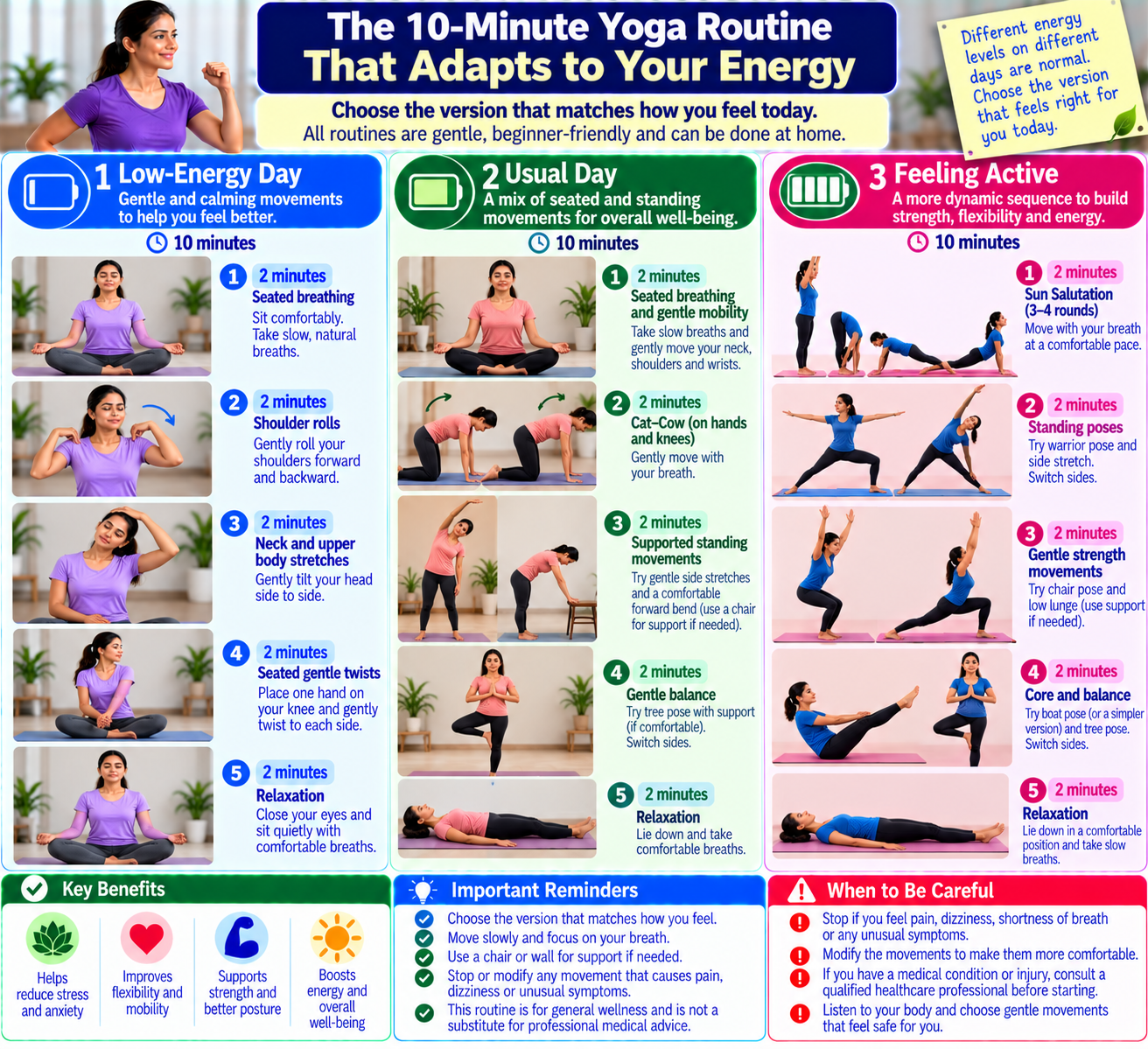
You do not need to perform all the poses you see in a yoga class. Begin with movements you can do comfortably and build gradually as your confidence improves. The following routine is an example for generally healthy beginners, not a personalized rehabilitation plan.
| Time | Activity | Main purpose |
|---|---|---|
| 1 minute | Stand or sit comfortably and notice your breathing. | Settle into the session. |
| 2 minutes | Gentle shoulder rolls and comfortable neck movements | Explore upper-body movement. |
| 2 minutes | Seated cat-cow or gentle spinal movement | Practise controlled mobility. |
| 2 minutes | Supported standing pose or comfortable seated side stretch | Explore posture and movement. |
| 2 minutes | Gentle seated or standing leg movement | Add light activity. |
| 1 minute | Sit quietly and notice how you feel | Finish without rushing. |
Total: about 10 minutes.
You can shorten the routine or use a chair for every movement. If a pose causes pain, dizziness, tingling, or unusual breathlessness, stop and reassess rather than trying to complete the timetable.
There is no universal ideal duration for everyone. Begin with a session you can tolerate comfortably, then increase the time only if it suits your health, energy, and schedule.
A More Useful Way to Measure Your Yoga Progress
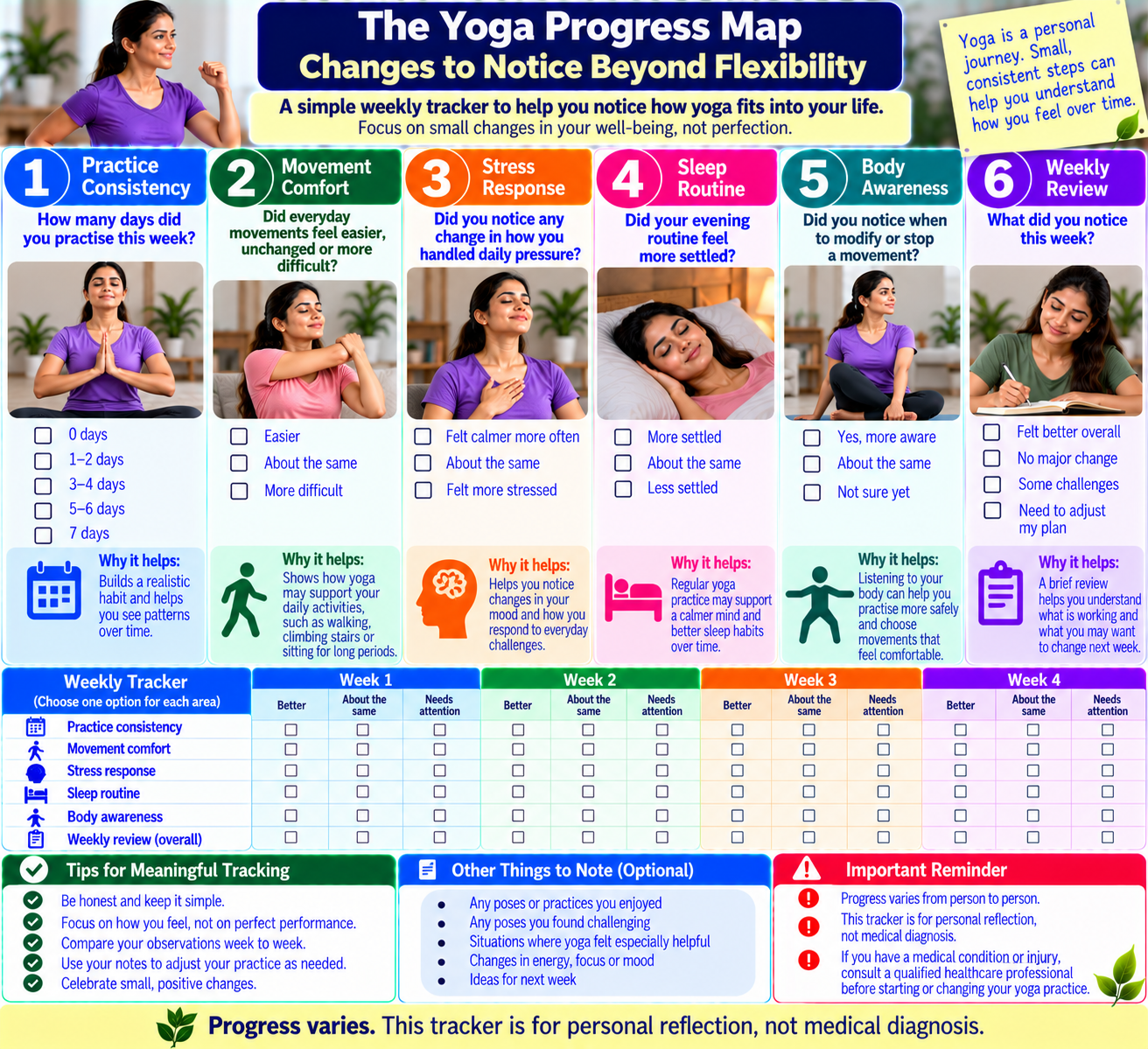
Many beginners judge success by flexibility alone. That can be misleading because flexibility is only one possible outcome, and changes may be gradual. A simple weekly log can help you notice patterns without turning yoga into another source of pressure.
| What to track | A simple question |
|---|---|
| Consistency | How many days did I practice? |
| Comfort | Were the movements comfortable, or did I need to modify them? |
| Movement | Did any everyday movement feel easier? |
| Stress | Did I notice any change in how I handled daily pressure? |
| Sleep | Did my evening routine feel more settled? |
| Energy | Did I feel more comfortable, tired, or unchanged afterward? |
Record observations once a week rather than checking repeatedly throughout the day. If a benefit does not appear, that does not mean you have failed. Your routine may need adjusting, or another form of activity or support may be more suitable.
Avoid treating this log as a medical test. It cannot diagnose a condition or prove that yoga caused a particular change.
Common Yoga Mistakes Beginners Should Avoid
1. Trying advanced poses too early
Headstands, shoulder stands, deep backbends, and extreme joint positions are not necessary for a useful beginner routine. Learn basic movements first and seek qualified instruction before attempting complex poses.
2. Treating pain as proof of progress
Stretching may feel unfamiliar, but sharp pain is not a target. Reduce the range, change the pose, or stop if discomfort occurs.
3. Holding your breath
Beginners sometimes concentrate so hard on a pose that they stop breathing normally. Use a comfortable breathing pattern and avoid forceful breathing practices unless appropriately trained.
4. Comparing your body with online instructors
Videos often show experienced practitioners and advanced variations. Choose the version that suits your mobility and strength, even if it looks less impressive.
5. Expecting immediate medical benefits
One session may feel relaxing, but lasting changes in flexibility, balance, sleep, or stress are not guaranteed. Do not use yoga as a reason to delay assessment or treatment.
6. Ignoring individual health needs
Pregnancy, recent surgery, joint injuries, glaucoma, severe high blood pressure, balance problems, and some spine conditions may require modifications or medical advice. The NCCIH yoga safety guidance explains that injuries can occur and recommends appropriate instruction and individual precautions.
7. Assuming every yoga style is gentle
Some forms of yoga are physically demanding, and hot yoga introduces additional concerns related to heat and dehydration. Beginners should select a class based on their ability, not just its popularity.
Who Should Take Extra Care With Yoga?
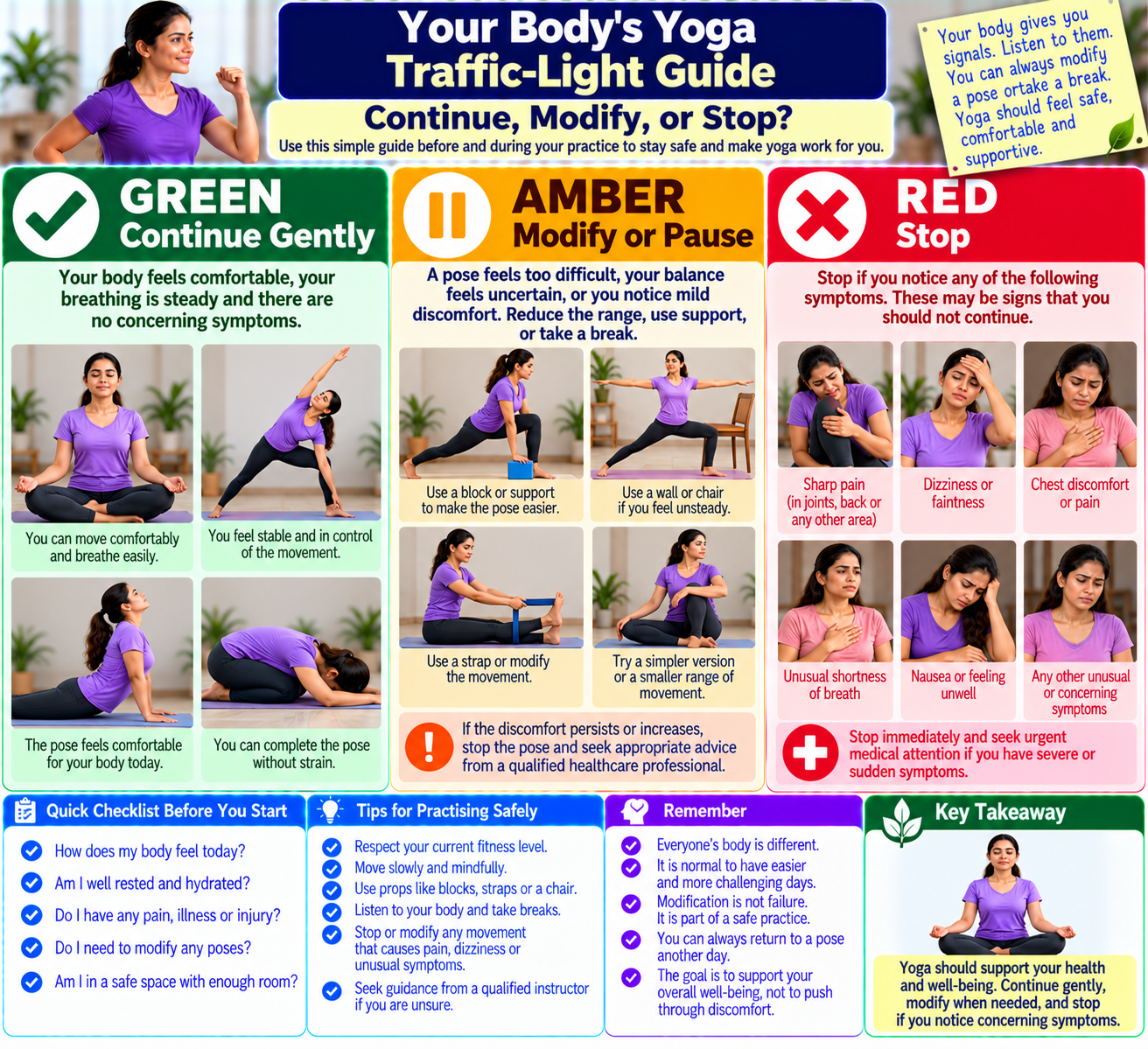
Yoga is generally considered safe for healthy people when practiced appropriately, but it is not risk-free. Sprains, strains, and other injuries can occur, especially when poses are forced or performed without suitable guidance.
Speak with a healthcare professional or qualified instructor about adaptations if you:
-
Are pregnant or have recently given birth.
-
Have a recent injury or surgery.
-
Have significant joint, neck, back, or spine problems.
-
Have severe high blood pressure, glaucoma, or a condition affecting balance.
-
Experience dizziness, fainting, or unexplained pain during movement.
-
Have a medical condition that limits exercise.
Avoid forceful breathing, extreme stretches, or advanced inversions if you are inexperienced. Stop if you develop sharp pain, chest discomfort, dizziness, or unusual shortness of breath. Seek urgent medical attention for severe or sudden symptoms.
The safest routine is one that respects your current abilities and can be adapted as your needs change.
Author Note
This article is intended to help beginners understand the potential benefits and limitations of regular yoga using accessible, evidence-informed guidance. The suggested routine is a general example, not an individual assessment or treatment plan.
Personal experience: If you have personally found that a short yoga session helps you feel more comfortable or less stressed, you can add a brief first-person example here describing what you practiced, how often you did it, and what you actually noticed. Do not publish an invented personal story or claim that your experience proves a medical benefit.
Conclusion: Make Daily Yoga Practical, Not Perfect
The most useful daily yoga benefits may be the ones that fit naturally into your life. Regular practice can offer opportunities to explore flexibility, practice balance, manage everyday stress, develop body awareness, and establish a calming routine. Research is encouraging for some outcomes, including sleep quality and selected measures of mental and physical well-being, but the strength of evidence varies.
Start with a few comfortable movements and a short session. Use a chair or wall when needed, breathe naturally, and choose consistency over difficult poses. Notice how you feel over several weeks rather than expecting an immediate transformation.
Yoga can be one part of a healthy lifestyle alongside regular physical activity, balanced nutrition, adequate sleep, and appropriate healthcare. You do not have to be flexible, young, or experienced to begin; you simply need a version of the practice that is safe and suitable for you.
Frequently Asked Questions About Daily Yoga Benefits
1. What are the main benefits of daily yoga?
Yoga may support flexibility, balance, stress management, sleep quality, body awareness, and general well-being. The benefits vary by individual and by the type of yoga practiced. Evidence is stronger for some outcomes than others.
2. Is 10 minutes of yoga a day enough for beginners?
Ten minutes can be a realistic starting point for learning movements and establishing a habit. It may not provide all the physical activity needed for overall health, so combine yoga with other appropriate activities as your abilities allow.
3. Is morning or evening yoga better?
Neither time is best for everyone. Morning yoga may help you establish a movement routine, while gentle evening yoga may help you wind down. Choose the time you can maintain comfortably.
4. Can yoga reduce stress and anxiety?
Research suggests yoga may improve measures of stress and anxiety for some people, but certainty is limited. It can complement appropriate mental health care; it should not replace professional treatment when symptoms are persistent or severe.
5. Can yoga improve sleep quality?
Some evidence suggests yoga may support sleep quality. A gentle routine may be useful as part of healthy sleep habits, but persistent insomnia or symptoms of a sleep disorder need appropriate assessment.
6. Can beginners do yoga at home?
Many beginners can start with simple movements at home, provided they choose suitable exercises and use reliable instruction. A qualified instructor can help with technique, modifications, and safety, particularly if you have health concerns.
7. Does yoga help with weight loss?
Yoga uses energy, and some styles challenge muscular strength, but the amount varies widely. Yoga alone does not guarantee weight loss. Weight management depends on several factors, including food intake, overall activity, sleep, health conditions, and medications.
8. Can yoga replace walking or strength training?
Not necessarily. Some yoga styles provide meaningful physical activity, but others are mainly restorative. Many people benefit from combining yoga with aerobic activity and suitable strength exercises to address different aspects of fitness.
9. Should I practice yoga if I have back or knee pain?
It depends on the cause and severity of your symptoms. Some people with chronic low-back pain may benefit from appropriately adapted yoga, but painful or unsuitable poses can aggravate symptoms. Ask a qualified healthcare professional about safe modifications.
10. When should I stop a yoga session?
Stop if you experience sharp or increasing pain, dizziness, faintness, chest discomfort, or unusual shortness of breath. Severe or sudden symptoms require urgent medical assessment. Never force your body to complete a pose.
Medical Disclaimer
This article is for general educational purposes only and does not provide medical diagnosis or treatment. Research findings describe potential effects across groups and cannot predict the outcome for every individual. Consult a qualified healthcare professional about persistent symptoms, existing medical conditions, or questions about whether yoga is suitable for you.
Fitness Disclaimer
The routine and movements described here are general examples, not personalized exercise instructions. Your mobility, balance, strength, pregnancy status, injuries, and medical history may affect which poses are appropriate. Move within a comfortable range, use stable support when needed, and stop if you experience pain or concerning symptoms.
Evidence-Based Sources and Further Reading
-
U.S. Department of Veterans Affairs — Evidence Map of Yoga for Various Adult Physical and Mental Health Issues: Update from 2014–2025 (June 2026). A review of 37 systematic reviews that explains where evidence is moderate and where uncertainty remains. Read the evidence map.
-
National Center for Complementary and Integrative Health (NCCIH) — Yoga: Effectiveness and Safety. An overview of research on yoga, pain, mental well-being, and precautions. Read the NCCIH guidance.
-
Mu and colleagues — The Effects of Yoga Exercise on Stress Relief Capacity and Emotional Changes: A Systematic Review and Meta-Analysis (2026). A review of 30 controlled studies involving 2,288 participants, with low-certainty evidence for improvements in stress, anxiety, and depression measures. Read the full research article.
-
Guo and colleagues—Effects of Yoga on Lower-Extremity Muscle Strength, Balance, and Quality of Life Across Diverse Older Adult Populations (2026). A systematic review and meta-analysis that discusses potential benefits and the limitations of balance and strength findings. Read the study on PubMed.
-
Centers for Disease Control and Prevention (CDC) — About Sleep. Practical guidance on sleep health and habits that may complement a relaxing evening routine. Read CDC sleep guidance.
-
World Health Organization (WHO)—Yoga for Healthy Ageing: Global Practice and Clinical Evidence (June 26, 2026). A public health overview discussing yoga and healthy aging. Read the WHO article.
Evidence note: The linked sources support the claims they are cited alongside, but the quality and certainty of yoga research vary by outcome. A research citation does not mean that every benefit is guaranteed or that yoga replaces standard medical care.
Also read
- 12 Dynamic Yoga Poses For Rapid Weight Loss
- 6 Home Exercises for Overall Fitness and Flexibility: A Comprehensive Guide
- 4 Holistic Approaches to Managing Chronic Pain: A Comprehensive Guide
- Body, Mind, and Soul: A Holistic Approach to Health in the USA
- 8 Effective Habits to Boost Mental Clarity and Focus











[…] 9 Daily Yoga Benefits for Mental and Physical Wellness (Science-Backed Guide) […]
[…] 9 Daily Yoga Benefits for Mental and Physical Wellness (Science-Backed Guide) […]
[…] 9 Daily Yoga Benefits for Mental and Physical Wellness (Science-Backed Guide) […]
[…] 9 Daily Yoga Benefits for Mental and Physical Wellness (Science-Backed Guide) […]
[…] 9 Daily Yoga Benefits for Mental and Physical Wellness (Science-Backed Guide) […]
[…] 9 Daily Yoga Benefits for Mental and Physical Wellness (Science-Backed Guide) […]
[…] 9 Daily Yoga Benefits for Mental and Physical Wellness (Science-Backed Guide) […]
[…] 9 Daily Yoga Benefits for Mental and Physical Wellness (Science-Backed Guide) […]
[…] 9 Daily Yoga Benefits for Mental and Physical Wellness (Science-Backed Guide) […]
[…] 9 Daily Yoga Benefits for Mental and Physical Wellness (Science-Backed Guide) […]
[…] 9 Daily Yoga Benefits for Mental and Physical Wellness (Science-Backed Guide) […]
[…] 9 Daily Yoga Benefits for Mental and Physical Wellness (Science-Backed Guide) […]
[…] 9 Daily Yoga Benefits for Mental and Physical Wellness (Science-Backed Guide) […]
[…] 9 Daily Yoga Benefits for Mental and Physical Wellness (Science-Backed Guide) […]
[…] 9 Daily Yoga Benefits for Mental and Physical Wellness (Science-Backed Guide) […]
[…] 9 Daily Yoga Benefits for Mental and Physical Wellness (Science-Backed Guide) […]
[…] 9 Daily Yoga Benefits for Mental and Physical Wellness (Science-Backed Guide) […]
[…] 9 Daily Yoga Benefits for Mental and Physical Wellness (Science-Backed Guide) […]
[…] 9 Daily Yoga Benefits for Mental and Physical Wellness (Science-Backed Guide) […]
[…] 9 Daily Yoga Benefits for Mental and Physical Wellness (Science-Backed Guide) […]
[…] 9 Daily Yoga Benefits for Mental and Physical Wellness (Science-Backed Guide) […]
[…] 9 Daily Yoga Benefits for Mental and Physical Wellness (Science-Backed Guide) […]
[…] 9 Daily Yoga Benefits for Mental and Physical Wellness (Science-Backed Guide) […]
[…] 9 Daily Yoga Benefits for Mental and Physical Wellness (Science-Backed Guide) […]
[…] 9 Daily Yoga Benefits for Mental and Physical Wellness (Science-Backed Guide) […]
[…] 9 Daily Yoga Benefits for Mental and Physical Wellness (Science-Backed Guide) […]
[…] 9 Daily Yoga Benefits for Mental and Physical Wellness (Science-Backed Guide) […]
[…] 9 Daily Yoga Benefits for Mental and Physical Wellness (Science-Backed Guide) […]
[…] 9 Daily Yoga Benefits for Mental and Physical Wellness (Science-Backed Guide) […]
[…] 9 Daily Yoga Benefits for Mental and Physical Wellness (Science-Backed Guide) […]
[…] 9 Daily Yoga Benefits for Mental and Physical Wellness (Science-Backed Guide) […]
[…] 9 Daily Yoga Benefits for Mental and Physical Wellness (Science-Backed Guide) […]
[…] 9 Daily Yoga Benefits for Mental and Physical Wellness (Science-Backed Guide) […]
[…] 9 Daily Yoga Benefits for Mental and Physical Wellness (Science-Backed Guide) […]
[…] 9 Daily Yoga Benefits for Mental and Physical Wellness (Science-Backed Guide) […]
[…] 9 Daily Yoga Benefits for Mental and Physical Wellness (Science-Backed Guide) […]
[…] 9 Daily Yoga Benefits for Mental and Physical Wellness (Science-Backed Guide) […]