























































































































































Early Warning Signs of Worsening Heart Failure: 10 Symptoms to Watch
Author: RVLNSV PRASAD
Updated On: September 2026
About Us
Author Bio
Editorial Policy
Contact Us
Author Note
I’m RVLNSV PRASAD, the author of this article for HealthTipsToYou. I write health-focused educational content with an emphasis on practical information that readers can understand and use responsibly.
For this article, I reviewed information from recognized medical organizations, including the American Heart Association (AHA), National Heart, Lung, and Blood Institute (NHLBI), and Mayo Clinic. The goal is not to help readers diagnose themselves from a symptom checklist. Instead, this guide explains how changes in symptoms may be recognized, tracked, and discussed with a healthcare professional. American Heart Association: Heart Failure Signs and Symptoms NHLBI: Heart Failure Symptoms
My editorial perspective is simple: health information is most useful when it helps a person understand what has changed from their usual condition and what action may be appropriate. A symptom by itself does not necessarily identify its cause.
This article is educational and does not replace individualized medical advice.
Introduction
Heart failure does not mean that the heart has stopped working. It means the heart is not pumping or filling well enough to meet the body’s needs. Symptoms can develop gradually, and they can also change over time. American Heart Association: Heart Failure Explained
That creates an important problem: worsening heart failure is not always dramatic at first.
A person may simply notice that walking across a room feels harder than it did a few weeks ago. Shoes may become tighter because of increasing swelling. Someone who normally sleeps with one pillow may start using two or three. A scale may show an unexpected upward trend before obvious swelling appears.
These changes do not automatically mean that heart failure is worsening. Many other health conditions can cause similar symptoms. However, a new or changing pattern deserves attention, particularly in someone who already has heart failure.
The American Heart Association recommends paying attention to subtle changes, tracking symptoms, and reporting new or suddenly worsening symptoms to the healthcare team. American Heart Association: Managing Heart Failure Symptoms
This guide explains the early warning signs of worsening heart failure, what changes may be worth tracking, when to contact a healthcare professional, and which symptoms require urgent medical attention.
Quick Answer: What Are the Early Warning Signs of Worsening Heart Failure?
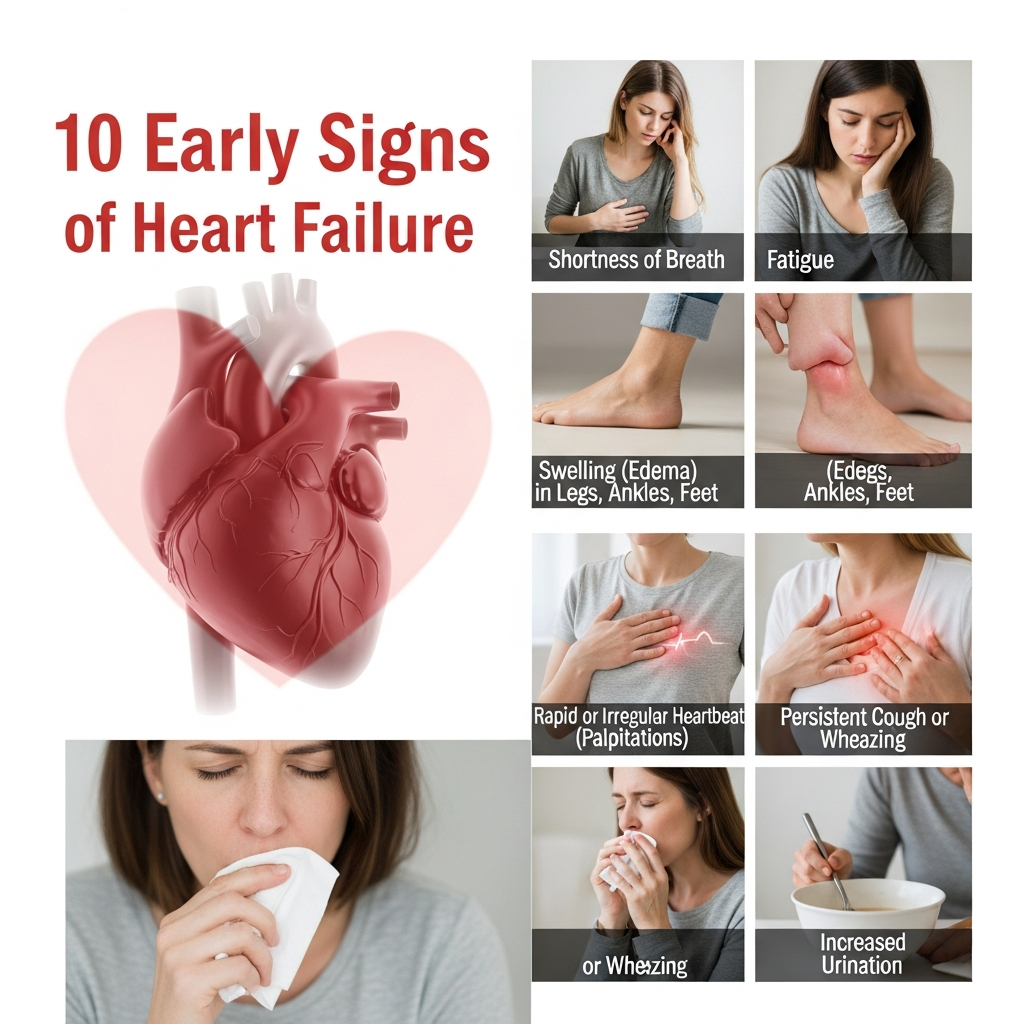
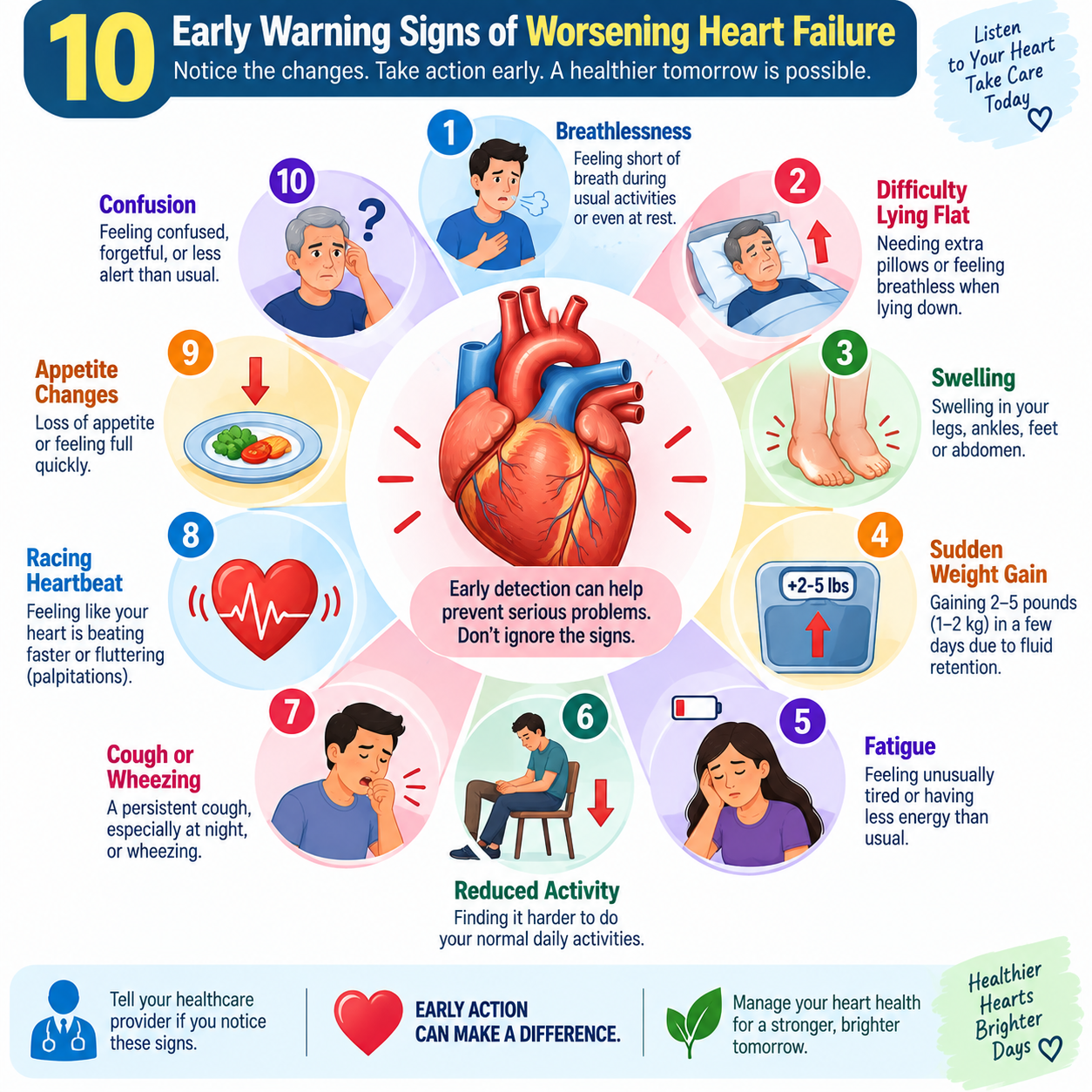
Possible warning signs include:
- Increasing shortness of breath
- Difficulty breathing when lying flat
- Waking suddenly at night feeling short of breath
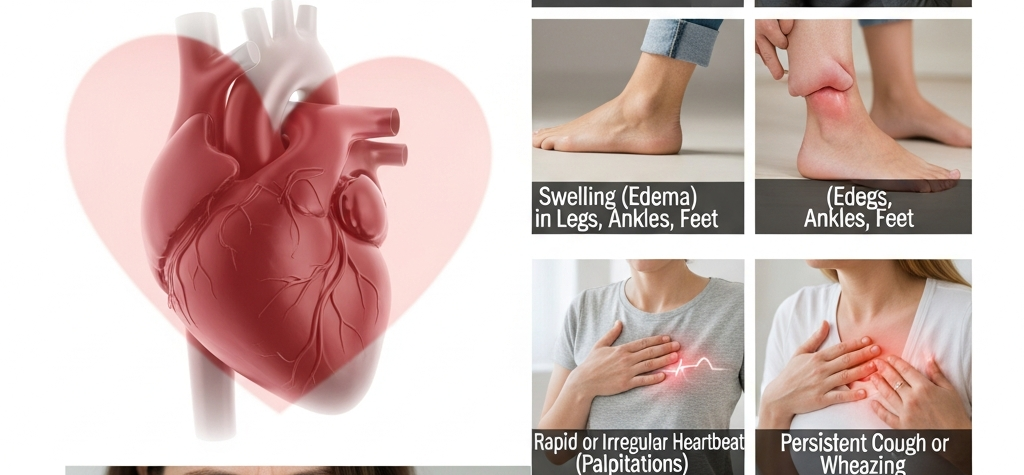
- Increasing swelling in the feet, ankles, legs, or abdomen
- Sudden or unexplained weight gain
- Unusual fatigue or weakness
- Reduced ability to perform normal activities
- Persistent cough or wheezing
- Racing, pounding, or irregular heartbeat
- Reduced appetite, nausea, or abdominal fullness
- New confusion or difficulty concentrating
Not everyone develops all of these symptoms. Some people have only a few, while others may experience changes that are more subtle. The AHA and NHLBI both emphasize that symptoms vary according to the person and the severity and type of heart failure. AHA: Heart Failure Signs and Symptoms NHLBI: Heart Failure Symptoms
Key Takeaways
- A change from your normal baseline can be important.
- Increasing breathlessness may be a sign that symptoms are worsening.
- New or increasing swelling can occur when fluid builds up.
- Sudden weight gain may reflect fluid retention rather than body-fat gain.
- Needing more pillows or waking breathless can be important changes to report.
- Fatigue that interferes with ordinary activities deserves attention.
- Several smaller changes occurring together may provide more useful information than one isolated symptom.
- Symptoms alone cannot diagnose heart failure.
- New or rapidly worsening symptoms should be discussed promptly with a healthcare professional.
- Severe breathlessness, chest pain, fainting, or other emergency symptoms require urgent medical help.
10 Early Warning Signs of Worsening Heart Failure
1. Increasing Shortness of Breath
Shortness of breath is one of the most recognizable symptoms associated with heart failure.
The important issue is not simply whether you sometimes become breathless. A change from your usual breathing pattern can be more meaningful.
For example, you might previously have been able to:
- Walk around your home without stopping;
- Climb one flight of stairs comfortably;
- Shop for groceries without needing frequent breaks.
If those activities suddenly leave you unusually breathless, it is worth paying attention.
Heart failure can cause blood to back up toward the lungs, contributing to fluid accumulation and breathing difficulty. Breathlessness can occur during activity and, in more serious situations, while resting. AHA: Heart Failure Signs and Symptoms
However, shortness of breath has many possible causes. Asthma, respiratory infections, anemia, lung disease, anxiety, poor fitness, and other cardiovascular problems can also cause it.
The practical point: don’t assume a new breathing problem is simply aging or being out of shape.
If your breathing is becoming noticeably worse, contact your healthcare professional for appropriate evaluation.
2. Difficulty Breathing When Lying Down
Some people with worsening heart failure notice that breathing becomes more difficult when they lie flat.
You might notice that:
- You need more pillows than usual
- Lying completely flat makes breathing uncomfortable;
- You sleep sitting more upright
- You wake during the night feeling short of breath.
This pattern can occur because changes in body position influence the movement of fluid within the body. In heart failure, fluid congestion can contribute to breathing difficulties when lying down. AHA: Managing Heart Failure Symptoms
A sudden change in sleeping position can therefore be worth mentioning to your healthcare team.
It does not, however, prove that heart failure is worsening. Reflux, lung disease, sleep apnea, obesity, and other conditions can also affect nighttime breathing.
3. Increasing Swelling in the Feet, Ankles, Legs, or Abdomen
Swelling, medically known as edema, can occur when excess fluid collects in body tissues.
You might notice:
- ankles looking larger than usual;
- sock marks becoming deeper;
- shoes feeling tighter;
- swelling moving higher up the legs;
- abdominal fullness or swelling.
The AHA identifies increased swelling in the feet, ankles, legs and other tissues as a symptom that people with heart failure may need to monitor. AHA: Physical Changes to Report for Heart Failure
Fluid accumulation can occur because the heart is not moving blood effectively enough, contributing to pressure changes and fluid movement into tissues. AHA: Heart Failure Signs and Symptoms
But swelling is not unique to heart failure.
Kidney problems, liver disease, venous circulation problems, certain medications, and prolonged sitting can also cause edema.
What matters is the pattern. If swelling is new, increasing, or accompanied by breathlessness or rapid weight gain, it should be discussed with a healthcare professional.
4. Sudden or Unexplained Weight Gain
A rapidly changing number on the scale can sometimes provide an earlier clue than visible swelling.
Why?
Because an increase in body weight over a short period can reflect fluid accumulation rather than an increase in body fat.
The AHA notes that many people with heart failure may first notice worsening symptoms after gaining more than two or three pounds in a day or more than five pounds in a week, although the appropriate threshold should be individualized with the person’s healthcare team. American Heart Association: Managing Heart Failure Symptoms
For people who have been advised to monitor weight, consistency matters.
A practical routine may involve:
- weighing at the same time each day;
- using the same scale;
- wearing similar clothing;
- recording the result;
- watching the trend rather than obsessing over one measurement.
The AHA recommends daily weight monitoring for many people with heart failure and suggests weighing in the morning before breakfast and after urinating, using the same scale and similar conditions. AHA: Physical Changes to Report for Heart Failure
Do not use a particular number as a self-diagnosis.
Instead, ask your healthcare professional:
“What amount of weight change should I report for my condition?”
5. Unusual Fatigue or Weakness
Everyone gets tired.
The more useful question is
Has your normal level of energy changed?
Someone with worsening heart failure may notice that ordinary tasks require considerably more effort.
For example:
- Grocery shopping becomes exhausting;
- Climbing stairs requires several pauses;
- Showering leaves you unusually tired;
- Walking around the house feels difficult;
- You need more rest during routine activities.
NHLBI notes that fatigue, weakness, and increasing difficulty with ordinary activities can occur with heart failure, particularly as the condition becomes more severe. NHLBI: Heart Failure Symptoms
Fatigue is also one of the least specific symptoms in medicine. Sleep problems, anemia, infections, thyroid disorders, medication effects, and many other conditions can cause it.
Therefore, the change in your usual ability to function can be more informative than simply saying, “I feel tired.”
6. Reduced Ability to Perform Normal Activities
This symptom deserves its own discussion because people sometimes overlook it.
Heart failure does not necessarily announce itself with a dramatic event.
Instead, your everyday routine may slowly become harder.
Consider this example:
| Your usual routine | Recent change |
|---|---|
| Walking for 20 minutes | Now stopping after 5–10 minutes |
| Climbing one flight of stairs | Now needing several breaks |
| Carrying groceries | Becoming unusually tiring |
| Doing household chores | Needing frequent periods of rest |
| Walking across the house | Becoming unexpectedly breathless |
This does not mean the person definitely has worsening heart failure.
Fitness can decline for many reasons.
But a persistent reduction in exercise tolerance or everyday function is worth discussing, particularly when it occurs together with swelling, weight gain, or increasing breathlessness.
NHLBI notes that shortness of breath can progress from occurring during harder activities to appearing during relatively ordinary activities as heart failure becomes more severe. NHLBI: Heart Failure Symptoms
7. Persistent Cough or Wheezing
A cough that does not go away can sometimes occur with heart failure, particularly when fluid accumulates in the lungs.
Some people may experience:
- persistent coughing;
- nighttime coughing;
- wheezing;
- coughing together with increasing breathlessness.
The AHA lists persistent coughing or wheezing among heart failure symptoms and explains that fluid accumulation in the lungs can contribute to these symptoms. AHA: Heart Failure Signs and Symptoms
But this symptom requires context.
A cough may result from:
- asthma;
- allergies;
- infection;
- smoking;
- chronic lung disease;
- reflux;
- medication side effects;
- other conditions.
A new or worsening cough should therefore not automatically be labeled a heart failure symptom.
If it occurs alongside increasing breathlessness, swelling, or rapid weight gain, tell your healthcare professional
8. Racing, Pounding, or Irregular Heartbeat
Some people with heart failure notice that their heart feels as though it is:
- racing;
- pounding;
- fluttering;
- beating irregularly.
The AHA lists increased heart rate and palpitations among possible heart failure symptoms. AHA: Heart Failure Signs and Symptoms
A faster heart rate can occur as the body tries to compensate when the heart is not pumping effectively. Heart rhythm disorders can also occur alongside heart failure or contribute to it.
But palpitations have many possible causes.
They can occur with:
- caffeine;
- stress;
- anxiety;
- certain medications;
- dehydration;
- thyroid disorders;
- abnormal heart rhythms.
That is why palpitations alone should not be used to diagnose worsening heart failure.
Palpitations combined with severe breathlessness, chest pain, fainting, or severe weakness are much more concerning and may require emergency evaluation. Mayo Clinic: Heart Failure Symptoms and Causes
9. Reduced Appetite, Nausea, or Abdominal Fullness
Digestive symptoms can be easy to overlook.
Some people with heart failure may experience:
- reduced appetite;
- nausea;
- feeling full after eating only a small amount;
- abdominal discomfort or swelling.
The AHA and NHLBI include appetite changes, nausea, and abdominal symptoms among possible heart failure-related symptoms. AHA: Heart Failure Signs and Symptoms NHLBI: Heart Failure Symptoms
These symptoms can have many other causes, so context is important.
For example, abdominal fullness together with increasing leg swelling and rapid weight gain may provide a different clinical picture from occasional nausea after a meal.
The goal is not to diagnose yourself from a combination of symptoms.
Instead, recognize when several changes are appearing at the same time and communicate them to your healthcare team.
10. New Confusion or Difficulty Concentrating
Changes in thinking can sometimes be overlooked because they may appear less obviously connected to the heart.
Possible changes include:
- difficulty concentrating;
- unusual forgetfulness;
- confusion;
- reduced alertness;
- difficulty following normal routines.
The AHA notes that confusion or impaired thinking can occur with heart failure and that family members may notice these changes before the person experiencing them does. AHA: Heart Failure Signs and Symptoms
This is particularly important for caregivers.
A family member might notice:
“You don’t seem like yourself today.”
Sudden confusion, however, should never automatically be blamed on heart failure. Infections, medication effects, metabolic problems, strokes, and many other conditions can cause confusion.
New or sudden confusion deserves prompt medical assessment.
Why Small Changes From Your Normal Baseline Matter
One of the most useful ideas in managing heart failure is understanding your personal baseline.
Your baseline is what is normal for you.
It might include:
- your usual morning weight;
- how far you normally walk;
- how many pillows you use;
- your usual amount of ankle swelling;
- your typical energy level;
- your normal appetite;
- your usual heart rate.
The AHA specifically recommends paying attention to subtle changes because gradual worsening can be difficult to notice when a person becomes accustomed to feeling slightly different. AHA: Managing Heart Failure Symptoms
A practical example
| Usual baseline | New change | Why it deserves attention |
|---|---|---|
| Walks around the neighborhood comfortably | Needs several breaks | Reduced activity tolerance |
| Uses one pillow | Now needs three | New positional breathing difficulty |
| Ankles normally not swollen | Socks leave deep marks. | Possible increased edema |
| Weight remains stable. | Rapid upward trend | Possible fluid retention |
| Normal appetite | Feels full quickly | Possible digestive/congestion change |
The “Pattern, Not Panic” Approach
I recommend thinking about symptom changes in four simple steps:
1. Pattern
What is normal for you?
2. Change
What is different now?
3. Combination
Are several changes occurring together?
4. Action
What does your healthcare plan say you should do?
This is an educational framework created for this article, not a medical scoring system.
Its purpose is to prevent two common mistakes:
Ignoring meaningful changes and panicking over every isolated symptom.
A person with diagnosed heart failure should ideally have an individualized plan from their healthcare team explaining which changes require a phone call and which require emergency care.
Everyday Changes Worth Tracking
| What to track | What a concerning change may look like | Practical action |
|---|---|---|
| Weight | Unexpected rapid increase | Follow your clinician’s reporting threshold. |
| Breathing | More breathless than usual | Contact the healthcare team if worsening. |
| Swelling | Increasing ankle, leg, or abdominal swelling | Report new or increasing swelling. |
| Activity | Ordinary tasks become harder | Record the change and discuss it |
| Sleep | More pillows or waking breathless | Report a new pattern. |
| Cough | New or worsening persistent cough | Discuss with a healthcare professional. |
| Heart rate | New racing or pounding sensation | Follow your care plan. |
| Appetite | New loss of appetite or nausea | Mention persistent changes. |
| Concentration | New confusion or difficulty thinking | Seek prompt medical advice. |
The AHA recommends monitoring symptoms such as weight, blood pressure, heart rate, swelling, breathing changes, and confusion and reporting sudden changes to the healthcare team. AHA: Managing Heart Failure Symptoms
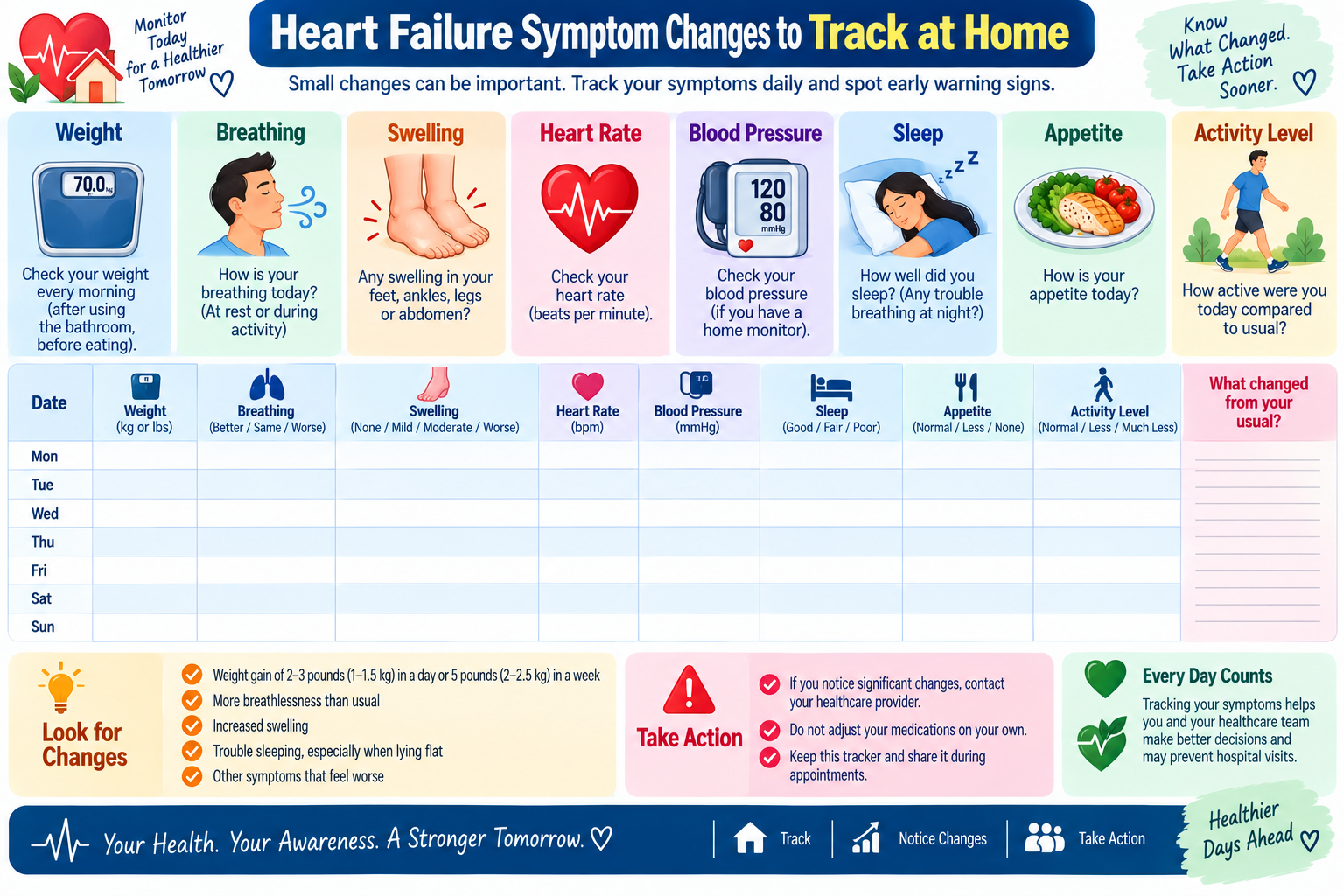
How to Track Heart Failure Symptoms at Home
If you have diagnosed heart failure, ask your healthcare team which measurements they want you to monitor.
Depending on your individual condition, your plan may include:
- daily weight;
- blood pressure;
- heart rate;
- swelling;
- breathing changes;
- appetite;
- sleep;
- activity tolerance;
- medication use;
- oxygen use if prescribed.
A simple notebook or phone record can make trends easier to see.
Keep the record simple.
You could record:
Date: Monday
Weight: ___
Breathing: usual / worse
Swelling: none / mild / increased
Activity: usual / reduced
Sleep: usual / more pillows
Other symptoms: ___
The objective is not to become obsessed with measurements.
It is to create useful information that can help you and your healthcare professional recognize changes.
The AHA recommends working with the healthcare team to determine which symptoms should be tracked and how changes should be reported. AHA: Managing Heart Failure Symptoms
What Should You Tell Your Doctor?
When contacting a healthcare professional about worsening heart failure symptoms, try to describe what changed and when.
Useful information includes:
- when the symptom started;
- whether it is getting worse;
- whether it occurs at rest or during activity;
- recent weight changes;
- new swelling;
- changes in sleep;
- increased cough;
- palpitations;
- appetite changes;
- recent illness;
- medication changes;
- new symptoms.
NHLBI recommends bringing information about symptoms, when they started, how often they occur, and medications to a heart-failure evaluation. NHLBI: Heart Failure Diagnosis
A simple statement such as
“I gained weight quickly, my ankles are more swollen, and I am now getting breathless walking to the bathroom.”
It may be much more useful than simply saying:
“My heart failure feels worse.”
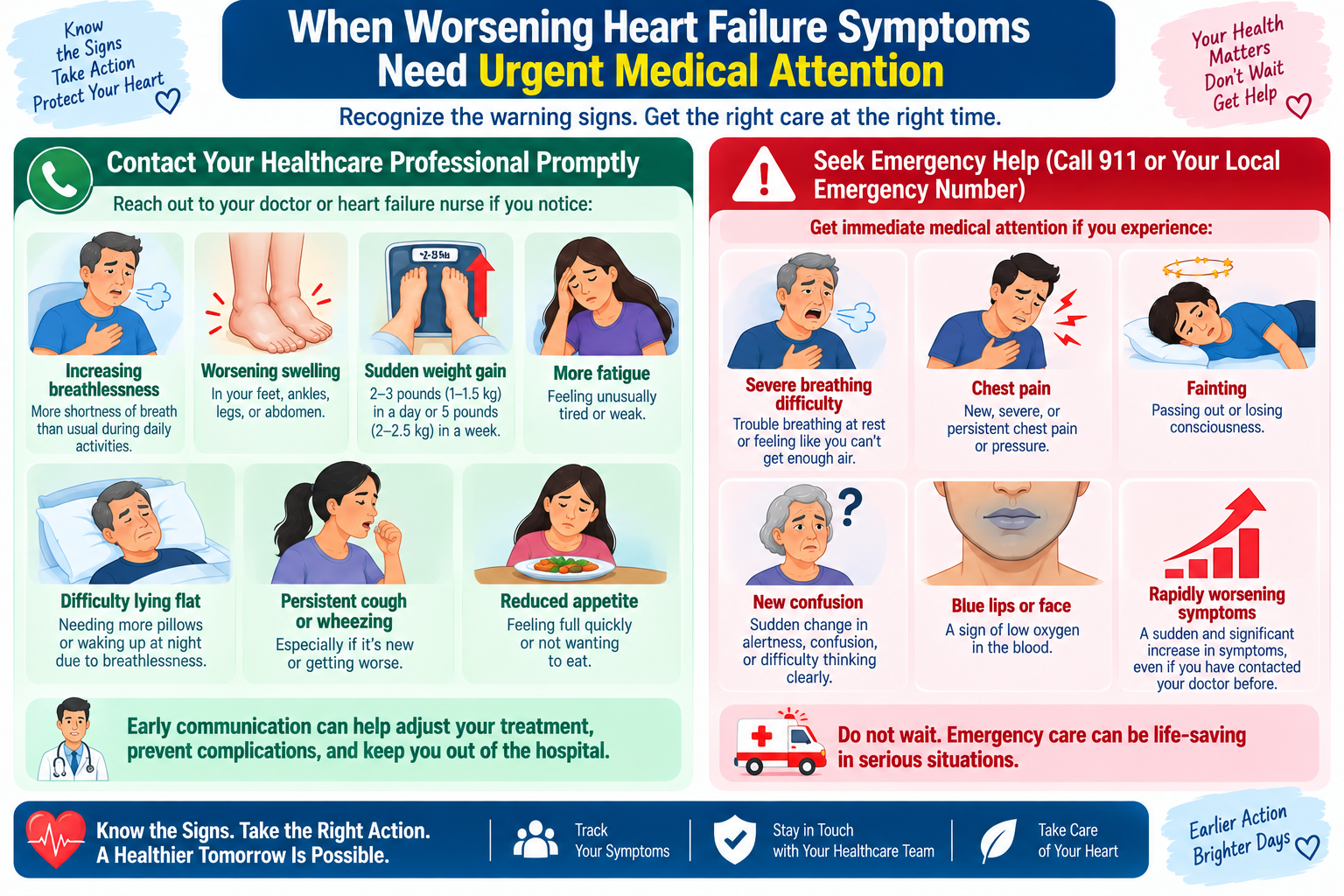
When Worsening Heart Failure Symptoms Need Urgent Medical Attention
Not every symptom requires an emergency department visit.
But some symptoms should never be ignored.
Seek urgent medical help for severe or sudden symptoms such as:
- severe shortness of breath;
- sudden difficulty breathing at rest;
- chest pain;
- fainting;
- severe weakness;
- new severe confusion;
- blue or gray lips or fingers;
- a very rapid or irregular heartbeat accompanied by concerning symptoms;
- coughing up pink or foamy mucus together with severe breathing difficulty.
Mayo Clinic advises emergency medical help for symptoms such as chest pain, fainting or severe weakness, certain rapid or irregular heartbeats accompanied by shortness of breath or chest pain, and sudden severe shortness of breath with pink or foamy mucus. Mayo Clinic: Heart Failure Symptoms and Causes
If you believe you are experiencing a medical emergency, contact your local emergency medical service immediately rather than waiting for an online article to tell you what to do.
Heart Failure Symptoms Can Have Other Causes
One of the most important safety points is that symptoms are not diagnoses.
| Symptom | Other possible explanations |
|---|---|
| Shortness of breath | Lung disease, infection, anemia, deconditioning, and other conditions |
| Leg swelling | Venous problems, kidney disease, medications, and other causes |
| Fatigue | Poor sleep, anemia, infection, thyroid problems, and many others |
| Palpitations | Arrhythmias, caffeine, stress, medications, and other causes |
| Cough | Infection, asthma, allergies, reflux, lung disease, and medications |
| Weight change | Fluid, diet, gastrointestinal problems, and other factors |
| Confusion | Infection, medication effects, metabolic disorders, stroke, and other causes |
This is why reputable medical organizations advise evaluation rather than self-diagnosis when heart-failure symptoms appear. Mayo Clinic specifically notes that there are many possible causes of these symptoms and that testing may be needed to determine the cause. Mayo Clinic: Heart Failure Symptoms and Causes
How Doctors Check Whether Heart Failure Is Getting Worse
Symptoms can raise concern, but they cannot establish the diagnosis by themselves.
A healthcare professional may review:
- medical history;
- symptoms and their timing;
- medications;
- blood pressure;
- heart rate;
- physical examination findings;
- blood tests;
- electrocardiogram (ECG/EKG);
- chest imaging;
- echocardiography;
- other heart tests when appropriate.
NHLBI explains that heart failure diagnosis is based on medical history, physical examination, and test results. Blood tests may measure substances such as BNP, while echocardiography can help assess ejection fraction. NHLBI: Heart Failure Diagnosis
The American Heart Association similarly lists physical examination, blood tests, chest X-rays, EKGs, echocardiograms, and other testing among possible diagnostic tools. AHA: Diagnosing Heart Failure
That distinction matters.
A symptom can tell you that something may be wrong. Testing helps determine what is actually happening.
What Can Help Manage Heart Failure Over Time?
Heart failure treatment depends on its type, severity, underlying cause, and the person’s overall health.
A treatment plan may include:
- prescribed medicines;
- monitoring symptoms;
- appropriate physical activity;
- dietary changes;
- sodium management when advised;
- management of other medical conditions;
- sleep-related care;
- devices or procedures in selected patients;
- regular follow-up.
NHLBI explains that treatment may include medicines, lifestyle changes, devices, or procedures depending on the type and severity of heart failure. NHLBI: Heart Failure Treatment
Do not start, stop, or change prescription medicines because of something you read online.
For example, if you think you are retaining fluid, do not independently change the dose of a diuretic unless your healthcare professional has already given you a specific action plan.
Questions to Ask at Your Next Heart-Failure Appointment
If you have heart failure, consider asking:
- Which symptoms should I monitor every day?
- What amount of weight gain should I report?
- What changes in swelling are concerning for me?
- What should I do if my breathing becomes worse?
- When should I call your office?
- Which symptoms require emergency care?
- Should I monitor my blood pressure?
- Should I monitor my heart rate?
- What activity level is appropriate for me?
- Are there medicines or over-the-counter products I should avoid?
- Should I follow a specific sodium or fluid plan?
- When should my treatment plan be reassessed?
Having these questions written down can make a medical appointment more productive.
A Practical Perspective: Notice the Change, Not Just the Symptom
One of the most useful lessons in health education is that people often recognize function before they recognize a medical label.
You may not think:
“My cardiac congestion may be increasing.”
You may simply think:
“Why am I suddenly struggling to climb the stairs?”
That observation is valuable.
The same applies to noticing that shoes fit differently, needing additional pillows, taking more breaks, or feeling unusually exhausted after an ordinary activity.
These observations do not diagnose heart failure.
They provide information that can help a healthcare professional decide whether further evaluation is appropriate.
For that reason, I believe practical health information should help readers recognize patterns and changes, rather than encouraging them to match themselves against a frightening checklist.
Frequently Asked Questions
What are the early warning signs of worsening heart failure?
Possible warning signs include increasing shortness of breath, new or worsening swelling, sudden weight gain, increasing fatigue, reduced ability to perform normal activities, nighttime breathing problems, persistent cough, palpitations, appetite changes, and confusion. Symptoms vary between individuals. AHA: Heart Failure Signs and Symptoms
What are the signs that heart failure is getting worse?
A noticeable change from your usual baseline may be important. Examples include rapidly increasing weight, greater swelling, worsening breathlessness, reduced activity tolerance, needing more pillows to sleep, increased fatigue or new confusion. The AHA recommends reporting new or suddenly worsening symptoms to the healthcare team. AHA: Managing Heart Failure Symptoms
Can sudden weight gain be a sign of worsening heart failure?
Yes. Rapid weight gain can sometimes reflect fluid retention. However, the amount of weight gain that should prompt a call varies by individual, so people with heart failure should ask their healthcare team what threshold applies to them. AHA: Managing Heart Failure Symptoms
Is swelling in the ankles always caused by heart failure?
No. Ankle and leg swelling can have many causes, including venous circulation problems, kidney disease, medications, and other conditions. New or increasing swelling should be evaluated in context.
Can heart failure symptoms get worse suddenly?
Yes. Heart failure can develop gradually, but symptoms can also worsen suddenly. Sudden or severe symptoms require prompt medical attention, particularly severe breathing difficulty, chest pain, or fainting. Mayo Clinic: Heart Failure Symptoms and Causes
Does needing more pillows at night mean heart failure is worsening?
It can be a warning sign when it represents a new change from your normal sleeping pattern. However, other conditions can also cause difficulty breathing while lying down. Discuss a new or worsening pattern with your healthcare professional. AHA: Managing Heart Failure Symptoms
When should someone with heart failure call a doctor?
Contact your healthcare professional when you notice a new symptom or an existing symptom suddenly becomes worse. Your healthcare team should also give you an individualized plan explaining which changes require a phone call and which require emergency care. AHA: Physical Changes to Report for Heart Failure
Can shortness of breath have causes other than heart failure?
Yes. Lung disease, respiratory infections, anemia, reduced fitness, and many other conditions can cause breathlessness. Symptoms alone cannot determine the cause.
Is heart failure the same as a heart attack?
No. A heart attack occurs when blood flow to part of the heart muscle is blocked. Heart failure means the heart is not pumping or filling adequately to meet the body’s needs. A heart attack can sometimes cause or contribute to heart failure, but the two conditions are not the same. NHLBI: What Is Heart Failure?
Conclusion
The most useful way to think about early warning signs of worsening heart failure is not as a fixed checklist.
Instead, pay attention to changes from your normal baseline.
Increasing breathlessness, new swelling, sudden weight gain, unusual fatigue, reduced activity tolerance, nighttime breathing problems, persistent cough, palpitations, appetite changes, and confusion can all be important symptoms to discuss with a healthcare professional. AHA: Heart Failure Signs and Symptoms
The key is context.
One symptom does not necessarily mean heart failure is worsening. But several changes appearing together, or a sudden deterioration from your usual condition, should not simply be ignored.
If you have diagnosed heart failure, ask your healthcare team exactly what changes you should monitor and when you should call.
And if you develop severe shortness of breath, chest pain, fainting, or another potentially life-threatening symptom, seek emergency medical care rather than relying on an online symptom guide.
Medical Disclaimer
This article is provided for general educational and informational purposes only. It is not intended to diagnose, treat, cure, or prevent heart failure or any other medical condition.
Symptoms described here can have many different causes. Having one or more symptoms does not mean that you have heart failure or that existing heart failure is necessarily getting worse.
Do not start, stop, or change prescription medicines, fluid restrictions, diuretics, or other treatments based solely on this article.
If you have new, persistent, or worsening symptoms, speak with a qualified healthcare professional. If symptoms are severe or potentially life-threatening, contact your local emergency medical service immediately.
Sources and Further Reading
- American Heart Association — Heart Failure Signs and Symptoms
- American Heart Association — Managing Heart Failure Symptoms
- American Heart Association — Physical Changes to Report for Heart Failure
- American Heart Association — Diagnosing Heart Failure
- National Heart, Lung, and Blood Institute — Heart Failure Symptoms
- National Heart, Lung, and Blood Institute — Heart Failure Diagnosis
- National Heart, Lung, and Blood Institute — Heart Failure Treatment
- Mayo Clinic — Heart Failure: Symptoms and Causes
- Mayo Clinic — Heart Failure: Diagnosis and Treatment
For more details of heart failure click here
Similar Articles
- 7 Simple Health Changes to Reduce The Risk of Chronic Disease
- 7 Ways To Keep Your Heart Healthy
- Home
- Category Holistic Welness









[…] 10 Early Signs Of Heart Failure […]
[…] 10 Early Signs Of Heart Failure […]
[…] 10 Early Signs Of Heart Failure […]