



































































































































































How to Burn 1,000 Calories a Day: What’s Realistic, Safe, and Sustainable?
Author: RVLNSV PRASAD
Updated: September 2026
About Us
Author Bio
Editorial Policy
Contact Us

Quick Summary
How to burn 1,000 calories a day is a popular question among people who want to lose weight, become more active, or increase their daily energy expenditure.
But there is an important fact that many calorie-burning articles overlook.
Burning 1,000 calories is not a universal daily requirement.
Some people can expend that much energy through substantial physical activity. For others, attempting to reach that number every day could be excessive, unnecessary, or difficult to recover from.
Your calorie expenditure depends on factors such as your body size, activity type, intensity, duration, fitness level, and individual circumstances.
Walking, cycling, running, swimming, sports, strength training, and everyday movement can all contribute to physical activity.
The CDC’s adult physical-activity guidelines focus on regular weekly activity rather than telling every adult to burn a specific number of exercise calories each day.
That distinction changes how we should approach the 1,000-calorie question.
Medical Disclaimer
This article is for general educational purposes only and is not a substitute for professional medical advice, diagnosis, or treatment.
Calorie expenditure and exercise needs vary according to age, fitness, health conditions, medications, mobility, and other individual factors.
If you have a medical condition, injury, significant inactivity, mobility limitations, or concerns about exercising safely, consult a qualified healthcare professional before making major changes to your activity routine.
Stop exercising and seek appropriate medical attention if you experience chest pain, fainting, severe or unusual shortness of breath, or other concerning symptoms.
Quick Answer: Can You Burn 1,000 Calories a Day?
Yes, some people can burn or expend 1,000 calories through physical activity in a day.
But that does not mean everyone should attempt to reach exactly 1,000 exercise calories every day.
There is also an important difference between:
1,000 calories used during exercise
and
a 1,000-calorie deficit.
They are not the same thing.
Your body uses energy for basic physiological functions as well as movement and exercise. Your overall energy balance is affected by food intake, physical activity, daily movement, and other individual factors. The National Institute of Diabetes and Digestive and Kidney Diseases explains the many factors that influence body weight and energy balance.
For that reason, a better question is
How can I increase my activity safely and consistently rather than simply chasing a 1,000-calorie number?
Key Takeaways
- Burning 1,000 calories through activity is possible for some people, but it is not a universal requirement.
- Calorie expenditure varies between people.
- Body size, activity type, intensity, duration, terrain, and fitness can all influence energy use.
- Walking can contribute to calorie expenditure, but there is no universal walking duration that guarantees 1,000 calories.
- Running, cycling, swimming, and sports can produce substantial energy expenditure.
- Strength training is important for overall fitness, not simply calorie burning.
- Everyday movement can contribute to total physical activity.
- Fitness trackers provide estimates rather than perfectly measured calorie expenditure.
- You do not need to burn 1,000 exercise calories every day to lose weight.
- Recovery and consistency are essential parts of a sustainable routine.
1. What Does “Burn 1,000 Calories” Actually Mean?
Before choosing an exercise, it helps to understand what people mean when they say “burn 1,000 calories.”
Your body uses energy throughout the day.
Energy is needed for processes such as breathing, circulation, maintaining body temperature, digestion, and movement.
Physical activity is therefore only one part of your total daily energy expenditure.
A simplified picture is:
Resting energy
Digestion
Everyday movement
Exercise
=
Total daily energy expenditure
This is why the phrase “burn 1,000 calories” can be confusing.
One person may be talking about exercise calories.
Another may be talking about total calories used during the entire day.
Someone else may mean creating a 1,000-calorie deficit.
Those are three different ideas.
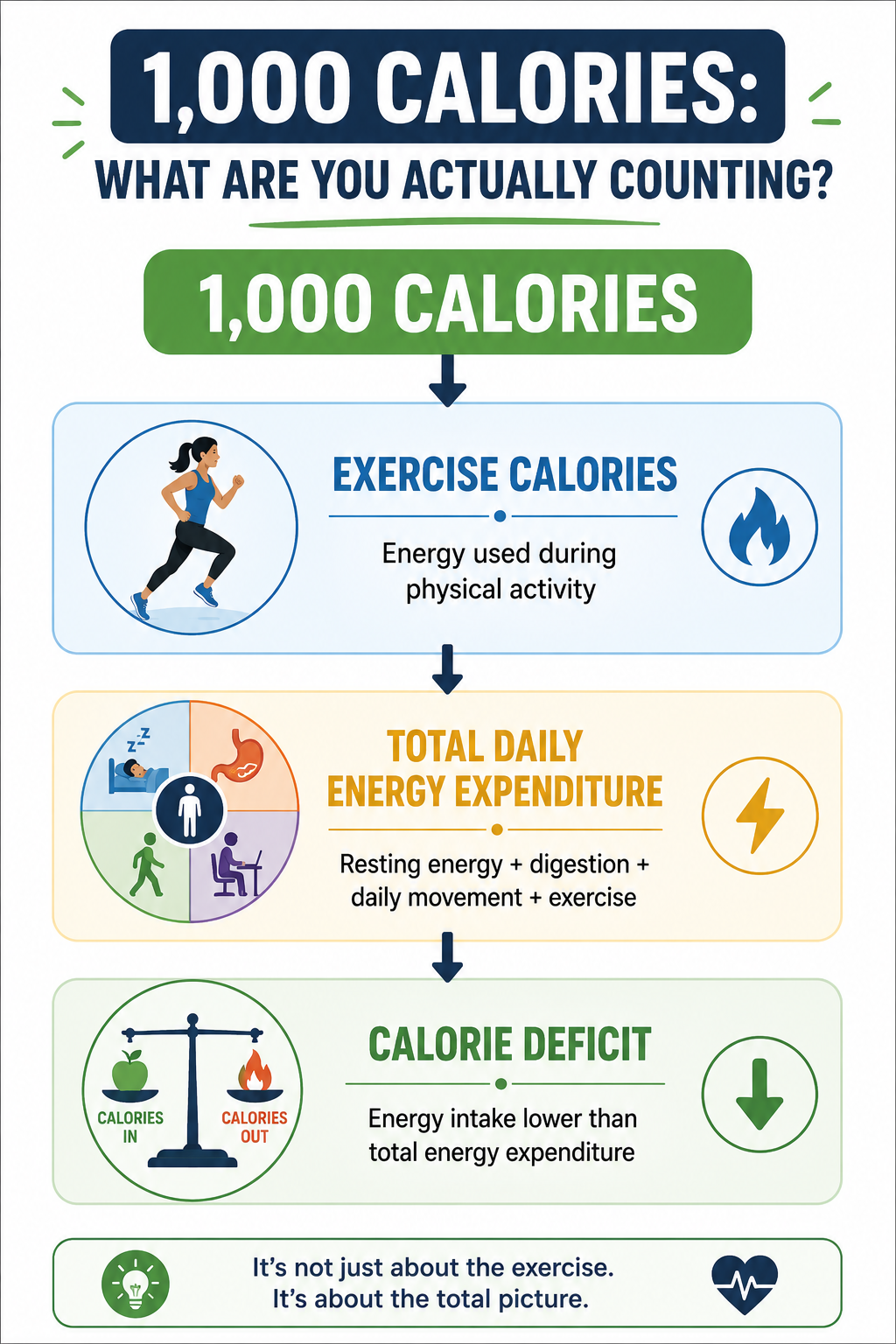
A useful distinction
Exercise calories
Energy used during physical activity.
Total daily energy expenditure
Energy your body uses across the whole day.
Calorie deficit
A situation in which energy intake is lower than energy expenditure over time.
Keeping these concepts separate makes the rest of the discussion much easier to understand.
2. Can You Really Burn 1,000 Calories Through Exercise?
Yes, it is possible for some people.
But possible does not mean necessary.
A highly active person may expend substantial energy through a long workout, endurance training, sports, or a combination of activities.
Someone who is new to exercise may find the same amount of activity extremely demanding.
The WHO recommends 150–300 minutes of moderate aerobic physical activity per week for adults, with additional activity potentially providing additional health benefits.
Notice what these guidelines do not say.
They do not say:
“Every adult must burn 1,000 exercise calories every day.”
That is an important difference.
The better question
Instead of asking:
“How can everyone burn 1,000 calories?”
Ask:
“What level of activity is appropriate for my current fitness and goals?”
That question is much more useful.
3. Why Calorie Burn Is Different for Everyone
One of the biggest weaknesses of online calorie-burn calculators is that they can make exercise look mathematically precise.
Human bodies are not that simple.
Two people can perform the same activity for the same amount of time and still have different energy expenditures.
What affects calorie expenditure?
| Factor | Why it matters |
|---|---|
| Body size | Moving your body requires energy. |
| Duration | Longer activity generally uses more energy. |
| Intensity | Harder activity generally increases energy demand. |
| Activity type | Different movements place different demands on the body. |
| Terrain | Hills and resistance can increase effort |
| Fitness | People respond differently to the same workload. |
| Individual physiology | Energy expenditure varies between people. |
| Movement efficiency | Technique and efficiency can affect energy use. |
That is why a statement such as
“This exercise burns exactly 500 calories.”
should be treated cautiously.
A more accurate statement is
This activity can require substantial energy, but the actual amount varies between people.
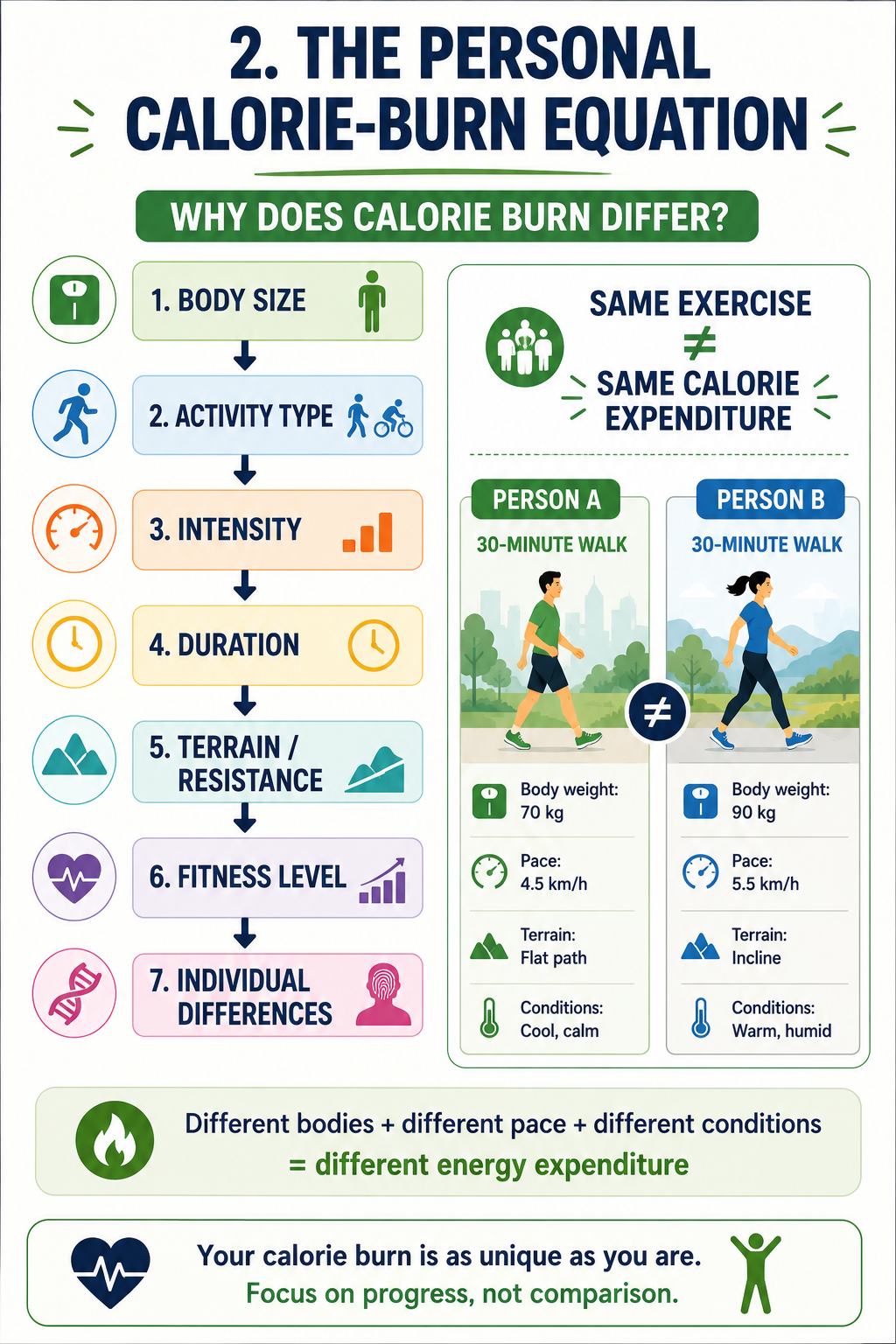
What Changes How Many Calories You Burn?
| Variable | What changes |
|---|---|
| Body size | Energy requirements during movement can differ. |
| Exercise intensity | Harder activity generally requires more energy. |
| Duration | Longer activity generally uses more energy. |
| Activity type | Different activities have different energy demands. |
| Terrain | Hills and resistance can increase effort |
| Fitness level | People can respond differently to the same activity. |
| Daily movement | Non-exercise activity contributes to total expenditure. |
| Recovery | Fatigue can affect how much activity you can realistically perform |
People-First Insight:
A calorie estimate should help you understand your activity, not make you feel that you failed because your body did not produce a particular number
4. Can Walking Burn 1,000 Calories?
Walking is one of the easiest ways to add more movement to everyday life.
You can walk:
- Before work
- During a suitable break
- To nearby destinations
- With family
- After dinner
- While exploring a new area
- As a structured workout
But can walking alone burn 1,000 calories?
It can contribute substantially to energy expenditure, but the answer depends on the individual.
Important variables include:
- Body size
- Walking pace
- Distance
- Duration
- Terrain
- Individual physiology
For some people, reaching 1,000 calories from walking alone could require a very long period of activity.
That is not necessarily the best goal.
A better walking strategy
Instead of asking:
“How many calories did this walk burn?”
Try asking:
“How can I make walking a regular part of my week?”
That change in thinking can make the habit much easier to maintain.
5. Running, Cycling, Swimming, and Sports
Some activities allow you to perform sustained movement at relatively high intensity.
Examples include:
- Running
- Cycling
- Swimming
- Rowing
- Hiking
- Dancing
- Basketball
- Football
- Tennis
But there is no universal calorie number for any of these activities.
A leisurely cycling session is not equivalent to hard cycling.
A gentle swim is not equivalent to sustained vigorous swimming.
And an easy walk is not equivalent to climbing a steep hill.
Higher intensity comes with a trade-off.
Higher intensity can increase energy expenditure.
It can also increase:
- Fatigue
- Recovery needs
- Muscle soreness
- Training stress
So more calories burned does not automatically mean a better workout.
A workout should also be appropriate for your current fitness and sustainable enough to repeat.
6. Strength Training Is About More Than Calories
Strength training often appears in calorie-burning articles because it uses energy.
But calorie expenditure is not the only reason to perform it.
Resistance training can help develop muscular strength and physical function.
The CDC recommends muscle-strengthening activities on at least two days each week for adults.
Examples include:
- Squats
- Lunges
- Push-ups
- Rows
- Resistance bands
- Dumbbell exercises
- Bodyweight exercises
Why combine strength and aerobic activity?
A balanced routine can target different aspects of fitness.
Aerobic activity → cardiovascular fitness
Strength training → muscular strength and function
Daily movement → overall activity
This is much more useful than judging your entire exercise routine by a calorie counter.
7. NEAT: The Movement You May Not Count
You may not think of household chores or walking around your home as exercise.
But movement does not need to happen in a gym to contribute to physical activity.
This is where NEAT, or non-exercise activity thermogenesis, becomes useful.
Examples include:
- Cleaning
- Cooking
- Shopping
- Standing
- Walking around the house
- Taking stairs
- Walking during appropriate phone calls
- Moving around at work
Imagine two people.
Person A
Workout → sits most of the day → drives home → sits again.
Person B
Workout → walks during breaks → takes stairs → walks for errands → does household tasks.
Even though both completed the same workout, their total daily movement can be different.
People-First Insight
You do not have to transform every movement into a workout.
Sometimes the most realistic improvement is simply to move more during the day you already have.
8. Can You Combine Activities Throughout the Day?
Yes.
And for some people, this can be more practical than trying to complete one enormous workout.
For example:
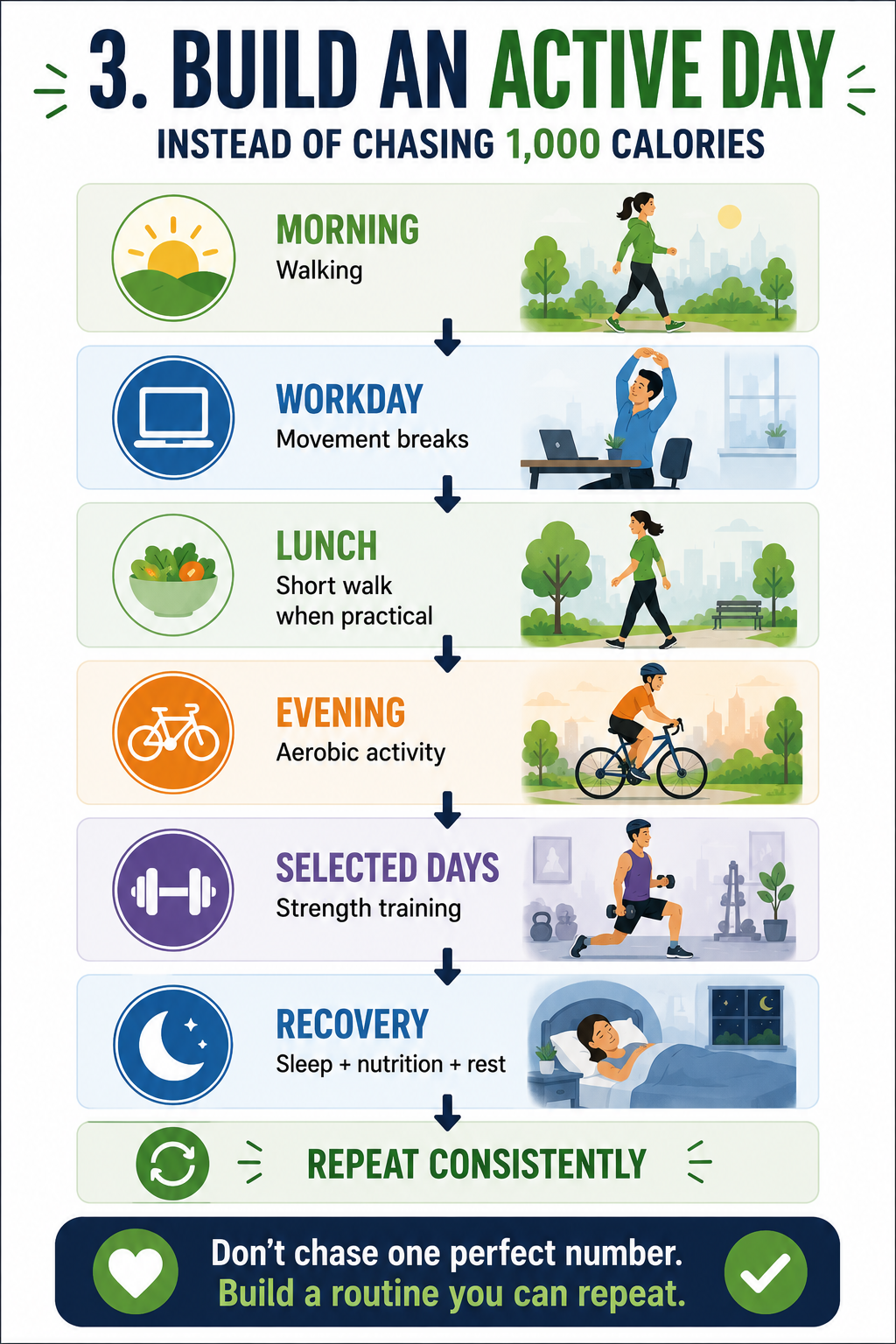
| Time | Activity |
|---|---|
| Morning | Walk |
| Workday | Short movement breaks |
| Lunch | Walk when practical. |
| Evening | Cycling or another aerobic activity |
| Selected days | Strength training |
| Daily life | Stairs, errands, and household movement |
This is an example of activity accumulation, not a guaranteed 1,000-calorie program.
That can be particularly useful for people who struggle to find one uninterrupted block of exercise time.
Think of the day as a movement budget.
Instead of:
One giant workout
think:
Small movement opportunities + planned exercise + everyday activity
That can make an active lifestyle feel less overwhelming.
9. How to Burn 1,000 Calories Without Going to a Gym
You do not need a gym membership to increase physical activity.
Depending on your circumstances, you can use:
- Walking
- Hiking
- Cycling
- Swimming
- Dancing
- Sports
- Home strength training
- Outdoor exercise
- Stairs
- Active transportation
- Household movement
Example of a gym-free active day
Morning: walk
↓
Workday: movement breaks
↓
Transportation: walk or cycle when practical
↓
Evening: enjoyable physical activity
↓
Home: ordinary household movement
The exact calorie expenditure will vary.
That is okay.
The objective is to make your day more active—not to manufacture a perfect number.
10. Why Your Fitness Tracker May Be Wrong About Calories
Fitness trackers can be useful.
They can show:
- Steps
- Exercise time
- Heart rate
- Activity trends
- Movement patterns
But calorie expenditure is difficult to measure accurately outside laboratory conditions.
A systematic review and meta-analysis published in the British Journal of Sports Medicine evaluated 60 studies and 104 effect sizes and found that wrist- and arm-worn activity monitors showed variable accuracy when estimating energy expenditure. Accuracy differed depending on the activity and device. (PubMed — Activity Monitor Energy-Expenditure Review)
That means a tracker displaying:
1,000 calories
does not necessarily mean your body used exactly 1,000 calories through exercise.
How I recommend using the number
Use it to observe trends.
For example:
“I was more active this month than last month.”
That can be more meaningful than worrying about whether your device says 976 or 1,024 calories.
11. Is Burning 1,000 Calories a Day Safe?
There is no universal answer.
For a highly trained and active person, substantial daily energy expenditure may be normal.
For someone who is inactive, injured, older, or managing a health condition, trying to force a high exercise workload could be inappropriate.
Consider:
- Current fitness
- Age
- Health
- Previous injuries
- Exercise experience
- Mobility
- Sleep
- Nutrition
- Recovery
- Training intensity
The CDC also provides specific guidance for people with chronic health conditions or disabilities, including consulting a healthcare professional or physical-activity specialist when appropriate.
Warning signs matter.
Do not interpret severe symptoms as a signal to push harder.
Chest pain, fainting, severe or unusual shortness of breath, or other serious symptoms require appropriate medical attention.
12. Recovery Is Part of the Plan
A common mistake is to think only about calories burned.
You exercise.
You see a large number.
Then you decide you need an even larger number tomorrow.
But your body also needs recovery.
A sustainable cycle looks like this:
Exercise
↓
Recover
↓
Adapt
↓
Exercise again
Recovery includes:
- Adequate sleep
- Appropriate nutrition
- Hydration
- Rest
- Reasonable training progression
The CDC recommends gradually increasing activity for people starting from lower activity levels.
My practical view
A workout that burns a large number of estimated calories but leaves you unable to exercise comfortably for several days may be less useful than a moderate routine you can repeat.
Sustainability is part of fitness.
13. Do You Need to Burn 1,000 Calories to Lose Weight?
No.
This is perhaps the most important point in the article.
You do not need to burn 1,000 exercise calories every day to lose weight.
Weight management involves many factors.
The CDC also explains that physical activity can increase calorie use and support weight management.
Exercise calories versus calorie deficit
Exercise calories
Energy used during physical activity.
Calorie deficit
Energy expenditure exceeding energy intake over time.
They are related, but they are not identical.
Someone can exercise without creating a 1,000-calorie deficit.
And someone does not need to create a 1,000-calorie deficit every day to make progress.
1,000 Exercise Calories vs. 1,000-Calorie Deficit
| These are different. | Meaning |
|---|---|
| 1,000 exercise calories | Energy estimated to be used during physical activity |
| 1,000 total daily calories | Energy your body uses across the entire day |
| 1,000-calorie deficit | Energy intake is 1,000 calories below expenditure. |
| 1,000 calories shown by a watch | An estimate generated by the device |
14. Why the “3,500 Calories = One Pound” Rule Is Too Simple
You may have seen the claim:
“A 3,500-calorie deficit equals one pound of weight loss.”
This is often presented as though the human body behaves like a calculator.
It doesn’t.
The body responds dynamically to changes in food intake and physical activity.
The NIH’s Body Weight Planner was developed to provide a more realistic model of how changes in calorie intake and physical activity can affect body weight over time.
That is why you should be cautious about articles promising:
“Burn exactly 1,000 calories every day and lose exactly X pounds.”
Real-world results vary.
15. A Better Way to Increase Daily Calorie Expenditure
Instead of making 1,000 calories the only objective, use this simple framework.
MOVE
Increase ordinary movement.
Try:
- Walking
- Stairs
- Movement breaks
- Active errands
EXERCISE
Choose an aerobic activity that fits your fitness.
Examples:
- Walking
- Cycling
- Swimming
- Running
- Dancing
STRENGTHEN
Include muscle-strengthening activity on appropriate days.
RECOVER
Give your body adequate sleep, nutrition, and rest.
REPEAT
Build a routine that can survive ordinary life.
The framework
MOVE → EXERCISE → STRENGTHEN → RECOVER → REPEAT
This is a practical framework created specifically for this article. It is not a clinical guideline.
16. When a 1,000-Calorie Goal May Be the Wrong Goal
Sometimes the problem is not your effort.
It is the target.
You may be better served by goals such as
- Walking consistently
- Improving endurance
- Building strength
- Reducing prolonged sitting
- Increasing weekly activity
- Becoming more comfortable with exercise
- Improving your routine
The WHO recommends 150–300 minutes of moderate-intensity aerobic activity per week for adults.
Neither organization says that every adult must burn 1,000 exercise calories every day.
Better mindset
| Calorie-focused mindset | Sustainable mindset |
|---|---|
| “I must burn 1,000 today.” | “I want to stay active consistently.” |
| “My tracker says 800, so I failed.” | “I still moved more than before.” |
| “More is always better.” | “More should also be recoverable.” |
| “I need one giant workout.” | “I can spread activity across my day.” |
| “I need an exact number.” | “I can monitor trends.” |
17. My Personal Experience With Increasing Daily Activity
My own experience changed how I think about calorie-burning goals.
There was a period when much of my day involved sitting at a computer.
At first, I thought the answer was one large workout.
That was difficult to maintain.
- I gradually started looking at the whole day instead.
- I added walking.
- I took movement breaks.
- I used stairs when practical.
- I included strength-focused activity rather than depending entirely on cardio.
- The biggest lesson was not that I had discovered a secret method for burning a particular number of calories.
It was that movement became part of my routine.
That made the habit easier to continue.
My personal takeaway
I would not treat 1,000 calories as a number that must be defeated every day.
A more useful mindset is
Build an activity level that challenges you appropriately, supports your goals and leaves you capable of doing it again.
This is my personal experience, not medical evidence or a promise that another person will experience the same results.
18. A Practical Active-Day Example
Here is an example of how someone might distribute movement across a day.
Morning
Take a walk.
Workday
Use suitable breaks to stand and move.
Lunch
Walk for part of the break when practical.
Evening
Choose an enjoyable aerobic activity.
Selected days
Include strength training.
Throughout the day
Walk for appropriate errands, use stairs when practical, and avoid unnecessary prolonged sitting.
This is not a guaranteed 1,000-calorie program.
Actual energy expenditure varies.
The purpose is to show that physical activity does not have to happen in one giant block.
19. What Should You Track Besides Calories?
If you use a fitness tracker, consider following several measurements.
| Metric | What it tells you |
|---|---|
| Steps | General movement |
| Active minutes | Time spent moving |
| Exercise sessions | Training consistency |
| Heart rate | Exercise-intensity context |
| Strength sessions | Resistance-training consistency |
| Weekly activity | Longer-term pattern |
| Sleep | Recovery context |
| How you feel | Personal response |
The NIDDK provides guidance on tracking physical activity and progress, which can help people understand and maintain healthier habits.
The important point is to use tracking as information, not punishment.
Frequently Asked Questions
1. Can you really burn 1,000 calories a day?
Yes, some people can expend 1,000 calories through substantial physical activity, but the amount varies significantly between individuals.
2. Is burning 1,000 calories a day safe?
It may be appropriate for some highly active people, but it is not a universal target. People who are new to exercise should increase activity gradually. The WHO recommends progressive increases for people who are currently inactive.
3. How long does it take to burn 1,000 calories?
There is no universal answer. The time depends on body size, activity, intensity, duration, and individual physiology.
4. Can walking burn 1,000 calories?
Walking can contribute substantially to energy expenditure, but reaching 1,000 calories through walking alone could require a long period of activity for many people.
5. Can you burn 1,000 calories without a gym?
Yes. Walking, cycling, swimming, hiking, dancing, sports, home exercise, and everyday movement can all increase physical activity without a gym.
6. What exercise burns the most calories?
Running, cycling, swimming, and vigorous sports can produce substantial energy expenditure, but there is no single exercise that burns the most calories for everyone.
7. Does body weight affect calorie burn?
Yes. Body size is one factor that influences energy expenditure, along with intensity, duration, activity type and individual physiology.
8. Can strength training help with calorie expenditure?
Yes, but its value goes beyond calories. Strength training helps develop muscular strength and function and is recommended as part of a balanced activity routine. (CDC strength-training guidance)
9. Can everyday movement help burn more calories?
Yes. Walking, household tasks, stairs, transportation, and other everyday activities contribute to physical activity. The NIDDK explains that daily activities such as housework and walking contribute to calories used.
10. Are fitness tracker calorie estimates accurate?
They are estimates rather than direct measurements. Research has found that wearable devices vary in their accuracy when estimating energy expenditure. (PubMed systematic review)
11. Do I need to burn 1,000 calories to lose weight?
No. Weight management depends on multiple factors and does not require every person to burn 1,000 exercise calories each day. (NIDDK weight-management guidance)
12. What is a better goal for a beginner?
A beginner may benefit more from gradually increasing activity, developing consistency, and improving fitness than from immediately pursuing a large calorie-burning target. The CDC recommends starting with manageable amounts of activity and building toward recommended levels.
Conclusion
The question “How to burn 1,000 calories a day?” sounds like it should have one simple answer.
It doesn’t.
Some people can expend that much energy through physical activity.
Others may find the target unrealistic, unnecessary, or difficult to recover from.
Your calorie expenditure depends on your body, activity, intensity, duration, fitness, and individual circumstances.
Walking, cycling, running, swimming, sports, strength training, and everyday movement can all contribute to a more active lifestyle.
But exercise does not need to become punishment for eating.
A better approach is
MOVE → EXERCISE → STRENGTHEN → RECOVER → REPEAT
Current CDC physical-activity recommendations and WHO physical-activity guidelines emphasize regular weekly activity rather than a universal 1,000-calorie exercise requirement.
And if weight loss is your goal, remember:
Burning 1,000 calories through activity is not the same as creating a 1,000-calorie deficit.
The most useful question may therefore be
“What level of activity can I safely maintain?”
That question is less dramatic than chasing a calorie number.
But it is much more useful for building a routine that can last.
Author Note
About the Author
RVLNSV PRASAD creates reader-focused health and lifestyle content designed to explain complex subjects in clear, practical language.
His approach combines personal observations, reputable public-health guidance, and research findings while clearly distinguishing personal experience from scientific evidence.
Health-related articles are written for educational purposes and avoid presenting general information as individualized medical advice.
Author: RVLNSV PRASAD
Focus: Health, fitness, lifestyle, and practical educational content
Sources
- CDC — Adult Activity: An Overview
- WHO — Physical Activity
- WHO — Guidelines on Physical Activity and Sedentary Behaviour
- NIDDK — Factors Affecting Weight & Health
- NIDDK — Body Weight Planner
- PubMed — Systematic Review of Activity Monitors and Energy Expenditure
Related Posts
- 10 Best Workouts To Get Six Pack Abs at Home
- 7 Strength Training Exercises for Women Over 40: A Comprehensive Guide
- Chest Workouts Without Equipment: Best 12 Moves to Build Muscle at Home
- 12 Dynamic Yoga Poses For Rapid Weight Loss











[…] How to Burn 1000 Calories Daily […]
[…] How to Burn 1000 Calories Daily […]
[…] How to Burn 1000 Calories Daily […]