
















































































































































Low-Impact Balance Exercises for Older Adults: 8 Safe Ways to Improve Stability
Author: RVLNSV PRASAD
Updated On: September 2026
About Us
Author Bio
Editorial Policy
Contact Us
Quick Answer
Low-impact balance exercises for older adults can help train stability, coordination, controlled movement, and physical function. Simple exercises such as supported marching, weight shifting, side stepping, sit-to-stands, and heel-to-toe walking can be adapted for beginners and performed at home with a sturdy chair or countertop nearby.
Balance training should not be viewed as a replacement for other forms of physical activity. The CDC recommends that adults aged 65 and older include aerobic activity, muscle-strengthening activity, and balance activities each week. CDC: Physical Activity Guidelines for Older Adults
The safest approach is to begin with movements you can control, use stable support when needed, and gradually increase the challenge.
If you have repeated falls, unexplained dizziness, sudden weakness, major walking problems, or another medical condition affecting balance, professional assessment is more appropriate than simply starting a difficult home exercise routine.
Introduction
Balance is something most of us use without thinking about it.
You stand up from a chair, walk to the kitchen, turn around, step over an object, or reach for something on a shelf. These movements require your muscles, joints, eyes, inner ear, and nervous system to work together.
As we get older, some of these systems can change. Muscle strength may decrease, reactions may become slower, vision can change, and certain medical conditions or medications may affect stability.
That does not mean every older adult will develop serious balance problems.
It does mean that maintaining physical activity becomes increasingly important.
The CDC recommends that adults aged 65 and older include aerobic activity, muscle-strengthening activity, and balance activities as part of their weekly physical activity. The agency gives examples such as heel-to-toe walking and standing up from a sitting position. CDC: Older Adult Activity
This is where low-impact balance exercises for older adults can become useful.
You can keep things simple without expensive equipment, advanced yoga poses, or unstable surfaces.
A sturdy chair, countertop, or wall can provide support while you gradually develop better control.
There is also an important point that many exercise articles overlook.
Improving balance and preventing every possible fall are not the same thing.
Falls can involve multiple factors, including muscle weakness, medications, vision problems, footwear, environmental hazards, neurological conditions, and other health issues. The CDC’s STEADI fall-prevention approach therefore looks at fall risk more broadly rather than treating exercise as the only solution. CDC STEADI: Older Adult Fall Prevention
This article focuses on practical, low-impact movements that can become part of that bigger strategy.
Key Takeaways
- Low-impact balance exercises can train stability, coordination, and controlled movement.
- Beginners should use a sturdy chair, countertop, or wall when necessary.
- Start with simple exercises before progressing to single-leg or more challenging movements.
- Balance training works best alongside strength and aerobic activity.
- No exercise can guarantee that an individual will never fall.
- Home safety, vision, footwear, medications, and medical conditions can also affect fall risk.
- Consistency is generally more useful than making every workout difficult.
- New or worsening balance problems deserve appropriate medical evaluation.
What Are Low-Impact Balance Exercises for Older Adults?
Low-impact balance exercises are movements that challenge stability without requiring jumping, running, or other high-impact activity.
For older adults, this can make exercises easier to adapt around fitness limitations, joint concerns, or fear of falling.
Balance is also more complicated than simply standing on one foot.
A useful balance routine may involve:
| Balance skill | Example in daily life |
|---|---|
| Weight shifting | Moving from one foot to another |
| Foot control | Stepping around furniture |
| Lower-body strength | Getting out of a chair |
| Coordination | Walking while performing another simple task |
| Postural control | Turning safely |
| Stepping ability | Moving sideways or backward |
| Body awareness | Knowing where your feet are during movement |
The CDC specifically lists heel-to-toe walking and standing from a sitting position among examples of balance activities for older adults. CDC: What Counts as Physical Activity for Older Adults
This is why the exercises in this article combine balance with practical movement instead of focusing only on standing still.
Why Balance Can Become More Difficult With Age
Balance depends on several body systems working together.
Muscle strength is important because your legs and trunk help keep your body controlled.
Vision provides information about the environment.
Joint mobility and foot sensation also contribute to stability.
Changes in any of these areas can influence balance.
Physical activity can help older adults maintain strength and physical function. The CDC notes that regular activity can help older adults maintain independence and manage or prevent several chronic health problems. CDC: Physical Activity and Older Adults
Falls are also an important health concern among older adults.
According to the CDC, falls are the leading cause of injury-related death among U.S. adults aged 65 and older. CDC data show that the age-adjusted fall death rate among older U.S. adults increased from 64.7 per 100,000 in 2018 to 78.4 per 100,000 in 2024. CDC: Older Adult Falls Data
These statistics describe the United States and should not be assumed to represent every country. They nevertheless demonstrate why fall-risk reduction deserves attention.
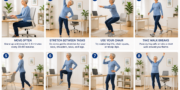
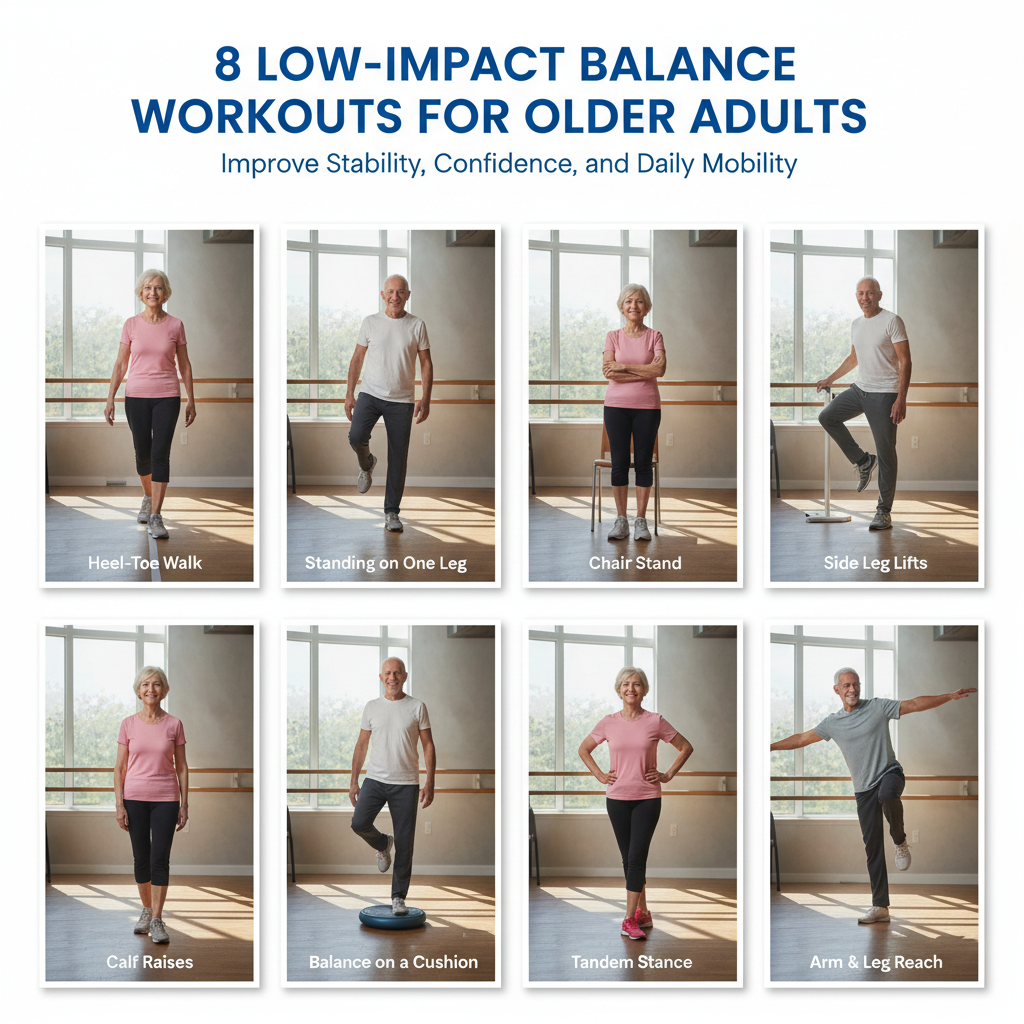
8 Low-Impact Balance Exercises for Older Adults
1. Supported Marching in Place
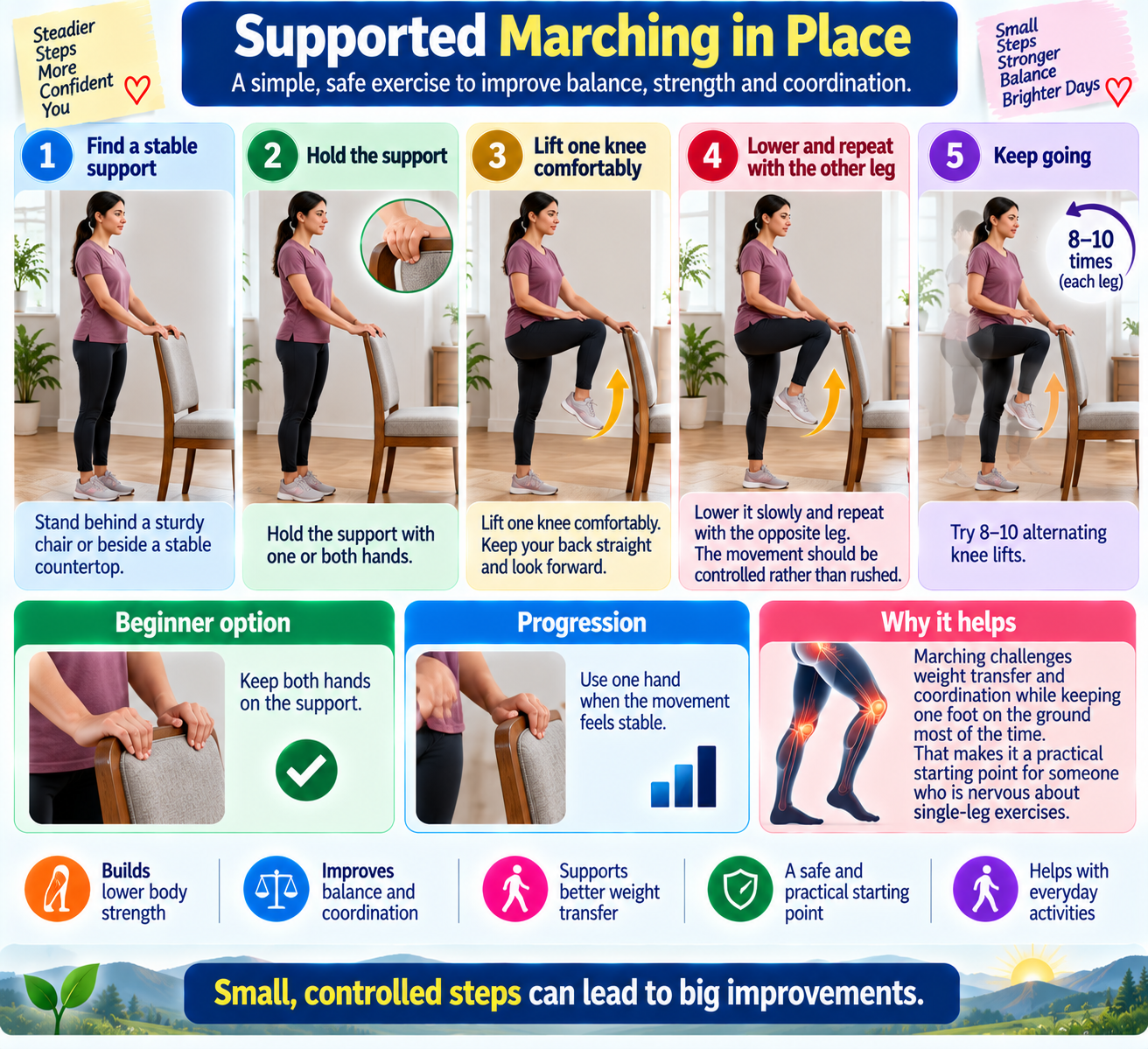
Stand behind a sturdy chair or beside a stable countertop.
Hold the support with one or both hands.
Lift one knee comfortably.
Lower it slowly and repeat with the opposite leg.
The movement should be controlled rather than rushed.
Try 8–10 alternating knee lifts.
Beginner option: Keep both hands on the support.
Progression: Use one hand when the movement feels stable.
Marching challenges weight transfer and coordination while keeping one foot on the ground most of the time.
That makes it a practical starting point for someone who is nervous about single-leg exercises.
2. Heel-to-Toe Walking
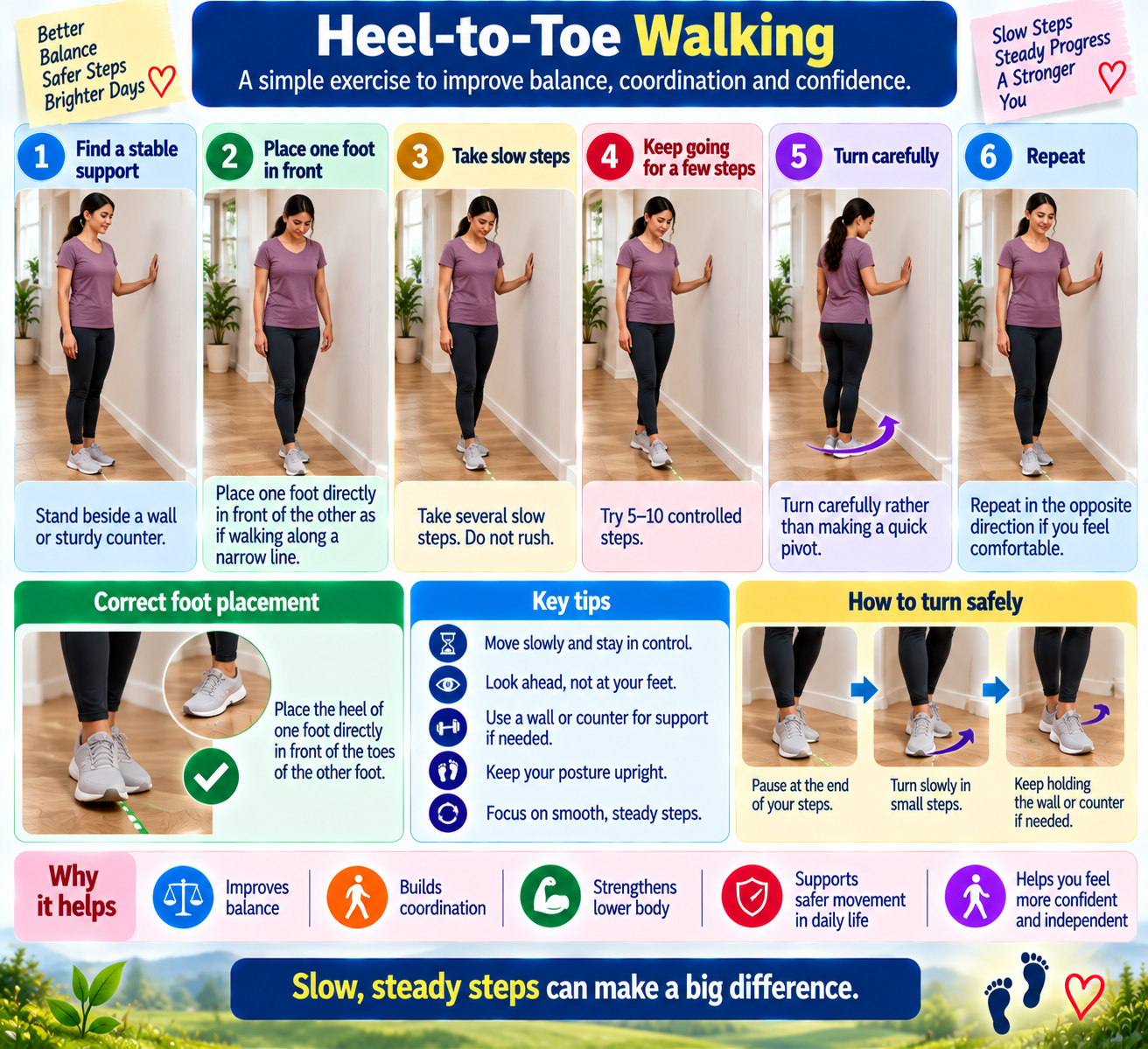
Stand beside a wall or sturdy counter.
Place one foot directly in front of the other as if walking along a narrow line.
Take several slow steps.
Do not rush.
Try 5–10 controlled steps.
Turn carefully rather than making a quick pivot.
Heel-to-toe walking is specifically included by the CDC as an example of balance activity for older adults. CDC: Older Adult Activity Guidelines
Healthline’s current guidance for older adults also includes heel-to-toe walking among balance exercises and emphasizes starting at a comfortable level before progressing. Healthline: Balance Exercises for Older Adults
If this exercise feels unsafe, widen your stance instead of forcing your feet into a straight line.
3. Side Step and Tap
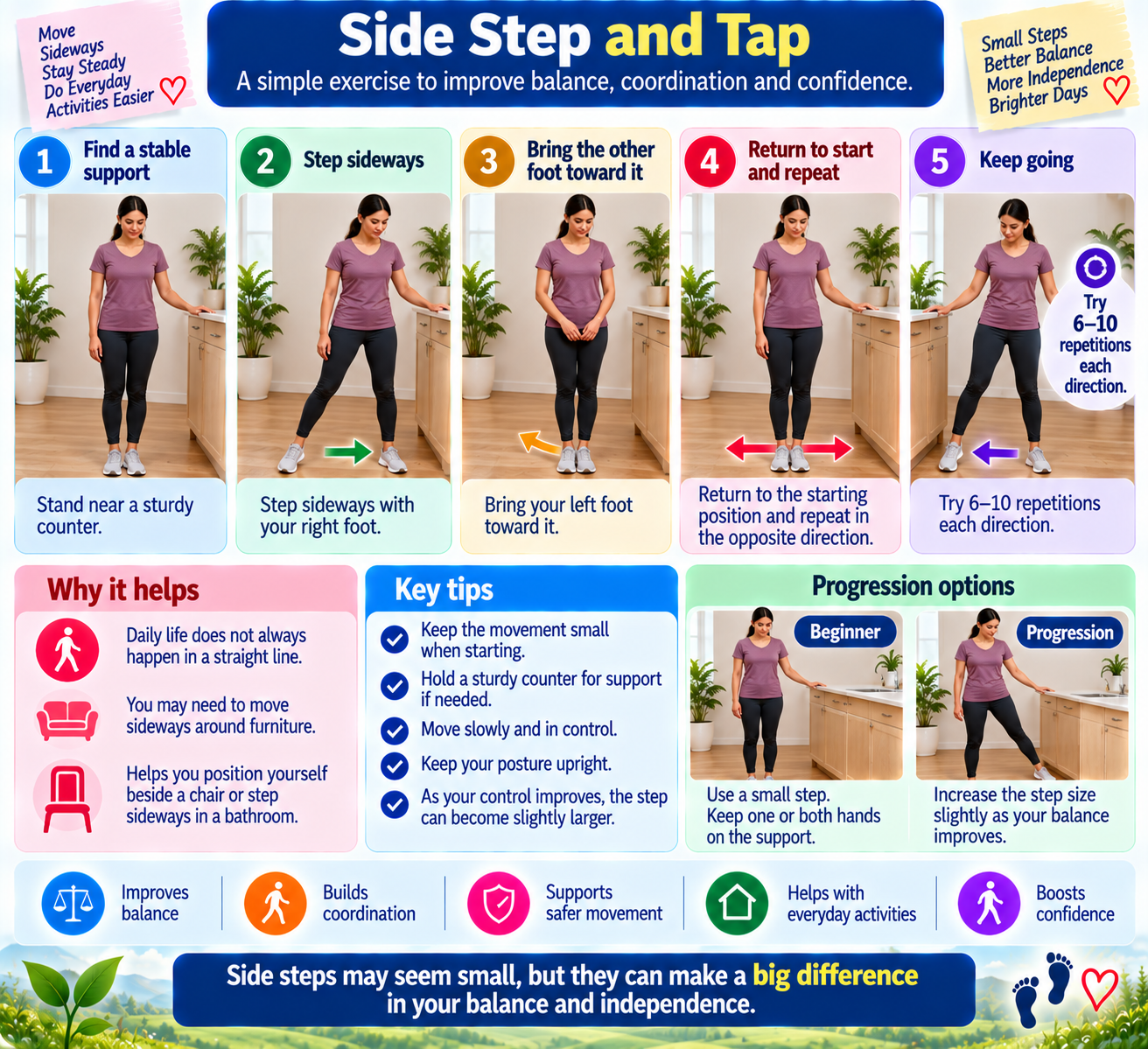
Stand near a sturdy counter.
Step sideways with your right foot.
Bring your left foot toward it.
Return to the starting position and repeat in the opposite direction.
Try 6–10 repetitions each direction.
Side-stepping is valuable because daily life does not always happen in a straight line.
You may need to move sideways around furniture, position yourself beside a chair, or step sideways in a bathroom.
Keep the movement small when starting.
As your control improves, the step can become slightly larger.
4. Sit-to-Stand With Controlled Balance
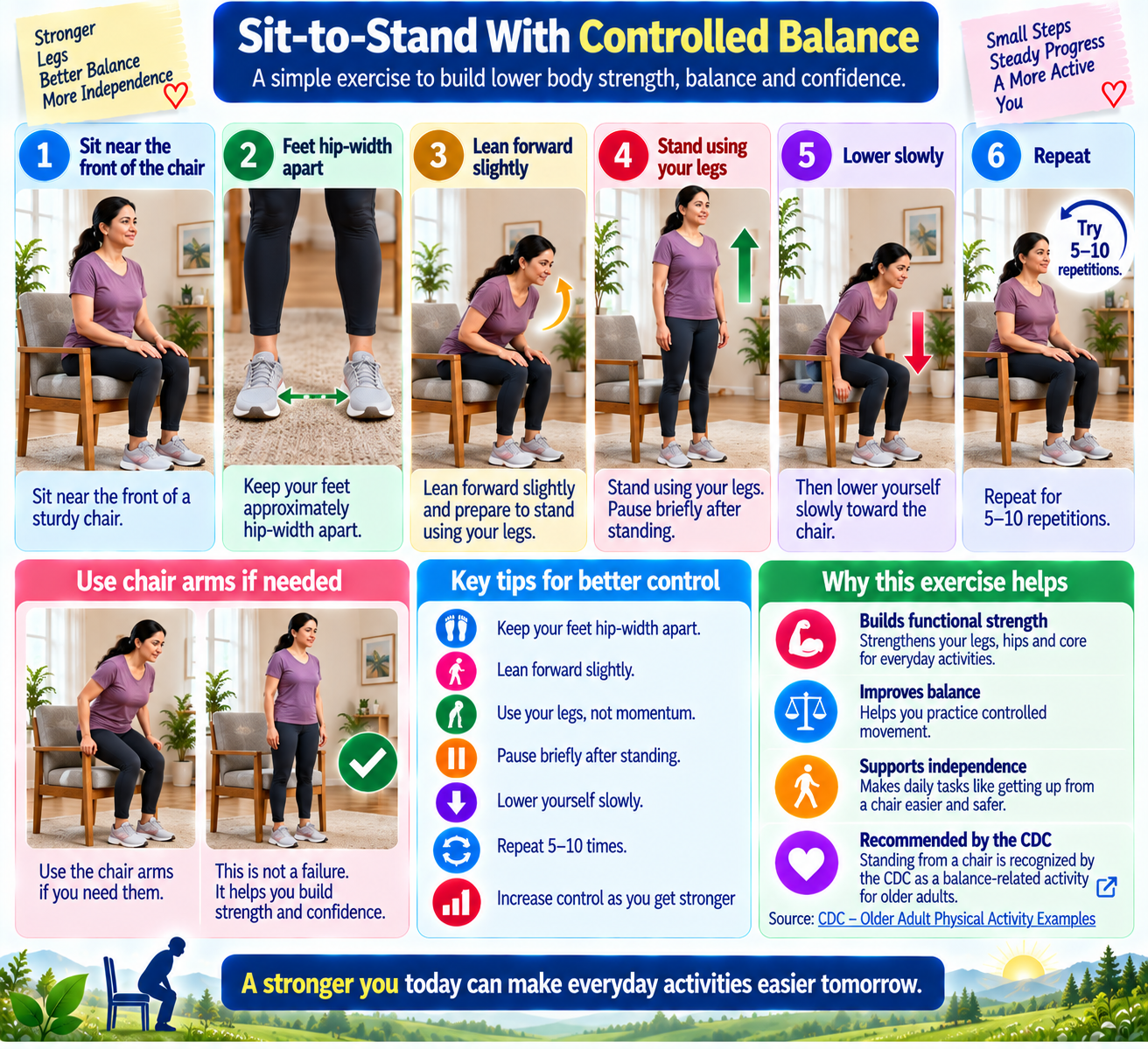
Sit near the front of a sturdy chair.
Keep your feet approximately hip-width apart.
Lean forward slightly and stand using your legs.
Pause briefly after standing.
Then lower yourself slowly toward the chair.
Use the chair arms if you need them.
Try 5–10 repetitions.
This exercise combines functional strength with balance.
Standing from a chair is also directly recognized by the CDC as a balance-related activity for older adults. CDC: Older Adult Physical Activity Examples
If you need your hands to stand, that is not a failure.
The goal is to work with your current ability and gradually improve control.
5. Supported Weight Shifts
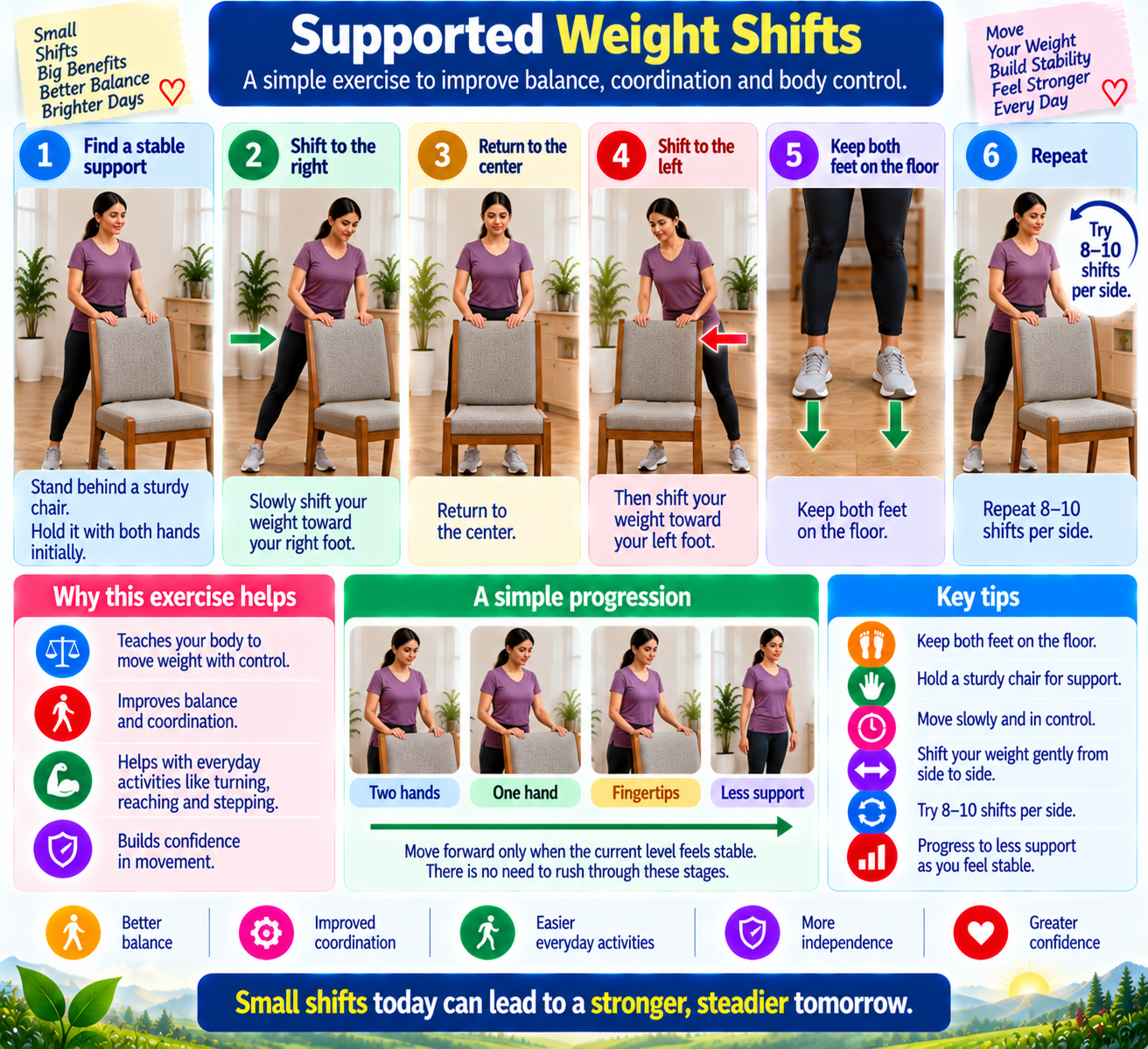
Stand behind a sturdy chair.
Hold it with both hands initially.
Slowly shift your weight toward your right foot.
Return to the center.
Then shift toward your left foot.
Keep both feet on the floor.
Try 8–10 shifts per side.
This exercise looks simple, but it teaches an important balance skill: moving your body weight while maintaining control.
A Simple Progression
You can gradually move from:
Two hands → one hand → fingertips → less support
There is no need to rush through these stages.
Move forward only when the current level feels stable.
6. Supported Single-Leg Stand
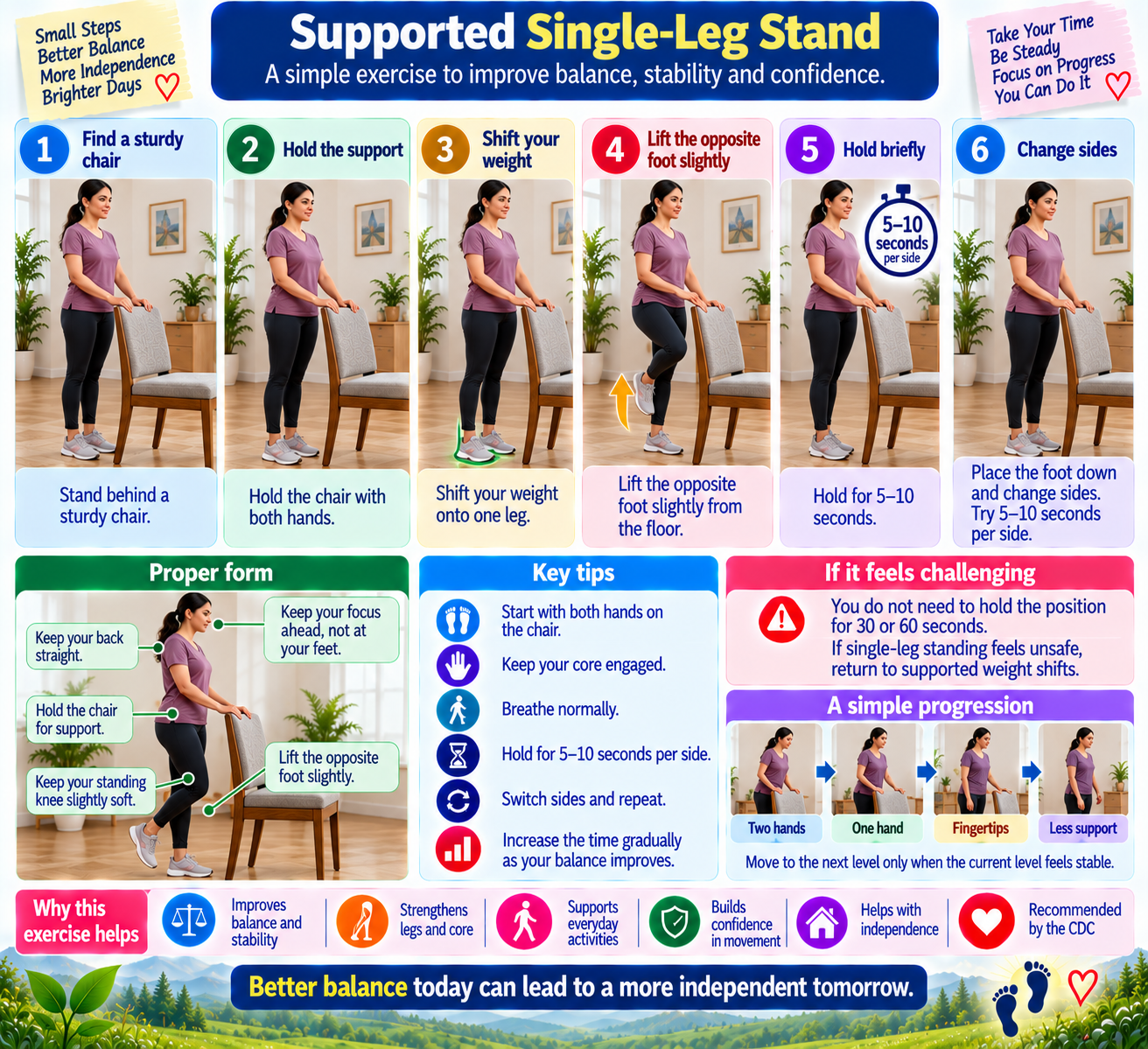
Stand behind a sturdy chair.
Hold the chair with both hands.
Shift your weight onto one leg.
Lift the opposite foot slightly from the floor.
Hold briefly.
Place the foot down and change sides.
Try: 5–10 seconds per side.
Standing on one leg is one of the balance activities recognized by the CDC. CDC: Balance Activities for Older Adults
However, this exercise should not become a competition.
You do not need to hold the position for 30 or 60 seconds if doing so makes you unstable.
If single-leg standing feels unsafe, return to supported weight shifts.
7. Clock-Reach Balance Drill
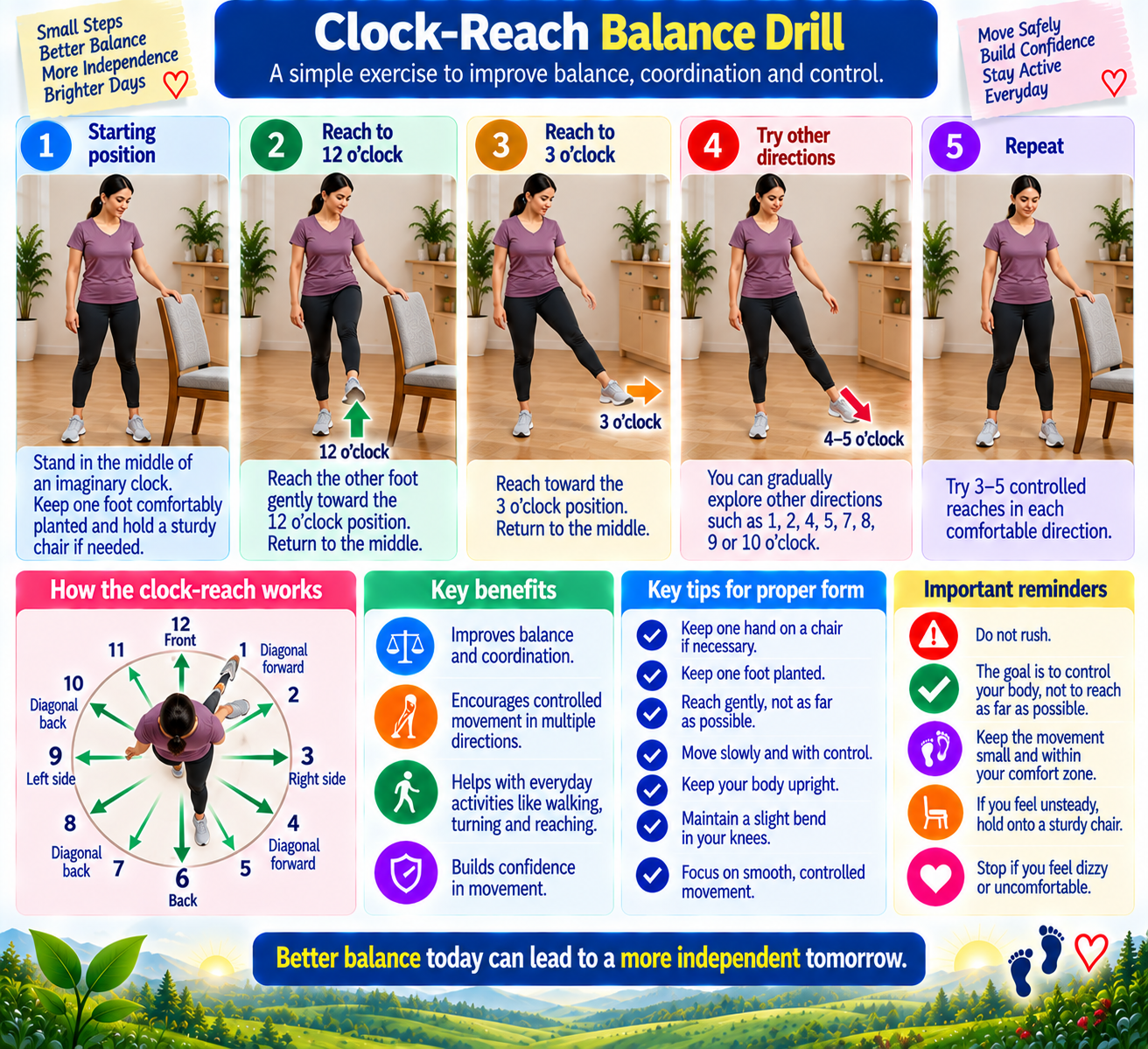
Imagine that you are standing in the middle of a clock.
Keep one foot comfortably planted.
Reach the other foot gently toward an imaginary 12 o’clock position.
Return to the middle.
Then try a small reach toward 3 o’clock.
Return again.
You can gradually explore other directions.
Try 3–5 controlled reaches in each comfortable direction.
The purpose is not to reach as far as possible.
The purpose is to control your body while your foot changes position.
Keep one hand on the chair if necessary.
8. Cross-Body Standing Reach
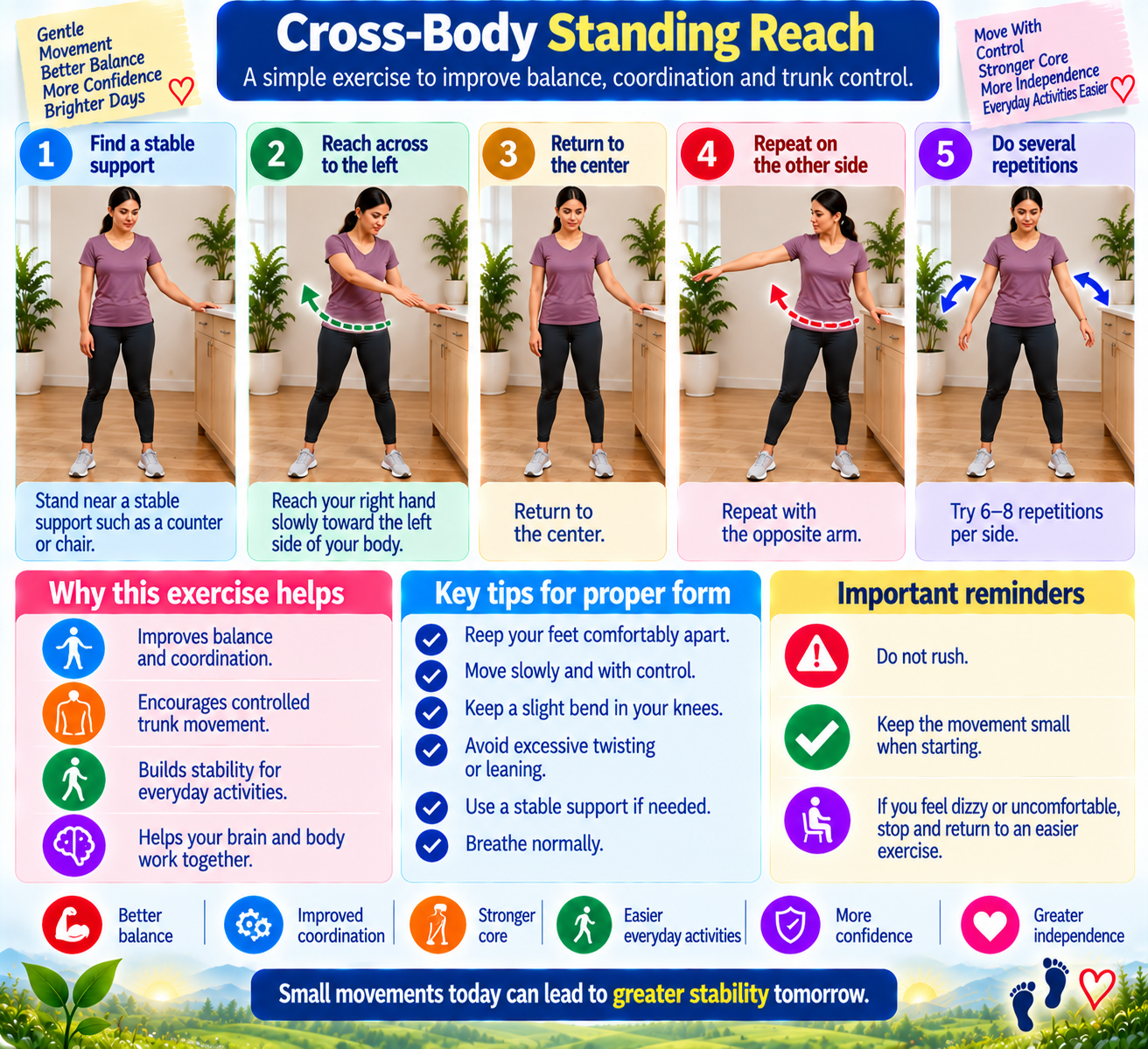
Stand near a stable support.
Reach your right hand slowly toward the left side of your body.
Return to the center.
Repeat with the opposite arm.
Keep your feet comfortably apart.
Try 6–8 repetitions per side.
This adds a simple coordination challenge while encouraging controlled trunk movement.
Avoid excessive twisting or leaning.
If the movement causes dizziness or discomfort, stop and return to an easier exercise.
Which Exercises Should a Beginner Start With?
You do not have to perform all eight exercises on your first day.
| Starting ability | Suitable starting exercises |
|---|---|
| Very cautious beginner | Weight shifts and supported marching |
| Comfortable standing | Side steps and sit-to-stands |
| Better stability | Heel-to-toe walking |
| More experienced | Supported single-leg standing |
| Coordination focus | Clock reaches and cross-body reaches |
The important question is not
“How difficult can I make this exercise?”
A better question is
“Can I perform this movement with control?”
That people-first approach is often more useful than following a rigid online routine.
A Simple 15-Minute Balance Routine
Here is a practical beginner routine:
| Exercise | Starting amount |
|---|---|
| Supported marching | 2 minutes |
| Weight shifts | 8 on each side |
| Side step and tap | 8 in each direction |
| Sit-to-stand | 6–10 repetitions |
| Heel-to-toe walking | 5–10 steps |
| Supported single-leg stand | 5–10 seconds each |
| Gentle walking | 2 minutes |
Take breaks whenever necessary.
The goal is controlled movement rather than exhaustion.
How Often Should Older Adults Practice Balance Exercises?
There is no single frequency that is appropriate for every older adult.
The CDC recommends that adults aged 65 and older include balance activities every week, alongside aerobic and muscle-strengthening activity. Its current recommendations include at least 150 minutes of moderate aerobic activity or an equivalent amount of vigorous activity, plus muscle-strengthening activity on at least two days each week. CDC: Physical Activity Guidelines for Adults 65+
For someone beginning a simple home balance routine, three short sessions per week can be a reasonable practical starting point when the exercises are appropriate for that person.
Someone with substantial balance impairment may need supervised exercise instead.
Consistency matters more than making each session extremely difficult.
What Does the Latest 2026 Research Say?
Research published in 2026 adds useful detail to our understanding of balance training.
A large 2026 systematic review and Bayesian network meta-analysis examined 423 randomized trials involving 33,901 participants. The researchers found that 18 of 19 exercise modalities improved overall balance compared with control conditions. Different approaches appeared to affect different balance domains, however, and the authors specifically cautioned that the estimates did not establish that one modality was universally superior. 2026 PubMed: Exercise Modalities and Balance in Older Adults
That finding is important for people searching for the “best balance exercise.”
There may not be one exercise that works best for every older adult.
The appropriate exercise can depend on the type of balance being trained, the person’s ability, the setting, and the level of challenge.
Another 2026 systematic review and meta-analysis evaluated FallProof exercise programs in older adults. The researchers examined randomized controlled trials and assessed outcomes including balance, fear of falling, and quality of life. 2026 PubMed: FallProof Exercise Programs
A separate 2026 systematic review examined exercise type and dose in relation to falls among older adults. It included 21 randomized controlled trials involving 3,387 participants. 2026 PubMed: Exercise Type and Dose for Falls
The broader message from these studies is more useful than trying to find one magic exercise: balance training should be appropriately challenging, progressive, and matched to the person’s ability.
Balance Training Is More Than Standing on One Leg
Standing on one leg is easy to demonstrate in an article.
Real life is not.
- You may need to turn while walking.
- You may step around a pet.
- You may carry groceries.
- You may get out of a low chair.
- You may walk across a different surface.
- You may reach into a cupboard.
- You may need to step sideways unexpectedly.
That is why functional movement deserves a place in balance training.
A 2026 systematic review and meta-analysis of task-oriented training found improvements in measures such as balance, gait speed, and functional mobility compared with conventional training, although the evidence for reducing actual falls was less conclusive. 2026 PubMed: Task-Oriented Training in Older Adults
This supports a practical idea:
Train movement that has meaning in everyday life.
A People-First Balance Strategy
Instead of asking an older adult to perform increasingly difficult exercises, ask what movement is actually difficult for them.
For example:
Problem: Getting out of a chair is difficult.
Training focus: Sit-to-stands.
Problem: Turning feels unstable.
Training focus: Controlled stepping and turning practice.
Problem: Moving sideways is difficult.
Training focus: Supported side steps.
Problem: Walking feels uncertain.
Training focus: Supported marching and gradual walking practice.
This makes the exercise more relevant.
It also avoids the common mistake of giving every person exactly the same routine.
Your Weekly Balance + Strength Plan
A practical week could look like this:
| Day | Main activity |
|---|---|
| Monday | Balance + strength |
| Tuesday | Walking or other aerobic activity |
| Wednesday | Balance + strength |
| Thursday | Gentle movement or recovery |
| Friday | Balance + strength |
| Saturday | Walking or enjoyable physical activity |
| Sunday | Rest or gentle mobility |
This is an example rather than a prescription.
The CDC specifically recommends combining aerobic activity, muscle strengthening, and balance activities for older adults. CDC: Weekly Activity Recommendations for Older Adults
People who cannot meet standard activity targets should still aim to be as active as their abilities and health conditions allow. CDC: Older Adults and Physical Activity
What Many Balance Articles Miss: Your Home Is Part of the Program
You can improve your physical balance and still have a dangerous home environment.
A loose rug can create a trip hazard.
Poor lighting can make obstacles harder to see.
Clutter can narrow walking space.
An unsafe bathroom can increase risk.
Footwear can also matter.
The CDC recommends addressing environmental hazards and other modifiable factors as part of fall prevention. CDC: Preventing Falls and Hip Fractures
Try This Five-Minute Home Balance Check
Walk through the rooms you use most.
Look at the floor first.
Remove loose objects, cords, and clutter that could catch your feet.
Check whether nighttime lighting is adequate.
Look at the bathroom and stairs.
Finally, consider whether your shoes provide a stable fit.
This is one of the most practical fall-risk improvements you can make without performing a single exercise.
Common Mistakes to Avoid
Starting with difficult exercises
A complicated single-leg movement is not necessarily better.
Start with supported exercises.
Exercising without stable support
Keep a sturdy chair, countertop, or other secure support nearby.
Closing your eyes too soon
Removing visual information can make balance exercises substantially harder.
Beginners generally do not need this extra challenge.
Moving too quickly
Slow movement allows you to notice whether your body is losing control.
Ignoring dizziness
Dizziness is not something to push through during balance training.
Stop and seek appropriate medical advice when needed.
Training balance but ignoring strength
Balance and strength work together.
The CDC recommends muscle-strengthening activities at least two days per week for adults 65 and older, alongside aerobic and balance activity. CDC: Older Adult Activity Guidelines
Treating exercise as the only fall-prevention method
A comprehensive approach can include exercise, medication review, vision assessment, footwear, and environmental changes.
The CDC’s STEADI framework emphasizes screening, assessment, and intervention for fall risk. CDC STEADI Fall Prevention Framework
When Balance Problems Need Medical Evaluation
Do not automatically assume that poor balance is simply part of aging.
Talk with a healthcare professional if you have:
- repeated falls
- unexplained dizziness
- fainting or near-fainting
- sudden walking changes
- new weakness
- numbness
- significant coordination problems
- difficulty standing safely
- balance problems that appeared suddenly
- unusual shortness of breath or chest discomfort during exercise
The CDC recommends discussing fall risk with a healthcare professional and reviewing medicines that may contribute to dizziness or sleepiness. CDC: Falls Prevention for Older Adults
Sudden neurological symptoms or serious symptoms should receive prompt medical attention rather than being treated with a home exercise program.
Who Should Get Extra Guidance Before Starting?
Talk with a qualified healthcare professional before beginning balance exercises if you have:
- a recent serious fall
- a recent injury or surgery
- major mobility limitations
- severe osteoporosis
- significant joint pain
- neurological disease
- uncontrolled cardiovascular symptoms
- severe dizziness
- major vision impairment
- a medical condition that makes standing unsafe
A physiotherapist or physical therapist may also be able to adapt exercises to your specific limitations.
Personal Experience and Practical Lesson
One practical lesson I have taken from creating exercise routines for readers is that people often need confidence before complexity.
An older adult who is worried about falling may not benefit from being told to immediately stand on one leg for 30 seconds.
A more realistic starting point may be standing behind a sturdy chair and shifting weight gently from one foot to the other.
Once that feels comfortable, supported marching can be added.
Side-stepping can follow.
More challenging balance exercises can come later if appropriate.
The important principle is simple:
Do not compete with the exercise. Use the exercise to make everyday movement more controlled and comfortable.
A 7-Day Beginner Balance Experiment
Rather than trying to completely change your fitness in one week, use seven days to understand your starting point.
| Day | Practice |
|---|---|
| Day 1 | Supported weight shifts |
| Day 2 | Supported marching |
| Day 3 | Sit-to-stands and side steps |
| Day 4 | Gentle walking |
| Day 5 | Heel-to-toe walking with support nearby |
| Day 6 | Combine three comfortable exercises. |
| Day 7 | Rest and review. |
At the end of the week, ask yourself:
- Which movement felt easiest?
- Which movement required the most concentration?
- Did I feel more comfortable moving around my home?
- Did any exercise cause pain or dizziness?
This gives you useful information for deciding what to practice next.
How to Progress Safely
Progress should be gradual.
A simple progression can look like this:
- Level 1: Two hands on support.
- Level 2: One hand on support.
- Level 3: Light fingertip support.
- Level 4: Less support while maintaining control.
- Level 5: Slightly more challenging movement or duration.
Do not progress just because you completed a certain number of repetitions.
Progress when the movement feels controlled.
The latest research also supports the idea that different exercise types influence different aspects of balance. The 2026 network meta-analysis found that exercise modality should be considered according to the balance domain being trained, along with safety and feasibility. 2026 Systematic Review of Exercise Modalities and Balance
Nutrition and Balance: Why Diet Still Matters
Exercise is important, but physical function is not determined by exercise alone.
A balanced eating pattern can provide the protein, carbohydrates, fats, vitamins, minerals, and fluids needed for normal body functions.
Practical foods can include:
- eggs
- fish
- dairy or suitable alternatives
- beans and lentils
- vegetables
- fruits
- whole grains
- nuts and seeds
- healthy oils
Individual nutritional needs can vary considerably, particularly when an older adult has kidney disease, diabetes, digestive problems, poor appetite, or takes several medications.
That is why one supplement or one “superfood” should not be presented as a solution for balance.
5 Small Habits That Make Balance Practice Easier
Keep the chair ready.
When your support is already available, starting the exercise becomes easier.
Choose a consistent time.
A routine attached to an existing daily habit may be easier to maintain.
Keep the session short.
A short routine can be more realistic than a demanding workout.
Keep the exercise area clear.
Removing clutter can make movement safer.
Focus on control.
A slow, controlled repetition is more useful than a rushed repetition that makes you unstable.
What These Exercises Can and Cannot Do
They may help you:
- practice postural control
- improve coordination
- develop lower-body strength when combined with strengthening exercises
- practice weight transfer
- support physical function
- become more comfortable with movement
Research reviews have found that exercise can improve balance and physical function in older adults. PubMed: Exercise, Balance and Falls in Older Adults
An earlier overview of systematic reviews also found that balance and functional training can reduce falls and improve some health outcomes in adults aged 65 and older. PubMed: Balance and Functional Training in Older Adults
They cannot:
- guarantee that you will never fall
- diagnose the cause of poor balance
- replace medical evaluation
- correct every vision problem
- treat every neurological condition
- replace appropriate treatment for an underlying disease
That distinction matters.
A person may need exercise and medical assessment and home-safety changes.
Latest Research Development: Why a Combination Approach Matters
One of the most interesting developments in recent research is the movement away from thinking about fall prevention as one isolated exercise.
A 2026 systematic review and component network meta-analysis examined 69 randomized controlled studies and found evidence supporting combinations involving gait and balance training, strength or resistance training, risk assessment, and environmental modification. 2026 PubMed: Multifactorial and Exercise Programs for Fall Prevention
This fits with what many older adults experience in real life.
Someone with good strength may have difficulty seeing an obstacle in a poorly lit room.
That is why a whole-person fall-risk approach can make more sense than simply adding more repetitions to a balance exercise.
Key Takeaways
Low-impact balance exercises for older adults can be simple, practical, and adaptable.
Supported marching, weight shifts, side stepping, sit-to-stands, and heel-to-toe walking provide useful starting points.
The goal is not to perform the hardest possible exercise but to develop controlled movement that supports everyday activities.
Current CDC guidance recommends combining balance activity with aerobic and muscle-strengthening activity for adults aged 65 and older. CDC: Older Adult Physical Activity Guidelines
The latest 2026 research also shows that different exercise modalities can influence different aspects of balance, so there is no need to search for one universally “best” balance exercise. 2026 PubMed: Exercise Modalities and Balance
Most importantly, exercise is only one piece of fall prevention.
Vision, medications, footwear, home hazards, strength, and medical conditions can also influence risk. CDC: STEADI Fall Prevention
FAQs
What are the best low-impact balance exercises for older adults?
Good beginner options include supported marching, weight shifts, side stepping, sit-to-stands, and heel-to-toe walking. The right exercise depends on the person’s balance, strength, mobility, and health.
How often should older adults do balance exercises?
Adults aged 65 and older should include balance activities each week along with aerobic and muscle-strengthening activity. CDC: Older Adult Activity Recommendations
A person beginning a home routine may find three short sessions per week practical, but individual needs vary.
Can balance exercises prevent falls?
Exercise can be an important part of fall-risk reduction, but it cannot guarantee that an individual will never fall. A broader approach may include exercise, vision care, medication review, footwear, and home-safety changes.
Is walking enough to improve balance?
Walking is valuable physical activity, but walking alone may not challenge every aspect of balance. Combining walking with specific balance and strengthening exercises can provide a broader program.
Can older adults do balance exercises at home?
Yes. Many balance exercises can be adapted for home use. A sturdy chair or countertop can provide support, and the exercise area should be free of clutter and other hazards.
What if I am afraid of falling while exercising?
Begin with both hands on a stable support and choose simple movements such as weight shifting. If you remain very unsteady or have experienced falls, professional assessment may be safer than exercising alone.
Should older adults exercise balance every day?
Not necessarily. Frequency should depend on the person’s overall activity, recovery, health, and ability. A consistent and appropriately challenging routine is more important than exercising every day simply for the sake of frequency.
Author Note
This article is written to make balance training easier to understand and more practical for everyday readers.
The exercises are intentionally simple and adaptable rather than designed as an advanced athletic program.
An online article cannot determine whether an individual exercise is safe for a particular person. Older adults with significant balance problems, repeated falls, dizziness, recent injuries, or medical conditions affecting movement should seek individualized guidance.
Medical Disclaimer
This article is for general educational purposes only and does not replace medical diagnosis, treatment, or individualized medical advice.
Exercise recommendations may need modification for people with medical conditions, injuries, mobility limitations, neurological disorders, cardiovascular conditions, or other health concerns.
If you experience sudden weakness, severe dizziness, fainting, chest pain, severe shortness of breath, or a sudden change in coordination or walking, seek appropriate medical attention instead of exercising through the symptoms.
Fitness Disclaimer
Perform balance exercises in a clear and safe environment.
Keep a sturdy support nearby when necessary.
Avoid challenging balance exercises near stairs, slippery floors, sharp furniture, or other hazards.
Stop if you experience pain, dizziness, faintness, chest discomfort, or a feeling that you may fall.
People with substantial fall risk may benefit from supervision from a qualified healthcare professional.
Research Methodology
This article was developed using current guidance and research concerning older-adult physical activity, balance training, functional movement, and fall-risk reduction.
Priority was given to government health guidance and peer-reviewed systematic reviews and meta-analyses indexed in PubMed.
Current CDC recommendations were used for general physical-activity guidance, while recent 2026 systematic reviews were used to update the discussion of balance training and fall prevention. CDC: Physical Activity Guidelines for Older Adults
The article does not treat one exercise as universally superior because recent research indicates that different exercise modalities may influence different balance domains and that exercise choice should consider safety, feasibility, and the person’s needs. 2026 PubMed: Exercise Modalities for Balance Performance
Source
- CDC — Older Adult Activity: An Overview
- CDC—Adding Physical Activity for Older Adults
- CDC—What Counts as Physical Activity for Older Adults
- CDC—Older Adult Falls Data
- CDC—STEADI Fall Prevention
- CDC—Falls Prevention
- National Institute on Aging — Exercise and Physical Activity
- PubMed—2026 Exercise Type and Dose for Falls
- PubMed—2026 FallProof Exercise Programs
- PubMed—2026 Exercise Modalities and Balance
- PubMed—2026 Task-Oriented Training
- PubMed—2026 Multifactorial Fall Prevention
- PubMed—Exercise, Balance and Falls in Older Adults
- PubMed — Balance and Functional Training in Older Adults
Conclusion
You do not need an advanced workout to start improving your balance.
For many older adults, a sturdy chair and a few controlled movements can provide a practical starting point.
Supported marching, weight shifting, side stepping, sit-to-stands, and heel-to-toe walking can help build a routine around stability, coordination, and functional movement.
The latest research supports a broader approach rather than searching for one perfect exercise. Different forms of exercise can influence different aspects of balance, while strength, functional movement, and environmental safety can all contribute to a more complete fall-risk strategy. 2026 Research on Exercise Modalities and Balance
Start with the level that feels manageable.
Use support when needed.
Progress gradually.
And if balance problems are new, severe, or getting worse, investigate the underlying cause rather than simply exercising harder.
The goal is not to perform the hardest balance exercise. The goal is to move through everyday life with greater control, confidence, and independence.
You also read these articles.
- Category Active living
- 4 Best Exercises for Health
- The Power of Movement: How Functional Fitness Training Boosts Strength and Longevity
- 11 Interesting Facts About Walking
- Best 8 Weight Loss Exercises
- 15 Pilates Exercises for Beginners: A Gentle Start to Core Strength and Flexibility








[…] 8 Low-Impact Balance Exercises for Older Adults: Improve Stability and Prevent Falls […]