






































































































































































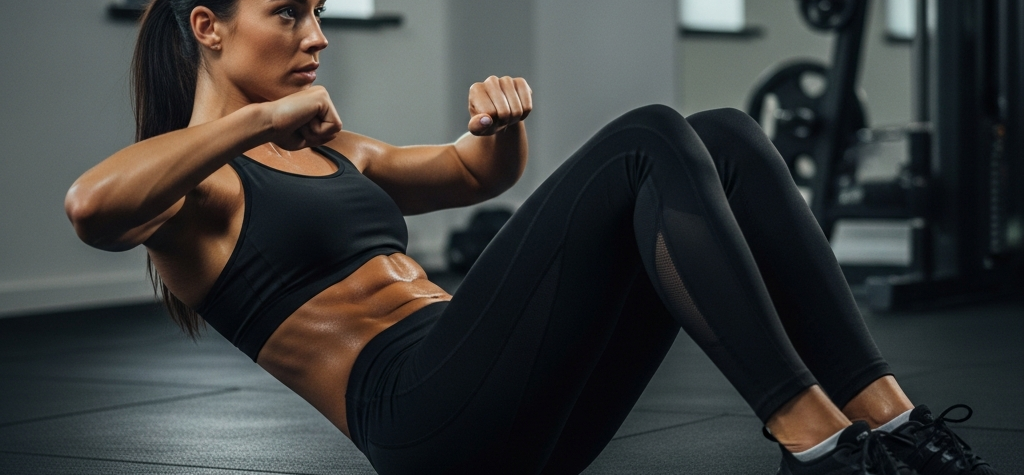
Full Abs Workout at Home: A Four-Week Beginner Plan Without Equipment
Author: RVLNSV PRASAD
Updated On: October 2026
About Us
Author Bio
Editorial Policy
Contact Us

Introduction
A full abs workout at home does not need complicated exercises, expensive equipment, or long sessions to be useful. The right routine can help you build abdominal strength, improve trunk control, and develop a more consistent exercise habit in a small space.
The difficulty is knowing where to start. Many online routines combine crunches, leg raises, mountain climbers, and long plank holds without explaining how to choose the right variation or when to rest. Beginners may end up using momentum, straining their necks, or repeating exercises that feel difficult but do not match their current ability.
A better approach is to train the core from several directions, learn controlled movement, and increase the challenge gradually. This guide provides a practical home routine, ten exercise options, a four-week progression plan, and ways to assess progress without relying only on the mirror.
The approach also reflects an important point from Mayo Clinic’s guide to core exercises: core training involves more than the abdominal muscles. The pelvis, hips, back, and trunk work together to support balance and everyday movement.
You do not need to complete every exercise in one session. Choose the versions you can perform comfortably, focus on technique, and use the plan as a starting point rather than a test of willpower.
Quick Answer: What Is the Best Full Abs Workout at Home?
A balanced beginner routine can include a dead bug, reverse crunch, bird dog, modified plank, glute bridge, and side plank variation. Start with two or three sessions per week, allow recovery between challenging sessions, and increase repetitions or hold times only when your technique remains controlled.
You can strengthen your abdominal muscles without equipment. However, abdominal exercise alone does not specifically remove belly fat, and visible abs are influenced by body composition, genetics, nutrition, and other individual factors.
Key Takeaways
- A full abs workout should train trunk control, abdominal strength, and the muscles that support the hips and back.
- Beginners can start with bodyweight movements and no gym equipment.
- Two or three focused sessions per week are a reasonable starting point for many healthy adults.
- A dead bug or bird dog may be more suitable than advanced leg raises if you struggle to control your lower back.
- Daily movement is useful, but hard abdominal sessions do not need to happen every day.
- Stronger abdominal muscles do not automatically mean visible six-pack abs.
- Sharp pain, persistent back discomfort, or loss of movement control are reasons to stop and reassess.
What Does a Full Abs Workout Actually Train?
People often use the word “abs” to describe the muscles at the front of the stomach. The broader core includes muscles around the abdomen, back, pelvis, and hips that help control movement and maintain stability.
| Muscle group | Main role | Useful beginner exercises |
|---|---|---|
| Rectus abdominis | Helps flex the trunk and control the pelvis | Modified crunch, reverse crunch |
| Transverse abdominis | Contributes to abdominal wall tension and trunk control | Dead bug, controlled breathing with abdominal bracing |
| Obliques | Help rotate the trunk and resist unwanted rotation. | Side plank, heel taps |
| Back and trunk stabilizers | Help control spinal position during movement. | Bird dog, modified plank |
| Gluteal muscles and hip stabilizers | Support hip movement and pelvic control. | Glute bridge, bird dog |
These muscles work together rather than functioning as completely separate units. A 2025 systematic review of core muscle training in competitive athletes reported improvements in some outcomes, including core endurance, dynamic balance, and sprint speed, while findings for other performance measures were less certain.
What this means for beginners: You do not need a separate exercise for every abdominal muscle. A small selection of well-chosen movements can provide a practical starting point.
Ten Best Abs Exercises at Home Without Equipment
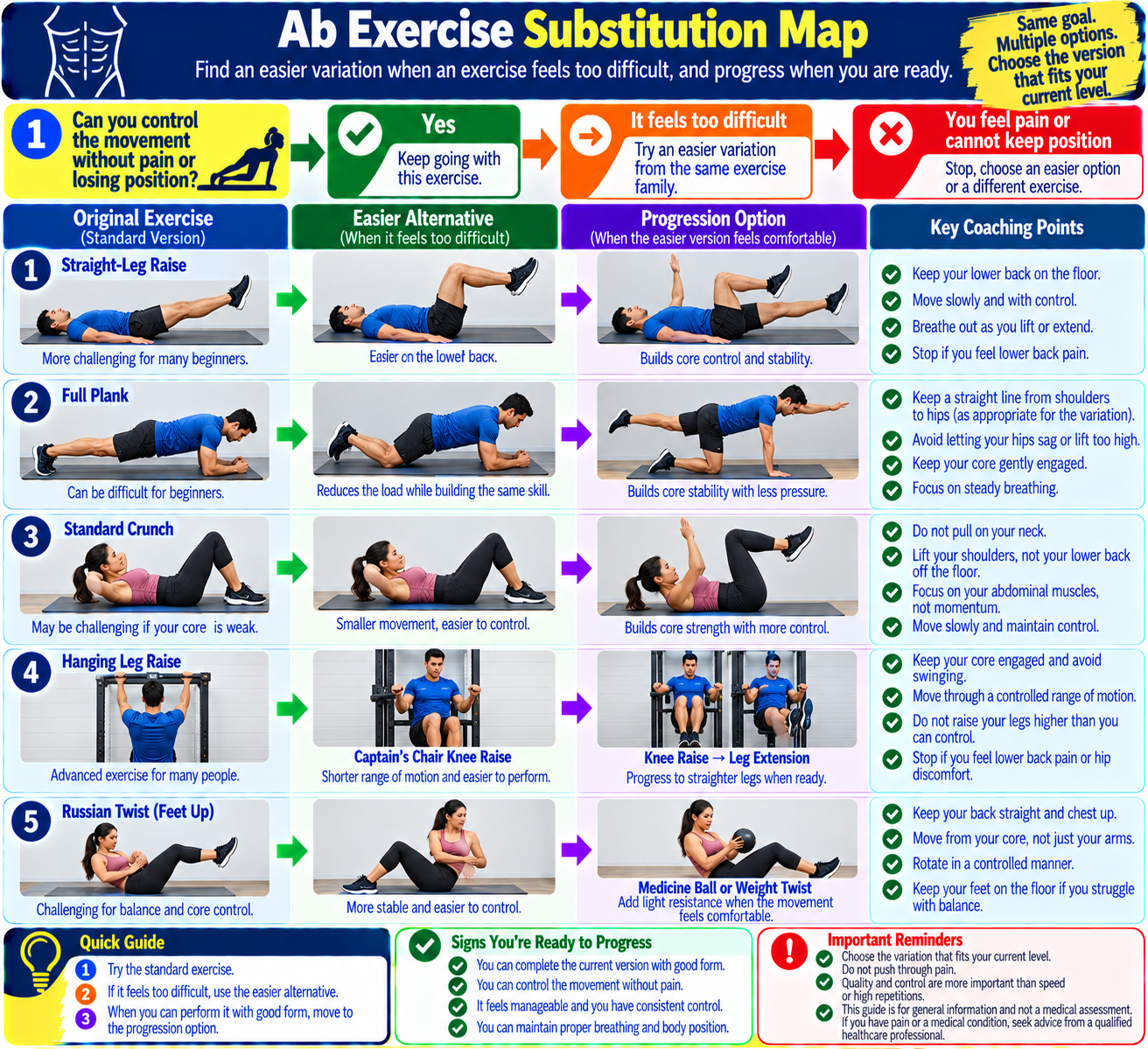
The following exercises are arranged from basic control movements to more demanding options. Begin with the easiest variation that lets you move without pain or losing control.
1. Dead Bug
Best for: Learning abdominal bracing while moving the arms and legs.
The dead bug is useful for beginners who find that their lower back arches during leg raises. The goal is to move slowly while keeping the trunk controlled.
How to do it:
- Lie on your back with your arms pointing toward the ceiling.
- Lift your legs so your hips and knees are bent comfortably.
- Gently brace your abdominal muscles without holding your breath.
- Slowly lower one arm and the opposite leg toward the floor.
- Return to the starting position and switch sides.
Start with 5–8 repetitions per side. Reduce the range of movement if your lower back arches or you cannot control the motion.
Common mistake: Lowering the leg too far just to make the exercise harder. A smaller, controlled movement is more useful than forcing a range you cannot manage.
2. Reverse Crunch
Best for: Practicing controlled pelvic movement.
Reverse crunches involve lifting the pelvis slightly rather than swinging the legs to create momentum.
How to do it:
- Lie on your back with your knees bent.
- Keep your arms beside your body.
- Bring your knees toward your chest.
- Gently curl your pelvis off the floor a small distance.
- Lower slowly and reset.
Try 6–10 repetitions. You do not need to lift your hips high or throw your legs backward.
Common mistake: Swinging the legs and using momentum. If you feel your lower back becoming uncomfortable, reduce the range or return to the dead bug.
3. Modified Forearm Plank
Best for: Developing trunk endurance.
A plank challenges your ability to maintain a stable body position. Beginners can start with their knees on the floor.
How to do it:
- Place your forearms on the floor.
- Keep your elbows approximately under your shoulders.
- Extend your legs or leave your knees down for the easier version.
- Gently tighten your abdomen and glutes.
- Breathe normally while holding the position.
Start with 10–20 seconds. End the set before your hips sag or your lower back begins to arch.
The Harvard Health guide to gentle core work emphasizes proper form and performing only as many repetitions or holding a position for as long as you can maintain good technique.
4. Bird Dog
Best for: Practicing coordination and trunk stability.
The bird dog combines arm and leg movement while you maintain a stable position on your hands and knees.
How to do it:
- Start on all fours with your hands below your shoulders.
- Keep your back in a comfortable neutral position.
- Extend one arm and the opposite leg.
- Avoid rotating your hips or lifting your leg too high.
- Return slowly and alternate sides.
Perform 5–8 repetitions per side.
Common mistake: Raising the leg high enough to twist the pelvis. Keep the movement small if necessary.
5. Glute Bridge
Best for: Supporting hip strength and pelvic control.
A glute bridge is not an isolated abdominal exercise, but it can complement a full core workout by training the muscles around the hips.
How to do it:
- Lie on your back with your knees bent and feet flat.
- Keep your arms relaxed beside your body.
- Tighten your glutes and raise your hips.
- Stop when your shoulders, hips, and knees form a comfortable line.
- Lower slowly.
Try 8–12 repetitions. Avoid pushing your hips so high that your lower back arches excessively.
Mayo Clinic includes the bridge among its recommended core-strength exercises.
6. Heel Taps
Best for: Practicing controlled trunk flexion and side-to-side reach.
Heel taps can be a simple option for people who are comfortable lying on their backs and moving through a small range.
How to do it:
- Lie on your back with your knees bent and feet flat.
- Keep your shoulders relaxed.
- Reach one hand toward the heel on the same side.
- Return to the center and reach toward the other heel.
- Alternate sides without pulling on your neck.
Start with 8–12 reaches per side.
Common mistake: Pulling the head forward or rushing from one side to the other. Keep the movement smooth and comfortable.
7. Modified Side Plank
Best for: Training the side muscles of the trunk.
The side plank challenges lateral stability. The knee-supported version is a useful alternative to a full side plank.
How to do it:
- Lie on one side with your elbow beneath your shoulder.
- Bend your knees and stack them comfortably.
- Lift your hips off the floor.
- Keep your trunk aligned without rolling forward.
- Hold briefly, then lower and switch sides.
Start with 10–15 seconds per side. Build the hold only while your shoulder and trunk position remain comfortable.
Common mistake: Allowing your hips to drop or twisting your torso toward the floor.
8. Modified Crunch
Best for: Training abdominal trunk flexion.
Crunches can be part of a full abs workout, but they are not compulsory. If they cause neck or back discomfort, choose a different exercise.
How to do it:
- Lie on your back with your knees bent.
- Place your hands lightly across your chest or beside your head.
- Exhale as you lift your head and shoulder blades slightly.
- Keep your neck relaxed and avoid pulling on your head.
- Lower under control.
Try 8–12 repetitions.
Common mistake: Trying to sit all the way up. A crunch uses a smaller movement and does not require you to lift your entire torso.
9. Bent-Knee Leg Raise
Best for: Progressing abdominal control during leg movement.
Straight-leg raises can be difficult for beginners because they may increase the tendency for the lower back to arch. Bent-knee versions offer a more manageable starting point.
How to do it:
- Lie on your back with your knees bent.
- Brace your abdomen gently.
- Lift your feet slightly off the floor.
- Lower them slowly without allowing your back to arch excessively.
- Return to the starting position.
Start with 5–8 repetitions. Keep your feet closer to the floor only if you can control the movement comfortably.
Common mistake: Continuing to lower the legs after losing abdominal control. Reduce the range rather than forcing the repetition.
10. Mountain Climbers
Best for: Combining core control with dynamic movement.
Mountain climbers are more demanding than the floor exercises above because they also raise your breathing rate.
How to do it:
- Start in a high plank with your hands under your shoulders.
- Bring one knee toward your chest.
- Return the foot and switch legs.
- Keep your hips relatively steady.
- Move at a speed that allows you to maintain good alignment.
Beginners can start with 10–20 seconds or practice slow knee drives. Stop when your hips begin bouncing or your shoulders cannot support the position comfortably.
Common mistake: Moving as fast as possible before learning the technique. Controlled repetitions are a better starting point.
The Full Abs Workout at Home: Your Beginner Routine
You do not need to perform all ten exercises in every workout. A balanced session can combine trunk control, abdominal movement, and side stability without creating an unnecessarily long routine.
| Exercise | Starting amount | Main purpose |
|---|---|---|
| Dead bug | 5–8 reps per side | Trunk control |
| Glute bridge | 8–12 reps | Hip and pelvic control |
| Modified plank | 10–20 seconds | Trunk endurance |
| Reverse crunch | 6–10 reps | Controlled abdominal movement |
| Bird dog | 5–8 reps per side | Coordination and stability |
| Modified side plank | 10–15 seconds per side | Side-trunk endurance |
Rest for approximately 30–60 seconds between exercises, or longer when needed. Beginners may complete one or two rounds. If you cannot maintain good form during the second round, finish after the first.
These ranges are practical starting suggestions, not a scientifically established ideal dose for every beginner. Adjust the workout to your experience, comfort, and recovery.
How long should a beginner ab workout take?
A short session of roughly 10–15 minutes can be enough to practice these movements. Allow time for a brief warm-up, controlled repetitions, and rest.
According to Harvard Health’s guidance on adding core exercises, people can start with basic core work and gradually increase the challenge. The important part is fitting it into a sustainable exercise routine.
A Four-Week Abs Workout Plan for Beginners
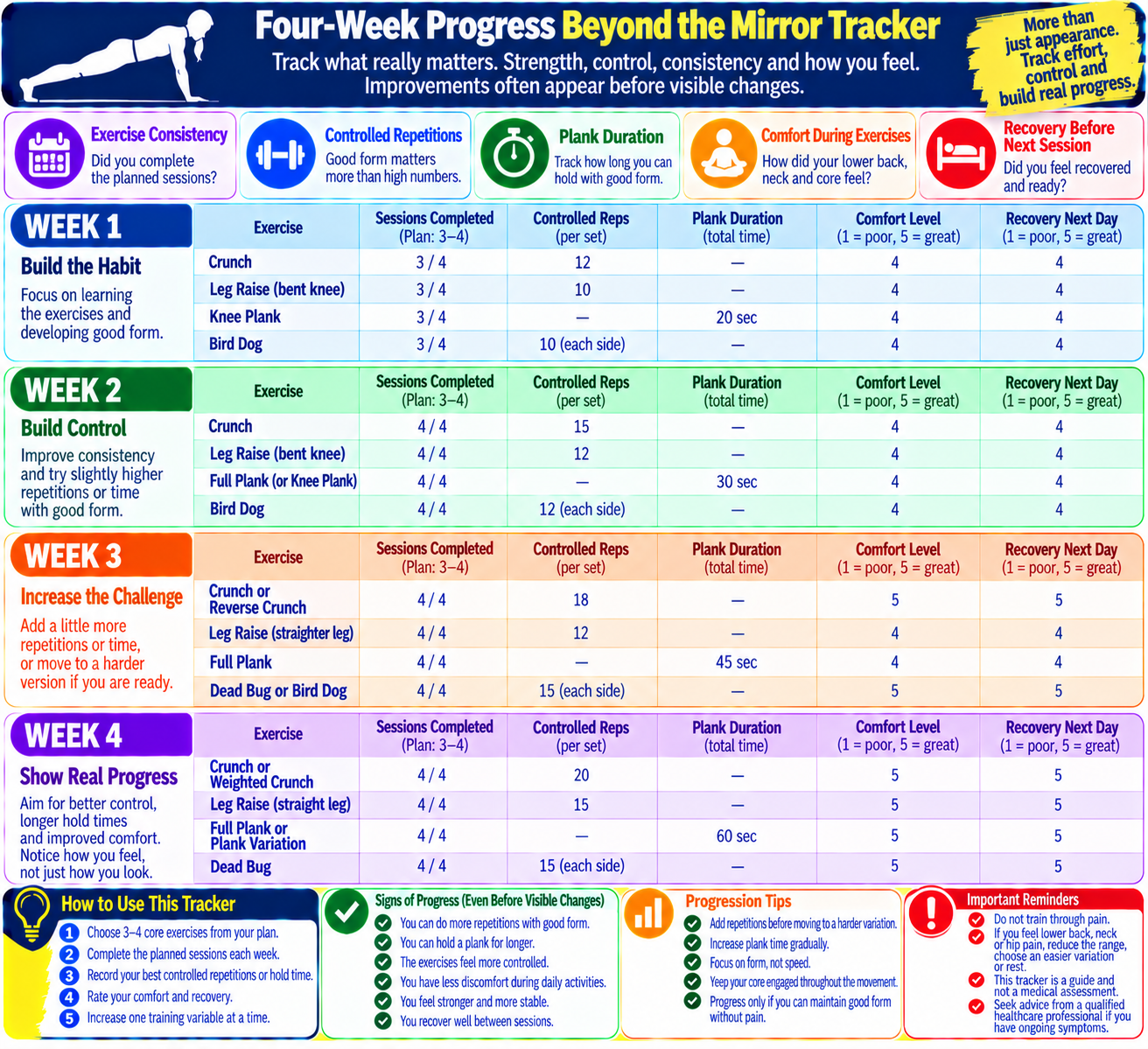
This four-week plan helps you build consistency without requiring hard abdominal exercise every day. Schedule the workouts on non-consecutive days when possible, and use the other days for walking, normal activity, mobility work, or rest.
| Week | Training goal | Suggested approach |
|---|---|---|
| Week 1 | Learn technique. | Perform 1 round of the first five exercises, using easier variations as needed. |
| Week 2 | Build consistency. | Perform 1–2 rounds of the selected routine if recovery is good. |
| Week 3 | Improve control. | Add a few repetitions or slightly longer holds to exercises you already perform well. |
| Week 4 | Consolidate progress | Maintain good form and review what has become easier before progressing. |
Example weekly schedule
| Day | Activity |
|---|---|
| Monday | Full abs workout |
| Tuesday | Walking or another comfortable activity |
| Wednesday | Full abs workout |
| Thursday | Rest or gentle mobility |
| Friday | Full abs workout, if recovered |
| Saturday | Walking or another enjoyable activity |
| Sunday | Rest and review the week. |
If three sessions feel too demanding, begin with two. If you are new to exercise, you can spend the first week practicing just the dead bug, bird dog, and glute bridge.
A practical progression rule: Change only one variable at a time. You might add two repetitions, extend a plank by five seconds, or move to a slightly harder variation. You do not need to increase all three in the same week.
Can You Get Visible Abs in 30 Days?
You may notice that certain movements become easier within a few weeks, particularly when you practice consistently. However, visible abdominal definition is much less predictable.
The appearance of abdominal muscles depends on several factors, including muscle development, the amount and distribution of body fat, genetics, and individual differences. A person can have a strong core without visible six-pack abs.
Core exercise can strengthen the muscles underneath abdominal fat, but it does not selectively remove the fat covering them. Mayo Clinic explains this distinction in its guide to core exercises.
A 2025 systematic review and meta-analysis of exercise programs in adults with higher weight or obesity included 12 studies involving 591 participants. The researchers reported reductions in abdominal visceral and subcutaneous fat after exercise programs, with outcomes associated with exercise intensity and baseline body mass index. These findings concern broader exercise programs, not abdominal exercises alone.
The takeaway is straightforward: use a 30-day plan to establish consistency and improve your exercise performance, not as a promise of a flat stomach.
Do Ab Exercises Burn Belly Fat?
Ab exercises help strengthen the abdominal muscles, but doing crunches or leg raises does not guarantee that your body will burn fat specifically from the stomach.
For changes in abdominal fat, the broader picture matters. Physical activity, eating patterns, total energy balance, sleep, and other health factors all influence body composition.
A 2024 systematic review and network meta-analysis of 84 randomized controlled trials examined different exercise types in people with higher weight or obesity. It found that aerobic exercise, resistance training, combined training, and high-intensity interval training were associated with improvements in measures such as visceral fat and waist circumference. This supports a broader fitness approach rather than relying on abdominal exercise alone.
For practical results:
- Include regular walking or other aerobic activity that suits your ability.
- Perform strength exercises for the major muscle groups.
- Eat balanced meals that provide enough protein, fiber, and other nutrients.
- Avoid extreme diets or routines that promise rapid belly-fat loss.
- Choose habits you can maintain beyond a four-week challenge.
If your primary goal is fat loss, the CDC’s guidance on healthy weight and physical activity can help you understand how movement fits into an overall approach.
A Simple Form and Recovery Check That Most Workout Plans Miss
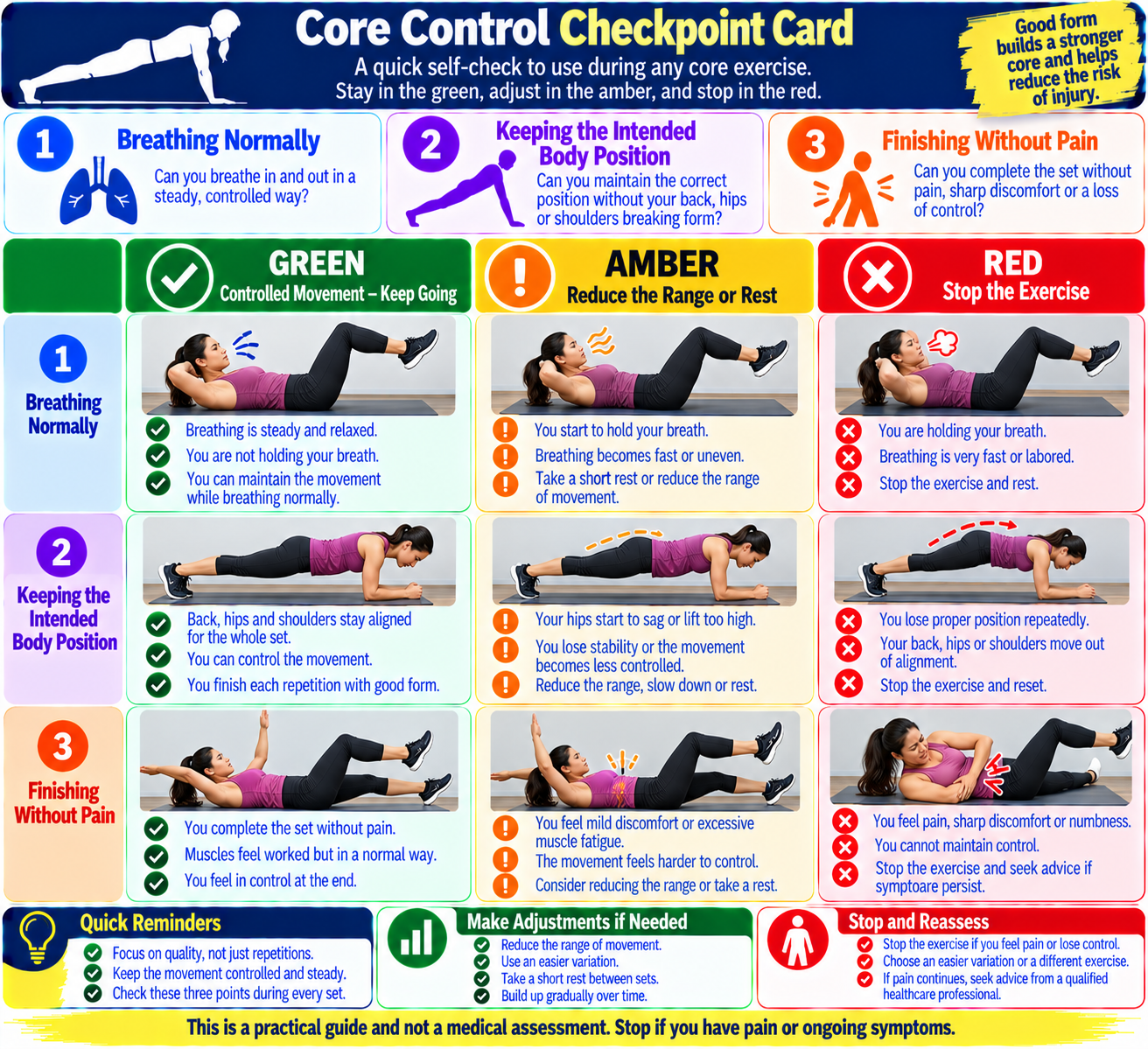
Instead of judging your workout only by how many repetitions you finish, use these checks before increasing the difficulty.
The three-question core control test
1. Can you breathe normally? You should not need to hold your breath throughout a basic plank or dead bug.
2. Can you control the movement? If your lower back repeatedly arches during a leg movement, reduce the range or select an easier version.
3. Can you finish without pain? Muscle effort can be normal, but sharp pain or worsening joint or back discomfort should not be ignored.
If one of these checks fails, make the exercise easier or stop the set. You do not have to complete every planned repetition.
Track control, not just numbers
A useful progress record includes:
| What to record | Example |
|---|---|
| Exercise | Dead bug |
| Repetitions | 6 per side |
| Technique | Controlled throughout |
| Difficulty | Moderate |
| Comfort | No pain |
| Next step | Repeat before progressing |
This simple log can help you notice improvements that a mirror cannot show. You might find that you can keep your pelvis steadier, breathe more naturally during a plank, or complete a movement with less effort.
People-first insight: If you are consistent but your stomach looks the same after four weeks, that does not automatically mean your workout has failed. Better movement control and greater exercise tolerance are meaningful improvements even when visible body changes take longer.
Common Mistakes That Can Slow Your Progress
Training your abs hard every day
More frequent training is not always better. Your abdominal muscles need time to recover, just like other muscles.
Try instead: Begin with two or three focused sessions per week and adjust according to your recovery.
Using momentum during leg raises
Swinging your legs may make repetitions easier to complete, but it can reduce your control over the movement.
Try instead: Bend your knees and lower your legs only as far as you can manage comfortably.
Holding a plank until your form collapses
A long hold is not useful if your hips sag, your back arches, or you cannot breathe comfortably.
Try instead: Use shorter holds with good alignment and gradually build duration.
Assuming soreness proves progress
Soreness is not a reliable measure of muscle growth or workout quality. You can make progress without feeling very sore after every session.
Try instead: Track technique, repetitions, exercise difficulty, and consistency.
Believing ab exercises alone will remove belly fat
Crunches train the abdominal muscles but do not selectively burn the fat above them.
Try instead: Combine core training with overall physical activity and sustainable nutrition habits.
Ignoring pain
Do not treat sharp pain or worsening back discomfort as a normal part of training.
Try instead: Stop the painful exercise, use an easier movement only if comfortable, and seek professional advice when symptoms persist or recur.
Frequently Asked Questions
What is the best abs workout at home for beginners without equipment?
A useful beginner routine can include dead bugs, bird dogs, glute bridges, modified planks, and reverse crunches. Start with controlled repetitions and select variations that you can perform comfortably.
How many days a week should I train my abs?
Two or three focused sessions per week are a reasonable starting point for many healthy adults. Your ideal schedule depends on your fitness, the difficulty of your workout, and how well you recover.
Can I do an abs workout at home every day?
Gentle movement may be appropriate on many days, but you do not need to perform a hard abdominal workout daily. Allow recovery between demanding sessions and reduce training if soreness or fatigue affects your technique.
Do I need equipment for a full abs workout?
No. Many core exercises use only body weight and a stable floor. A mat may make floor exercises more comfortable, but it is not essential.
How long does it take to strengthen abdominal muscles?
The time varies with your starting point, training consistency, exercise difficulty, and recovery. You may notice improvements in control or endurance within a few weeks, but visible muscle definition can take longer.
Are crunches necessary for strong abs?
No. Crunches are one option, not a requirement. Exercises such as dead bugs, planks, reverse crunches, and bird dogs train different aspects of trunk control and abdominal strength.
Can ab workouts reduce lower belly fat?
Ab workouts can strengthen the muscles in that area, but they do not selectively remove lower belly fat. Overall changes in body fat depend on broader activity, nutrition, and individual factors.
What should I do if I feel lower back pain during an ab exercise?
Stop the movement and reassess your technique. You may need a smaller range of motion or a simpler exercise. If pain persists, recurs, or affects everyday activities, seek advice from a qualified healthcare professional.
Conclusion: Build a Stronger Core One Session at a Time
A full abs workout at home can be simple, practical, and effective for developing abdominal strength and trunk control. You do not need dozens of exercises or daily high-intensity sessions to get started.
Begin with a few movements you can control, such as the dead bug, bird dog, glute bridge, and modified plank. Follow a consistent schedule, increase the challenge gradually, and allow time for recovery.
Remember that stronger abdominal muscles and visible abs are not the same outcome. If your goal includes reducing belly fat, combine core training with regular physical activity and sustainable eating habits rather than relying on crunches alone.
Your best routine is one you can repeat safely and adjust as your ability improves. Focus on good technique, realistic goals, and progress you can measure—not promises of a dramatic transformation in 30 days.
Author Note
This article provides general fitness education for people who want to develop core strength at home. Exercise instructions and training ranges are intended as practical starting points, not a personalized assessment. Add personal stories or claims of firsthand results only when they reflect genuine, verifiable experience.
Medical Disclaimer
This article is for informational purposes only and is not a substitute for professional medical advice, diagnosis, or treatment. Consult a qualified healthcare professional before starting a new exercise program if you have a medical condition, recent surgery, a significant injury, persistent back pain, or concerns about whether these exercises are appropriate for you.
Fitness Disclaimer
Exercise ability and tolerance vary from person to person. Start with a manageable level, use a stable surface, and stop if you experience sharp pain, dizziness, unusual shortness of breath, or loss of control. Do not force a movement through pain. Seek professional guidance when needed.
Sources
- Mayo Clinic — Core exercises: Why you should strengthen your core muscles
- Harvard Health — 11 tips for doing gentle core work safely and effectively (January 2026)
- Harvard Health — How to add core exercises to your workout routine
- Systematic review of core muscle training and sports performance (2025)
- Systematic review and meta-analysis of exercise programs and abdominal fat (2025)
- Systematic review and network meta-analysis of exercise types and visceral fat (2024)
- CDC — Physical activity and healthy weight
Related Topics
More knoqledge bout this tipic click here
10 Best Exercises to Lose Belly Fat
- 10 Best Core Exercises for Beginners at Home: Build a Stronger Core Without Equipment
- 10 Best Workouts To Get Six Pack Abs at Home
- 10 Best Workouts To Get Six Pack Abs at Home
- Home
- chest workouts without equipment
- 15-pilates-exercises-for-beginners










[…] Full Abs Workout at Home: Daily Routine to See Results in 30 Days […]
[…] Full Abs Workout at Home: Daily Routine to See Results in 30 Days […]
[…] Full Abs Workout at Home: Daily Routine to See Results in 30 Days […]
[…] Full Abs Workout at Home: Daily Routine to See Results in 30 Days […]
[…] Full Abs Workout at Home: Daily Routine to See Results in 30 Days […]
[…] Full Abs Workout at Home: Daily Routine to See Results in 30 Days […]
[…] Full Abs Workout at Home: Daily Routine to See Results in 30 Days […]
[…] Full Abs Workout at Home: Daily Routine to See Results in 30 Days […]
[…] Full Abs Workout at Home: Daily Routine to See Results in 30 Days […]
[…] Full Abs Workout at Home: Daily Routine to See Results in 30 Days […]
[…] Full Abs Workout at Home: Daily Routine to See Results in 30 Days […]