







































































































































































Breaking Bad Habits: 10 Evidence-Based Ways to Build Healthier Routines
Author: RVLNSV PRASAD
Updated On: October 2026
About Us
Author Bio
Editorial Policy
Contact Us

Quick Answer: How Can You Break Bad Habits?
To break bad habits, identify what triggers the behavior, understand what you get from it, and replace it with a healthier action that meets the same need. Make the unwanted behavior less convenient, prepare a realistic alternative, and repeat the new behavior in a consistent situation. Track your progress without expecting perfection, and treat setbacks as information rather than proof of failure.
For example, if stress makes you reach for snacks even when you are not hungry, pause to identify what you need at that moment. You might need a proper meal, a short break, emotional comfort, or a way to unwind. Choosing an alternative that addresses the real need is often more useful than relying on willpower alone.
Introduction: Why Breaking Bad Habits Is Harder Than It Looks
You decide to stop scrolling on your phone before bed, eat fewer sugary snacks, exercise regularly, or stop putting off important tasks. For a few days, everything seems manageable. Then a stressful afternoon, a poor night’s sleep, or an unexpected change in your schedule brings back the familiar behavior.
It is easy to interpret this as a lack of discipline. However, unhealthy habits are often connected to repeated situations, emotional needs, environmental cues, and rewards. When a behavior becomes familiar, you may perform it before you consciously consider whether it is helpful.
The National Institutes of Health (NIH) explains how habits develop and why familiar behaviors can be difficult to change. Repeated actions can become automatic, while rewarding experiences can reinforce the desire to repeat them. This helps explain why knowing that a habit is unhealthy does not automatically make it easy to stop.
The good news is that changing your routine does not require transforming your entire life overnight. A more practical approach is to identify one behavior, understand the circumstances surrounding it, and build a replacement that fits your real schedule.
This guide explains how to break bad habits using evidence-based behavior-change principles, practical examples, and realistic strategies for busy people. It also explores why common advice fails and how to make healthier routines easier to maintain.
What Are Bad Habits, and Why Do They Develop?
A habit is a behavior that becomes increasingly automatic after being repeated in a familiar context. Habits can be helpful, such as brushing your teeth after breakfast, or unhelpful, such as automatically checking social media whenever work becomes difficult.
The behavior itself is not the only part that matters. The circumstances surrounding it can help determine whether it becomes a repeated pattern.
A common way to understand an unwanted habit is to examine three elements:
- Trigger: Something that prompts the behavior, such as boredom, stress, a notification, or a particular time of day.
- Behavior: The action you take, such as opening an app, eating a snack, smoking, or delaying a task.
- Immediate outcome: What happens afterward, such as temporary relief, pleasure, distraction, or a sense of completion.
This is a practical framework for observing behavior, not a complete explanation of every habit. Some behaviors are influenced by dependence, mental health conditions, social pressures, financial circumstances, or other factors.
Research on habit formation suggests that context and repetition matter. A behavior performed repeatedly in a consistent situation can become more automatic over time. The NIH’s explanation of habit science provides a useful introduction to this process.
Understanding the pattern helps you choose a more effective response. Instead of asking only, “How can I stop doing this?” ask, “What usually happens immediately before I do it, and what need does it seem to meet?”
Why Willpower Alone Often Fails
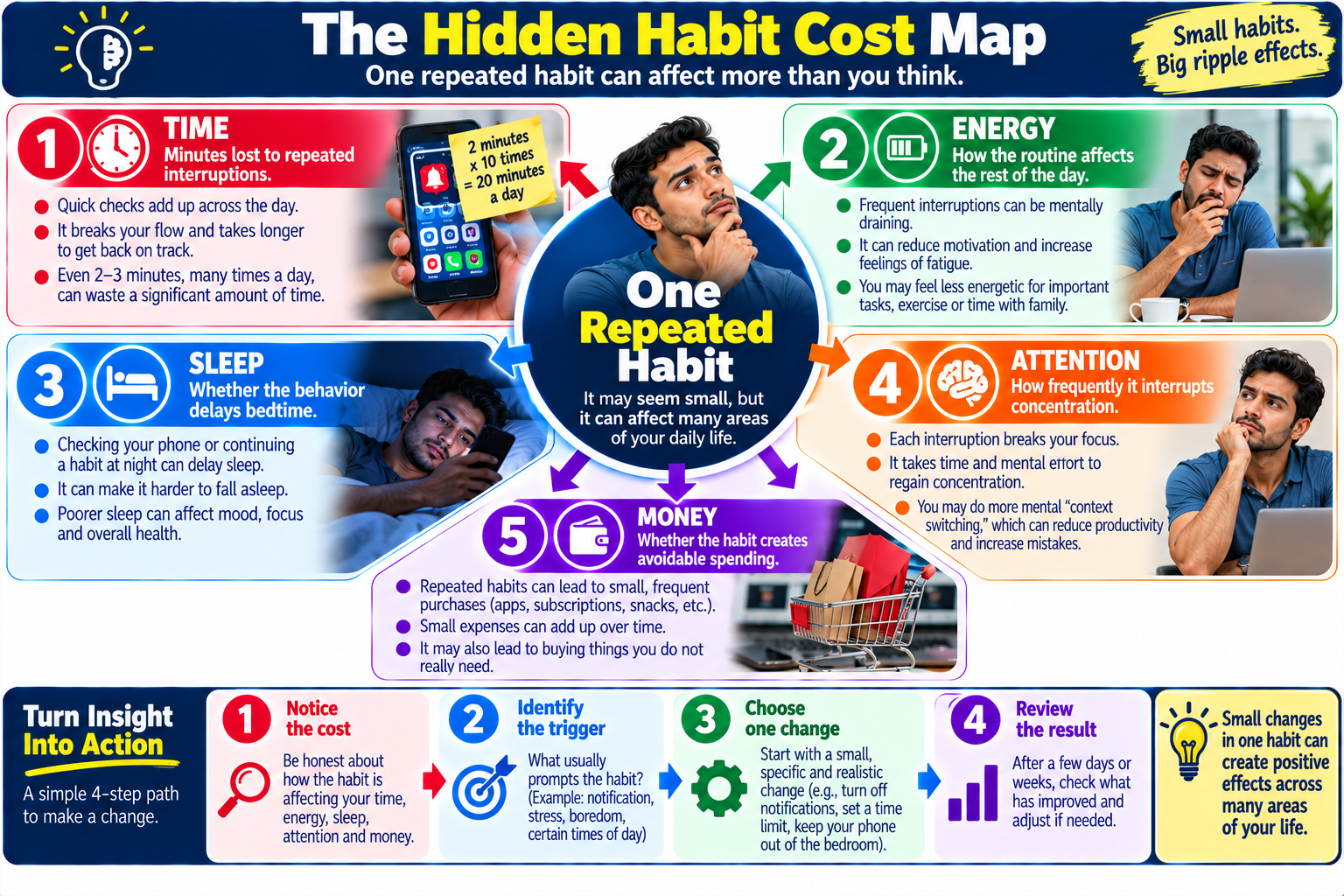
Willpower can help you make a decision, but repeatedly resisting a strong cue can be difficult, especially when you are tired, stressed, hungry, or surrounded by reminders of the behavior.
Imagine that you want to reduce unnecessary phone use. You keep your phone beside you while working, receive frequent notifications, and use the device whenever a task feels frustrating. Every notification creates another opportunity to interrupt your work.
Telling yourself to concentrate may help temporarily, but it does not change the environment that repeatedly invites distraction.
A more practical solution is to silence nonessential notifications, place the phone outside arm’s reach, and decide when you will check messages. You still need to make choices, but you have reduced the number of unnecessary decisions.
The same principle applies to food, sleep, physical activity, and household routines. Healthy choices become easier when your surroundings support them.
10 Evidence-Based Ways to Break Bad Habits
1. Identify the Trigger Before Trying to Stop the Habit
One of the most useful steps in breaking bad habits is learning when and why the behavior occurs.
For three to seven days, observe the unwanted habit without judging yourself. Record what happened immediately before it, where you were, how you felt, and what happened afterward.
For example, you might discover that you snack frequently while watching television, check messages whenever a work task becomes confusing, or stay awake late because nighttime is the only time you feel free from responsibilities.
These patterns suggest different solutions. A person who snacks because meals are inadequate needs a different approach from someone who eats for comfort. Someone who scrolls because they are lonely may need meaningful social connection rather than another screen-time limit.
Try this simple observation table.
| Habit | Possible trigger | What to investigate |
|---|---|---|
| Unplanned snacking | Stress, hunger, boredom | Meal timing, emotional needs, food availability |
| Excessive phone use | Notifications, difficult tasks | App cues, task avoidance, need for connection |
| Delaying exercise | Fatigue, lack of preparation | Sleep, workout timing, convenient alternatives |
| Late-night scrolling | Stress or desire for personal time | Evening routine, workload, bedtime environment |
| Procrastination | Uncertainty or fear of failure | Task size, unclear instructions, confidence |
These are possibilities, not diagnoses. Your own observations are more useful than assuming every behavior has the same cause.
Practical insight: Look for the first small decision in the sequence. If you regularly eat snacks while preparing dinner, for instance, the opportunity for change may occur when you enter the kitchen rather than after you have already started eating.
2. Replace the Habit Instead of Leaving an Empty Space
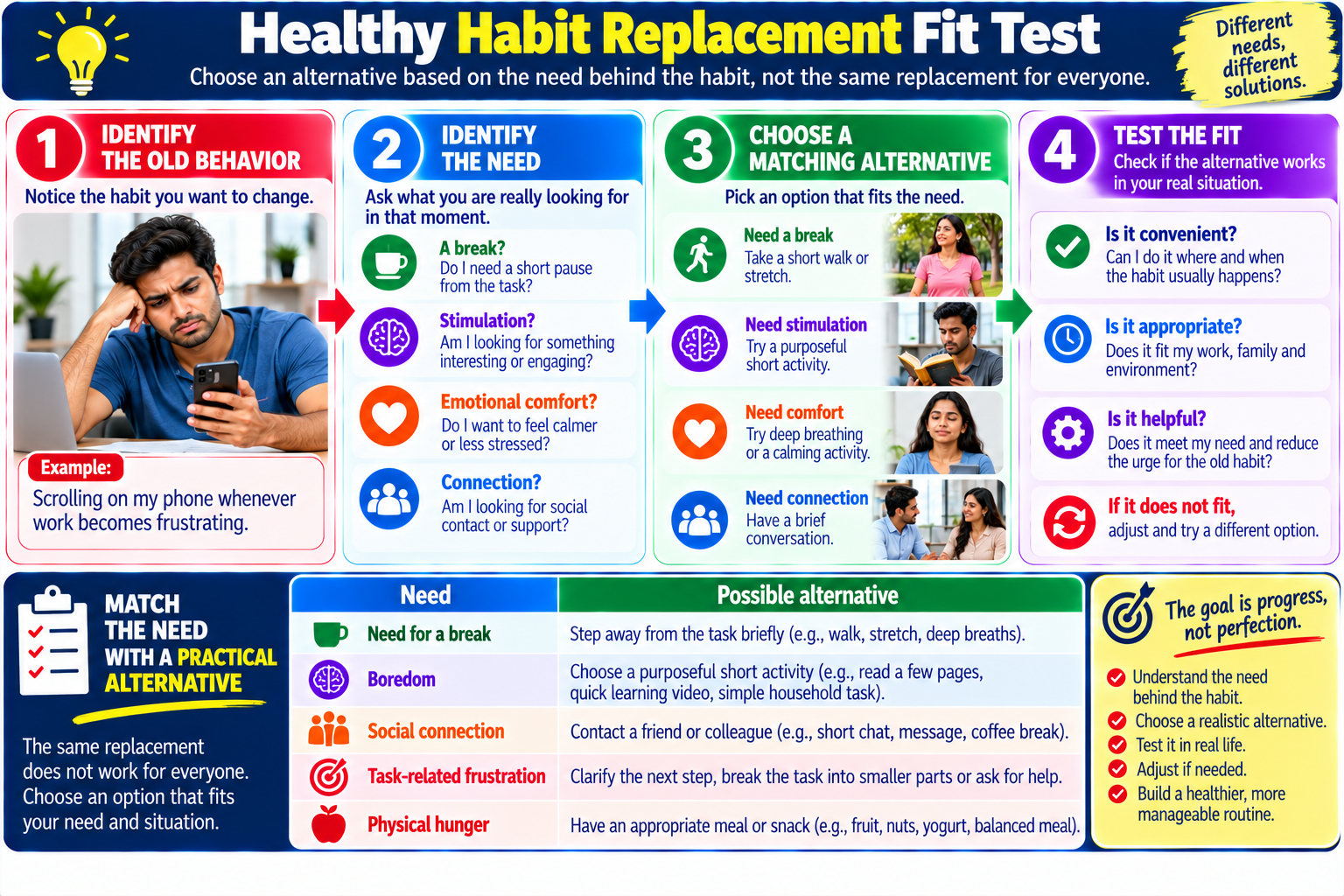
Simply removing an unwanted behavior can leave the original need unresolved.
If you use your phone to escape stressful work, taking the phone away without changing how you handle stress may leave you searching for another distraction. If you smoke during work breaks, removing the cigarette without planning an alternative break may make the change harder to maintain.
A healthier replacement should address the function of the old behavior whenever possible.
| Unwanted habit | Possible replacement |
|---|---|
| Checking social media during every break | Take a short walk or speak with a colleague |
| Eating automatically while watching television | Pause to assess hunger and choose a planned snack if needed |
| Sitting continuously for long periods | Stand, stretch, or walk briefly when practical |
| Scrolling in bed | Charge the phone away from the bed and read a book |
| Delaying a large task | Work on one clearly defined, small step |
| Reaching for a cigarette during stress | Use a prepared coping strategy and seek appropriate smoking-cessation support |
Replacement behaviors should be realistic. A person who is exhausted after work may not maintain a demanding exercise program, but they may manage a short walk or gentle movement.
The NIH discusses replacing unwanted routines with alternative behaviors as one potential habit-change strategy. Read its guide to breaking bad habits for further context.
Remember that smoking, substance use, and other forms of addiction may require specialized treatment. A simple replacement habit is not a substitute for appropriate medical care.
3. Make the Unwanted Habit Less Convenient
Your environment can either encourage or discourage a behavior.
When an unwanted action requires very little effort, it may become your automatic choice. Increasing the number of steps needed to perform it can create a useful pause in which you have time to choose differently.
For example, sign out of distracting websites, remove unnecessary apps from your home screen, keep your phone away from your desk during focused work, or avoid routinely purchasing foods you tend to eat without intending to.
This does not mean you must remove every enjoyable item from your life. The goal is to reduce automatic behavior, not to create a rigid environment in which ordinary pleasures become forbidden.
You can also make healthy actions easier. Keep walking shoes near the door, prepare tomorrow’s lunch after dinner, or place a book beside your bed.
This two-sided strategy is more practical than relying on restriction alone: add friction to the unwanted behavior and remove friction from the healthier alternative.
Research on habits also highlights the importance of context. When familiar environmental cues change, previously automatic behaviors may become less likely to occur. See the peer-reviewed study on changing circumstances and disrupting habits.
4. Use a Small Starting Action to Overcome Resistance
Large goals can create unnecessary pressure, particularly when you are already tired or busy.
Instead of promising to exercise for an hour every day, start with a short walk after lunch. Rather than deciding to reorganize your entire diet, begin by planning one balanced meal. If you want to read instead of scrolling, start with a few pages before bed.
The first action should be small enough to perform on an ordinary day.
This does not mean small actions are sufficient for every health goal. It means they can provide an achievable starting point from which you gradually build a more complete routine.
Consider the difference between these plans:
- Difficult starting point: Exercise intensely every morning, regardless of sleep or schedule.
- Flexible starting point: Walk for five to ten minutes after a regular daily activity, then increase the duration when appropriate.
The second plan offers a clear starting action and room to adapt.
A 2024 systematic review and meta-analysis examined 20 studies involving 2,601 participants and found improvements in habit-strength measures across the included health behaviors. The researchers also reported substantial variation in how long habit formation took, so no single timetable applies to everyone. You can read the full review of health-behavior habit formation.
5. Attach the New Habit to an Existing Routine
Remembering to perform a new behavior can be difficult when it has no natural place in your day.
One approach is to connect it to an activity that already happens regularly. This creates a predictable cue for the new action.
Examples include:
- After brushing your teeth, prepare the items you need for the morning.
- After lunch, take a short walk if your circumstances allow.
- After finishing work, put your phone away before starting your evening routine.
- After preparing dinner, arrange the ingredients or supplies needed for tomorrow.
- Before getting into bed, place your phone on its designated charger.
Choose a cue that genuinely fits your routine. If your mornings vary significantly, an evening cue may be more dependable.
You can make the plan more specific by writing an implementation intention: “When situation X occurs, I will perform action Y.”
For example, “When I finish lunch, I will walk outside for five minutes if the weather and my schedule allow.”
This turns a vague intention into a clear decision made in advance. It also reduces the need to decide repeatedly when to act.
6. Understand the Need Behind Emotional Habits
Some unwanted behaviors are closely connected to emotions.
You might eat when anxious, shop when lonely, scroll when bored, or avoid tasks when you fear making mistakes. These behaviors may offer short-term relief even when they create longer-term problems.
The solution is not to ignore emotions or label them as weakness. Instead, identify the feeling and choose a response that addresses it more directly.
Try this brief pause:
- Name the feeling as accurately as you can.
- Ask whether you need food, rest, movement, connection, reassurance, or help with a problem.
- Choose one appropriate action.
- Reassess how you feel afterward without expecting the feeling to disappear immediately.
For example, if work frustration leads to unnecessary scrolling, write down the specific problem that is blocking progress. You may discover that you need clarification, a short break, or assistance rather than more discipline.
Other options include journaling, speaking with a trusted person, spending time outdoors, or using a relaxation technique that suits you.
The CDC’s guidance on managing stress includes practical approaches such as connecting with others, engaging in enjoyable activities, and maintaining healthy routines.
If emotional eating, anxiety, low mood, or another difficulty is persistent or significantly affecting daily life, consider seeking support from a qualified healthcare professional.
7. Build a More Supportive Sleep Routine
Poor sleep can make it harder to concentrate, manage stress, and maintain planned routines. An evening pattern that repeatedly delays bedtime may therefore affect more than sleep alone.
Start by identifying the part of your routine that keeps you awake. It might be late caffeine, work messages, an inconsistent schedule, an uncomfortable sleeping environment, or the feeling that nighttime is your only personal time.
Then choose one manageable change.
For example, set a reminder to begin winding down, prepare tomorrow’s essentials earlier, or move entertainment away from the bed. If work regularly extends into the evening, you may need to address workload and boundaries rather than simply setting an earlier bedtime.
Most adults need at least seven hours of sleep, although individual needs vary. The CDC provides sleep recommendations and practical guidance for supporting healthier sleep habits.
Avoid treating every sleep problem as a bad habit. Persistent insomnia, loud snoring, breathing interruptions, or excessive daytime sleepiness may require medical evaluation.
8. Make Physical Activity Easier to Start
An inactive routine can become self-reinforcing. When movement feels tiring or inconvenient, it is easy to postpone it, particularly after a demanding day.
Instead of depending on motivation, make activity fit your existing life.
You could walk while taking a phone call, use stairs when appropriate, schedule a short movement break, or choose a form of exercise you genuinely enjoy. People who dislike gyms may prefer dancing, gardening, cycling, swimming, or walking with friends.
Preparation also matters. Keeping comfortable shoes accessible or deciding when to exercise the previous evening removes some of the decisions that might otherwise delay activity.
The World Health Organization’s physical activity guidelines explain the health benefits of physical activity and the importance of reducing sedentary behavior. Adults should work toward the recommended levels appropriate to their circumstances, while recognizing that some movement is generally better than none.
If you have a chronic health condition, significant pain, mobility limitations, or other concerns about exercise, choose an appropriate activity with guidance from a healthcare professional when necessary.
9. Use Technology as a Support Tool, Not Another Distraction
Technology can reinforce both helpful and unhelpful behaviors. A phone may remind you to move, support a sleep schedule, or track progress. The same device can also interrupt work repeatedly and encourage automatic checking.
The key is to give each tool a defined purpose.
For example, use a timer to remind yourself to take movement breaks, schedule specific times to check messages, or track one behavior that matters to your goal. Turn off notifications that do not need immediate attention.
Avoid tracking so many measures that the system becomes another burden. If your goal is to reduce late-night scrolling, recording your bedtime and whether you followed your planned routine may be enough.
A 2024 systematic review of digital behavior-change interventions identified approaches such as self-monitoring, goal setting, prompts, and feedback among the techniques used to support habit formation. However, digital tools vary in design and effectiveness; their presence alone does not guarantee lasting change. Explore the systematic review of digital behavior-change interventions.
Choose technology that helps you take action, and remove it when it repeatedly gets in the way.
10. Plan for Setbacks Before They Happen
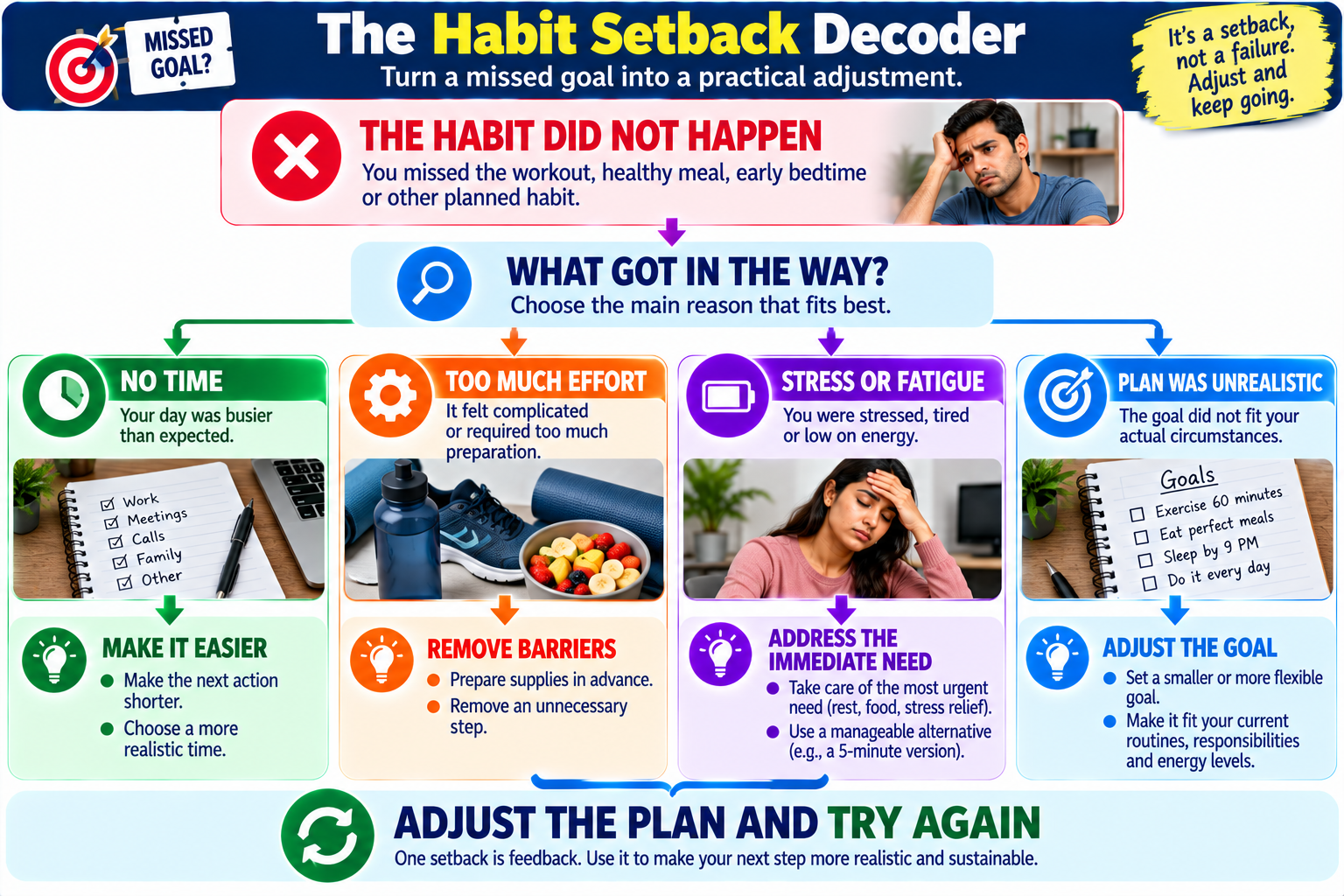
A common mistake is assuming that a successful change means never repeating the old behavior.
Real life is less predictable. Travel, illness, deadlines, family responsibilities, financial pressure, and disrupted sleep can all interfere with routines.
Instead of making an all-or-nothing promise, prepare a fallback plan.
For example, if you cannot complete your usual workout, choose a shorter session or gentle movement appropriate to your ability. If you miss your planned bedtime, return to your normal routine the following evening rather than deciding that the entire effort has failed.
It can help to ask three questions after a setback:
- What was different about this situation?
- Was my plan realistic under those conditions?
- What adjustment would make the next attempt easier?
This approach treats a setback as useful information. It does not require you to approve of the unwanted behavior or ignore its consequences.
However, repeated substance use, dangerous behaviors, or significant loss of control may need more than self-directed habit strategies. Seek appropriate professional support rather than treating every recurrence as an ordinary lapse.
A Practical Table: Common Habits and Better Alternatives
The following examples can help you turn broad intentions into specific plans. Adapt them to your circumstances instead of treating them as strict rules.
| Unwanted pattern | Possible reason | Practical replacement | How to make it easier |
|---|---|---|---|
| Checking your phone constantly | Notifications or boredom | Scheduled message checks | Silence nonessential alerts |
| Late-night scrolling | Stress or lack of personal time | Reading or another relaxing activity | Charge the phone away from the bed |
| Skipping movement | Fatigue or poor planning | Short walks or movement breaks | Keep shoes accessible |
| Eating without noticing | Distraction or emotional needs | Pause and assess hunger | Eat seated when practical |
| Procrastinating | Unclear or intimidating tasks | Complete one small step | Define the next action in advance |
| Inconsistent sleep | Variable routines | A more consistent wind-down period | Prepare for bed earlier |
| Abandoning goals after one lapse | All-or-nothing thinking | Resume with a smaller action | Create a fallback plan |
The aim is not to eliminate every imperfect behavior. It is to make repeated choices more consistent with your health, priorities, and daily responsibilities.
A Less Common but Useful Strategy: The Habit Friction Audit
Many habit-change articles recommend setting goals, tracking progress, and staying motivated. A useful additional step is to investigate how much effort your daily environment requires from you.
A habit friction audit is a simple personal exercise, not a validated medical assessment. It helps you identify unnecessary obstacles and design your environment around the behavior you want to change.
Choose one unwanted habit and answer these questions:
Where does it usually happen? Identify the room, device, time of day, or social situation that commonly precedes it.
What makes it easy to repeat? Consider notifications, convenient access, fatigue, lack of preparation, or an unclear alternative.
What makes the healthier choice difficult? Perhaps exercise clothes are unavailable, healthy meals take too long to prepare, or work interruptions make concentration difficult.
What single adjustment could change the situation? Move the phone, prepare a meal component, set a clear work boundary, or choose a more convenient activity.
How will you know whether the change helps? Record a simple outcome, such as fewer unplanned phone checks or more days when you take a walk.
For example, someone who repeatedly orders takeaway after a tiring workday may not benefit much from being told to cook every meal from scratch. Preparing a few ingredients in advance and keeping convenient, nutritious alternatives available may be more realistic.
The important distinction is that the strategy changes the conditions surrounding the habit instead of demanding more effort from the person every time.
How Long Does It Take to Break a Bad Habit?
There is no universal deadline for breaking bad habits.
A 2024 systematic review and meta-analysis of 20 studies involving 2,601 participants found substantial variation in the time needed for health-related habits to develop. In the subset of studies reporting formation times, median estimates were approximately 59–66 days, while mean estimates were approximately 106–154 days. Individual estimates varied considerably, and many included studies had a high risk of bias. These findings concern habit formation, not a guaranteed timetable for eliminating an unwanted habit. Read the full scientific review.
The practical lesson is to measure progress by changes in behavior rather than counting down to an arbitrary day.
A simple approach is to track three things:
- How often the unwanted behavior occurs.
- How often you perform the healthier alternative.
- Whether the new routine becomes easier to repeat in its usual context.
If progress stalls, reconsider the trigger, the replacement behavior, or the amount of effort your plan requires. You may need a different approach rather than a stricter one.
Common Mistakes That Make Habit Change Harder
Trying to change everything at once
Attempting to overhaul your diet, sleep, exercise, screen use, and schedule simultaneously can make your plan difficult to maintain. Start with one behavior that matters and expand when your routine becomes manageable.
Depending on motivation every day
Motivation changes with sleep, stress, mood, and circumstances. Use reminders, preparation, predictable cues, and a supportive environment to make action easier even when motivation is low.
Choosing a replacement that does not meet the same need
If an unwanted behavior provides comfort or a break from work, replacing it with another demanding task may not help. Identify what the behavior provides and select a healthier alternative that addresses that need.
Treating a setback as complete failure
Missing one planned activity does not erase previous progress. Examine what happened, make a realistic adjustment, and return to your routine when appropriate.
Using shame as a source of motivation
Harsh self-criticism can make an already difficult process more stressful. Honest reflection is useful, but personal insults do not provide a practical plan for the next situation.
Following advice that ignores your circumstances
A strategy designed for someone with flexible working hours may not suit a shift worker, caregiver, or person with a disability. Choose changes that fit your available time, resources, responsibilities, and health needs.
A Simple Seven-Day Plan to Start Breaking Bad Habits
You do not need to change your whole life in one week. Use the following plan to understand one unwanted behavior and test a more helpful routine.
| Day | Action | Goal |
|---|---|---|
| Day 1 | Choose one habit | Make the target specific |
| Day 2 | Observe its triggers | Identify common situations |
| Day 3 | Identify the need it meets | Understand why it repeats |
| Day 4 | Choose a replacement | Select a realistic alternative |
| Day 5 | Change your environment | Make the new action easier |
| Day 6 | Test your plan | Observe what works and what does not |
| Day 7 | Review and adjust | Prepare for the following week |
At the end of the week, ask whether the plan fits your actual life. If it does, continue practicing it. If it does not, reduce the difficulty or select a different replacement.
Seven days is a starting period for observation and experimentation, not a promise that a habit will disappear within a week.
When Should You Seek Professional Help?
Many everyday habits can be addressed with practical changes, but some behaviors require specialized support.
Consider speaking with a qualified healthcare professional if a behavior feels difficult to control despite repeated attempts, causes significant distress, damages relationships, or interferes with work and daily responsibilities.
Examples include problematic alcohol or drug use, nicotine dependence, gambling that creates financial harm, persistent emotional eating, and compulsive behaviors. Mental health conditions, chronic pain, sleep disorders, and other medical factors may also influence routines.
For smoking cessation, the CDC’s guidance on quitting smoking explains that counseling and approved medications can help people quit. People who are concerned about alcohol or other substance use can discuss appropriate treatment options with a healthcare professional.
Seeking help is not evidence of weak character. It is a way to match the support to the difficulty you are experiencing.
Key Takeaways
- Breaking bad habits starts with understanding triggers and the needs that a behavior may meet.
- Replacing an unwanted routine with a practical alternative can be more useful than simply trying to suppress it.
- A supportive environment reduces unnecessary reliance on willpower.
- Small starting actions and consistent cues can help you practice a new behavior.
- Stress, sleep, social circumstances, and access to resources can affect your ability to maintain change.
- Habit formation takes different amounts of time for different people; the familiar 21-day rule is not a universal scientific deadline.
- Setbacks can reveal where your plan needs adjustment.
- Some behaviors, particularly addictions and compulsive patterns, may require professional treatment.
Frequently Asked Questions
1. What is the easiest way to break a bad habit?
Start by identifying the situation that usually triggers the behavior. Choose one realistic replacement, make it easier to perform, and practice it in a consistent context. The best starting point is a strategy you can repeat in ordinary daily life.
2. Can you break a bad habit without willpower?
You still need to make decisions, but you can reduce the number of times you must resist a familiar cue. Changing your environment, planning alternatives, and establishing predictable routines can make healthier behavior easier to maintain.
3. Is it possible to replace a bad habit with a good one?
Yes, in many everyday situations. Identify what the unwanted behavior provides and choose an alternative that meets a similar need. For example, a short walk or a conversation may provide a break from stressful work without relying on an unhelpful pattern of distraction.
4. Why do bad habits return after you stop them?
Old cues and familiar situations can prompt previously learned behavior, even after you have practiced a new routine. Stress, fatigue, changes in circumstances, and easy access to the old behavior may also contribute. Returning to the plan and adjusting the environment can help, although some problems require professional support.
5. How long does it take to form a healthier habit?
There is no fixed number of days. A 2024 systematic review found substantial variation across health-related behaviors and individuals. Repetition in a consistent context can help, but the time needed depends on the behavior and the circumstances. Read the research.
6. What is the difference between a habit and an addiction?
Habits are repeated behaviors that can become automatic. Addiction involves more complex processes, including impaired control and continued behavior despite harmful consequences. Some behaviors may feel compulsive without necessarily meeting the criteria for an addiction. A qualified professional can help assess concerns and recommend treatment.
7. What should I do if I keep failing to change a habit?
Review the situations in which the behavior occurs, the difficulty of your plan, and whether the replacement meets your needs. Consider starting with a smaller action or seeking additional support. Repeated difficulty is a reason to reassess the approach, not to conclude that change is impossible.
Author Note
Author: RVLNSV PRASAD
This article is intended to help readers understand everyday habit patterns and identify practical, evidence-informed ways to support healthier routines. It draws on published research and guidance from established health organizations. Individual results vary, and the suggestions should be adapted to each person’s circumstances.
For more information about the author, visit the Author Biography. You can also review the site’s Editorial Policy.
Medical Disclaimer
This article is for educational purposes only and does not replace professional medical advice, diagnosis, or treatment. Do not stop prescribed medication or delay appropriate care because of information in this article. Consult a qualified healthcare professional if an unwanted behavior is causing significant distress, affecting your health, or feels difficult to control.
Fitness Disclaimer
Physical activity recommendations should be adapted to individual fitness levels, health conditions, mobility, and medical advice. Start at a comfortable level and increase activity gradually when appropriate. Stop exercising and seek medical guidance if you experience concerning symptoms such as chest pain, faintness, or unusual shortness of breath.
Sources
The following resources support the article’s discussion of habit formation, behavior change, physical activity, stress management, and smoking cessation.
- National Institutes of Health — Breaking Bad Habits: An overview of how habits develop and approaches that may help change them.
- Singh and colleagues — Time to Form a Habit: A Systematic Review and Meta-Analysis (2024): Research examining habit formation across health behaviors and the variation in time needed.
- Journal of Medical Internet Research — Digital Behavior Change Intervention Designs for Habit Formation: A systematic review of digital approaches, including self-monitoring, prompts, and goal setting.
- PubMed — Changing Circumstances, Disrupting Habits: Research examining how changes in context can disrupt habitual behavior.
- Centers for Disease Control and Prevention — Managing Stress: Practical guidance on stress management, social connection, and healthy routines.
- World Health Organization — Guidelines on Physical Activity and Sedentary Behaviour: Evidence-based physical activity recommendations for different populations.
- Centers for Disease Control and Prevention — How to Quit Smoking: Guidance on smoking cessation and evidence-based support.
Final Thoughts: Make the Next Healthy Choice Easier
Breaking bad habits is not simply a test of determination. It involves learning which situations encourage unwanted behavior, identifying the needs behind it, and creating conditions that support a better response.
A healthier routine might begin with a phone-free period before bed, a short walk after lunch, a more consistent sleep schedule, or a plan for handling stressful moments without returning automatically to an unwanted behavior.
The most useful change is not necessarily the biggest one. It is the change that addresses a real problem, fits your circumstances, and can be repeated often enough to become part of your life.
You do not need to follow every strategy in this article. Choose one habit, experiment with one practical alternative, and review what happens. If your first plan does not work, use what you learned to make the next attempt more realistic.
Progress comes from building a system that supports healthier
Related Articles
- Category
- How to Achieve Balance Holistic Wellness Practices
- The American Wellness Revolution: How to Thrive in a Fast-Paced World
- Body, Mind, and Soul: A Holistic Approach to Health in the USA
- From Coast to Coast: Embracing a Best Healthy Lifestyle in the USA










[…] Breaking Bad Habits: How Americans Are Redefining Health and Wellness […]