







































































































































































Science-Backed Fitness Habits: 12 Ways to Get Stronger and Healthier
Author: RVLNSV PRASAD
Updated On: October 2026
About Us
Author Bio
Editorial Policy
Contact Us
Introduction
Getting fit does not require an extreme workout plan, a perfect diet, or hours in the gym.
For most people, the harder part is not knowing that exercise is good for them. The harder part is building a routine that can survive busy workdays, poor sleep, family responsibilities, travel, low motivation, and the occasional bad week.
That is why science-backed fitness habits matter.
A good fitness routine should improve more than appearance. It should help you become stronger, move more easily, build cardiovascular fitness, recover well, and stay active over the long term. The CDC notes that regular physical activity can improve sleep, reduce anxiety, support heart health, help maintain a healthy weight, strengthen bones, and reduce the risk of several chronic diseases. CDC: Health Benefits of Physical Activity for Adults
The latest evidence also gives us a useful reminder: fitness does not have to look complicated. The American College of Sports Medicine’s 2026 resistance-training update synthesized 137 systematic reviews involving more than 30,000 participants and found that many different resistance-training approaches can work. Consistency is more important than building an unnecessarily complicated program. ACSM: 2026 Resistance Training Guidelines
I learned a similar lesson from my own experience. Earlier in my fitness journey, I sometimes tried to do too much at once. I would start with enthusiasm, follow a demanding routine, and then struggle to maintain it. Eventually, I began focusing more on repeatable habits than impressive workouts.
That change made fitness feel much more manageable.
This guide explains the habits that matter most, what current research says, common mistakes that can slow progress, and several practical strategies that are still overlooked in many general fitness articles.
Quick Answer: What Are the Best Science-Backed Fitness Habits?
The most useful habits are not necessarily the hardest ones.
A strong foundation includes regular aerobic activity, resistance training, daily movement, adequate sleep, sensible nutrition, gradual progression, recovery, mobility, and a routine you can realistically repeat.
For most adults, current U.S. guidelines recommend at least 150 minutes of moderate-intensity aerobic activity each week or 75 minutes of vigorous activity, plus muscle-strengthening activity on at least two days per week. More activity can provide additional health benefits. CDC: Adult Physical Activity Guidelines
You do not have to achieve the full target immediately.
The National Institute of Diabetes and Digestive and Kidney Diseases recommends starting slowly and building up gradually. Even 10-minute periods of activity can be a practical starting point for someone who is currently inactive. NIDDK: Tips for Starting Physical Activity
The goal is not to find the perfect workout but to build a fitness routine that you can enjoy, maintain, and continue over time.
Key Takeaways
- Consistency beats occasional extreme workouts.
- Combine aerobic activity with resistance training.
- Start below your maximum if you are new to exercise.
- Increase training gradually rather than changing everything at once.
- Train major muscle groups regularly.
- Break up long periods of sitting when possible.
- Treat sleep and recovery as part of fitness rather than wasted time.
- Eat enough nutritious food to support your activity.
- Track useful measures such as strength, endurance, consistency, and how you feel.
- Do not confuse soreness with progress.
- Short activity sessions can still be useful when a long workout is impossible.
- The best routine is the one you can realistically repeat.
What Makes a Fitness Habit Evidence-Based?
A fitness habit should not become “science-backed” simply because a social-media post says it is.
A stronger approach is to look for several things:
- Evidence from controlled trials or systematic reviews.
- Recommendations from recognized health organizations.
- Findings that have been reproduced across different populations.
- A realistic explanation of what the evidence does and does not prove.
- Practical advice that does not exaggerate expected results.
This distinction matters.
For example, research supports regular physical activity as an important part of health. It does not mean that one particular exercise, supplement, morning routine, or workout style is guaranteed to produce the same result for everyone.
A 2025 systematic review of physical-activity patterns found that consistently active adults generally had lower risks of all-cause and cardiovascular mortality than people with lower activity levels, although observational research cannot prove that activity alone caused every difference. PubMed: Physical Activity Trajectories and Mortality
That is a better way to understand fitness research: strong evidence can guide decisions without promising identical results.
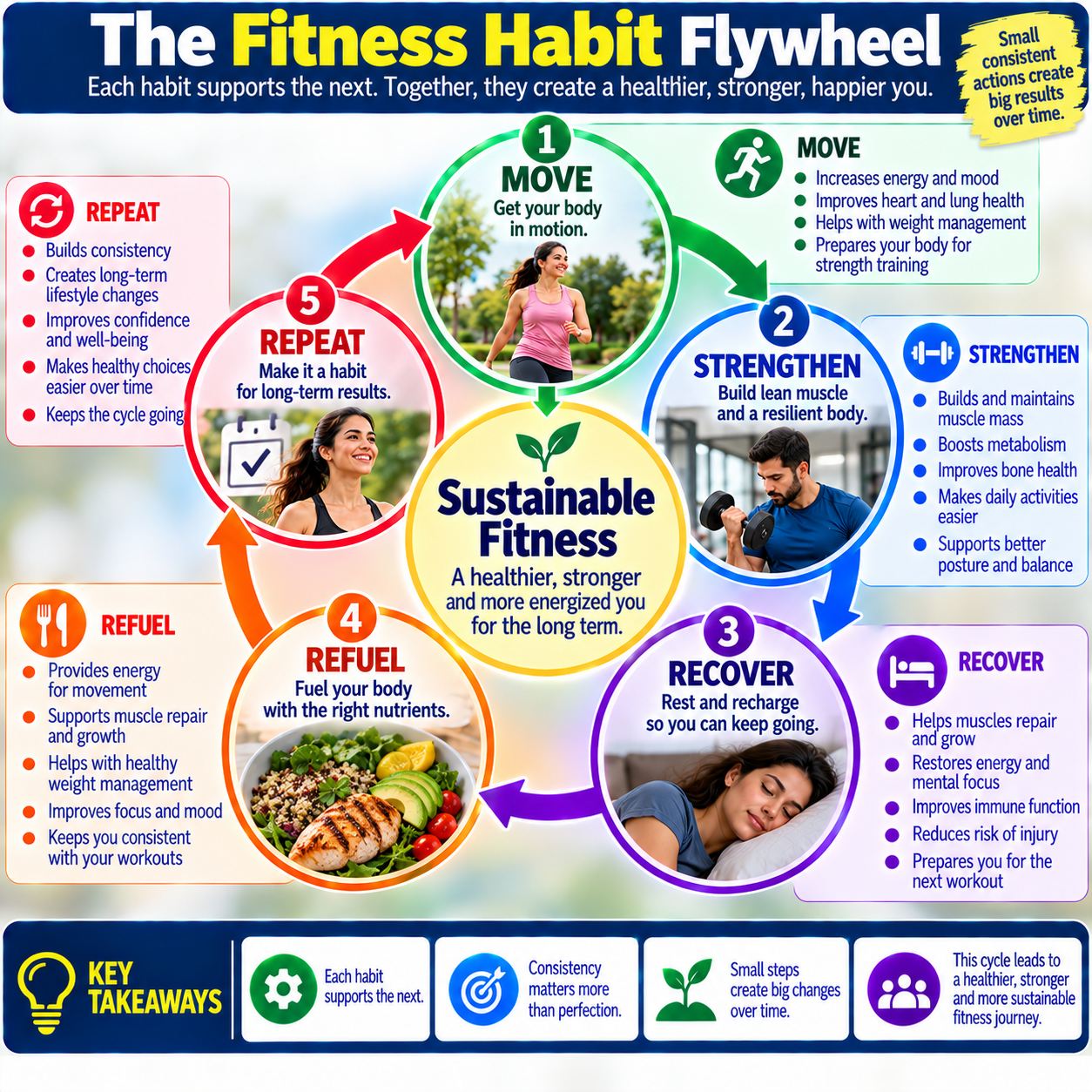
1. Make Regular Movement Your Foundation
The first of the most practical science-backed fitness habits is simple: move regularly.
You do not need to begin with a sophisticated workout program.
Walking, cycling, swimming, dancing, household activity, recreational sports, and structured exercise can all contribute to physical activity.
The CDC emphasizes that some physical activity is better than none, and adults can divide their weekly activity into smaller periods rather than completing it in long sessions. CDC: Adding Physical Activity as an Adult
This is particularly useful for busy people.
Instead of thinking:
“I don’t have one free hour today.”
Try:
“Where can I add several short periods of movement?”
A 10-minute walk after a meal, a few minutes of stairs, walking during a phone call, or a short home workout can make an inactive day more active.
A practical starting point
If you currently do very little activity:
- Walk for 10 minutes.
- Repeat this several days a week.
- Add a few minutes as your tolerance improves.
- Eventually work toward the recommended weekly amount.
NIDDK specifically recommends starting slowly and adding approximately 5 to 10 minutes at a time as activity becomes easier. NIDDK: Tips for Starting Physical Activity
2. Build Strength at Least Twice a Week
Cardio is important, but a complete fitness routine also needs resistance training.
Strength training can involve:
- Dumbbells
- Resistance bands
- Machines
- Bodyweight exercises
- Push-ups
- Squats
- Lunges
- Rows
- Carries
- Other forms of resistance
The CDC recommends muscle-strengthening activity on at least two days each week for adults, with exercises that work all major muscle groups. CDC: What Counts as Physical Activity for Adults
The evidence for resistance training is substantial.
A 2026 ACSM Position Stand synthesized 137 systematic reviews involving more than 30,000 participants and found that resistance training improved muscle strength, muscle size, power, endurance, balance, gait speed, and other measures of physical function. PubMed: ACSM Resistance Training Position Stand 2026
This does not mean you need an advanced bodybuilding routine.
For many people, two well-designed full-body sessions each week can be a practical starting point.
3. Progress Gradually Instead of Chasing Exhaustion
One of the biggest mistakes beginners make is confusing difficulty with effectiveness.
A workout does not have to leave you exhausted to be productive.
Progress can come from gradually increasing:
- Resistance
- Repetitions
- Sets
- Exercise difficulty
- Range of motion
- Training frequency
- Movement quality
The 2026 ACSM evidence review found that many different resistance-training prescriptions can improve fitness, while some variables are more important for particular goals. For example, heavier loads can be useful for maximizing strength, while higher training volumes can support hypertrophy. ACSM: Updated Resistance Training Guidelines
A useful rule is
Change one major variable at a time.
If you increase weight, add many sets, increase frequency, and introduce new exercises in the same week, it becomes harder to know what your body is responding to.
4. Stop Treating Muscle Failure as Mandatory
You do not have to take every set to complete muscular failure.
This is one of the more interesting recent developments in resistance-training research.
A 2026 systematic review and meta-analysis of 20 studies involving 556 participants compared resistance training performed to failure with training that stopped short of failure. The researchers found no significant differences in several outcomes such as hypertrophy, muscular endurance, and power, while non-failure training showed an advantage for dynamic strength in the pooled analysis. PubMed: Resistance Training to Failure vs Non-Failure
That does not mean training close to failure is useless.
It means failure is not a magical requirement for every set.
For everyday fitness, leaving some capacity in reserve can make training more manageable and may help you maintain good technique.
5. Include Cardiovascular Exercise You Actually Enjoy
Cardiovascular fitness is another major part of a complete program.
You could choose:
- Brisk walking
- Jogging
- Cycling
- Swimming
- Dancing
- Rowing
- Hiking
- Sports
- Elliptical training
- Other activities that raise your heart rate
The current adult activity guidelines provide several ways to reach the aerobic target. You can accumulate moderate activity, vigorous activity, or an appropriate combination of both. CDC: Adult Activity Guidelines
You do not have to choose the most fashionable form of cardio.
- If you hate running but enjoy walking, walking may be the better long-term choice.
- If you enjoy cycling, use cycling.
- If you prefer dancing, dance.
The practical advantage is adherence.
6. Use “Exercise Snacks” When Life Gets Busy
One of the more useful emerging ideas is the exercise snack.
An exercise snack is a short bout of activity performed during the day instead of relying entirely on one long workout.
Recent research is making this concept particularly interesting.
A 2025 systematic review and meta-analysis of randomized trials found that brief exercise bouts performed throughout the day could improve cardiorespiratory fitness in adults, although the certainty of evidence varied across outcomes. PubMed: Exercise Snacks and Fitness in Inactive Adults
Another 2025 systematic review involving 26 studies reported potential improvements in metabolic, cardiovascular, functional, cognitive, and other outcomes, while also emphasizing the need for more research on optimal protocols and long-term sustainability. PubMed: Exercise Snacks Systematic Review
This creates an easy option for busy readers.
Instead of waiting for a perfect workout window, try:
Morning: 5 minutes of brisk movement
Afternoon: 5 minutes of stairs or walking
Evening: 5–10 minutes of bodyweight exercises
These short bouts do not replace every structured workout, but they can help reduce inactivity and make movement part of the day.
7. Break Up Long Periods of Sitting
A person can exercise regularly and still spend much of the day sitting.
That does not mean exercise is pointless.
It means there is another opportunity for improvement.
The Physical Activity Guidelines explain that reducing sedentary behavior and replacing some sitting with light-intensity activity can provide health benefits. U.S. Physical Activity Guidelines
Try creating simple movement triggers:
- Stand during some phone calls.
- Walk while waiting for food.
- Take a short walk after long computer sessions.
- Use stairs when practical.
- Stand up during television breaks.
- Keep frequently used objects slightly farther away.
These are not glamorous fitness strategies.
They are useful because they reduce the amount of planning required.
8. Protect Your Sleep
Sleep is not separate from fitness.
It is part of the environment in which training occurs.
The NIH notes that adults generally need at least 7 hours of sleep per night, with sleep needs varying by age and individual circumstances. NIH: Healthy Sleep
The CDC also notes that adequate sleep supports normal daytime functioning and helps the body repair itself. CDC: Sleep and Heart Health
A practical sleep routine can include:
- Keeping a relatively consistent bedtime.
- Keeping a regular wake time.
- Limiting unnecessary late-night screen use.
- Allowing enough time for sleep.
- Keeping the bedroom comfortable and dark.
- Avoiding very demanding workouts immediately before bed if they interfere with sleep.
If your training improves but your sleep deteriorates, the overall routine may need adjustment.
9. Eat to Support Your Training
Fitness is not created by exercise alone.
Food supplies energy and nutrients needed for normal body function and adaptation to training.
A practical approach is to build meals around:
- Vegetables and fruit
- Protein-rich foods
- Whole grains or other carbohydrate sources
- Healthy fats
- Adequate fluids
Protein deserves particular attention when strength and muscle development are goals.
A large meta-analysis of 49 studies involving 1,863 participants found that protein supplementation produced additional improvements in muscle mass and strength during prolonged resistance training, although supplementation is not the same thing as saying everyone needs a protein powder. PubMed: Protein Supplementation and Resistance Training Meta-Analysis
That distinction matters.
A person who already eats enough protein from normal foods may not need a supplement.
Good options can include eggs, dairy foods, fish, lean meat, soy foods, beans, lentils, and other protein-rich foods that fit the person’s dietary pattern.
10. Give Mobility, Balance, and Movement Quality a Place
Strength and cardio receive most of the attention, but physical function is broader than either one.
Mobility helps you move through useful ranges of motion.
Balance becomes increasingly important with age.
Coordination helps you control movement.
The CDC specifically includes balance activities in its recommendations for adults aged 65 and older. CDC: Physical Activity Recommendations for Older Adults
Simple additions include:
- Controlled squats
- Heel-to-toe walking
- Single-leg balance near a stable support
- Gentle mobility work
- Controlled lunges
- Reaching movements
- Yoga-based movement
You do not need a separate 60-minute mobility session.
Five to ten minutes can be enough to make movement practice more realistic.
11. Track Progress Beyond Body Weight
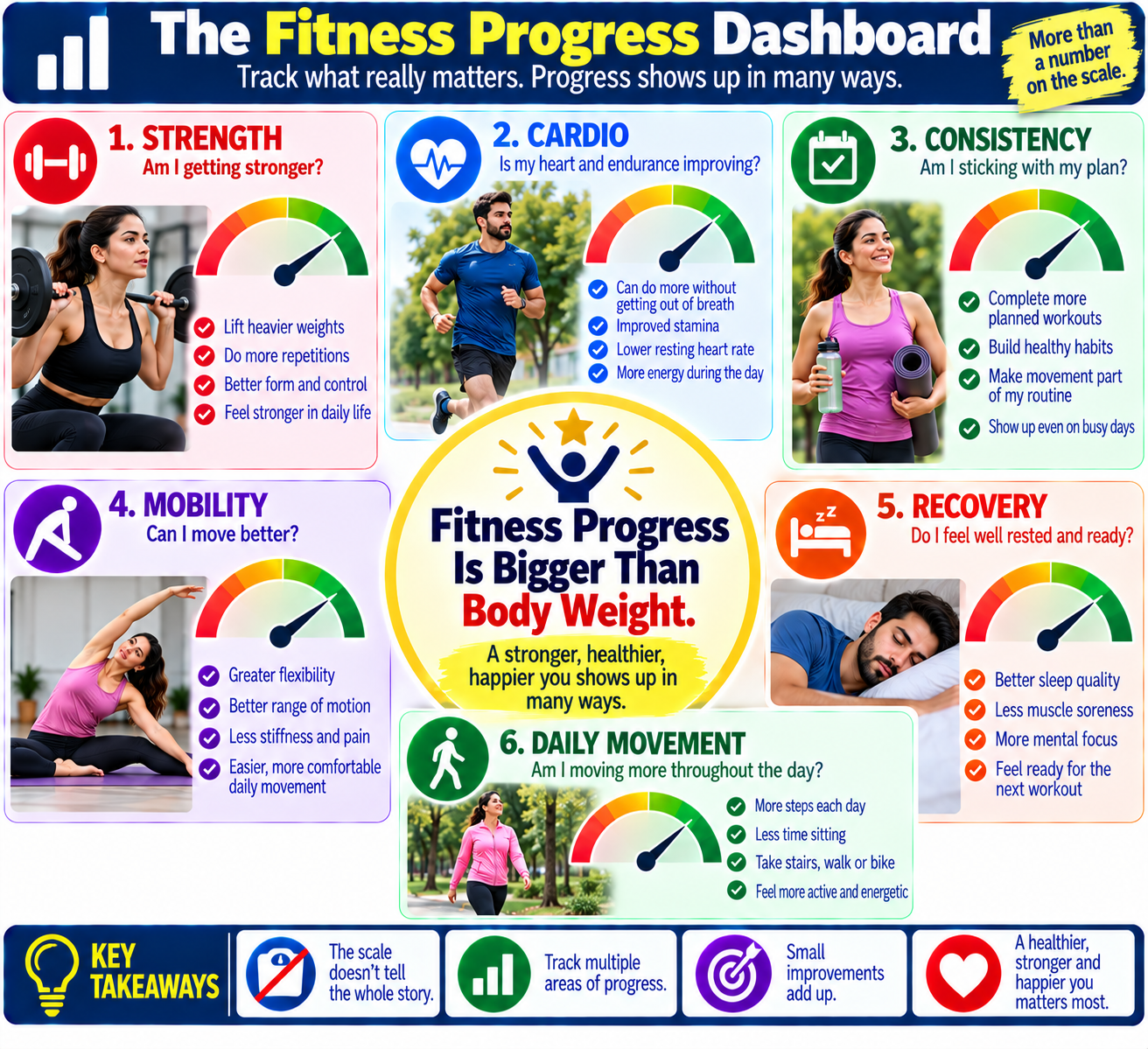
The scale is only one measurement.
It can be useful, but it does not tell the whole story.
A better fitness scorecard might include:
| Measure | What to track |
|---|---|
| Strength | Weight, repetitions, or exercise difficulty |
| Cardio | Walking pace, distance, or perceived effort |
| Consistency | Number of planned sessions completed |
| Mobility | Ease of specific movements |
| Recovery | Sleep and perceived readiness |
| Daily movement | Steps or active minutes |
| Function | Everyday tasks becoming easier |
| Well-being | Energy and mood |
This approach is especially useful for people whose body weight changes slowly.
You might not see a dramatic scale change while becoming stronger, walking farther, recovering better, or completing activities that previously felt difficult.
Those are meaningful outcomes.
12. Make Consistency Easier Than Avoidance
This may be the most important of all the science-backed fitness habits.
Do not build your routine around your most motivated days.
Build it around your ordinary days.
A good plan should answer:
- What will I do when I have only 15 minutes?
- What will I do when I sleep poorly?
- What will I do when I travel?
- What will I do when I miss a workout?
This is where people-first fitness differs from extreme fitness culture.
A sustainable routine has a backup plan.
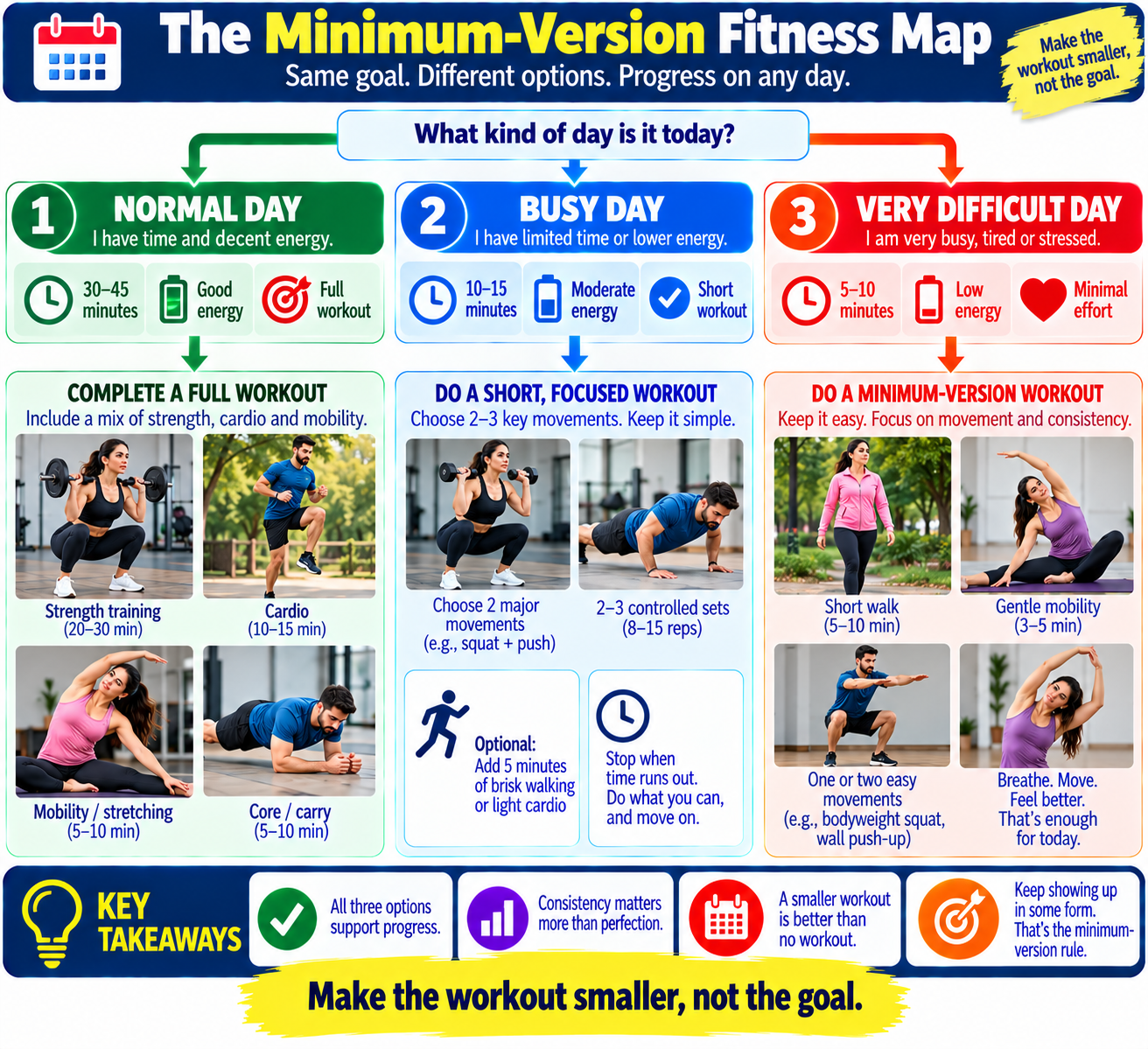
The Minimum-Version Rule
Create a smaller version of your normal workout.
For example:
Normal day:
30–45 minutes of training.
Busy day:
15-minute walk + 10 minutes of strength exercises.
Very difficult day:
5–10 minutes of easy movement.
Recovery day:
Gentle walking and mobility.
This prevents the common “I missed Monday, so the whole week is ruined” mindset.
A Simple Weekly Fitness Framework
You do not need to copy someone else’s exact schedule.
Use this as a starting framework.
| Day | Main focus | Simple example |
|---|---|---|
| Monday | Strength | Full-body resistance training |
| Tuesday | Cardio | Brisk walking or cycling |
| Wednesday | Recovery + movement | Walking and mobility |
| Thursday | Strength | Full-body resistance training |
| Friday | Cardio | Moderate cardio |
| Saturday | Optional activity | Hiking, sport, walking, cycling |
| Sunday | Recovery | Easy movement and preparation |
This structure can be modified according to fitness level, schedule, age, preferences, and medical circumstances.
The CDC’s basic adult framework is at least 150 minutes of moderate activity or 75 minutes of vigorous activity each week, together with muscle-strengthening activity on at least two days. CDC: Adult Activity Guidelines
You can build toward that target gradually.
A People-First Fitness Strategy Most Articles Miss
Many fitness articles begin with:
“What is the best workout?”
I prefer a different question:
“What can this person realistically repeat?”
Imagine two people.
Person A chooses a demanding five-day program but frequently misses workouts.
Person B walks regularly, performs two strength sessions, and occasionally cycles or plays a sport.
The second person may have a less impressive-looking program on paper.
But if that routine continues for months and years, it may be far more valuable.
Recent evidence supports the importance of accumulated and consistent physical activity. A 2025 systematic review and meta-analysis involving 85 studies found that higher physical-activity levels and more consistently active patterns were associated with lower risks of all-cause and cardiovascular mortality. PubMed: Physical Activity Across Adulthood and Mortality
The lesson is not “exercise as hard as possible.”
It is:
Keep moving, keep progressing, and keep coming back.
Mental Fitness Is Part of Physical Fitness
Fitness is not purely physical.
Exercise can also influence mental health.
A 2026 umbrella review of 63 systematic reviews and 79,551 participants found that exercise was associated with reductions in depression and anxiety symptoms, although the effects varied by population, exercise type, and other factors. PubMed: 2026 Exercise, Depression, and Anxiety Umbrella Review
A separate 2025 systematic review involving more than 3.3 million people also found associations between several domains of physical activity and better mental-health outcomes. PubMed: Physical Activity and Mental Health Meta-Analysis
This does not mean exercise should replace professional mental health care.
It means movement can be one useful component of a broader approach to well-being.
My Personal Fitness Insight
I used to think that getting fitter meant doing more.
- More exercises.
- More intensity.
- More days.
- More effort.
Over time, I learned that doing more is not always the same as doing better.
A shorter workout that I can repeat is often more useful than an ambitious routine that I abandon.
I also noticed that the days when I felt least motivated were often the days when having a very small fallback routine helped most.
- A short walk was better than doing nothing.
- A few simple strength exercises were better than waiting for the perfect gym session.
- That experience changed how I think about fitness.
- The goal is not to win one workout.
- The goal is to build a body and routine that can keep working for years.
Common Fitness Mistakes to Avoid
Mistake 1: Changing everything at once
Starting a new diet, running program, strength routine, supplement stack, and sleep schedule simultaneously can make the plan difficult to maintain.
Change one or two important behaviors first.
Mistake 2: Believing soreness equals progress
Muscle soreness can occur after unfamiliar or demanding exercise, but soreness is not a reliable score of workout quality.
Progress should be measured by performance, consistency, recovery, and function.
Mistake 3: Copying advanced workouts
A workout designed for an experienced athlete may be inappropriate for a beginner.
Start with your current ability.
Mistake 4: Ignoring recovery
Training is the stimulus.
Recovery is part of the adaptation process.
Mistake 5: Using supplements as the foundation
Supplements may have specific uses, but they cannot replace regular activity, adequate food, sleep, and progressive training.
Mistake 6: Treating one missed workout as failure
Missing one session is normal.
The important question is what you do next.
Latest Research Developments: What Is Changing in Fitness?
The fitness conversation is becoming more nuanced.
Short exercise bouts are gaining attention.
Recent systematic reviews are investigating whether very brief activity periods can provide meaningful benefits. Evidence is promising for some cardiometabolic and fitness outcomes, but researchers are still working to determine the best frequency, intensity, duration, and long-term strategy. PubMed: Exercise Snacks Research Review
Resistance training does not need to be complicated.
The 2026 ACSM Position Stand is particularly important because it synthesizes 137 systematic reviews and more than 30,000 participants. The evidence supports progressive resistance training but does not suggest that everyone needs advanced techniques. ACSM: 2026 Resistance Training Update
Training to failure is not mandatory.
Recent evidence suggests that stopping short of failure can still produce useful adaptations, especially when the overall program is well designed. PubMed: Non-Failure Resistance Training Meta-Analysis
Fitness is increasingly viewed as a long-term behavior.
Research on physical-activity patterns increasingly supports the value of maintaining activity across adulthood rather than relying on short bursts of enthusiasm. PubMed: Physical Activity Trajectories and Mortality
These developments all point toward the same idea:
Effective fitness does not have to be extreme. It has to be sustainable.
When Should You Make Your Routine Easier?
Some days call for pushing harder, while others are better suited to reducing intensity and giving your body more room to recover.
Consider scaling back when:
- You are unusually exhausted.
- Your technique is deteriorating.
- You have significant muscle or joint pain.
- Your performance has dropped repeatedly.
- You are not recovering between sessions.
- You are sleeping poorly for several nights.
- You are becoming unusually irritable or unmotivated.
Normal exercise discomfort is different from an injury.
Sharp pain, chest pain, fainting, severe shortness of breath, or other concerning symptoms require medical attention rather than simply pushing through.
Who Should Get Professional Advice Before Starting?
People with certain medical conditions may need individualized exercise guidance.
NIDDK recommends speaking with a health professional about appropriate physical activity if you have conditions such as heart disease, high blood pressure, diabetes, or a disability that affects your ability to exercise. NIDDK: Starting Physical Activity Safely
The same principle applies if you have a significant injury, unexplained symptoms, or have been inactive for a long period and want to begin vigorous exercise.
The right program is the one that fits your health status as well as your goals.
A Simple 30-Day Habit-Building Plan
You do not need to transform your entire lifestyle in one week.
Week 1: Build the movement habit
- Walk regularly.
- Choose one enjoyable aerobic activity.
- Avoid sitting continuously for long periods.
- Focus on showing up rather than intensity.
Week 2: Add strength
Perform two simple full-body strength sessions.
Start with manageable resistance.
Focus on technique.
Week 3: Improve consistency
Create a weekly schedule.
Add short exercise snacks on busy days.
Track completed sessions.
Week 4: Review and adjust
Ask:
- What did I enjoy?
- What was difficult?
- What caused missed workouts?
- Am I recovering well?
- Which activity can I continue next month?
Then modify the plan.
Do not automatically make it harder.
Make it more sustainable.
A Better Definition of Fitness
Peak fitness does not have to mean looking like an athlete.
- For one person, fitness may mean climbing stairs without becoming exhausted.
- For another, it may mean getting stronger in the gym.
- For another, it may mean walking comfortably after retirement.
Someone else may care most about maintaining independence, playing with their children, hiking, cycling, or simply having enough energy for daily life.
That is why a useful fitness goal should be personal.
The science provides the framework.
Your life determines how you apply it.
Frequently Asked Questions
What are science-backed fitness habits?
Science-backed fitness habits are repeatable behaviors supported by research and established health recommendations, such as regular aerobic activity, resistance training, adequate sleep, gradual progression, recovery, and healthy nutrition.
How many days a week should I exercise?
There is no single perfect number for everyone. Current adult guidelines recommend at least 150 minutes of moderate aerobic activity or 75 minutes of vigorous activity each week, plus muscle-strengthening activity on at least two days. CDC: Adult Activity Guidelines
Can I improve fitness without going to a gym?
Yes. Walking, cycling, bodyweight exercises, resistance bands, outdoor activities, and home-based strength workouts can all contribute to physical fitness.
Is 20 minutes of exercise enough?
Twenty minutes is better than doing nothing, and short activity periods can contribute to your weekly total. Recent research on exercise snacks also suggests that brief repeated bouts can improve some fitness and cardiometabolic outcomes. PubMed: Exercise Snacks and Fitness
Should I exercise every day?
You can be physically active every day, but that does not mean every day should be hard training. Easy walking, mobility work, recreational activity, strength sessions, cardio, and recovery days can all have different roles.
Is strength training important for overall fitness?
Yes. Resistance training improves strength and can improve muscle size, power, endurance, balance, and physical function. The 2026 ACSM evidence review provides particularly strong support for including progressive resistance training in adult fitness programs. PubMed: ACSM 2026 Resistance Training Position Stand
Do I need protein supplements to build muscle?
No. Protein supplements can be convenient, but they are not mandatory. A balanced diet can provide protein through foods such as dairy, eggs, fish, meat, soy, beans, and lentils.
Is soreness necessary for muscle growth?
No. Soreness is not a requirement for productive training. A well-designed routine can improve strength and muscle adaptations without making you extremely sore after every session.
What is the most important fitness habit?
The most important habit is the one you can maintain consistently while progressing appropriately.
Conclusion
The best science-backed fitness habits are not built around extremes.
They are built around regular movement, strength training, cardiovascular fitness, adequate recovery, sleep, nutritious food, gradual progression, and consistency.
Current evidence does not support the idea that everyone needs the same workout.
The 2026 ACSM resistance-training update reinforces this point: many different training approaches can improve strength and physical function, while consistency and appropriate progression matter more than unnecessary complexity. ACSM: Updated Resistance Training Guidelines
The same principle applies to aerobic exercise.
- You do not need to run if you dislike running.
- You do not need to train for an hour if your schedule does not allow it.
- You do not need to destroy yourself during every workout.
Start with what you can realistically do.
Then make it slightly better.
- A short walk can become a longer walk.
- A few strength exercises can become a structured routine.
- Two weekly strength sessions can become a lasting habit.
- A few minutes of movement during a busy day can become a more active lifestyle.
That is the real path to becoming stronger and healthier.
Do not build a fitness routine that looks impressive for two weeks. Build one that still makes sense two years from now.
Author Note
I believe fitness should be practical enough for ordinary people to use.
My own experience taught me that complicated routines are not always the most sustainable. The goal of this article is not to tell every reader to follow the same workout. It is to help you understand the principles behind fitness and choose habits that fit your own life.
The research and recommendations cited throughout this article are intended to provide an evidence-based foundation, while personal experience is clearly presented as personal experience rather than scientific evidence.
Medical Disclaimer
This article provides general health and fitness information for educational purposes. It is not a substitute for medical diagnosis, treatment, or individualized medical advice.
If you have heart disease, high blood pressure, diabetes, a significant injury, unexplained symptoms, or another medical condition that may affect exercise, speak with an appropriate healthcare professional before beginning or substantially increasing physical activity. NIDDK specifically recommends discussing appropriate activity with a healthcare professional for people with certain chronic conditions or disabilities. NIDDK: Tips for Starting Physical Activity
Fitness Disclaimer
Exercise responses differ between individuals.
The examples in this article are general suggestions, not an individualized training program. Begin at an appropriate level, use controlled technique, increase training gradually, and stop if you experience concerning symptoms.
If you are new to exercise, start slowly rather than immediately copying an advanced workout.
Strong EEAT Sources
- CDC — Health Benefits of Physical Activity for Adults
- CDC — Adult Physical Activity Guidelines
- CDC — Adding Physical Activity as an Adult
- CDC — What Counts as Physical Activity for Adults
- NIDDK — Tips for Starting Physical Activity
- NIH — Healthy Sleep
- ACSM — 2026 Resistance Training Guidelines Update
- PubMed — ACSM Resistance Training Position Stand 2026
- PubMed — Resistance Training to Failure vs Non-Failure
- PubMed — Physical Activity Trajectories and Mortality
- PubMed — Exercise Snacks and Fitness in Inactive Adults
- PubMed — Exercise Snacks Systematic Review
- PubMed—Exercise, Depression, and Anxiety 2026 Umbrella Review
- PubMed — Physical Activity and Mental Health Meta-Analysis
- U.S. Physical Activity Guidelines
Related Article
- Category
- 22 Natural Remedies for Anxiety: What Really Works?
- 3 Best Tips To Maintain Fitness.
- Home
- 15 Best Ideas Stronger Every Day: The Science-Backed Path to Peak Fitness
- 9 Benefits Of Regular Exercise And Fitness











[…] Stronger Every Day: The Science-Backed Path to Peak Fitness […]
[…] Stronger Every Day: The Science-Backed Path to Peak Fitness […]