






































































































































































Yoga Asanas for Blood Sugar Control: 10 Poses, Benefits, Evidence, and Safety
Author: RVLNSV PRASAD
Updated: September 2026

Author Note
Written by RVLNSV PRASAD, independent health and wellness writer.
This article explains how yoga may fit into a broader approach to blood sugar management. It does not present yoga as a cure for diabetes, and it does not recommend stopping medication or changing medical treatment.
The article also makes an important distinction between evidence about yoga programs and claims about individual yoga poses. Research has investigated yoga as a broader mind-body intervention involving different combinations of movement, breathing, relaxation, and other practices. That evidence should not automatically be interpreted as proof that one particular posture directly stimulates the pancreas or produces a predictable reduction in blood glucose.
The information presented here is based on publicly available medical guidance and peer-reviewed research, including the American Diabetes Association, the National Institute of Diabetes and Digestive and Kidney Diseases, and research indexed in PubMed.
Introduction
Searching for yoga asanas for blood sugar control can produce a confusing mixture of advice.
One article may recommend a handful of poses.
Another may claim that a particular posture “stimulates the pancreas.”
A third may suggest that yoga can replace medication or rapidly normalize blood glucose.
Those claims need to be separated from what medical research actually tells us.
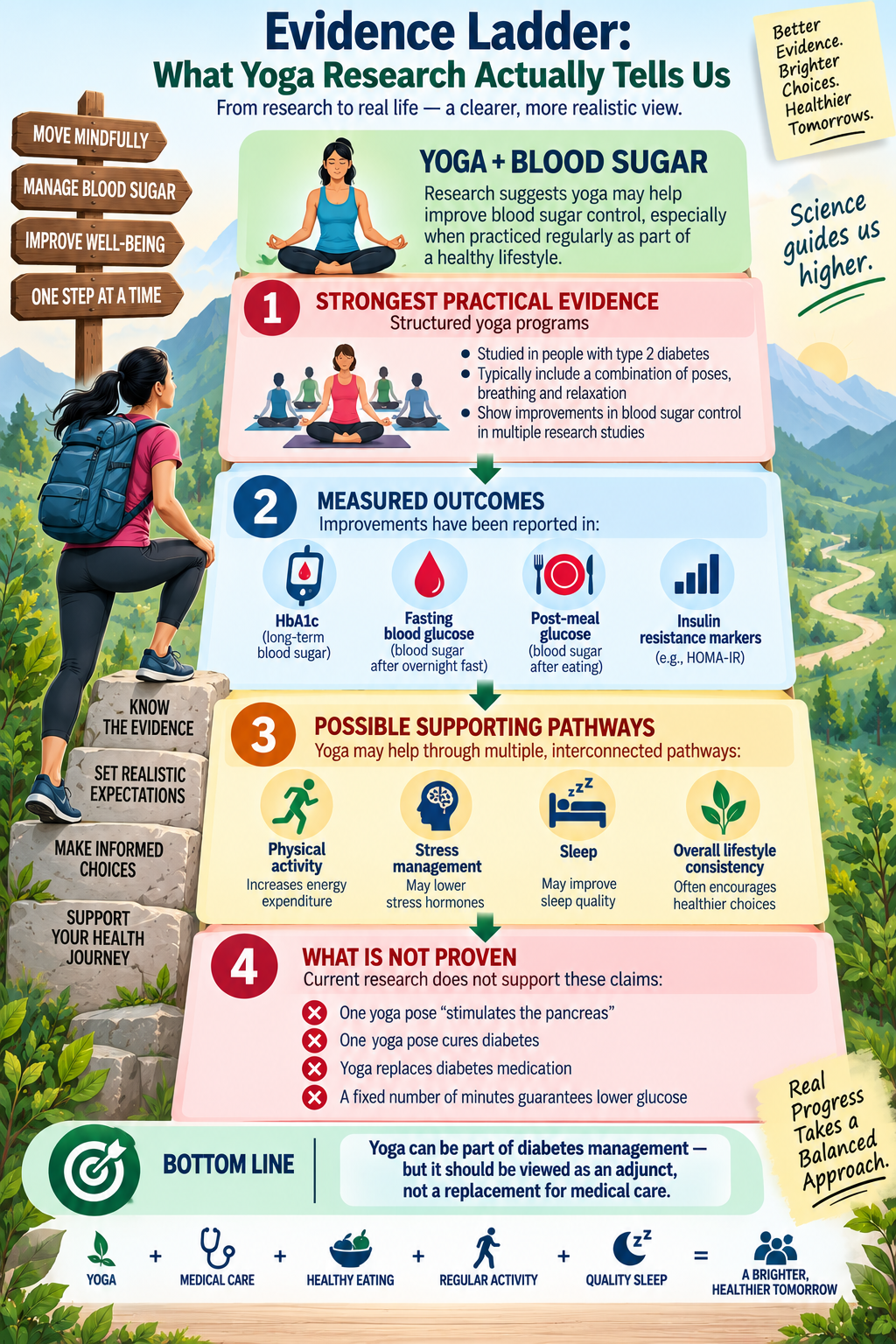
Yoga may have a useful place in diabetes management. Research has found improvements in measures such as fasting blood glucose and HbA1c among people with type 2 diabetes who participated in structured yoga interventions. A recent 2026 meta-analysis of randomized controlled trials found reductions in HbA1c and fasting plasma glucose among adults with type 2 diabetes who participated in structured yoga programs.
Earlier research points in a similar direction. A systematic review and meta-analysis covering 23 studies and 2,473 adults with type 2 diabetes found improvements in HbA1c, fasting blood glucose, and post-meal blood glucose among yoga participants compared with control groups. The researchers also emphasized methodological limitations and the need for longer-term research.
The American Diabetes Association describes yoga and other mind-body practices as potential additions to diabetes management. It does not present yoga as a replacement for prescribed treatment.
The National Institute of Diabetes and Digestive and Kidney Diseases likewise emphasizes regular physical activity as part of healthy diabetes management and recommends discussing new or changed exercise plans with a healthcare professional when appropriate.
That leads to a more useful question.
Instead of asking, “Which yoga pose cures high blood sugar?” ask:
“How can I use yoga safely and consistently as one part of a complete blood sugar-management plan?”
That is the approach taken in this guide.
Quick Answer: Can Yoga Help Control Blood Sugar?
Yes, yoga may support blood sugar management, particularly when it is used alongside appropriate medical treatment, nutrition, physical activity, and other healthy habits.
The evidence is most relevant to structured yoga interventions, rather than individual poses.
A 2026 Bayesian meta-analysis of 28 randomized controlled trials involving 2,241 adults with type 2 diabetes reported reductions in HbA1c and fasting plasma glucose following structured yoga interventions.
A separate systematic review of 23 studies involving 2,473 adults also found improvements in HbA1c, fasting blood glucose, and post-meal glucose compared with control groups.
Another systematic review and meta-analysis comparing yoga, walking, and control groups reported improvements in several glycemic measures among participants practicing yoga.
However, this does not mean that one posture will immediately lower your blood sugar.
Yoga should be viewed as a possible complementary lifestyle practice rather than a replacement for diabetes treatment.
Key Takeaways
- Yoga may support glycemic control in people with type 2 diabetes.
- Research generally evaluates yoga programs rather than isolated poses.
- No individual yoga asana has been established as a standalone treatment for diabetes.
- Physical activity may help muscles use glucose and can support overall metabolic health.
- Breathing and relaxation may also contribute to the potential value of yoga.
- People taking insulin or certain diabetes medicines need to consider exercise-related hypoglycemia.
- Diabetes complications can affect which yoga movements are appropriate.
- Difficult poses are not automatically better for blood sugar management.
- A sustainable routine may be more useful than an extreme routine that cannot be maintained.
- Yoga should complement, not replace, prescribed diabetes treatment.
Why Yoga May Support Blood Sugar Management
The relationship between yoga and glucose control is probably more complex than the popular claim that certain poses “massage the pancreas.”
Several factors may contribute to the potential benefits.
Physical Movement Uses Energy
When muscles contract, they require energy.
Physical activity can therefore influence glucose use and overall metabolic health.
According to the National Institute of Diabetes and Digestive and Kidney Diseases, regular physical activity can help people manage diabetes and may improve blood glucose, blood pressure, cholesterol, cardiovascular health, mood, and sleep.
Yoga varies greatly in intensity.
A gentle seated pose is not physiologically identical to a dynamic sequence involving repeated full-body movements.
That distinction matters when discussing yoga for blood sugar control.
Stress Management May Also Matter
Diabetes management involves more than glucose numbers.
Stress, sleep, activity, and daily habits can all influence how easy it is to follow a healthy routine.
The American Diabetes Association notes that yoga, deep breathing, and meditation may be useful mind-body practices for some people with type 2 diabetes.
That does not mean every person will experience the same response.
It does suggest that yoga may have value beyond physical stretching.
Consistency Is More Important Than Complexity
A difficult pose performed occasionally is not necessarily more useful than a comfortable routine practiced regularly.
Someone may be able to perform a simple sequence several times each week.
Another person may find advanced postures uncomfortable or impractical.
For long-term health, sustainability deserves more attention than difficulty.
10 Yoga Asanas for Blood Sugar Control
The following poses can form part of a yoga routine when they are appropriate for the individual.
They are presented for their potential contribution to movement, flexibility, strength, balance, breathing, or relaxation.
They should not be interpreted as individually proven diabetes treatments.
1. Surya Namaskar — Sun Salutation
Surya Namaskar is a sequence of movements rather than one static posture.
It can involve the arms, legs, trunk, and spine and may provide more physical activity than a quiet seated pose.
That makes it a potentially useful option for someone looking for a more active form of yoga.
Potential benefits
- Whole-body movement
- Mobility
- Coordination
- Muscular activity
- Physical activity
Beginners should learn the sequence gradually.
There is no universal evidence-based number of rounds that every person with diabetes should perform.
Your fitness level, age, medical conditions, and experience should influence how much you do.
2. Vajrasana—Thunderbolt Pose
Vajrasana is a seated kneeling posture often used during breathing or meditation.
The pose is simple for some people but uncomfortable for others.
People with knee, ankle, or mobility problems may need a modification.
Its potential value for diabetes management is more closely related to relaxation and mindful practice than to a proven direct effect on blood glucose.
Do not force the posture simply because it appears on a list of yoga poses for diabetes.
3. Bhujangasana — Cobra Pose
Bhujangasana involves lying on the abdomen and gently extending the upper body.
It can contribute to spinal mobility and back-strengthening activity when performed appropriately.
Some websites describe Cobra Pose as directly stimulating the pancreas.
That explanation should be treated cautiously.
Research on yoga and diabetes generally evaluates broader yoga interventions rather than demonstrating that Cobra Pose alone increases insulin production or controls blood glucose.
Focus on
- Comfortable movement
- Controlled spinal extension
- Breathing
- Avoiding pain
Anyone with significant spinal or back problems should obtain appropriate professional advice.
4. Setu Bandhasana—Bridge Pose
Setu Bandhasana, or Bridge Pose, involves lifting the hips while lying on the back.
The movement can engage the legs, glutes, and trunk.
For someone developing a yoga routine for type 2 diabetes, it may provide a manageable combination of strengthening and mobility.
Potential role
- Lower-body strengthening
- Hip movement
- Trunk engagement
- Controlled physical activity
Its value should be understood as part of a broader exercise routine rather than a direct pancreatic treatment.
5. Paschimottanasana—Seated Forward Bend
Paschimottanasana is a seated forward fold.
It can provide a stretch through the back of the body when performed comfortably.
Flexibility varies from person to person.
A beginner should not force the torso toward the legs.
Safer practice
- Keep the movement controlled.
- Bend the knees if necessary.
- Avoid bouncing.
- Stop if pain develops.
- Use appropriate support when needed.
The pose may fit into the flexibility and relaxation portion of a broader yoga session.
6. Ardha Matsyendrasana—Seated Spinal Twist
Ardha Matsyendrasana involves rotating the trunk while seated.
It can challenge spinal mobility and coordination.
Traditional yoga explanations sometimes suggest that twisting “massages” the pancreas.
Modern clinical evidence does not establish that a particular spinal twist directly controls blood glucose.
A more evidence-conscious description is that the pose can contribute to mobility and controlled movement within a yoga routine.
Do not force the rotation.
People with spinal problems should seek appropriate guidance.
7. Balasana—Child’s Pose
Balasana, or Child’s Pose, is commonly used as a resting posture.
Its physical demands are generally lower than those of more active yoga movements.
That makes it useful as a recovery position for people who can comfortably kneel.
Potential role
- Relaxation
- Gentle stretching
- Breathing
- Recovery
People with knee, hip, or ankle problems may need another resting position.
8. Dhanurasana—Bow Pose
Dhanurasana is a more demanding posture.
The practitioner lies on the abdomen, reaches toward the feet, and lifts parts of the body from the floor.
It requires flexibility, coordination, and strength.
For that reason, it is not automatically appropriate for beginners.
There is also no need to perform Bow Pose simply because it appears in a list of best yoga asanas for blood sugar control.
The research supporting yoga for diabetes evaluates broader interventions rather than proving that Dhanurasana independently lowers blood glucose.
9. Halasana—Plow Pose
Halasana is an advanced posture.
The legs move over the head while the body remains supported by the shoulders and upper back.
Beginners should not feel that they need this pose to manage blood sugar.
People with neck, spinal, balance, or other medical concerns should receive professional guidance before attempting advanced positions.
A simpler movement may be a better choice.
10. Savasana—Corpse Pose
Savasana is primarily a relaxation posture.
Its inclusion highlights an important feature of yoga.
Yoga is not simply a collection of strenuous movements.
Breathing, concentration, and relaxation may also be part of the practice.
The American Diabetes Association discusses yoga as a mind-body practice that may support blood glucose goals in some people with type 2 diabetes.
A More Useful Comparison of the 10 Poses
| Yoga practice | Main focus | Blood-sugar relevance | Beginner consideration |
|---|---|---|---|
| Surya Namaskar | Whole-body movement | Physical activity | Learn gradually. |
| Vajrasana | Seated practice | Relaxation | Modify for knee problems. |
| Bhujangasana | Mobility | General movement | Avoid painful extension. |
| Setu Bandhasana | Strength and mobility | Physical activity | Use a comfortable range. |
| Paschimottanasana | Flexibility | Mobility and relaxation | Do not force the fold. |
| Ardha Matsyendrasana | Spinal mobility | General movement | Rotate gently. |
| Balasana | Recovery | Relaxation | Modify for joint limitations. |
| Dhanurasana | Strength and mobility | More demanding movement | Better for experienced practitioners |
| Halasana | Advanced mobility | Not necessary for beginners | Seek guidance. |
| Savasana | Relaxation | Mind-body practice | Prioritize comfort. |
What Does the Research Actually Say?
The evidence supporting yoga and diabetes has developed over several years.
A systematic review and meta-analysis published in 2016 included 17 randomized controlled trials and found beneficial effects of yoga as an add-on intervention for fasting blood glucose, post-meal blood glucose, and HbA1c. The researchers also reported that the overall risk of bias was high, which means the findings should be interpreted carefully.
A larger systematic review published in 2017 included 23 studies and 2,473 participants with type 2 diabetes.
Compared with control groups, participants practicing yoga showed improvements in:
- HbA1c
- Fasting blood glucose
- Post-meal blood glucose
- Some cardiovascular and metabolic measures
However, the review also noted methodological limitations and called for additional long-term studies.
A 2022 systematic review focusing on people with type 2 diabetes without complications reported significant improvements in HbA1c, fasting blood glucose, and post-meal blood glucose after yoga interventions.
A 2023 systematic review comparing yoga and walking with control conditions also reported improvements in several glucose-related outcomes among participants in the yoga group.
More recent evidence is also encouraging.
A 2026 Bayesian three-level meta-analysis evaluated 28 randomized controlled trials involving 2,241 adults with type 2 diabetes. The analysis reported reductions in HbA1c and fasting plasma glucose following structured yoga interventions.
Taken together, these findings support a careful conclusion:
Yoga appears promising as a complementary approach to glycemic management in type 2 diabetes, but it should remain part of comprehensive diabetes care.
Why One Yoga Pose Cannot Be Called a Diabetes Treatment
This distinction is often missing from online articles.
Suppose a study reports that people who practiced yoga for several months experienced lower HbA1c.
That does not prove that one particular pose caused the improvement.
A yoga intervention may include:
- Physical movement
- Breathing exercises
- Relaxation
- Meditation
- Stretching
- Strengthening
- Mindfulness
- Changes in daily habits
Participants may also change their:
- Diet
- Activity level
- Weight
- Sleep
- Stress
- Medication adherence
Therefore, saying “this pose lowers blood sugar because it stimulates the pancreas” goes beyond what the broader evidence establishes.
A more responsible interpretation is
Yoga as a broader intervention may support glycemic control, while the contribution of an individual asana remains uncertain.

Yoga and Walking: Do You Need to Choose One?
Not necessarily.
Yoga can complement other forms of physical activity.
The National Institute of Diabetes and Digestive and Kidney Diseases explains that people with diabetes can benefit from different forms of physical activity, including aerobic exercise, strength training, balance activities, and stretching.
Walking may provide sustained aerobic activity.
Yoga can add:
- Flexibility
- Balance
- Mobility
- Strength
- Breathing
- Relaxation
For some people, combining different activities may make exercise more enjoyable and easier to maintain.
The appropriate combination depends on individual health and medical advice.
A Simple Beginner Approach
You do not need to begin by performing all ten poses.
A practical structure could be
Start with gentle movement.
Begin with comfortable joint movements and breathing.
Add accessible poses.
Use a modified bridge pose or gentle cobra pose if appropriate.
Include mobility.
A comfortable seated stretch can provide flexibility for work.
Add relaxation.
Use Child’s Pose if comfortable, or choose another suitable resting position.
Finish calmly.
Savasana or quiet breathing can provide a gentle conclusion.
This is an example of how a routine can be organized.
It is not an individualized medical or exercise prescription.
When Should You Speak With a Healthcare Professional?
People with diabetes should not assume that every yoga practice is automatically safe.
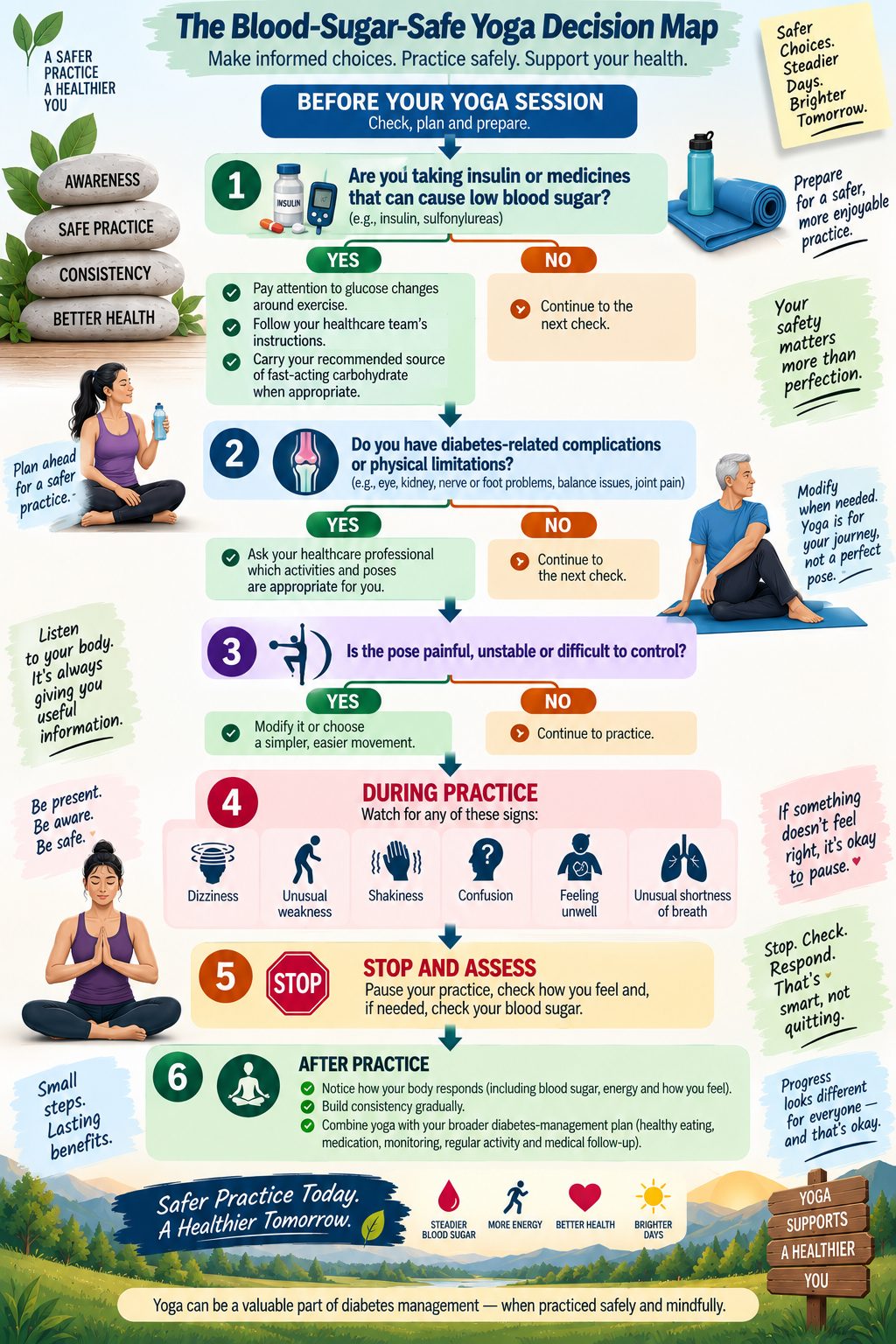
Speak with a healthcare professional before starting or substantially changing your exercise routine if you have:
- Diabetes complications
- Heart disease
- Significant blood-pressure problems
- Frequent hypoglycemia
- Diabetic neuropathy
- Diabetic retinopathy
- Foot problems
- Balance difficulties
- Significant joint or spinal problems
- Another condition that affects exercise tolerance
The National Institute of Diabetes and Digestive and Kidney Diseases recommends talking with a healthcare professional before starting a new physical activity or changing how much activity you do. It also notes that the appropriate activity may depend on your abilities, medications, and health conditions.
The American Diabetes Association likewise recommends discussing yoga and other mind-body practices with your diabetes-care team when appropriate.
When Should You Stop Yoga and Seek Medical Care?
Stop exercising and seek appropriate medical attention if you develop concerning symptoms such as:
- Chest pain
- Fainting
- Severe dizziness
- Serious shortness of breath
- Confusion
- Severe weakness
- Symptoms of significant hypoglycemia
- A serious injury
- Sudden or unusual symptoms
Do not attempt to manage repeated concerning symptoms by changing your medication without medical supervision.
What People Taking Diabetes Medication Should Know
Physical activity can lower blood glucose.
For some people, the effect can continue after exercise.
The National Institute of Diabetes and Digestive and Kidney Diseases specifically notes that people taking insulin or certain other diabetes medicines, including sulfonylureas, may be more likely to experience low blood glucose during or after physical activity.
Your precautions may depend on:
- The medication you use
- Exercise intensity
- Exercise duration
- Meal timing
- Your usual glucose response
- Your healthcare team’s instructions
If your clinician has given you specific instructions about monitoring blood glucose around exercise, follow those instructions.
Personal Experience: Why Consistency Matters
My interest in this subject also comes from seeing how difficult it can be for someone with diabetes to maintain lifestyle changes.
A family member close to me initially viewed diabetes management as a long list of restrictions.
Over time, a simpler routine became easier to follow.
That routine included medical guidance, healthier food choices, walking, and regular yoga.
The most useful lesson was not that one particular yoga pose solved the problem.
It was that a manageable routine was easier to continue.
That experience influenced how I approach health writing.
I believe practical health information should encourage realistic habits rather than promise instant results.
This is a personal observation, not clinical evidence. One person’s experience cannot establish that another person will experience the same blood sugar changes.
What Yoga May Help With—and What It Cannot Guarantee
| Yoga may contribute to | Yoga cannot automatically guarantee |
|---|---|
| Regular physical activity | A cure for diabetes |
| Stress management | Normal glucose in everyone |
| Flexibility | Medication replacement |
| Balance and mobility | Permanent blood sugar control |
| Relaxation | Elimination of complications |
| Healthy routine building | A specific HbA1c reduction |
| Mind-body awareness | Immediate glucose normalization |
This distinction is especially important in health content.
A useful article should explain both the potential benefits and the limits.
The “Best” Pose May Be the One You Can Safely Maintain
The phrase “best yoga pose for diabetes” sounds simple.
Real life is more complicated.
A person with good mobility may tolerate a challenging posture.
Someone with knee problems may need a chair-based modification.
Someone with diabetic retinopathy may need specific exercise precautions.
Another person taking insulin may need to consider glucose monitoring around physical activity.
The best routine therefore depends on the individual.
Instead of chasing the most difficult pose, focus on:
- Safety
- Comfort
- Consistency
- Appropriate progression
- Overall physical activity
- Medical guidance when necessary
How to Make a Yoga Routine More Sustainable
Start gradually.
Beginning with a manageable routine can make it easier to continue.
Do not compete with yourself.
Yoga is not a test of how flexible you are.
Modify positions.
A modified pose is better than forcing a movement that causes pain.
Combine different forms of activity.
Walking, strength training, mobility work, and yoga can serve different purposes.
Track meaningful progress.
Instead of judging success by the difficulty of a pose, consider:
- How regularly you exercise
- How comfortable your routine feels
- Whether you can maintain it
- What your healthcare professional observes
- Your glucose and HbA1c results over time
What Readers Should Be Careful About
Be cautious when a health article claims:
- One pose will cure diabetes.
- A posture permanently activates the pancreas.
- Yoga allows everyone to stop medication.
- A fixed number of repetitions guarantees lower glucose.
- A particular pose works for every person.
- Advanced yoga is automatically better.
- Blood sugar will normalize immediately after practice.
These claims are much stronger than the available evidence.
Research supports a more measured interpretation of yoga as a complementary approach.
Frequently Asked Questions
Can yoga asanas lower blood sugar?
Yoga may support improved glycemic control when practiced as part of a broader diabetes-management plan. Systematic reviews and newer meta-analyses have reported improvements in HbA1c and blood glucose among people with type 2 diabetes participating in yoga interventions.
However, this does not prove that one individual asana will immediately lower blood glucose.
Which yoga asanas are best for blood sugar control?
There is no scientifically established single “best” yoga pose for blood sugar control.
A suitable routine may combine movement, mobility, strengthening, breathing, and relaxation.
The right choice depends on your health, fitness level, diabetes complications, and experience.
Can yoga replace diabetes medication?
No.
Yoga should not replace prescribed diabetes medication unless your healthcare professional specifically changes your treatment.
The American Diabetes Association presents yoga as a potential addition to diabetes management rather than a replacement for standard treatment.
Can beginners practice yoga with diabetes?
Many people with diabetes can participate in modified yoga.
However, the appropriate routine varies.
Beginners should start gradually and obtain professional guidance when they have diabetes complications, significant medical conditions, or concerns about exercise safety.
Can yoga improve insulin sensitivity?
Research suggests that yoga interventions may improve measures associated with glucose regulation and insulin resistance.
However, this does not mean that a particular yoga pose directly increases insulin sensitivity.
The evidence concerns broader yoga interventions rather than a single posture.
How often should I practice yoga for diabetes?
There is no single schedule that is appropriate for everyone.
Your routine should take into account your health, fitness level, medications, and other forms of physical activity.
Consistency and safety are more important than following an arbitrary number of sessions.
Should I check my blood sugar before yoga?
Some people with diabetes may need to monitor glucose around physical activity, especially when using insulin or medicines that can cause hypoglycemia.
Follow the monitoring instructions provided by your diabetes-care team.
Can yoga prevent type 2 diabetes?
Regular physical activity and healthy lifestyle habits can help reduce the risk of type 2 diabetes in appropriate populations.
Yoga may be one way to remain physically active, but it should not be described as a guaranteed diabetes-prevention method.
Is yoga safe for people with diabetic complications?
Not every yoga posture is appropriate for every person with diabetes complications.
Neuropathy, retinopathy, cardiovascular disease, balance problems, and other conditions may require modifications or professional guidance.
Discuss your exercise choices with your healthcare professional if you have concerns.
Medical Disclaimer
This article is provided for general educational and informational purposes only.
It is not a substitute for professional medical advice, diagnosis, or treatment.
If you have diabetes, prediabetes, diabetes-related complications, cardiovascular disease, significant mobility limitations, or another medical condition, speak with your healthcare professional before starting or substantially changing your exercise routine.
Do not stop, reduce, or change prescribed diabetes medication because of yoga or information presented in this article.
Individual responses to exercise vary.
Fitness Disclaimer
The yoga positions discussed here are general educational examples and are not individualized exercise instructions.
Yoga can involve physical strain, balance challenges, and joint or spinal movement.
Use appropriate modifications.
Stop if a movement causes pain, dizziness, unusual shortness of breath, or another concerning symptom.
If you are new to yoga, consider learning from a qualified yoga instructor who can adapt movements to your physical abilities and limitations.
Conclusion
Yoga asanas for blood sugar control can be a useful part of a broader healthy lifestyle, especially when the practice is safe, realistic, and consistent.
The strongest evidence does not identify one magical posture that controls blood sugar.
Instead, systematic reviews and recent randomized-trial research suggest that structured yoga interventions may improve measures such as HbA1c and fasting blood glucose among adults with type 2 diabetes.
That is a more realistic message than promising a miracle pose.
Choose movements that match your ability.
Modify positions when necessary.
Combine yoga with appropriate nutrition, physical activity, medication when prescribed, and regular medical follow-up.
Do not judge your progress by how advanced a posture looks.
For someone managing diabetes, a safe routine that can be repeated consistently may be much more valuable than an impressive pose performed occasionally.
Yoga can be part of the plan. It does not have to be the entire plan.
Evidence and Sources
- American Diabetes Association — How Yoga Can Help You Reach Your Blood Glucose Goals
- American Diabetes Association — Standards of Care in Diabetes 2026: Facilitating Positive Health Behaviors and Well-being
- NIDDK — Healthy Living with Diabetes
- NIDDK — Low Blood Glucose (Hypoglycemia)
- PubMed — Effect of Yoga on Glycemic Control in Adults With Type 2 Diabetes Mellitus: A Bayesian Three-Level Meta-Analysis of Randomized Controlled Trials
You Also Like These Posts
- 10 Best Foods To Control Blood Sugar Levels
- 10 Best Morning Health Propensities to Boost Your Vitality and Productivity
- 9 Benefits of Yoga for Holistic Health and Well-Being
- 8 Best Poses of Yoga For Asthma Cure
- Home
- Category Active Living