


































































































































































11 Skin Lightening Treatments for Dark Spots & Uneven Skin Tone
Author: RVLNSV PRASAD
Updated On: September 2026
About Us
Author Bio
Editorial Policy
Contact Us
Quick Answer
The most useful skin lightening treatments for dark spots are not designed to change your natural skin color. They are intended to reduce excess pigmentation and help the skin look more even.
The right option depends on why the dark area appeared in the first place. Common causes include acne-related marks, sun exposure, melasma, inflammation, skin injuries, and some medications or medical conditions.
For many people, a sensible starting point is daily broad-spectrum sun protection combined with a well-chosen topical ingredient such as azelaic acid, a retinoid, vitamin C, glycolic acid, or kojic acid. The American Academy of Dermatology lists several of these ingredients as options that may help fade dark spots. American Academy of Dermatology: How to fade dark spots
More persistent pigmentation may require professional treatment. Chemical peels and laser or light-based procedures can sometimes help, but they are not automatically better than topical treatment. In melasma especially, procedures can produce irritation or post-inflammatory hyperpigmentation when they are poorly selected or performed. PubMed: Evidence-based review of melasma treatment
The most important lesson is simple: treat the cause, protect the skin from further pigment stimulation, and avoid aggressive products that can create more pigmentation.
Introduction
A dark mark can seem like a small cosmetic problem until you have tried to make it disappear.
An old acne mark may remain long after the pimple has gone. A patch of pigmentation may become more noticeable after a sunny holiday. Melasma can return even after a person has invested considerable time and money in treatment.
That is why searching for skin-lightening treatments for dark spots can lead people in very different directions.
Some people want to fade acne marks.
Others are dealing with melasma, sun spots, or uneven pigmentation.
Some simply want their complexion to look more even.
The problem is that the internet often places all of these concerns into one category called “skin whitening.”
That description is misleading.
The medically useful goal is usually not to make naturally healthy skin lighter. It is to reduce excess pigmentation while preserving the skin barrier and avoiding unnecessary irritation.
Melanin is the pigment that gives skin its color and also contributes to protection from ultraviolet radiation. When pigment production or distribution becomes uneven, visible dark areas can develop.
A treatment that works well for one type of pigmentation may be disappointing—or even counterproductive—for another.
That distinction is the starting point for safer skin care.
Medical Disclaimer
This article is for general educational purposes and is not a diagnosis or a substitute for an examination by a dermatologist or other qualified healthcare professional.
Pigmentation has many possible causes. A new, changing, unusual, painful, bleeding, or otherwise concerning skin lesion should not be assumed to be a simple dark spot.
Prescription treatments, chemical peels, laser procedures, oral medicines, and combinations of active ingredients should be selected according to the individual’s skin condition, medical history, medications, pregnancy status when relevant, skin type, and risk of post-inflammatory pigmentation.
Do not use prescription-strength medicines or professional procedures based solely on information in an online article.
Key Takeaways
- The goal should generally be even, healthy-looking skin, not changing your natural complexion.
- Sunscreen is a foundation of pigmentation management.
- Treating the cause of a dark spot is often more important than choosing the strongest brightening product.
- Azelaic acid, retinoids, vitamin C, glycolic acid, and kojic acid are among ingredients dermatologists may use for dark spots. American Academy of Dermatology: Fading dark spots
- Melasma often needs long-term management rather than a one-time “cure.”
- Chemical peels and lasers can have a role, but they can also cause complications, particularly in susceptible skin.
- Unregulated skin-lightening products may contain harmful substances such as mercury or undeclared steroids.
- Irritation can make pigmentation worse.
- Faster is not always better.
- A dermatologist can determine whether the discoloration is actually pigmentation and identify its likely cause.
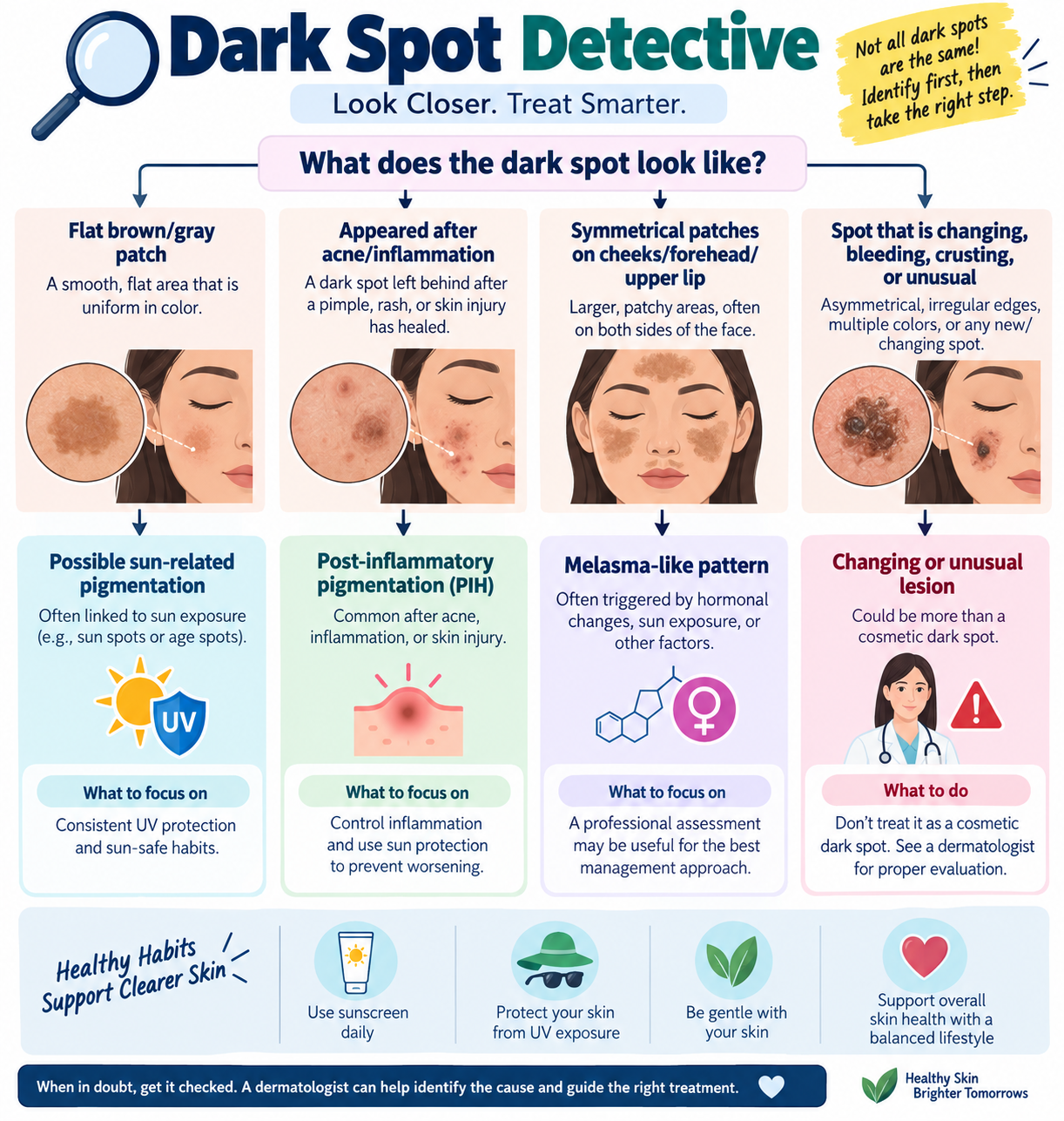
Why Dark Spots Appear in the First Place
Before choosing among skin-lightening treatments, it helps to ask a more useful question:
Why did the dark spot appear?
A brown mark left after acne is different from melasma.
A sunspot is different from pigmentation caused by irritation.
And a persistent patch that has been incorrectly treated for months may require an entirely different approach.
Common contributors include:
Acne and inflammation
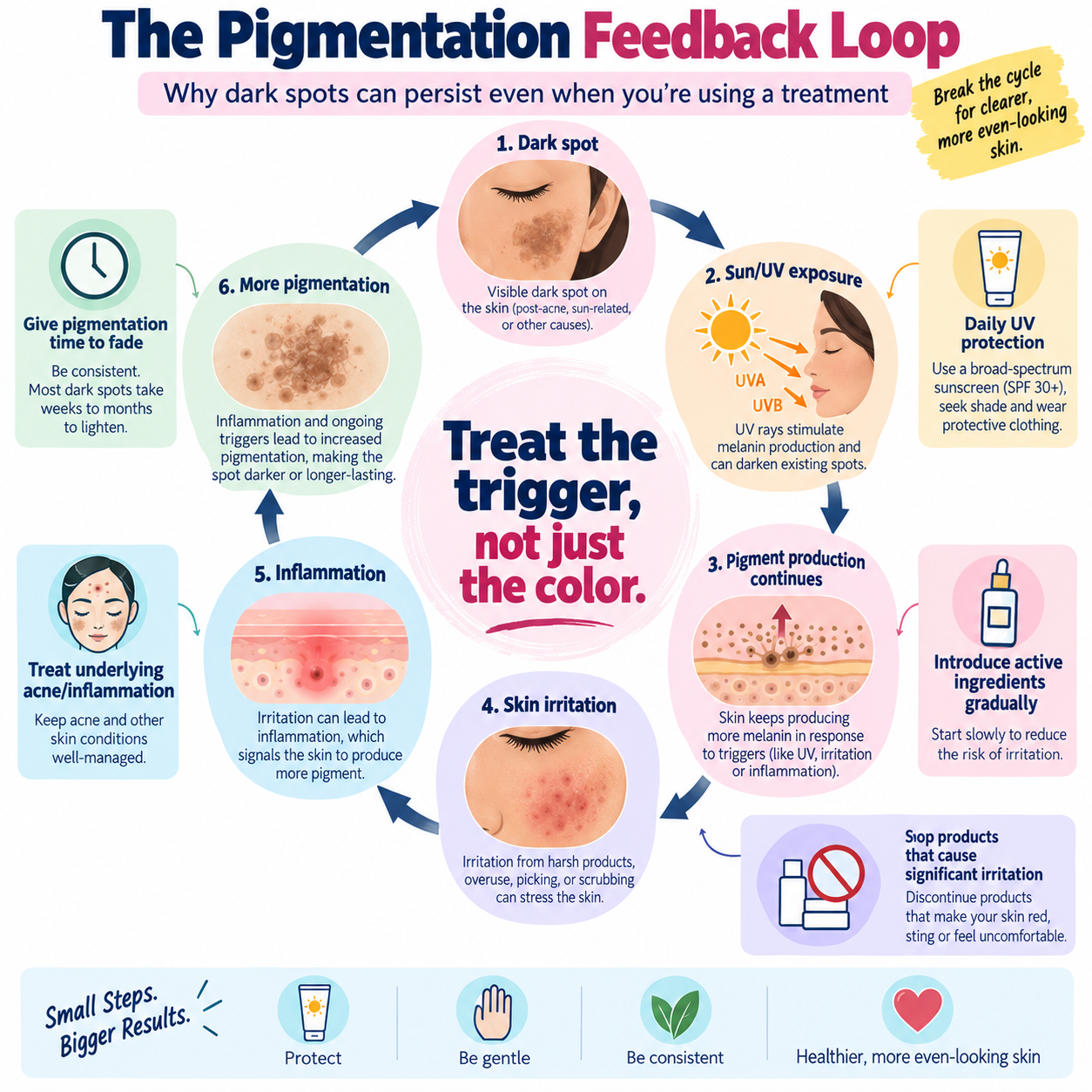
When the skin becomes inflamed, pigment production can increase. This can leave a darker area after the original acne lesion has disappeared.
This is one reason aggressive acne treatment can sometimes create a frustrating cycle: the person treats the acne aggressively, irritates the skin, and then develops additional discoloration.
Ultraviolet exposure
UV radiation can stimulate pigment production and make existing pigmentation more noticeable.
This is why fading an existing spot while continuing to expose the skin to significant sunlight can feel like trying to empty a bucket while leaving the tap running.
Melasma
Melasma usually appears as patches of brown or gray-brown pigmentation, often on areas such as the cheeks, forehead, nose, or upper lip.
It can be persistent and recurrent. A major international expert consensus published in 2025 emphasized photoprotection as an essential component of melasma management and recommended medical supervision for stronger treatment approaches. 2025 International Expert Consensus on Melasma Management
Irritation or injury
Skin irritation itself can contribute to post-inflammatory hyperpigmentation.
This is particularly important for people who repeatedly try new acids, scrubs, bleaching products, or multiple active ingredients at once.
11 Skin Lightening Treatments for Dark Spots
1. Broad-Spectrum Sunscreen
Sunscreen may not sound like a “dark spot treatment,” but it is one of the most important parts of pigmentation management.
UV exposure can encourage further pigment production and make existing discoloration harder to control.
For someone already trying to fade pigmentation, skipping sun protection can undermine the rest of the routine.
The American Academy of Dermatology recommends sun protection as part of managing dark spots and specifically identifies sunscreen as an important step when trying to prevent pigmentation from becoming darker. American Academy of Dermatology: Dark spots and sun protection
A practical routine can include:
- broad-spectrum sunscreen
- appropriate protective clothing
- shade when practical
- reapplication according to exposure and product instructions
Think of sunscreen less as a cosmetic extra and more as pigment maintenance.
2. Azelaic Acid
Azelaic acid is particularly interesting because it can fit into a routine for people dealing with both acne and pigmentation.
That matters because acne and post-acne dark marks often arrive together.
The American Academy of Dermatology includes azelaic acid among ingredients that may help fade dark spots. American Academy of Dermatology: Ingredients for dark spots
It may be worth discussing with a dermatologist or pharmacist when pigmentation is associated with acne-prone skin.
The important point is not to judge the ingredient after a few days. Pigmentation generally changes gradually.
3. Retinoids
Retinoids are vitamin A derivatives used in dermatology for several concerns, including acne and changes in skin texture.
Some retinoids may also help with pigmentation by influencing skin-cell turnover and pigment distribution.
Options can include retinol in cosmetic products or prescription retinoids such as tretinoin, depending on the individual situation.
The AAD lists retinoids among ingredients that may help fade dark spots. American Academy of Dermatology: Dark spot treatment ingredients
However, stronger does not automatically mean better.
Retinoids can cause irritation, especially when someone starts too frequently or combines them with several other potentially irritating products.
4. Vitamin C
Vitamin C is widely used in skin-brightening products.
Its appeal is partly related to its antioxidant properties and its role in pathways involved in pigmentation.
The AAD includes vitamin C among topical ingredients that can help fade dark spots. American Academy of Dermatology: Fading dark spots
A useful way to think about vitamin C is as one possible component of a broader routine rather than a magic eraser for pigmentation.
Product stability, formulation, concentration, and regular use can all influence how useful a product is.
5. Glycolic Acid and Other Exfoliating Acids
Glycolic acid is an alpha-hydroxy acid that can help remove surface skin cells and improve the appearance of uneven texture and pigmentation.
The AAD lists glycolic acid among ingredients that may help fade dark spots. American Academy of Dermatology: Dark spot ingredients
But exfoliation has a point of diminishing returns.
If someone repeatedly applies strong acids because a mark has not disappeared quickly, irritation may become the new problem.
A better approach is usually controlled, gradual use rather than treating pigmentation as something that needs to be “burned off.”
6. Kojic Acid
Kojic acid is another ingredient used in products aimed at reducing pigmentation.
It is included by the AAD among ingredients that may help fade dark spots. American Academy of Dermatology: Dark spot treatment
It may be useful in a carefully designed topical routine, but individual tolerance matters.
If a product causes persistent burning, redness, peeling, or discomfort, continuing simply because it is marketed as a powerful lightening treatment is not a good strategy.
7. Hydroquinone Under Professional Guidance
Hydroquinone deserves a different category from ordinary cosmetic brightening ingredients.
It has a substantial history in the treatment of hyperpigmentation and melasma, and clinical reviews have found it to be one of the better-studied topical options for melasma. PubMed: Melasma treatment evidence review
However, this does not mean that buying an unregulated “strong whitening cream” online is safe.
The FDA warns about skin-lightening products containing hydroquinone or mercury and has reported serious adverse effects associated with inappropriate products, including rashes, facial swelling, and ochronosis. FDA: Skin Product Safety
The lesson is important:
An effective medical ingredient and an unsafe product are not the same thing.
If hydroquinone is appropriate, the formulation, duration, concentration, and monitoring should be determined by a qualified professional.
8. Prescription Combination Therapy for Melasma
Melasma can be stubborn enough that dermatologists sometimes use combinations of treatments.
A well-studied combination for melasma has included hydroquinone, tretinoin, and a corticosteroid.
Evidence reviews have found triple-combination therapy to be among the best-studied and most effective medical approaches for melasma. PubMed: Evidence-based melasma review
That does not mean everyone with a dark spot should use such a combination.
Melasma treatment is a medical decision, not a DIY recipe.
This distinction is especially important because inappropriate corticosteroid use on the face can cause problems.
9. Chemical Peels
Chemical peels use controlled application of chemical agents to produce a planned skin response.
They may be considered for selected pigmentation problems, including some cases of melasma.
However, peels are not simply a stronger version of a home exfoliant.
An expert consensus from Indian pigmentary specialists describes peels as a possible second-line approach in melasma and emphasizes appropriate preparation and careful technique. PubMed: Chemical peels in melasma
This is particularly relevant for darker skin tones because excessive injury can result in post-inflammatory hyperpigmentation.
Therefore, “strongest peel” is not a sensible way to choose treatment.
The better question is
Which procedure is appropriate for this person’s pigmentation and skin type?
10. Laser and Light-Based Treatments
Laser treatment sounds attractive because it promises a technological solution to pigmentation.
But melasma demonstrates why this area requires caution.
Evidence reviews have found mixed results with laser and light-based treatments, while expert guidance has emphasized that lasers are generally not first-line treatment for melasma. PubMed: Lasers in melasma consensus recommendations
Some people with resistant pigmentation may benefit from carefully selected procedures.
Others may experience worsening pigmentation.
That is why laser treatment should not be selected simply because it is marketed as faster.
A dermatologist should determine:
- What type of pigmentation is present
- whether the pigment is superficial or deeper
- whether the condition is melasma
- the individual’s skin type
- previous reactions to treatment
- whether a test treatment is appropriate
11. Treating the Trigger and Maintaining the Result
This is the treatment option that is often forgotten.
Suppose acne caused the original dark marks.
If the acne remains uncontrolled, new marks may continue appearing.
Suppose the pigmentation is related to sun exposure.
If strong UV exposure continues, the problem may return.
Suppose irritation from a skincare product caused the discoloration.
Continuing that product makes little sense.
In other words, the best pigmentation routine is not necessarily the one with the most products.
It is the one that addresses the cause while protecting the skin from repeated pigment triggers.
A Practical Treatment Comparison
| Approach | Best suited to | Main advantage | Main caution |
|---|---|---|---|
| Sunscreen | Most pigmentation concerns | Helps prevent worsening | Must be used consistently |
| Azelaic acid | Dark spots, acne-related pigmentation | Can address acne and pigmentation | May irritate some skin |
| Retinoids | Acne, texture, pigmentation | Multiple dermatologic benefits | Irritation is possible. |
| Vitamin C | Mild discoloration and antioxidant support | Convenient topical option | Results vary by formulation. |
| Glycolic acid | Surface pigmentation and texture | Exfoliating effect | Overuse can irritate. |
| Kojic acid | Selected dark spots | Pigment-focused ingredient | Sensitivity may occur. |
| Hydroquinone | Selected hyperpigmentation | Strong evidence in medical treatment | Professional supervision may be needed. |
| Chemical peels | Selected pigmentation | Procedure-based approach | Risk of irritation/PIH |
| Laser/light treatment | Selected resistant cases | Can be useful in specialist care | Not appropriate for everyone |
| Cause-directed treatment | Recurrent pigmentation | Addresses the source | Requires identifying the cause |
What Makes a Dark Spot Routine Fail?
A surprising number of disappointing results come from behavior rather than a lack of treatment options.
Using too many active ingredients
Someone may combine:
- vitamin C
- retinoid
- several acids
- scrubs
- whitening cream
- spot treatment
all at once.
The result can be redness and irritation rather than faster fading.
Expecting a one-week transformation
Pigment does not necessarily disappear because a product feels strong.
Many pigmentation problems require weeks or months of consistent management.
Ignoring sunscreen
A person can spend considerable money on pigmentation products while leaving the skin exposed to the factor that keeps stimulating pigment.
Treating every brown patch as the same condition
This is perhaps the biggest mistake.
A dermatologist may distinguish between post-inflammatory hyperpigmentation, melasma, lentigines, medication-related pigmentation, and other conditions.
Chasing stronger products
“Strong” is an advertising word, not a treatment plan.
What I Would Avoid
Be especially cautious with products marketed as instant whitening or bleaching solutions.
The FDA has warned that some skin-lightening products contain mercury or hydroquinone and may cause significant health or skin problems. FDA: Warning about mercury and hydroquinone in skin products
The FDA has also reported that mercury-containing products can cause neurological, kidney, and other health problems. FDA: Mercury poisoning linked to skin products
Avoid products that:
- have no clear ingredient list
- promise dramatic whitening within days
- encourage permanent daily use of an unknown bleaching cream
- cause significant burning
- make unsupported medical claims
- are sold without reliable labeling
- contain undeclared or suspicious ingredients
Be particularly careful with products purchased through informal online sellers.
A cheap cream can become very expensive if it causes a prolonged skin reaction.
Why Skin Tone Should Not Be the Enemy
There is another side to this subject that is rarely discussed in treatment lists.
Wanting to reduce a dark mark is not the same thing as believing naturally darker skin is unhealthy.
Pigmentation itself is not a defect.
A person can have deep, medium, or light natural skin and still have healthy skin.
The medical goal is to address unwanted or abnormal pigmentation, not to suggest that one natural complexion is superior to another.
This distinction also makes treatment decisions clearer.
Someone with post-acne hyperpigmentation does not necessarily need to “become lighter.”
They may simply want the mark left behind by inflammation to become less noticeable.
That is a much more realistic and healthier objective.
A Personal Experience That Changed How I Think About Skin Lightening
I have seen how easy it is for people to become impatient when pigmentation does not disappear quickly.
A friend once developed noticeable dark marks after severe acne had settled.
The acne itself was improving, but the marks remained.
Instead of waiting, she began trying strong products she had found through online recommendations.
- The first reaction was not dramatic.
- Then came redness and sensitivity.
- The experience changed the way I look at skin-lightening advice.
- The problem was not simply that one product “failed.”
The bigger issue was that the skin was being repeatedly challenged without first understanding what the pigmentation was or how much irritation it could tolerate.
Eventually, she sought professional advice and moved toward a much simpler routine.
The improvement was gradual.
That experience taught me something worth remembering:
A treatment does not have to feel aggressive to be working.
Sometimes the most useful step is removing the things that are continually irritating the skin.
This is a personal observation, not medical evidence, and individual results can be very different.
When Should You See a Skin Health Expert?
Consider seeing a dermatologist when:
- Pigmentation keeps returning
- Dark patches are spreading
- Treatment causes burning or persistent redness
- You have tried several products without improvement
- You suspect melasma
- Pigmentation developed after starting a medication
- You are unsure what caused the discoloration
- You are considering a chemical peel or laser
- You have darker skin and are worried about post-inflammatory hyperpigmentation
- A skin lesion is changing, bleeding, painful, or otherwise unusual
Professional evaluation is particularly useful when the diagnosis is uncertain.
It is difficult to choose the right treatment if you do not know what you are treating.
A Simple Decision Framework
Instead of asking:
“What is the strongest skin-lightening treatment?”
Ask these five questions:
1. What caused the pigmentation?
Acne? Sun exposure? Melasma? Irritation? Something else?
2. Is the skin currently irritated?
If yes, reducing irritation may need to come before adding more active ingredients.
3. Is sun exposure being controlled?
If not, pigmentation may remain difficult to manage.
4. Is the problem mild or persistent?
Mild marks may respond to a consistent topical routine. Persistent or recurrent pigmentation may require professional assessment.
5. Is a procedure actually necessary?
A laser or peel is not automatically superior simply because it is performed in a clinic.
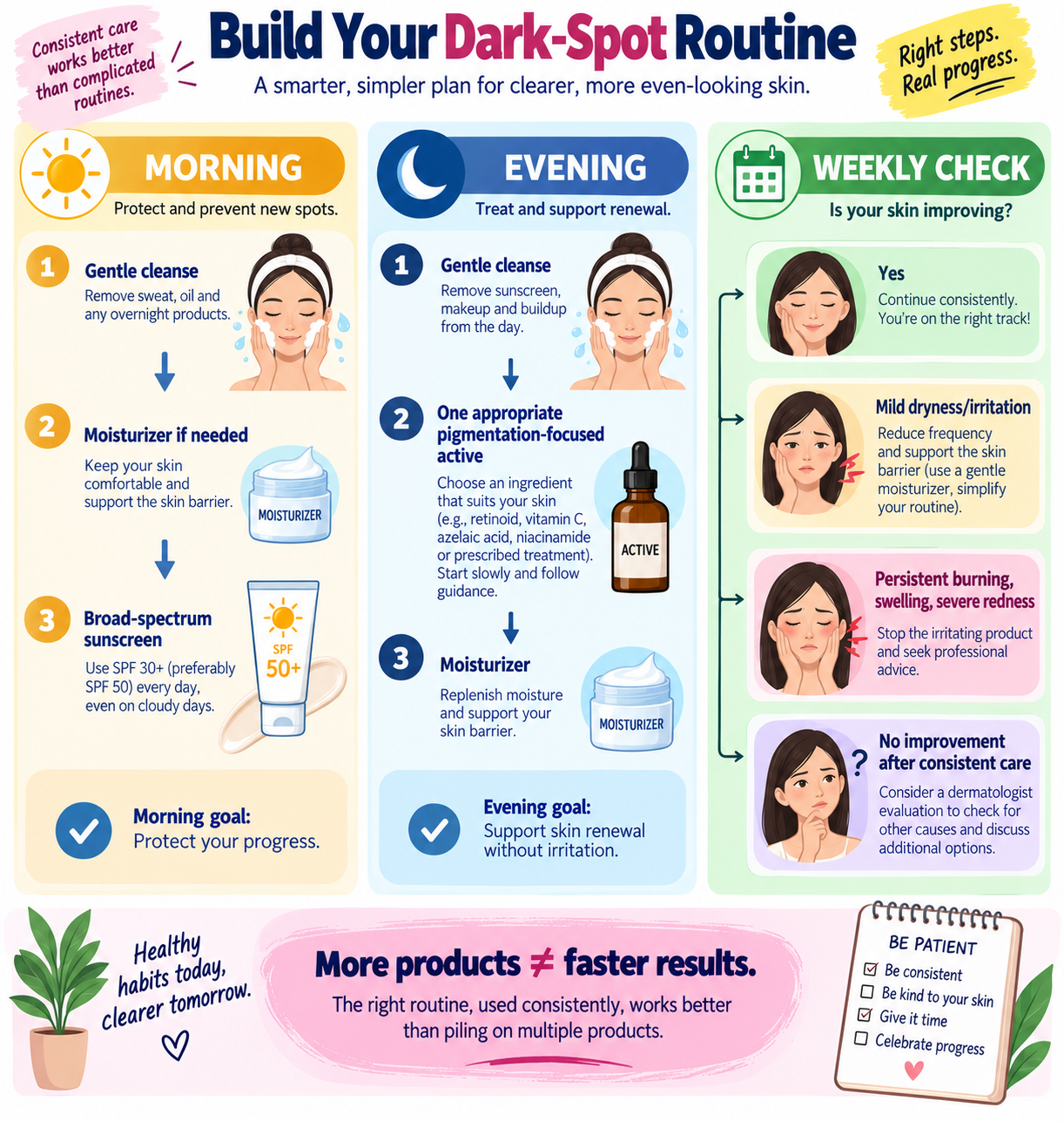
A Safer Routine for Someone Starting From Scratch
A simple routine may be more useful than a cabinet full of products.
Morning
- Gentle cleanser if needed
- One appropriate treatment product
- Moisturizer if required
- Broad-spectrum sunscreen
Evening
- Gentle cleansing
- One selected active ingredient
- Moisturizer
Do not introduce several strong products simultaneously.
If irritation develops, stop and reassess rather than assuming that more burning means more effectiveness.
People with persistent pigmentation, melasma, significant acne, or sensitive skin should consider professional advice before building a more complicated routine.
Health and Fitness Disclaimer
Physical activity, sleep, hydration, and a balanced diet can support overall health, but they should not be presented as direct cures for hyperpigmentation.
Exercise can contribute to general well-being, but sweating does not “detox” dark spots or remove excess melanin.
Do not replace medical treatment for persistent pigmentation with fitness routines, restrictive diets, supplements, or unproven detox programs.
If exercise causes a skin reaction, dizziness, breathing difficulty, or another concerning symptom, seek appropriate medical advice.
Author Note
Author: RVLNSV PRASAD
I wrote this guide with a simple principle in mind: people looking for pigmentation treatment deserve practical information without being pressured into unrealistic promises about changing their natural skin color.
The purpose of this article is to help readers understand the difference between fading unwanted pigmentation and trying to permanently alter their natural complexion.
Medical evidence and professional guidance should take priority over personal experience or online product claims.
Medical Safety Note
Do not use prescription medicines, bleaching agents, chemical peels, or laser devices without appropriate professional guidance.
Pregnant or breastfeeding individuals should ask their healthcare professional before using certain active ingredients or treatments.
If a skincare product causes severe swelling, blistering, significant pain, breathing difficulty, or another serious reaction, seek medical attention promptly.
FAQ
What are the best skin-lightening treatments for dark spots?
There is no single best treatment for every dark spot. Sunscreen is foundational, while ingredients such as azelaic acid, retinoids, vitamin C, glycolic acid, and kojic acid may help selected cases. Persistent pigmentation may require dermatologist-guided treatment. American Academy of Dermatology: Fading dark spots
Can skin-lightening treatments remove dark spots permanently?
Not necessarily. Some pigmentation can recur, particularly when the original trigger remains. Melasma, for example, is often chronic and may require ongoing maintenance and sun protection. PubMed: Medical therapies for melasma
Is sunscreen really necessary when treating pigmentation?
Yes. Sun exposure can stimulate pigmentation and make existing discoloration harder to control. Photoprotection is considered an essential component of melasma management. 2025 International Melasma Expert Consensus
Is laser treatment the fastest way to remove pigmentation?
Not necessarily. Laser and light treatments can help selected patients, but evidence is mixed for melasma, and inappropriate treatment can cause post-inflammatory pigmentation. Expert recommendations generally reserve lasers for selected resistant cases. Indian Pigmentary Expert Group: Lasers in Melasma
Are natural remedies safe for dark spots?
“Natural” does not automatically mean safe or effective. Some home remedies can irritate the skin, and irritation itself can contribute to pigmentation. It is better to use ingredients with reasonable evidence and known formulations than to experiment with harsh kitchen ingredients.
Is hydroquinone safe?
Hydroquinone is an established medical treatment for certain pigmentation disorders, but it should not be confused with unregulated whitening creams. The FDA warns consumers about potentially harmful skin-lightening products containing hydroquinone or mercury. FDA: Skin Product Safety
Can dark spots get darker after treatment?
Yes. Irritation or injury can trigger post-inflammatory hyperpigmentation. This is one reason aggressive peels, lasers, or excessive exfoliation should not be undertaken without appropriate assessment, particularly in skin of color. Indian Pigmentary Expert Group: Chemical Peels in Melasma
How long does it take for pigmentation to fade?
It depends on the cause, depth of pigmentation, treatment, skin type, and whether the trigger continues. Expecting meaningful improvement within a few days can lead to unnecessary over-treatment.
When should I see a dermatologist for dark spots?
See a dermatologist if pigmentation is persistent, recurrent, spreading, difficult to identify, resistant to reasonable skincare, or associated with other concerning changes. Professional assessment is also advisable before undergoing chemical peels, laser treatment, or prescription therapy.
Conclusion
The best skin-lightening treatments for dark spots are not necessarily the strongest products or most expensive procedures.
A better strategy begins by identifying why the pigmentation developed.
For some people, consistent sunscreen and a carefully selected topical ingredient may be enough. Others may need prescription treatment or professional procedures. Melasma and stubborn hyperpigmentation can require a longer-term plan rather than a quick cosmetic fix.
The evidence also gives an important warning: more aggressive treatment is not automatically more effective. Chemical peels and lasers have a role in selected situations, but they can produce complications when used inappropriately. PubMed: Melasma treatment review
Perhaps the most useful mindset is this:
Do not fight your natural skin color. Treat the pigmentation you actually want to change.
Protect the skin from further damage, avoid unregulated whitening products, introduce active ingredients thoughtfully, and seek professional help when the cause is uncertain.
Healthy, even-looking skin is a more realistic goal than an overnight transformation—and it is a goal that can be approached without sacrificing the health of the skin.
Similar Posts
- 10 Effective Treatments for Depression Without Medication
- 4 Diseases Associated With Eczema Treatment
- 12 Best Ways to Treat Acne
- Best 5 Ways to Prevent Skin Cancer
- Home











[…] 11 Best Skin Lightening Treatments […]
[…] 11 Best Skin Lightening Treatments […]
[…] 11 Best Skin Lightening Treatments […]