


























































































































































How Long Can You Live With Early Fatty Liver Disease?
Author: RVLNSV PRASAD
Updated On: September 2026
About Us
Author Bio
Editorial Policy
Contact Us

Author Note
Written by RVLNSV PRASAD for HealthTipsToYou.
I write health-focused educational content with an emphasis on making complicated medical information easier to understand and use responsibly. For this article, I reviewed information from recognized medical organizations and clinical sources, including Mayo Clinic, the National Institute of Diabetes and Digestive and Kidney Diseases (NIDDK), and the American Association for the Study of Liver Diseases (AASLD).
The purpose of this article is not to predict an individual’s lifespan from a diagnosis. Instead, it explains what an early fatty liver finding may mean, why liver fibrosis matters, which health factors can influence prognosis, and what questions may be useful to discuss with a healthcare professional.
Introduction
If you have recently been told that you have fatty liver, one of the first questions that may come to mind is
How long can you live with early fatty liver disease?
It is an understandable question.
Seeing the words “fatty liver” on an ultrasound, scan, or medical report can make a person immediately think about cirrhosis, liver failure, cancer, or a shortened life.
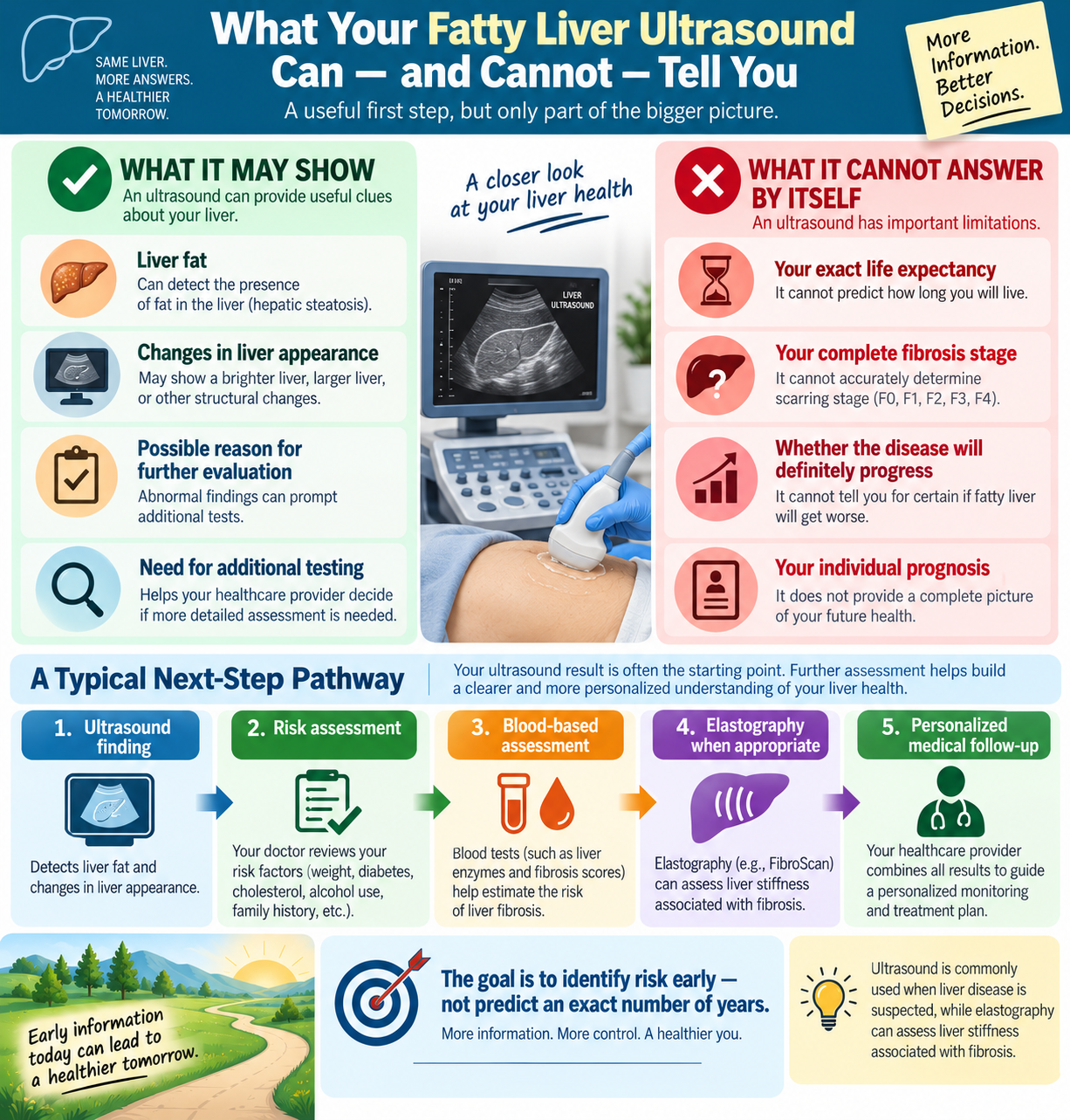
If your ultrasound shows fatty liver, the next question is usually not ‘How many years do I have?’ It is ‘Do I have evidence of liver scarring, and what is my overall metabolic risk?’
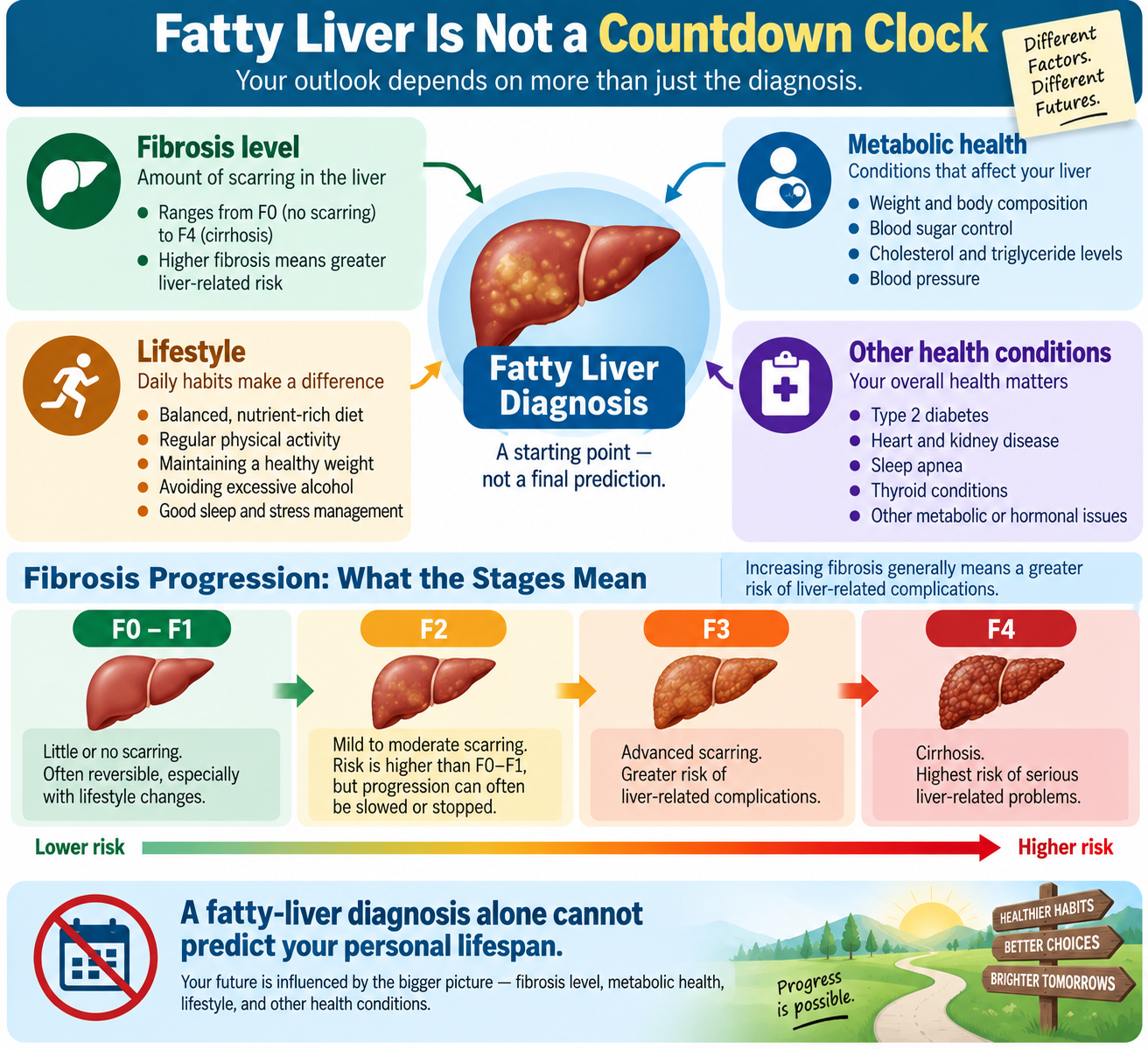
But a fatty liver diagnosis is not a countdown clock.
Early fatty liver disease can have a very different outlook from advanced liver disease. The diagnosis alone cannot tell you exactly how many years you will live. A more useful assessment considers whether there is inflammation, how much liver fibrosis or scarring is present, and whether conditions such as diabetes, obesity, high blood pressure, or cardiovascular disease are also present.
Current Mayo Clinic information identifies fibrosis stage as a particularly important factor when considering prognosis and survival in metabolic dysfunction-associated steatotic liver disease (MASLD).
That changes the question.
Instead of asking only, “How long will I live?” it can be more useful to ask:
“How much liver damage do I have, what is my fibrosis risk, and what can I do now?”
That is the approach this article takes.
Quick Answer: How Long Can You Live With Early Fatty Liver Disease?
Many people with early fatty liver disease can live for many years, and having fatty liver does not automatically mean that a person will develop cirrhosis or liver failure.
However, there is no single life-expectancy figure that applies to everyone.
Your outlook can depend on:
- the amount of liver fibrosis
- whether MASH is present
- diabetes and blood-sugar control
- body weight and metabolic health
- blood pressure and cholesterol
- alcohol exposure
- other liver conditions
- cardiovascular health
- age and overall health
- whether the condition is monitored and managed appropriately
Current evidence also shows that MASLD is associated with increased health risks beyond the liver, particularly metabolic and cardiovascular problems. Mayo Clinic notes that many people with MASLD do not develop liver-related complications, especially when metabolic risk factors are addressed.
So the most accurate answer is
Early fatty liver is not the same as advanced liver disease, and your individual prognosis depends on more than the presence of fat in the liver.
Key Takeaways
- Early fatty liver disease does not automatically mean cirrhosis.
- A fatty liver finding by itself cannot predict your exact lifespan.
- Fibrosis, or liver scarring, is one of the most important factors in prognosis.
- MASLD and MASH are related but are not interchangeable terms.
- Not everyone with fatty liver progresses to advanced liver disease.
- Improving metabolic health can be an important part of protecting long-term health.
- Gradual weight loss, when appropriate, can reduce liver fat and may improve inflammation and fibrosis.
- Physical activity can provide benefits even when it does not produce major weight loss.
- A healthcare professional can help determine whether you need additional testing for fibrosis.
What Is Early Fatty Liver Disease?
Fatty liver means that excess fat has accumulated in the liver.
The medical terminology has changed in recent years. What was commonly called nonalcoholic fatty liver disease (NAFLD) is now generally referred to as metabolic dysfunction-associated steatotic liver disease (MASLD) when the appropriate metabolic criteria are present.
The related inflammatory condition previously called NASH is now called metabolic dysfunction-associated steatohepatitis (MASH). AASLD describes the terminology change as part of a newer approach to classifying steatotic liver disease.
This matters because “fatty liver” is not one single level of disease.
A person may have liver fat without significant scarring.
Another person may have inflammation and fibrosis.
Someone else may have advanced fibrosis or cirrhosis.
Those situations have different implications.
A Fatty Liver Diagnosis Is Not a Countdown Clock
This is perhaps the most important idea to understand.
If an imaging report says fatty liver, it does not automatically tell you:
- how much fibrosis you have
- whether you have MASH
- whether your liver function is impaired
- whether you will develop cirrhosis
- how long you will live
An imaging finding can identify liver fat, but additional evaluation may be needed to understand fibrosis risk.
That is why two people with the same phrase on an ultrasound report can have very different medical situations.
Think of the diagnosis as a starting point.
Instead of:
“I have fatty liver, so how many years do I have?”
A more useful sequence is
Fat detected → risk assessed → fibrosis considered → metabolic health reviewed → appropriate follow-up
That shift can turn a frightening diagnosis into a practical health plan.
The Most Important Question May Not Be “How Much Fat?”
People often focus on the amount of fat in the liver.
But prognosis is more complicated.
One of the most important questions is whether there is fibrosis, meaning scar tissue caused by ongoing liver injury.
Mayo Clinic states that fibrosis staging is the most important factor in determining survival rates and prognosis in MASLD. Its current staging system ranges from F0, with no scarring, through F4, which represents cirrhosis.
Understanding Liver Fibrosis
| Fibrosis stage | Plain-language meaning | What it tells you |
|---|---|---|
| F0 | No fibrosis detected | No measurable liver scarring |
| F1 | Mild fibrosis | Early scarring |
| F2 | Moderate fibrosis | More significant scarring |
| F3 | Advanced fibrosis | Substantial scarring and higher risk |
| F4 | Cirrhosis | Advanced, extensive scarring |
These stages are not a timetable.
F0 does not mean everyone will eventually reach F4.
Some people remain stable for long periods, while others experience progression. The underlying causes, metabolic risk factors, inflammation, alcohol exposure, and other health conditions can influence the course.
This is why asking about fibrosis can be much more informative than simply asking how much fat is visible on an ultrasound.
Fatty Liver, MASH, Fibrosis, and Cirrhosis Are Not the Same Thing
These terms are sometimes used together online, which can make the subject unnecessarily frightening.
They describe different aspects of liver disease.
| Term | What it means | Why it matters |
|---|---|---|
| MASLD | Steatotic liver disease associated with metabolic dysfunction | May range from relatively mild disease to more serious liver injury |
| MASH | MASLD with liver inflammation and injury | Has greater potential to cause fibrosis |
| Fibrosis | Formation of scar tissue in the liver | Increasing fibrosis generally means increasing liver-related risk. |
| Cirrhosis | Advanced fibrosis with extensive architectural damage | Can lead to serious complications and requires medical management |
MASH can contribute to progressive fibrosis, while not everyone with MASLD develops MASH or advanced scarring.
That distinction is essential.
Having fatty liver does not automatically mean you have cirrhosis.
Does Early Fatty Liver Shorten Life Expectancy?
The honest answer is more nuanced than yes or no.
MASLD is associated with increased health risks, including cardiovascular disease and certain other complications. Mayo Clinic reports that research has found an average reduction in lifespan among people with MASLD compared with people without the condition, while also emphasizing that many people do not develop liver-related complications.
An average from a population study should not be interpreted as an individual countdown.
- For one person, the important question may be whether significant fibrosis is already present.
- For another, cardiovascular risk may be a major concern.
- For someone else, diabetes, alcohol exposure, or another liver disease may substantially change the picture.
Therefore:
A diagnosis of early fatty liver cannot be converted into a personal number of remaining years.
Your individual situation needs individual assessment.
Can You Live a Normal Life With Fatty Liver Disease?
Many people with earlier-stage fatty liver disease can continue normal daily activities and may never develop advanced liver complications.
That does not mean the condition should be ignored.
Instead, think of fatty liver as an opportunity to examine the health factors that may be contributing to it.
These may include:
- excess body weight
- insulin resistance
- type 2 diabetes
- high triglycerides
- high cholesterol
- high blood pressure
- low physical activity
- dietary patterns
- alcohol exposure
- other metabolic conditions
Cleveland Clinic also notes that MASLD may cause few or no symptoms and that improving activity and losing weight when appropriate may slow or reverse liver injury.
Feeling well is encouraging.
It is not, however, a substitute for appropriate medical follow-up.
What Actually Affects Fatty Liver Prognosis?
Instead of trying to predict your lifespan from one diagnosis, consider these major factors.
| Factor | Why it matters | Useful discussion with your clinician |
|---|---|---|
| Fibrosis | Reflects liver scarring | Do I need fibrosis assessment? |
| MASH | Indicates inflammation and liver injury | Is there evidence of liver inflammation? |
| Diabetes | Adds metabolic and cardiovascular risk | How well controlled is my blood sugar? |
| Excess weight | Often associated with metabolic dysfunction | Would gradual weight loss benefit me? |
| Blood pressure | Influences cardiovascular risk | Is my blood pressure controlled? |
| Cholesterol | Contributes to cardiovascular risk | Do I need lipid management? |
| Alcohol | May contribute to liver injury | What level is appropriate for me? |
| Other liver disease | Can change prognosis | Have other causes been considered? |
| Physical activity | Supports metabolic health | What activity is appropriate for me? |
| Follow-up | Helps identify changing risk | How often should I be reassessed? |
The important point is that these factors interact.
Someone may have very little liver scarring but significant cardiovascular risk.
Another person may have more advanced fibrosis but otherwise well-controlled metabolic conditions.
That is why prognosis should be individualized.
How Fibrosis Changes Fatty Liver Prognosis
If you remember only one medical concept from this article, remember this:
Liver fat and liver scarring are not the same thing.
Fat describes one feature of the liver.
Fibrosis describes scarring.
As fibrosis becomes more advanced, the risk of liver-related complications generally increases. Mayo Clinic specifically identifies fibrosis stage as a major determinant of prognosis.
Early fibrosis can also be difficult to recognize from symptoms alone.
Mayo Clinic notes that liver fibrosis usually causes no symptoms in its early stages, meaning someone can feel well while scarring is present.
That is one reason medical evaluation can be more useful than trying to judge disease severity from how you feel.
How Do Doctors Estimate Fibrosis Risk?
A fatty liver diagnosis does not necessarily mean that everyone needs the same tests.
Healthcare professionals may combine:
- medical history
- blood tests
- liver enzymes
- metabolic risk factors
- noninvasive fibrosis scores
- ultrasound
- elastography
- other imaging
- specialist assessment when appropriate
AASLD describes blood-based and imaging-based noninvasive approaches to assessing liver fibrosis and steatosis. Its clinical material also discusses tools such as FIB-4 and vibration-controlled transient elastography (VCTE).
The important takeaway is
Do not try to calculate your own liver prognosis from one test result.
A fibrosis score, liver enzyme value, or ultrasound finding needs to be interpreted in context.
Can Early Fatty Liver Disease Be Reversed?
This is one of the most encouraging questions people ask.
The answer is that liver fat can improve, and lifestyle changes can have meaningful effects on metabolic health and liver disease.
NIDDK reports that, for people who are higher weight or have obesity, losing at least 3% to 5% of body weight can reduce liver fat, while greater weight loss may be needed to improve liver inflammation and fibrosis. It also notes that physical activity can be beneficial even without weight loss.
But there is an important distinction:
Improving liver fat is not exactly the same as reversing advanced fibrosis.
The further disease has progressed, the more complicated management becomes.
Therefore, avoid thinking:
“I lost weight, so my liver disease is definitely gone.”
A better approach is
“I have made changes that may improve my liver and metabolic health, and I should continue appropriate medical follow-up.”
Lifestyle Changes: Think in Habits, Not Punishment
A fatty liver diagnosis can cause people to immediately start extreme diets or exhausting exercise programs.
That approach is rarely necessary.
Sustainable changes are generally more useful.
1. Work Toward a Healthy Weight When Appropriate
If you have higher weight or obesity, gradual weight loss may improve MASLD.
NIDDK specifically advises gradual rather than rapid weight loss because rapid weight loss and malnutrition can worsen liver disease.
Instead of:
“I need to lose 20 kilograms immediately.”
Try thinking:
“What sustainable change can I maintain for the next several months?”
Your healthcare professional can help determine an appropriate target.
2. Move More
Physical activity can benefit liver and metabolic health even when the scale changes very little.
Potential activities include:
- walking
- cycling
- swimming
- resistance exercises
- household movement
- other activities you can perform safely
NIDDK specifically notes that physical activity alone can be beneficial for fatty liver disease.
If you have another medical condition or have been inactive for a long time, ask your healthcare professional what level of activity is appropriate.
3. Improve Food Quality Rather Than Chasing a “Liver Detox”
There is no need to turn liver health into a search for a miracle food.
A sustainable eating pattern can emphasize:
- vegetables
- fruits
- whole grains
- beans and other legumes
- appropriate protein sources
- nuts and seeds
- healthier unsaturated fats
At the same time, reducing highly processed foods and excessive added sugar and sugary beverages can be useful.
NIDDK identifies healthy dietary changes and physical activity as important components of fatty liver management.
4. Be Careful With Alcohol
Alcohol can add another source of liver injury.
If you already have liver disease, the appropriate amount of alcohol is not necessarily the same as the advice given to the general population.
Ask your healthcare professional what is appropriate for your particular diagnosis.
Do not assume that “moderate” automatically means “safe for my liver.”
5. Look Beyond the Liver
This is frequently overlooked.
MASLD is strongly connected with metabolic health.
That means managing:
- blood glucose
- blood pressure
- cholesterol
- body weight
- physical activity
can be important not only for the liver but also for overall health.
Mayo Clinic notes that MASLD can increase cardiovascular and other health risks.
The Five Numbers Worth Knowing
Instead of obsessing over a predicted lifespan, consider learning which measurable health factors your healthcare professional is following.
1. Weight or waist measurement
When appropriate, these can help track metabolic changes over time.
2. Blood pressure
High blood pressure contributes to cardiovascular risk.
3. Blood glucose or A1C
These can help assess blood-sugar control.
4. Cholesterol and triglycerides
These help evaluate cardiovascular and metabolic risk.
5. Fibrosis risk
This is different from simply knowing that you have liver fat.
Ask whether you need a fibrosis assessment and what your results mean.
This five-number framework is not a substitute for medical care. It is a way to turn a frightening diagnosis into measurable questions you can discuss with your healthcare team.
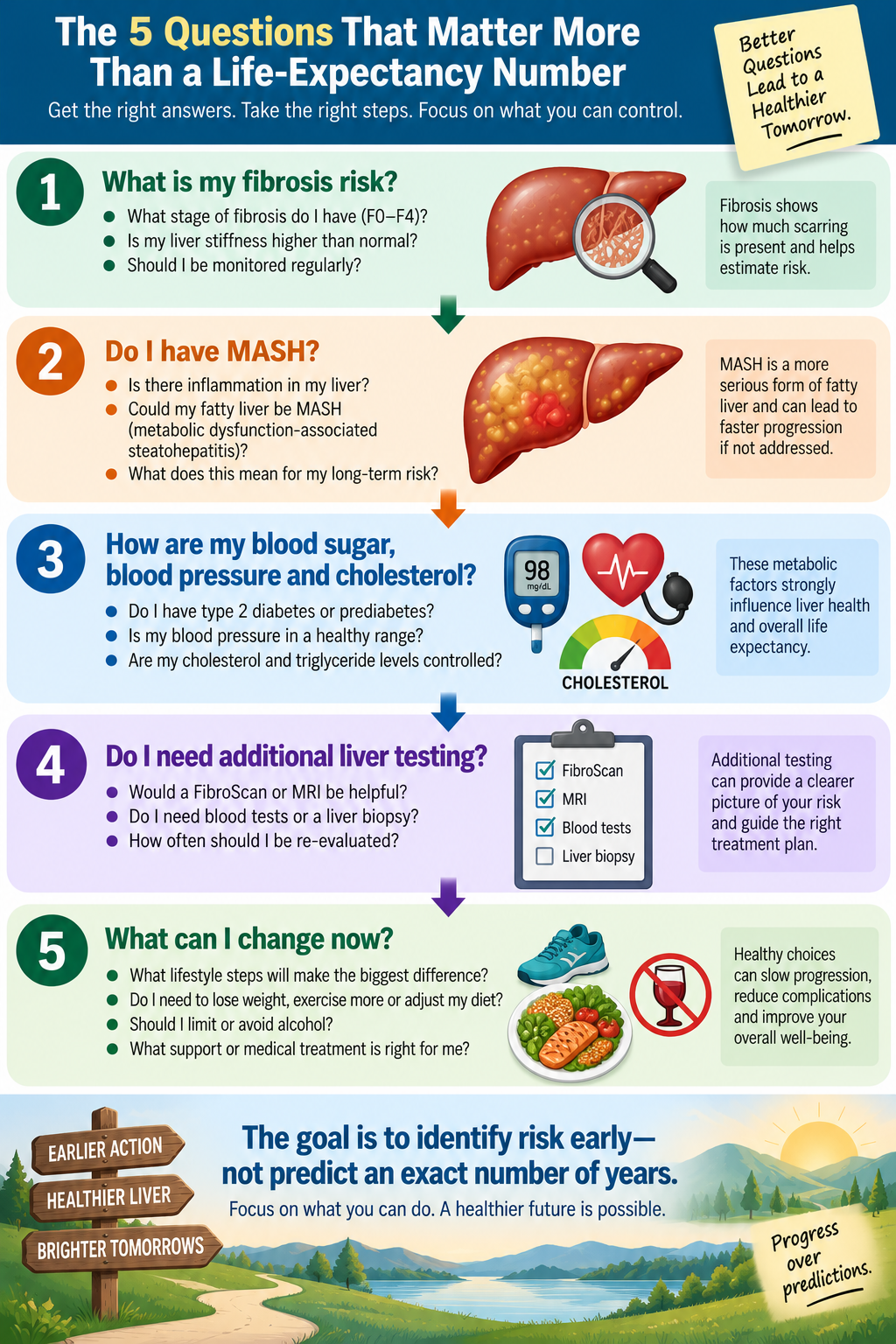
What If You Have Fatty Liver but Feel Completely Fine?
That is common.
Early MASLD may produce few or no obvious symptoms. Cleveland Clinic notes that MASLD may not cause symptoms, while Mayo Clinic also describes early disease as something that may be discovered during testing.
That creates an interesting problem.
A person may feel completely healthy while still having metabolic risk factors that deserve attention.
The absence of symptoms does not necessarily tell you how much fibrosis is present.
At the same time, feeling well does not mean you should panic.
The appropriate response is evaluation, not fear.
Does Fatty Liver Always Lead to Cirrhosis?
No.
Fatty liver does not inevitably progress to cirrhosis.
MASLD can follow different courses in different people.
Some people have liver fat without major progression.
Others develop MASH and fibrosis.
A smaller proportion develop advanced fibrosis and cirrhosis.
The risk is influenced by factors including metabolic health, inflammation, fibrosis, and other causes of liver injury. Mayo Clinic explains that MASH can progress to fibrosis and that higher fibrosis stages carry greater risk.
Therefore, saying:
“I have fatty liver, so I will eventually have cirrhosis”
is not an accurate conclusion.
When Fatty Liver Becomes More Serious
Advanced liver disease can cause symptoms and complications that are different from simple liver fat.
Seek medical evaluation for concerning symptoms such as
- yellowing of the skin or eyes
- increasing abdominal swelling
- unexplained severe weakness
- vomiting blood
- black or tar-like stools
- new confusion
- significant swelling
- other rapidly worsening symptoms
These symptoms can have multiple causes, and not every symptom means cirrhosis.
However, they should not be ignored.
If symptoms are severe, sudden, or potentially life-threatening, seek urgent medical attention rather than relying on an online article.
A Practical Way to Think About Your Diagnosis
Imagine two people receive the same ultrasound statement:
“Fatty liver.”
Person A
- no significant fibrosis
- improving blood pressure
- healthy blood-sugar levels
- physically active
- working on sustainable nutrition
- appropriate medical follow-up
Person B
- advanced fibrosis
- poorly controlled diabetes
- significant cardiovascular risk
- continued liver injury
- little medical follow-up
The phrase “fatty liver” appears in both reports.
But their overall risk profiles are not identical.
That is why a diagnosis label should not be confused with an individual prognosis.
Stop Asking Only “How Many Years?”
When people search for life expectancy, they often want certainty.
Unfortunately, medicine cannot always provide that certainty from one diagnosis.
A better set of questions is
“Do I have liver scarring?”
“If so, how advanced is it?”
“Do I have evidence of MASH?”
“Which metabolic risk factors should I address?”
“Do I need additional testing?”
“How often should my liver health be monitored?”
“What changes would be most useful for me?”
These questions can produce actionable information.
A lifespan estimate without context may provide little practical help.
Understanding your current risk and what can be changed may be far more useful.
Questions to Ask Your Doctor
Take this checklist to your next appointment:
- Do I have MASLD, MASH, or another type of liver disease?
- Do I have evidence of liver fibrosis?
- How is my fibrosis risk being assessed?
- Do I need an elastography or another noninvasive test?
- Are my blood-sugar levels contributing to my risk?
- What should I do about my weight if weight loss is appropriate for me?
- How much physical activity is suitable for my health?
- Should I avoid alcohol completely?
- How often should my liver health be reassessed?
- Which symptoms should make me seek medical attention?
You do not need to remember every medical term.
Take your report with you and ask the clinician to explain what the findings mean in your specific situation.
Frequently Asked Questions
How long can you live with early fatty liver disease?
There is no single number that applies to everyone. Many people with earlier-stage disease do not develop advanced liver complications, but prognosis depends on factors such as fibrosis, metabolic health, MASH, and other medical conditions.
Does early fatty liver shorten life expectancy?
MASLD is associated with increased health risks, including cardiovascular risks, but an individual diagnosis cannot be converted into a precise number of years. The severity of liver disease and overall health matter.
Can you live a normal life with fatty liver disease?
Many people with earlier disease can continue normal daily life. Appropriate management of metabolic risk factors and medical follow-up can help address factors that influence long-term health.
Can early fatty liver disease be reversed?
Liver fat can improve, particularly when appropriate lifestyle changes are made. NIDDK reports that weight loss can reduce liver fat and that greater weight loss may improve inflammation and fibrosis in appropriate patients.
Does fatty liver always lead to cirrhosis?
No. Fatty liver does not automatically progress to cirrhosis. Progression varies, and the fibrosis stage is particularly important when assessing risk.
What affects fatty liver prognosis?
Fibrosis, MASH, diabetes, excess weight, cardiovascular health, alcohol exposure, other liver conditions, and overall metabolic health can all influence the outlook.
Does fibrosis affect fatty liver life expectancy?
Yes. Fibrosis stage is a major factor in determining prognosis and survival risk in MASLD. Higher fibrosis stages are associated with more serious disease.
Is fatty liver dangerous if I have no symptoms?
It may not cause symptoms, particularly in earlier stages. Feeling well does not necessarily tell you whether fibrosis is present, so appropriate medical evaluation can still be important.
Can losing weight improve fatty liver?
For people who are heavier or have obesity, gradual weight loss can reduce liver fat. NIDDK reports that losing 3% to 5% of body weight can reduce liver fat, while greater weight loss may be needed to improve inflammation and fibrosis.
What is the difference between fatty liver and cirrhosis?
Fatty liver refers to excess fat in the liver. Cirrhosis represents advanced scarring and structural damage. They are not interchangeable diagnoses.
Conclusion: Focus on What You Can Learn and Change
So, how long can you live with early fatty liver disease?
There is no honest answer that gives every person the same number of years.
A diagnosis of early fatty liver does not automatically mean liver failure, cirrhosis, or an early death.
The more useful question is what is happening beyond the fat.
- Is there fibrosis?
- Is there MASH?
How are blood sugar, blood pressure, and cholesterol being managed?
- Is weight management appropriate?
- Is physical activity part of the plan?
- Is there another cause of liver injury?
Those questions can tell you much more about your individual situation than a generic life-expectancy estimate.
Current medical evidence supports taking MASLD seriously while avoiding unnecessary fear. Lifestyle changes can improve liver and metabolic health, and appropriate testing can help identify people at higher risk.
The most useful mindset is therefore not:
“How many years do I have left?”
It is:
“What does my liver look like today, what is my fibrosis risk, and what can I do next?”
That shift turns a frightening diagnosis into a practical plan.
Medical Disclaimer
This article is for general educational purposes only. It does not diagnose fatty liver disease, determine an individual’s fibrosis stage, predict personal life expectancy, or replace medical advice.
If you have been diagnosed with fatty liver, MASLD, MASH, fibrosis, or cirrhosis, discuss your individual results and treatment options with a qualified healthcare professional. Do not start an extreme diet, stop medications, change prescribed treatment, or use supplements to treat liver disease without appropriate medical advice.
Seek urgent medical attention for severe or rapidly worsening symptoms, including vomiting blood, black or tar-like stools, severe confusion, significant breathing difficulty, severe abdominal swelling, or other potentially serious symptoms.
Medical Disclaimer
This article is provided for general educational and informational purposes only. It does not diagnose fatty liver disease, determine an individual’s fibrosis stage, predict personal life expectancy, or replace advice from a qualified healthcare professional.
If you have been diagnosed with fatty liver disease, MASLD, MASH, fibrosis, or cirrhosis, discuss your individual test results, risk factors, medications, alcohol use, weight-management options, and monitoring plan with your healthcare professional.
Do not stop prescribed medicines, begin an extreme diet, use supplements, or attempt to treat liver disease on your own based solely on information from this article. NIDDK specifically advises discussing supplements and complementary treatments with a healthcare professional because some products can harm the liver.
Seek urgent medical attention for severe or rapidly worsening symptoms such as vomiting blood, black or tar-like stools, severe confusion, significant abdominal swelling, severe weakness, or other potentially life-threatening symptoms.
Sources
- Mayo Clinic—Fatty liver disease (MASLD): Symptoms and causes Mayo Clinic MASLD overview
- Mayo Clinic—MASLD stages and fibrosis Mayo Clinic MASLD stages
- Mayo Clinic—MASLD survival rates Mayo Clinic MASLD survival rates
- Mayo Clinic—MASLD diagnosis and treatment Mayo Clinic MASLD diagnosis and treatment
- NIDDK—Treatment for NAFLD/NASH NIDDK fatty liver treatment information
- NIDDK—Diagnosis of NAFLD/NASH NIDDK fatty liver diagnosis information
- AASLD — MASLD clinical guidance AASLD MASLD practice guidance
- AASLD—Noninvasive assessment of MASLD AASLD fibrosis assessment guidance
Editorial note: Medical terminology and recommendations can change as research develops. The article should be reviewed periodically so that terminology, treatment information, and cited guidance remain current.
Related posts
- 7 Simple Health Changes to Reduce The Risk of Chronic Disease
- 6 Ways to Detox Your Body Holistically: A Comprehensive Guide
- The Nutritional Secrets of Superfoods
- 12 Best Supplements for Skin Health
- Liver Disease Cirrhosis life Expectancy
- Home
- Category Holistic Welness